The short answer
- What does it cost?
- Sources disagree sharply: KBB's regional ranges run roughly $278-$425, YourMechanic averages $197, and RepairPal lists $651-$754 for a comparable year — get a local, itemized quote.
- Which years carry the power-train history?
- Four straight: 2019, 2020, 2021 and 2022. Together they hold 46.6% of every power-train complaint this corpus has captured in any model year's top five, on only 10.3% of the nameplate's total complaint volume.
- Is there a real recall behind it?
- Partly — NHTSA recall 20V550 covers 2019-2020 Edge vehicles for a start/stop-accumulator leak risk, and separate shudder-related TSBs extend through 2021 and, per later reporting, through 2024.
The numbers, and whose numbers they are
Kelley Blue Book’s fair-repair ranges for an Edge transmission fluid change vary by model year and ZIP code: roughly $278–$390 for a 2016 model in a Tyler, TX sample, $315–$401 for a 2020 model in Albany, GA, and $340–$425 for a 2023 model in Gainesville, FL. YourMechanic puts its own average at $197 ($102 in parts, $95 in labor) — well under every KBB figure above. RepairPal’s estimator goes the other direction entirely, listing $651–$754 for a 2016 Edge, several times YourMechanic’s number for a similar year. None of these figures is ours — we sell VIN checks, not repairs, and price nothing on this page ourselves.
A flat estimator number cannot tell you which of those ranges applies, and it cannot tell you which Edge is actually in the driveway. On this nameplate, that second question lines up with both a documented gearbox change and a sharply uneven complaint record.
What 13,042 complaints say about one generation
Our corpus of federal NHTSA complaints holds 13,042 reports against the 2008–2022Edge. POWER TRAIN is not a constant presence in this record. In the Edge’s first model year, 2008, it ranks 2nd (24.7% of that year’s complaints). It then fades — and in 2011, 2012 and 2013, three of the nameplate’s four highest-volume complaint years of any kind in this 15-year record (ranked #2, #4 and #1by raw complaint count), it does not place in that year’s own top five at all.
Then it returns, and takes over: POWER TRAIN ranks as the single largest complaint category of any kind in exactly four consecutive model years — 2019, 2020, 2021 and 2022. Those four years hold 736 of the 1,579power-train complaints this corpus captures in any model year’s own top five — 46.6% of the total — while accounting for only 10.3% of the nameplate’s overall complaint volume. 2019 holds both the highest share (59.9%) and the highest raw count (463) of the four — the same year on both measures, worth stating plainly since several sibling nameplates in this series split those two honors across different years.
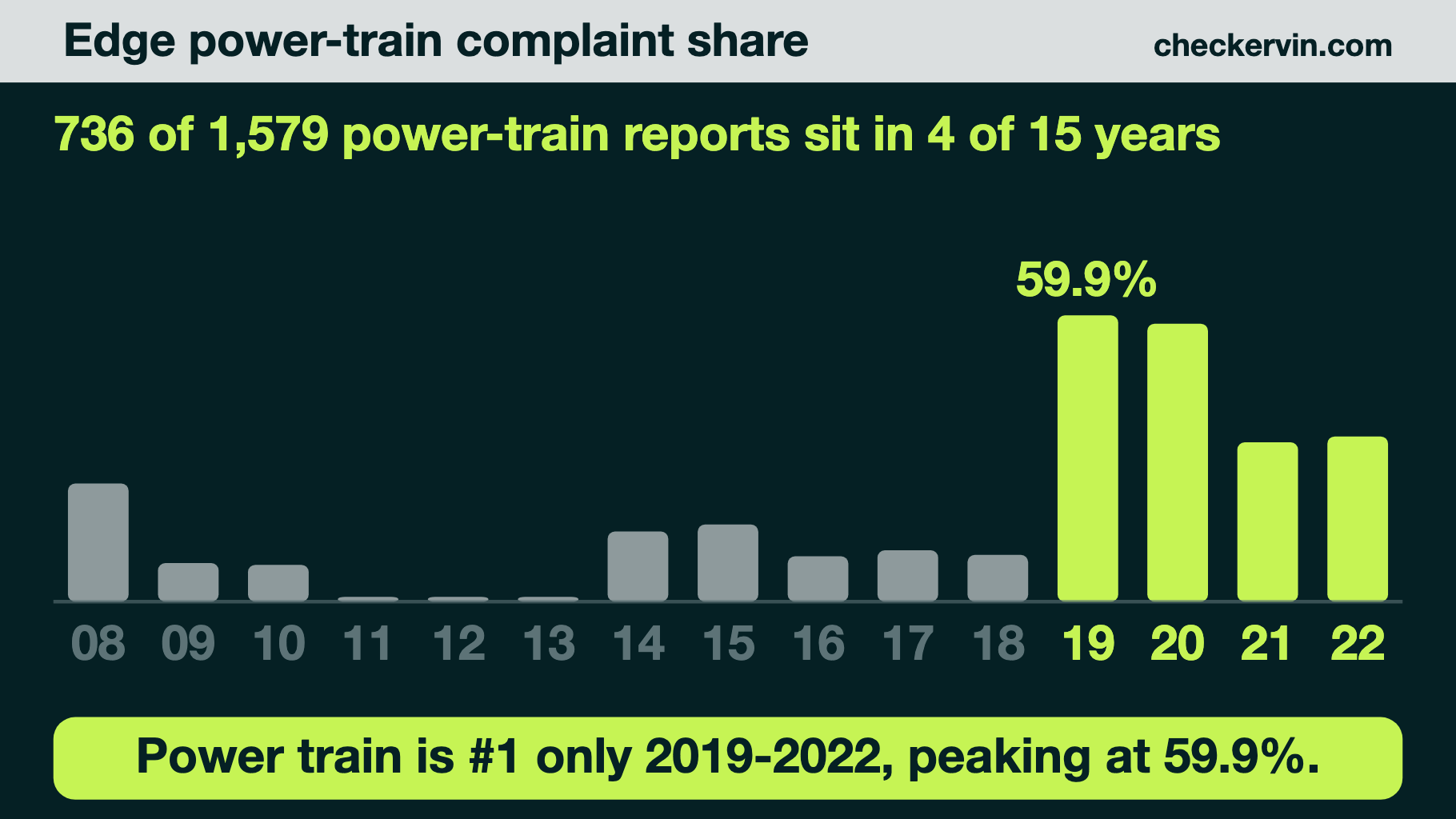
The year Ford changed the gearbox
The corpus’s four-year run has a plausible mechanical starting point. Per sources located via WebSearch, Ford moved the Edge from a 6-speed automatic to an all-new 8-speed platform for model year 2019: the 2.7L EcoBoost turbo pairs with the 8F57 (developed jointly with General Motors, derived from the 6F50), and the 2.0L EcoBoost pairs with the 8F35. 2019 is exactly the model year our corpus’s four-year #1 run begins.
| Edge era | What the corpus shows |
|---|---|
| 2011-2013 (6-speed, highest-volume years) | POWER TRAIN absent from that year's own top five |
| 2014-2018 (6-speed, later years) | POWER TRAIN present, ranking 3rd-5th |
| 2019-2022 (new 8-speed platform) | POWER TRAIN ranks #1 every single year |
This is ordinary product history, stated as context rather than as a finding this corpus itself proves — a new transmission platform is one plausible explanation for a sharp complaint-pattern change, not a conclusion the complaint counts alone can establish.
Three real NHTSA filings, same window
Independently of our own corpus, three separate federal filings line up with the same 2019-onward window, each located via WebSearch and none independently re-opened as a primary PDF in this environment (see Sourcing):
- Recall 20V550 (2019-2020 Edge) — loose start/stop-accumulator bolts that can cause a transmission fluid leak, which Ford's own filing describes as a fire risk in the presence of an ignition source; remedy is a free accumulator replacement
- TSB 21-2389 (November 2021, supersedes 21-2081; 2019-2021 Edge/Nautilus built through 11-Mar-2021, 8F35) — a shudder, buck or jerk below 35 mph traced to powertrain-control-module software, fixed by a PCM/TCM reprogram
- TSB 19-2288 (September 2019; 2019 Edge/Nautilus, 8F57) — harsh upshifts and downshifts and harsh Park-Reverse-Drive engagement
- A later bulletin, 26-2341 (reported 2026, supersedes 26-2171; 2019-2024 Edge/Nautilus, 8F35), describes a heavier shudder fix requiring transmission removal, both fluid filters, the torque converter and the output planetary carrier
No single one of these filings covers all four of the corpus’s flagged years on its own — the recall stops at 2020, the 2021 TSB stops at 2021, and the heavier 2026-reported bulletin is the one that reaches 2022 and beyond. Read together, they describe more than one issue sitting inside the same four-year window, not a single defect explaining the entire spike.
The fluid is spec-locked, not generic ATF
A 2008 Edge owner’s manual calls for Motorcraft fluid meeting Ford’s WSS-M2C930-A specification — MERCON V, or a fluid explicitly dual-rated MERCON/MERCON V. The 2019-and-later 8-speed Edge (8F35/8F57) specifies Motorcraft MERCON ULV, part XT-12-QULV, under specification WSS-M2C949-A, per a Ford fluid-specification document and Motorcraft’s own product page. One independent FAQ source names Mercon LV for a 2013 Edge — which conflicts with the 2008 manual’s MERCON V call — stated here as a genuine disagreement across sources, not collapsed into a single answer.
That disagreement is one more reason a flat price from a search result is a starting estimate, not a spec: it does not say which fluid, by which specification, actually went into a specific Edge’s transmission.
How often Ford actually says
Ford’s published maintenance guidance generally defers to the scheduled-maintenance information for the specific vehicle rather than stating one fixed mileage for every Edge. Independent sources located via WebSearch disagree sharply on a number to use in its place: one shop blog cites roughly 150,000 miles for normal driving, Firestone’s own Edge maintenance page suggests an inspection, and possible change, closer to every 30,000–60,000 miles, and a separate FAQ source states there is no single fixed interval Ford mandates for the 2013 Edge specifically, emphasizing fluid condition over mileage. None of these is a Ford-published figure. The honest answer is to check the Owner’s Manual for the specific model year and ask a Ford dealer directly.
What a power-train problem sounds like before it costs anything
- A shudder, buck or jerk below about 35 mph — the specific symptom TSB 21-2389 describes on the 8F35
- Harsh upshifts, downshifts, or a harsh engagement moving between Park, Reverse and Drive — the symptom TSB 19-2288 describes on the 8F57
- A transmission fluid leak or a burnt-fluid smell — the symptom recall 20V550's accumulator defect produces
- Delayed or inconsistent engagement when shifting from park into drive
The order matters because the cheap check comes first: confirm the exact model year and build by VIN, pull its open recalls, and check whether 20V550’s remedy was ever performed — before anyone prices a repair beyond a routine fluid service.
Before you authorize the service
- Confirm the exact model year by VIN before assuming a flat estimator price applies
- Pull the VIN's open recalls and check specifically for 20V550's accumulator remedy on a 2019-2020 Edge
- Confirm the shop is using the correct fluid for the specific transmission — MERCON V/dual-rated for the 6-speed, Motorcraft MERCON ULV for the 8F35/8F57
- Ask whether a transmission-control-module software update has already been applied before paying for a shudder diagnosis
- Get the quote itemized — fluid specification, quantity and labor — not a single flat-rate line
If you are buying the Edge, not maintaining it
The same record reads as a shopping map. A 2019–2022 Edge carries the heaviest power-train concentration in this corpus and sits inside the window of three real NHTSA filings — worth asking a seller directly whether 20V550’s remedy and any transmission software update have already been performed. A 2014–2018 Edge shows a lighter but still-present power-train record, and a 2011–2013 Edge — despite being among the nameplate’s highest-volume complaint years overall — does not place power train in that year’s own top five at all in this corpus.
A Ford VIN decode confirms the exact model year and build before you price a service or ask a seller about recall history, and checking what factory coverage remains by VIN settles whether anything on the transmission is still someone else’s responsibility to fix. Run the Ford recall lookup before you negotiate, and check which Edge model years show the most complaints overall rather than judging the nameplate by the power-train figure alone.
Where this information comes from
- NHTSA — Edge complaint databaseThe federal complaint record this page's figures are computed from, browsable by model year.
- NHTSA — recalls by VINThe official lookup that confirms whether recall 20V550's remedy was performed on a specific Edge.
- Kelley Blue Book — Edge transmission fluid change fair-repair rangeOne of the KBB regional estimator pages the cost figures above are drawn from.
- Motorcraft — MERCON ULV automatic transmission fluidThe manufacturer product page naming the 8F-family fluid specification cited above.
Keep reading
Frequently asked questions
How much does it cost to change the transmission fluid in a Ford Edge?
Estimates disagree sharply by source. Kelley Blue Book's regional fair-repair ranges run from about $278-$390 (2016 model, Tyler TX) to $315-$401 (2020, Albany GA) and $340-$425 (2023, Gainesville FL). YourMechanic puts its own average at $197 ($102 parts, $95 labor). RepairPal's estimator, by contrast, lists $651-$754 for a 2016 Edge — several times YourMechanic's figure for a comparable year. None of these is ours, since we sell VIN checks, not repairs; get a local, itemized quote rather than assuming any one of these applies to a specific car.
Which Ford Edge model years show the most power-train complaints?
Four straight years, and only these four: 2019, 2020, 2021 and 2022 — the only model years where POWER TRAIN ranks as the single largest complaint category of any kind in that year's own record. Computed from src/data/models/ford-edge.json, those four years hold 736 of the 1579 power-train complaints this corpus captures in any model year's top five (46.6%), on just 10.3% of the nameplate's total complaint volume. 2019 carries both the highest share (59.9%) and the highest raw count (463) of the four — the same year in both measures, which is not true of every nameplate in this series.
Is the power-train spike explained by a known recall?
In part. Per NHTSA filing 20V550, located via WebSearch (the primary PDF could not be fetched in this environment), Ford recalled certain 2019-2020 Edge vehicles for loose start/stop-accumulator bolts that can cause a transmission fluid leak — and a fluid leak near an ignition source is named as a fire risk. That recall covers two of the four years our corpus flags, not all four; a separate shudder-related service bulletin (TSB 21-2389) covers 2019-2021, and a later one (26-2341, reported 2026) extends a heavier shudder fix through 2024 — so more than one issue appears to sit inside the same four-year window, not a single defect explaining all of it.
Why did power train go from absent to the #1 complaint category?
The timing lines up with a drivetrain change, not just an aging fleet. Per sources located via WebSearch, Ford moved the Edge from a 6-speed automatic to a new 8-speed platform (8F57 on the 2.7L turbo, 8F35 on the 2.0L EcoBoost) for model year 2019 — the exact year our corpus's four-year #1 run begins. 2011-2013, by contrast, are three of the Edge's four highest-volume complaint years of any kind in this 15-year record, and in every one of them power train does not place in that year's own top five at all.
What transmission fluid does a Ford Edge actually need?
Not generic automatic transmission fluid, and not the same fluid across every generation. A 2008 Edge owner's manual calls for Motorcraft fluid meeting Ford's WSS-M2C930-A specification (MERCON V, or dual-rated MERCON/MERCON V). The 2019-and-later 8-speed Edge (8F35/8F57) specifies Motorcraft MERCON ULV, part XT-12-QULV, under specification WSS-M2C949-A, per a Ford fluid-specification document and the Motorcraft product listing. One independent FAQ source names Mercon LV for a 2013 Edge, which conflicts with the 2008 manual's MERCON V call — stated here as a genuine disagreement across sources, not resolved one way. Confirm the exact specification against the Owner's Manual for the specific model year before any shop fills the pan.
Confirm the exact model year before you price the service
A free CheckerVIN report shows the factory build, specifications and open recalls for any VIN — confirm what you're actually pricing.
Run a free VIN check