The short answer
- What does it cost?
- No installed-price estimate could be confirmed. Honda's 1.5T alternator lists at $742.81 MSRP, part only, before labor.
- Is it really the alternator?
- Often not. On 2013–2016 Accords Honda tied the charging light to a battery sensor and replaces that sensor free under recall 17V-418.
- Which years?
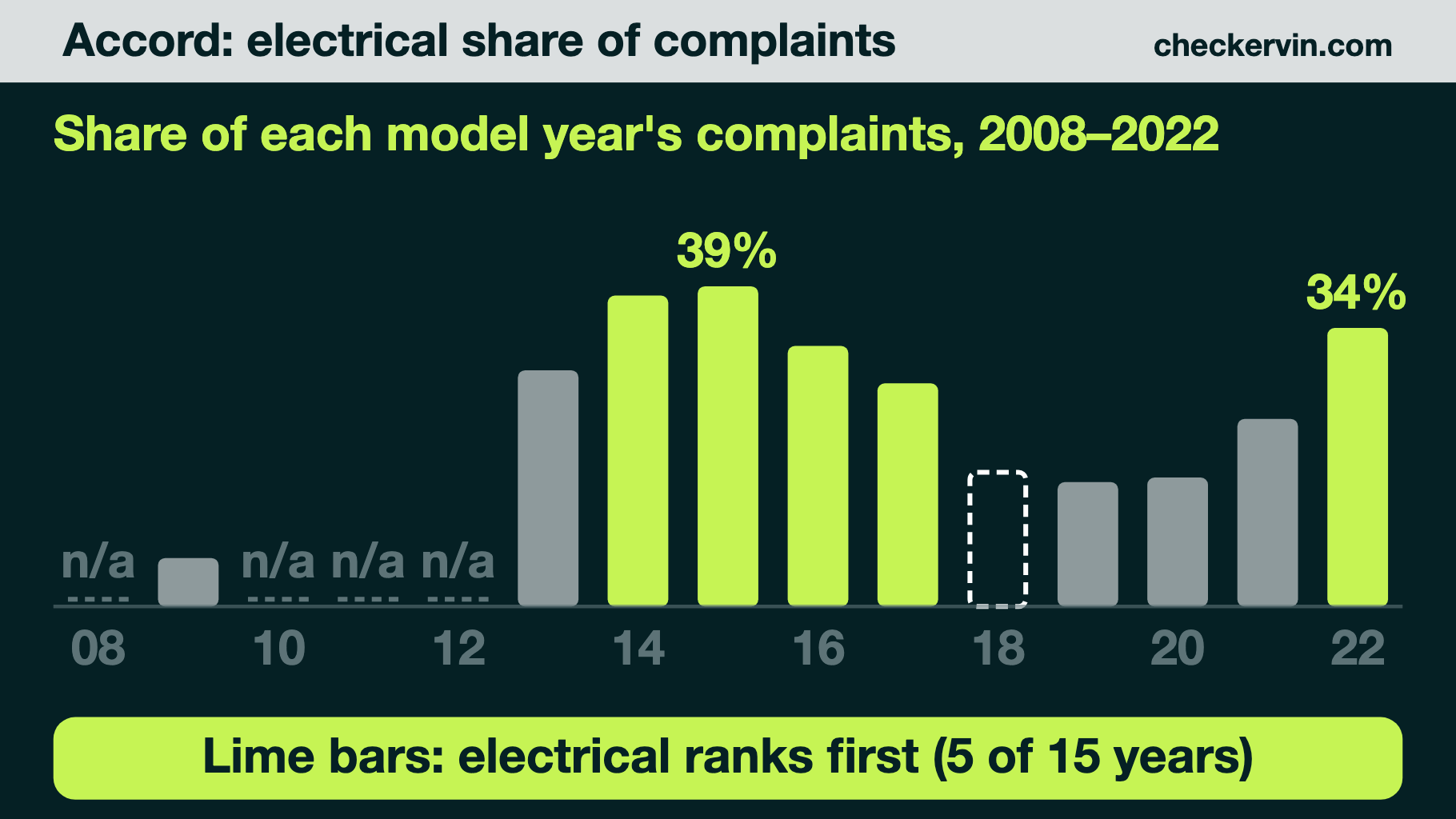
- Electrical complaints make up 33% of everything filed against the 2013–2017 cars, and rank first in 2014, 2015, 2016, 2017 and 2022.
$742.81
1.5T alternator list price, part only
HondaPartsNow MSRP, Oct. 2026
$0
Battery sensor under recall 17V-418
2013–2016 Accord, except Hybrid
33%
Electrical share, 2013–2017
Of all complaints on those years
39%
Highest share: 2015
Electrical ranks first that year
The numbers, and whose numbers they are
CheckerVIN decodes VINs and lists open recalls; we do not repair cars, so any price here belongs to someone else, with the date we read it. We could not confirm an installed-price estimate for an Accord alternator. RepairPal’s estimator refuses direct requests from our research tools, and the figures search engines attributed to it did not agree with each other, so we print none of them. Secondary sites quote several “RepairPal” ranges for the Accord; we left those out too.
What we could confirm is a part price. HondaPartsNow’s 2020–2022 Accord pages list the 1.5-liter turbo alternator, 31100-5PA-A01, at $742.81 MSRP on October 26, 2026. That is a list price for the part alone: labor, tax and any core charge come on top, and sale prices vary by seller. Ask any shop for a written quote that separates the part from the labor and says whether the unit is new Honda, Honda remanufactured or aftermarket. The bigger question comes first, though: whether the alternator needs replacing at all.
How much of each Accord year is electrical
Our corpus holds 9,607 federal NHTSA complaints against the 2008–2022Accord. NHTSA has no alternator category. The nearest one, ELECTRICAL SYSTEM, also takes in the 12-volt battery, wiring, lighting and control modules, so it is an outer boundary on charging trouble and never a count of failed alternators. Our data keeps each year’s top five components only, and ELECTRICAL falls below fifth place in 2008, 2010, 2011 and 2012; those years are uncounted, not zero.
Our starter analysis counted these complaints by year. Here the question is different: what share of each year’s complaints is electrical, and where does it rank? On the 2013–2017 cars it is 33% of everything owners filed, and it is the single largest category for 2014, 2015, 2016, 2017 and 2022. The 2015 Accord peaks at 39%. In 2009, the one older year where it reaches the top five, it is 6%. On the 2019–2021 cars it falls to 17%, ranked no higher than No. 3, then climbs back to 34% and first place on the 2022.
A high share does not mean alternators failed on those cars. It means electrical faults were what owners most often wrote about, and for the 2013–2017Accord, Honda’s own documents say what one of those faults was.
2013–2016: the charging light Honda fixed for free
The ninth-generation Accord has a battery sensor clamped to the negative battery post. It reports the battery’s condition so the engine computer can choose how hard to charge. In March 2016 Honda published Service Bulletin 16-026, “Charging System Indicator Is On with DTC P154A,” for all 2013–2014 Accords and early 2015 cars by VIN. The cause it gives is plain: the battery sensor has an internal failure. The fix is a new sensor, booked at 0.4 hours. No alternator is involved.
A year later the problem became a safety recall. Honda filed recall 17V-418 in June 2017 for 2013–2016 Accords, because the sensor’s plastic case could let in water carrying road salt, short the circuit board and start a fire. The owner letter spells out the link to the dashboard: the charging system indicator “may illuminate in the Multi-Information Display when a problem is detected with the battery sensor prior to the time that a short may occur.” Dealers replace the sensor free of charge, a job Honda estimated at about 30 minutes. Honda’s revised 16-026 then moved the 2013–2015 Accords out of the paid bulletin and into the recall bulletin, 17-057.
Honda was looking at the same warning before the recall. In July 2015 it asked dealers for 2013–2014 Accords, Hybrid and Plug-In included, showing the check charging system message with code B1192, the gauge module losing contact with the battery sensor. It wanted cars with no previous battery sensor or engine harness replacement. That is the picture the chart’s tall bars sit on: a sensor, a harness and a message, more than a charging part.
What Accord owners describe
A category share cannot tell an alternator from a sensor, so we read every Accord complaint from 2008 to 2022 that mentions the alternator. On the 2013–2017cars the same sentence recurs: the battery and alternator “tested good.” Owners describe check charging system messages that survive a new battery, no-starts that come and go, and alternators replaced, sometimes twice, without a cure. Several name the battery sensor recall; a few believe the sensor damaged their alternator, which is their reading, not a finding.
The older cars read differently. Owners of 2008–2010 Accords describe fluids reaching the alternator: engine oil on some cars, and power steering fluid from a leaking pump on others. Several also describe headlights that dim and brighten as the charging output cycles; some were told by dealers that this was the normal behavior of the electrical load detector, which trims alternator output to save fuel, and Honda’s 2012 tester bulletin lists headlight flicker as a normal condition. On the newest cars the alternator is rarely blamed at all.
2018–2022: Honda went looking for the same sensor
The tenth-generation Accord carries a different battery sensor and no recall for it. But in January 2024 Honda sent dealers a request for parts titled “2018-2022 Accord Battery Sensor Failure.” It wanted cars showing the Charging System Problem warning (the battery icon) or the Auto Engine Idle Stop Problem lamp, provided the technician had traced the lamp to a failed battery sensor, part 38920-TVA-A02, on a car with its original battery and sensor. Honda repeated the request through June 2024. We found no bulletin that followed it in NHTSA’s lists as of October 2026, so there is no published fix, but there is a documented suspect.
The 2018 bar needs a word. Our row for that year records 113complaints, and it is incomplete: NHTSA’s live database returned many times that number on October 26, 2026, while the other years matched our data within a few percent. We have not patched the row by hand, because every figure here recomputes from the same dataset. The live electrical share for 2018 sits close to the 17% our short row shows, so the bar’s height is roughly right even though its counts are not; read it with that caution.
The V6, the spool valve and a loose screw
The Odyssey alternator post traces many van alternator failures to oil from a leaking front rocker arm oil control valve, the spool valve. We checked whether the Accord shares it. Honda Service Bulletin 20-023, dated March 5, 2020, lists the 2008–2012 Accord with the V6 and automatic transmission among its affected vehicles, next to the Odyssey, Pilot and Crosstour. Same cause (a deteriorated gasket or an out-of-spec groove), same part, 15810-R70-A04, 0.8 hours, normal warranty only.
The bulletin says nothing about the alternator. That link comes from owners: a 2009 Accord owner describes an alternator “contaminated with oil” from the valve-timing solenoid located above it, and a 2008 owner reports paying for three alternators in four years “because of oil dripping.” Neither complaint names the engine, so treat them as a pointer rather than proof that the bulletin’s leak was the cause. If your 2008–2012 V6 needs an alternator, look up at the valve first; a new unit under an active leak is the same failure on a delay. The 2013–2017 Accord V6 is not on the 20-023 list.
One more V6 document is narrow but worth knowing. Honda Service Bulletin 18-010 covers early 2017 Accord V6 cars (VINs ending HA000954 through HA023577) with flickering lights, multiple warning lights and jerky steering, and blames a B+ sensing screw on the alternator that was not torqued properly. The fix is to tighten one screw, booked at half an hour, with the alternator left in place. Honda’s procedure removes the No. 4 ignition coil just to reach the alternator’s rear cover, which says something about access on that engine.
Make the test come before the part
Honda will not pay its own dealers for a warranty alternator on a 2005–2012 Honda unless a GR8 tester printout says REPLACE ALTERNATOR. That rule, Service Bulletin 12-002, is unpacked in the Civic alternator post, and it covers the 2008–2012 Accord the same way. The same bulletin notes that many charging complaints come from lights left on, normal headlight flicker or accessories that drain the battery.
On a newer Accord the bulletin no longer applies, but its order of operations still does: a charged battery that passes a load test, clean and tight cables and grounds, a scan for battery sensor codes such as P154A, then an output test at the alternator. Ask for the numbers. A shop that replaced the alternator without them has guessed. The battery size lookup by VIN tells you which battery the car takes before you buy one.
Which alternator your Accord takes, and what it lists for
Honda fits different alternators by generation and engine, and parts sellers ask for the VIN to confirm. The figures below come from search listings on October 26, 2026, because the sellers refuse direct requests from our tools; sale prices vary and are not quoted.
| Accord | What we could confirm |
|---|---|
| 2017 V6 | Honda's SB 18-010 names 31100-5G0-A02 as the original unit |
| 2018–2022 1.5L turbo | 31100-5PA-A01; HondaPartsNow lists $742.81 MSRP on its 2020–22 pages |
| 2018–2022 2.0L turbo | Different unit; listings disagreed on part and price, so none is quoted |
| 2008–2017 2.4L and V6 | Confirm by VIN; we found no single list price worth quoting |
We did not obtain Honda’s retail labor times or removal procedures for the 2.4-liter, the V6 or either turbo engine, so we will not guess which is hardest to reach or what the labor costs. A Honda VIN decode confirms the engine, which decides the part.
Accord Hybrid: the 12-volt battery is charged another way
The two-motor Accord Hybrid does not keep its 12-volt battery topped up the way the gasoline car does. Honda’s recall filing for 20V-798, made December 17, 2020, covers 10,385 Accord Hybrids built for the 2020 model year whose DC-DC converter, inside the power converter unit, can shut down from overvoltage in cold weather, “which prevents the 12-volt battery from recharging.” If the car is driven on after the 12-volt charging indicator comes on, Honda says, the depleted battery can restrict or eliminate motive power. The remedy is a software update.
Honda’s feature guide adds that the hybrid’s motor/generator only acts as a motor to start the engine and is a generator the rest of the time. A 2018 Accord Hybrid owner put the practical point to NHTSA: with the ignition on, the engine need not run, so nothing is turning a belt-driven charger.
Before you authorize an alternator
- Run the VIN for open recalls: 17V-418 on a 2013–2016 Accord, 20V-798 on a 2020 Accord Hybrid
- Ask for the battery load test, the charging voltage and any stored codes, especially P154A or B1192
- On a 2018–2022 car with the battery-icon warning, ask whether the battery sensor was checked
- On a 2008–2012 V6, look for oil at the front spool valve above the alternator before replacing it
- Ask whether the quote is for a new Honda, Honda remanufactured or aftermarket unit, and about the core charge
The first item costs nothing and is the one most likely to change the bill. A Honda recall check shows any open campaign on the VIN, and the guide to bulletins versus recalls explains why 16-026 was a paid repair while 17-057 is free.
If you are buying the Accord, not repairing it
On a 2013–2016 car, confirm that recall 17V-418 is closed; an open one is a free repair and a fire risk you should not inherit. Watch the dash on the test drive for a charging message, and on an older V6 look under the engine cover for wet oil around the front valve. The Honda Accord years-to-avoid page lays out the full complaint record by year, and the Honda warranty check by VIN estimates whether any factory coverage remains.
The same ninth-generation cars carry other documented trouble, covered in the Accord starter post and the Accord head gasket post. A free CheckerVIN report returns the factory build, engine, specifications and open safety recalls for any VIN. It does not include accident, title, odometer or repair history, so it cannot tell you whether an alternator was ever replaced.
Where this information comes from
- Honda owner letter for recall 17V-418 (NHTSA copy), November 2017Says the charging indicator may come on when the 2013–2016 Accord battery sensor has a problem; free sensor replacement.
- Honda defect information report, recall 17V-418 (NHTSA copy)Water and road salt entering the sensor case; the recall population and chronology.
- Honda Service Bulletin 16-026 (NHTSA copy): charging indicator on with DTC P154A2013–2015 Accord battery sensor internal failure; replace the sensor, 0.4 hr.
- Honda Service Bulletin 16-026 v2 (NHTSA copy), June 2017Moves the 2013–2015 Accords into the recall bulletin 17-057.
- Honda dealer request, January 2024 (NHTSA copy): 2018–2022 Accord battery sensor failureCharging System Problem or Auto Idle Stop lamp traced to the battery sensor.
- Honda Service Bulletin 20-023 (NHTSA copy): front rocker arm oil control valve leaksLists the 2008–2012 Accord V6 automatic; spool valve, 0.8 hr, normal warranty.
- Honda Service Bulletin 18-010 (NHTSA copy): alternator B+ sensing screwEarly 2017 Accord V6 by VIN; tighten the screw, 0.5 hr.
- Honda Service Bulletin 12-002 (NHTSA copy): GR8 alternator testerNo warranty alternator on 2005–2012 Hondas without a REPLACE ALTERNATOR printout.
- Honda defect information report, recall 20V-798 (NHTSA copy)2020 Accord Hybrid DC-DC converter can stop recharging the 12-volt battery.
- NHTSA: recalls by VINOur year-by-year query found no Accord recall naming the alternator.
- NHTSA: vehicle complaintsThe federal complaint database our electrical shares are computed from.
- Honda Info Center: 2018 Accord Hybrid two-motor systemHonda's description of the motor/generator that starts the hybrid's engine.
Keep reading
Frequently asked questions
How much does it cost to replace an alternator on a Honda Accord?
We could not confirm an installed-price estimate for an Accord alternator from any source we could read directly. What we could confirm is a part price: HondaPartsNow lists the 2018–2022 1.5-liter turbo alternator, 31100-5PA-A01, at $742.81 MSRP, part only, before labor, tax and any core charge. Get a written quote that separates part and labor, and on a 2013–2016 Accord rule out the free battery sensor recall before paying for any of it.
Why does my Honda Accord say check charging system?
Often not because of the alternator. Honda's Service Bulletin 16-026 traces the charging system indicator on 2013–2015 Accords to an internal battery sensor failure, and the owner letter for recall 17V-418 says the indicator may come on when the 2013–2016 Accord's battery sensor has a problem. In 2024 Honda asked dealers for failed battery sensors from 2018–2022 Accords showing the same battery-icon warning. Have the sensor, the battery and the cables checked first.
Is there a recall on the Honda Accord alternator?
No. Our query of NHTSA's recall database for every Accord model year from 2008 to 2022 found no campaign naming the alternator. The charging-related recall is 17V-418, which replaces the battery sensor on 2013–2016 Accords free of charge. The 2020 Accord Hybrid has its own recall, 20V-798, for a DC-DC converter that can stop recharging the 12-volt battery in cold weather.
Can an oil leak ruin an Accord alternator like it does on the Odyssey?
On the V6 it can be the same leak. Honda's Service Bulletin 20-023 on leaking front rocker arm oil control valves, the spool valve, lists the 2008–2012 Accord V6 automatic alongside the Odyssey and Pilot. The bulletin itself does not mention the alternator; Accord owners' complaints describe oil, and on some cars power steering fluid, reaching it. The 2013–2017 Accord V6 is not on that bulletin's list.
Does the Honda Accord Hybrid have an alternator?
Honda's recall filing for the 2020 Accord Hybrid describes its 12-volt battery being recharged by a DC-DC converter in the power converter unit, and Honda's feature guide says the hybrid's motor/generator starts the engine. So a hybrid with a charging warning points to the converter, the 12-volt battery or the hybrid system. Ask exactly which part a shop wants to replace before approving an alternator quote.
Check the recall before you price the alternator
A free CheckerVIN report shows the factory build, engine, specifications and open recalls for any VIN, including whether Honda's battery sensor recall is still open.
Run a free VIN check