The short answer
- What does it cost?
- RepairPal lists $573-$823 for a Malibu alternator on its model-year pages. That is RepairPal's national range, not ours; engine and ZIP code move it.
- Which year stands out?
- 2013. It carries 424 electrical complaints, 46% of that year's reports, and it is the year of the Malibu Eco, whose eAssist motor generator does the alternator's job.
- Is there a recall?
- No Malibu recall from 2008 to 2022 names the alternator or charging system. GM issued service updates on the 2013 Eco's generator module and belt instead.
The estimate, and whose it is
RepairPal’s 2020 and 2023 Malibu repair-cost pages both list alternator replacement at $573 to $823. We read that range on October 26, 2026 from the text search engines serve for those pages, because RepairPal returns a block to a direct fetch; two separate searches returned the same figures. We could not see how RepairPal divides that between parts and labor, so we do not guess at it. RepairPal’s figures exclude taxes and fees and are not adjusted for your location.
An older range credited to RepairPal circulates on third-party blogs at a lower figure; we could not trace it to a current RepairPal page and do not use it. Kelley Blue Book’s Malibu alternator page rendered no repair price when we checked, so we quote none. We sell VIN checks, not repairs, and publish no price of our own. What we can add is what the federal complaint record and GM’s own bulletins say about which Malibus have charging trouble, and which ones don’t take a normal alternator at all.
What 2,789 counted electrical complaints hold
Our corpus of federal NHTSA complaints holds 10,185 owner reports against the 2008–2022 Malibu. For each model year it keeps the five most-reported components. ELECTRICAL SYSTEM makes that list in every one of the fifteen years, for 2,789 counted reports, and it is the single most-reported category in 2011, 2012, 2013, 2021, 2022. A live check of NHTSA’s complaint database shows our 2021 and 2022 figures running a few reports behind, so treat the count as a floor.
The category is wide. It takes in the 12-volt battery, wiring and connectors, lighting, body and control modules, ignition and shifter switches, and the charging system. A high electrical count says owners had electrical trouble. It does not say their alternators failed, and on the Malibu most of it is something else. Read the chart as a map of where to look, never as a tally of alternator jobs.
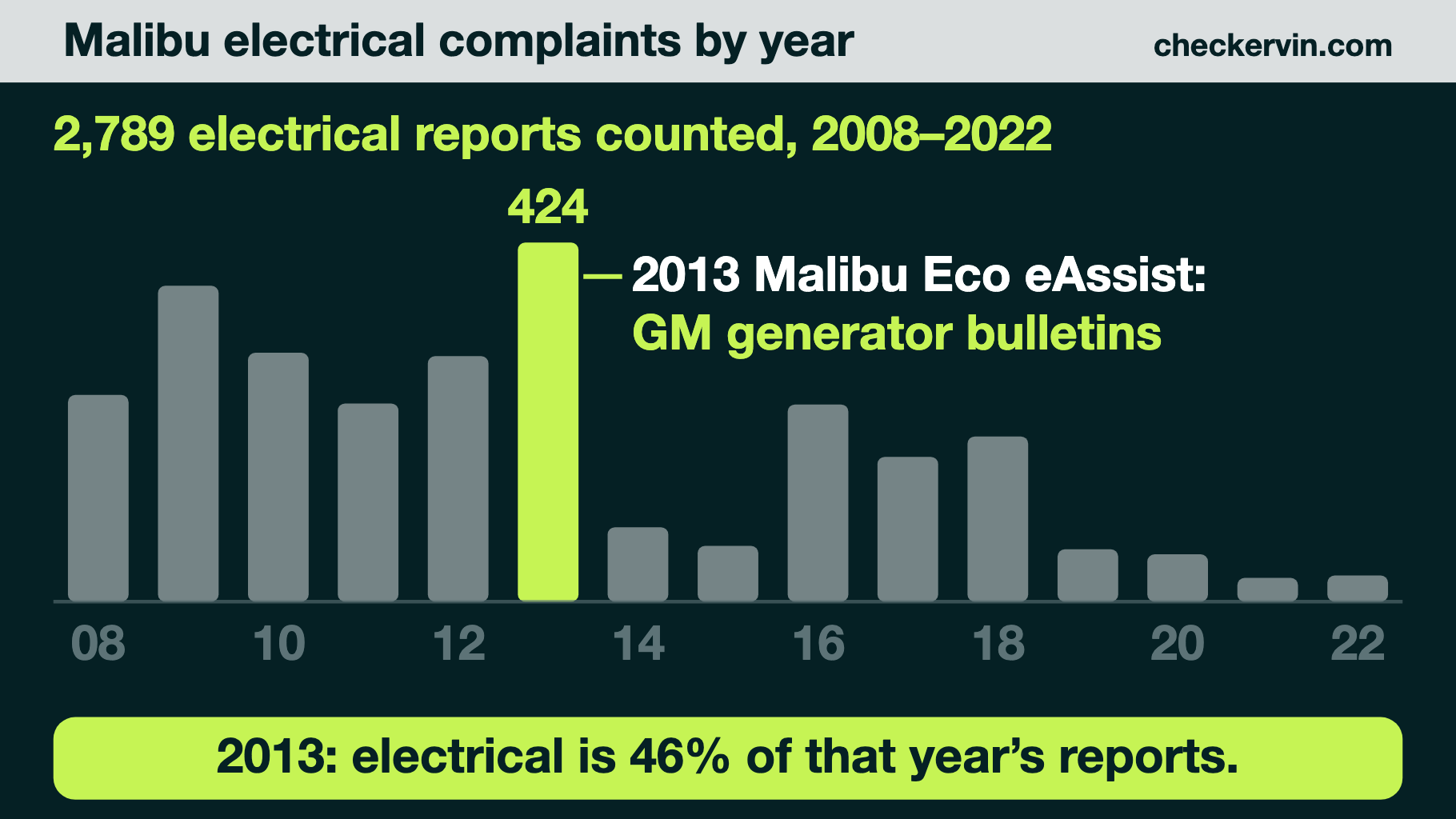
2013: the year the Malibu Eco replaced the alternator
The 2013 Malibu carries 424 electrical complaints, the most of any model year and 15% of the fifteen-year count. The share is more telling than the count: electrical is 46% of everything owners reported about the 2013 car, where every other year sits between 22% and 34%. No other Malibu year comes close on that measure.
2013is the redesign year, and it is also the year GM launched the Malibu Eco. EPA’s fuel-economy listings show it as a separate “Malibu eAssist” model for 2013 and 2014, with a 2.4-liter four, alongside the regular 2.5-liter and 2.0-liter turbo cars. The eAssist system swaps the conventional alternator for a belt-driven motor generator unit that also works as a motor, managed by a generator control module and paired with its own battery module. GM’s bulletins call these the motor generator unit, the generator control module and the drive motor generator battery.
We read the 2013electrical narratives in NHTSA’s complaint file. It is the only Malibu year where alternator or generator language turns up in more than a dozen of them, and much of it comes from Eco owners describing the generator control module, a drained 12-volt battery, a “Service Battery Charging System” message and then a stall. Several describe the power steering going heavy at the same moment, because the electric steering needs the voltage the charging system is no longer supplying.
What GM told its dealers about the Eco
We searched every manufacturer communication NHTSA holds for the 2008–2022 Malibu for alternator, generator and charging language, then read the documents behind the hits. Two GM service updates from October 2012 name the 2013 Malibu Eco directly.
| GM bulletin | What it says |
|---|---|
| Service Update 12238 (Oct. 2012) | Generator control module may not work properly, causing gradual loss of battery charge, a check-engine light and eventual stall or no-start. Dealer inventory only; expired Oct. 31, 2013. |
| Service Update 12239 (Oct. 2012) | Drive belt may separate, cutting power to the motor generator unit and A/C compressor and lighting the red BATTERY light. Covers customer cars too; expires with the base warranty. |
The first one is narrower than it sounds. It covered cars still on dealer lots, and GM’s own estimate was that roughly 3% of the inspected vehicles would need a new module. Later preliminary information bulletins in the index walk technicians through the same “Service Charging System” and “Battery Saver” messages on 2013–2014 eAssist cars. None of these is a recall. Our explainer on how a service bulletin differs from a recall covers why an owner cannot demand a free repair on the strength of one, and why it is still worth showing a shop.
2008-2012: the electrical count is mostly not about charging
The 2008–2012 Malibus add up to 1,435 counted electrical complaints, a large block of the total. Their narratives read differently from 2013. Owners describe the power steering cutting out with a dash warning and brake lights that misbehave. Alternator mentions are rare.
The recall record explains much of that. GM recall 14V153000 covers electric power steering on 2008–2009 Malibus, and STEERING is the most-reported category outright in 2008, 2009, 2010, with 2,100counted steering reports across the five years. Recall 14V252000, coded ELECTRICAL SYSTEM, covers 2004–2012 Malibus whose body control module connection can make the brake apply sensor voltage fluctuate, with brake lights, cruise control, the Park interlock and stability features all affected. Neither is a charging fault, and neither is fixed by an alternator.
2014-2015: a charging message that is not always a charging fault
Electrical complaints fall sharply after 2013: 154 counted across 2014 and 2015 together. GM’s bulletins tie stop/start (option code KL9) to the 2.5-liter Malibu in these years, and that is where a lot of the narratives go, with owners describing an engine that will not restart promptly after an auto-stop.
GM’s preliminary information bulletin PIC6017A, from November 2014, covers 2014–2015 Malibus with the 2.5-liter and stop/start that show an intermittent “Service Charging System” message or battery light, code P0621, sometimes noticed during an auto-stop. Its instruction is to run normal diagnostics and, if no fault is found, call GM technical assistance. A separate bulletin, PI1426, lists the conditions that keep AutoStop from engaging, including a battery below 12 volts. On these cars a charging warning is a reason to test, not a diagnosis.
2016-2018: the electrical complaint is a shifter switch
The redesigned 2016–2018 Malibu holds 599 counted electrical complaints, 21% of the total. Read the narratives and one fault keeps coming back: the car is in Park, the driver presses the button to shut it off, and the dash says “Shift to Park.” The engine or accessories stay on, and some owners report a drained battery afterward.
GM bulletin 18-NA-297 covers it for 2016–2018 Malibus, putting the cause in the park switch inside the shifter assembly; GM later moved the repair content to bulletin 19-NA-206. A shop that hears “dead battery” on one of these cars and replaces the alternator has fixed nothing. If you are pricing an alternator for a 2016–2018 Malibu with a recurring dead battery, ask about the shifter first. The 2019–2022 cars are much quieter in the record, 177 electrical reports counted across 4 years.
Which engine, which part
An alternator is matched to its engine, and the Malibu went through several. These are the engines EPA’s fuel-economy listings show by model year.
| Malibu model years | Engines listed by EPA |
|---|---|
| 2008-2010 | 2.4L four; 3.5L V6; 3.6L V6; Malibu Hybrid 2.4L |
| 2011-2012 | 2.4L four; 3.6L V6 |
| 2013-2015 | 2.5L four; 2.0L turbo; Malibu eAssist 2.4L (2013-2014) |
| 2016 | 1.5L turbo; 2.0L turbo; Malibu Limited 2.5L; Malibu Hybrid 1.8L |
| 2017-2019 | 1.5L turbo; 2.0L turbo; Malibu Hybrid 1.8L |
| 2020-2022 | 1.5L turbo; 2.0L turbo |
Three rows need care. The 2008–2010 Malibu Hybrid was an earlier mild hybrid; GM’s bulletin index for those years refers to a starter generator control module. The 2013–2014 eAssist car uses the motor generator unit described above. The 2016–2019 Malibu Hybrid is a full hybrid whose 5ET50 drive unit GM’s bulletins group with the Volt’s; we could not confirm from a GM document whether it carries a belt alternator at all, so do not let anyone sell you one until they have shown where it is.
Access to the alternator, and so the labor a shop bills, differs between the four-cylinders, the V6s and the turbos. We could not verify book labor hours by engine from a named source, so we print none. Ask for the labor time the shop’s estimating guide lists for your engine and compare quotes on that basis. The engine lookup by VIN settles which one you have.
Test before you buy the part
The Malibu record is full of owners who replaced a battery, then an alternator, and kept the fault. On this car the reasons are specific: a brake-lamp circuit on the older generation, a stop/start battery strategy on 2014–2015, a shifter switch that keeps the car awake on 2016–2018, and a different charging system entirely on the Eco.
- A charging-system test with the engine running and loads on: is the alternator producing current?
- A separate battery load test, so a tired battery is not blamed on the alternator
- Battery terminals, the main ground and the underhood fuse block checked before parts are ordered
- On a 2013-2014 Eco: confirm whether the fault is the motor generator, its control module, its belt or the battery module
- On a 2016-2018 car with repeat dead batteries: ask whether it shows Shift to Park at shutdown
Most parts stores will test a battery and alternator for free. On some 2016 stop/start cars GM describes a battery sensor learn procedure for when stop/start stops working after a repair, so a new battery alone may not settle it. A shop that wants to replace the alternator without a written test result is guessing with your money.
No charging recall on record, but check the VIN anyway
We queried NHTSA’s recall database for every Malibu model year from 2008 through 2022. No campaign’s summary, consequence or remedy mentions the alternator, generator, charging system or battery. The same pull does return electrical-coded recalls, including the brake-apply-sensor campaign above and a 2018 1.5-liter turbo engine-software recall, so a charging recall would have appeared if one existed.
One GM program sat close to the charging circuit. Customer satisfaction program 15611 covered certain 2016 Malibus with the 2.5-liter engine built with the wrong fuse-block bracket, which could let the generator bus bar in the underhood electrical center short against the shock tower. That program ran until September 30, 2017. Run the Chevrolet recall check before the car goes in, so any open campaign is handled on the same visit at no cost.
If you are buying the Malibu, not repairing it
A fresh alternator receipt on a used Malibu proves little on its own. Ask why it was replaced and what was tested first. A Chevrolet VIN decode confirms the model year, trim and engine, which tells you whether a 2013 or 2014 is an Eco with eAssist. The battery size lookup helps if the real fault is the battery, and a warranty check by VIN shows whether any coverage is left before you pay.
For the wider picture, see which Malibu model years draw the most complaints overall. On the 2016–2018 cars the larger risk is the engine, covered in our Malibu timing chain cost post. Cross-shopping the Malibu’s main rival? The Altima alternator post shows how differently that car’s electrical record breaks down.
Where this information comes from
- NHTSA — Malibu complaint databaseThe federal complaint record this page's figures are computed from, and whose electrical narratives we read for every model year.
- NHTSA-hosted GM Service Update 12238 — eAssist generator control moduleRead in full: 2013 Malibu Eco, gradual loss of battery charge leading to stall or no-start; dealer inventory only, expired Oct. 31, 2013.
- NHTSA-hosted GM Service Update 12239 — eAssist drive belt separationRead in full: loss of power to the motor generator unit, red BATTERY light, no-start if ignored; runs with the base warranty.
- NHTSA-hosted GM bulletin PIC6017A — 2014-2015 Malibu Service Charging System messageIntermittent charging message and code P0621 on 2.5L stop/start cars, sometimes during an auto-stop.
- NHTSA-hosted GM bulletin 18-NA-297 — 2016-2018 Malibu Shift to ParkPuts the cause in the shifter's park switch; repair content later moved to 19-NA-206.
- NHTSA-hosted GM program 15611 — 2016 Malibu 2.5L fuse-block bracketThe generator bus bar short risk and the program's Sept. 30, 2017 end date.
- NHTSA recalls API — Malibu by model yearQueried for every model year 2008-2022; no alternator or charging campaign, checked against electrical-coded campaigns that do appear.
- EPA fueleconomy.gov — Malibu engine listings by yearQueried for each model year 2008-2022; source of the engine table (2013 eAssist shown).
- RepairPal — 2020 Chevrolet Malibu repair and maintenance costsThe $573-$823 alternator range, read from search-served page text on October 26, 2026; the 2023 page lists the same range.
Keep reading
Frequently asked questions
How much does it cost to replace the alternator on a Chevy Malibu?
RepairPal lists $573 to $823 for a Malibu alternator replacement on its 2020 and 2023 Malibu repair-cost pages. We read that range on October 26, 2026 from the text search engines serve for those pages, because RepairPal blocks automated fetches, and we could not see a parts and labor split. Those are RepairPal's national figures, before taxes and without your ZIP code. We sell VIN checks, not repairs, and publish no price of our own.
Does the Malibu Eco have an alternator?
Not a conventional one. The 2013 and 2014 Malibu Eco used GM's eAssist system, and GM's own service bulletins describe a belt-driven motor generator unit, a generator control module and a separate generator battery module doing the charging work. GM issued two 2013 Malibu Eco service updates on it: one for a generator control module that could let the battery charge drain away until the car stalled or would not start, and one for a drive belt that could separate and light the red battery warning. A shop pricing a standard alternator for an Eco is pricing the wrong part.
Is there a recall on the Chevy Malibu alternator?
No. We queried NHTSA's recall database for every Malibu model year from 2008 through 2022 and no campaign mentions the alternator, generator, charging system or battery, after confirming the same pull returns other electrical-coded recalls. GM did issue service updates and bulletins on the 2013 Malibu Eco's eAssist charging system, but a bulletin is repair guidance, not a free-repair recall.
Which Chevy Malibu years have the most electrical problems?
2013, on both count and share. Computed from our NHTSA corpus, ELECTRICAL SYSTEM is in the Malibu's top five complaint categories in every model year from 2008 to 2022, at least 2,789 reports counted, and 2013 holds 424 of them, 46% of that year's complaints. That category covers the battery, wiring, lighting and modules as well as charging, so it is not a count of alternator failures.
What does the Service Battery Charging System message mean on a Malibu?
It means the car has detected a charging fault, not that the alternator has failed. On a 2013 or 2014 Malibu Eco it can point to the eAssist generator, its control module or its belt. On a 2014 or 2015 Malibu with the 2.5-liter engine and stop/start, GM told technicians the message can appear intermittently during an auto-stop event with code P0621, and to call GM technical assistance when no fault is found. A charging-system test with the engine running is the first step either way.
Confirm the engine before you price the alternator
A free CheckerVIN report shows the factory build, engine, specifications and open recalls for any VIN, so you know whether that Malibu is an Eco before anyone quotes a part.
Run a free VIN check