The short answer
- What does it cost?
- RepairPal: $579–$727 for a 2019 Journey, $674–$818 for a 2010. KBB showed $1,123–$1,251 for a 2018 in one Washington ZIP.
- Is it a big job?
- Depends on the engine. The 2009–2010 3.5L V6 drives the pump with its timing belt. The 3.6L pump bolts to the chain cover but appears to run on the serpentine belt.
- Is it really the pump?
- Check first. Stellantis's coolant-leak inspection lists 14 places to look, from the front cover to the oil filter adapter, before any part is replaced.
12 of 12
Years ENGINE is in the top five
2009–2020 model years
2015 and 2016
Years ENGINE ranks #1
Federal NHTSA complaints
14
Leak points on Stellantis's list
STAR case S2307000002, 2023
0
Recalls naming the water pump
All years 2009–2020
The prices, and whose prices they are
We sell VIN checks, not repairs, so every dollar figure on this page belongs to the site that published it. RepairPal’s estimator for a 2019 Journey shows $579 to $727, split into $220 to $322 of labor and $360 to $405 of parts, with Columbus, Ohio as its example location. Its 2010 Journey page lists $674 to $818. Kelley Blue Book’s 2018 Journey page, served for ZIP 98296 north of Seattle, showed a fair repair range of $1,123 to $1,251. All three were retrieved on November 22, 2026, from the text those pages served to a search engine.
Open a KBB Journey page without a ZIP and it shows no local range at all, only an FAQ line that a Dodge water pump runs $375 to $787. That sentence is the same on every model year’s page, so read it as a generic figure, not a Journey one. The spread between the 2019 RepairPal number and the 2018 KBB number is mostly location and labor rate, which is why a local quote beats any national average. What no survey tells you is which of the Journey’s three engines the quote is for, and that changes the job more than the ZIP does.
What 981 engine complaints say, and what they cannot
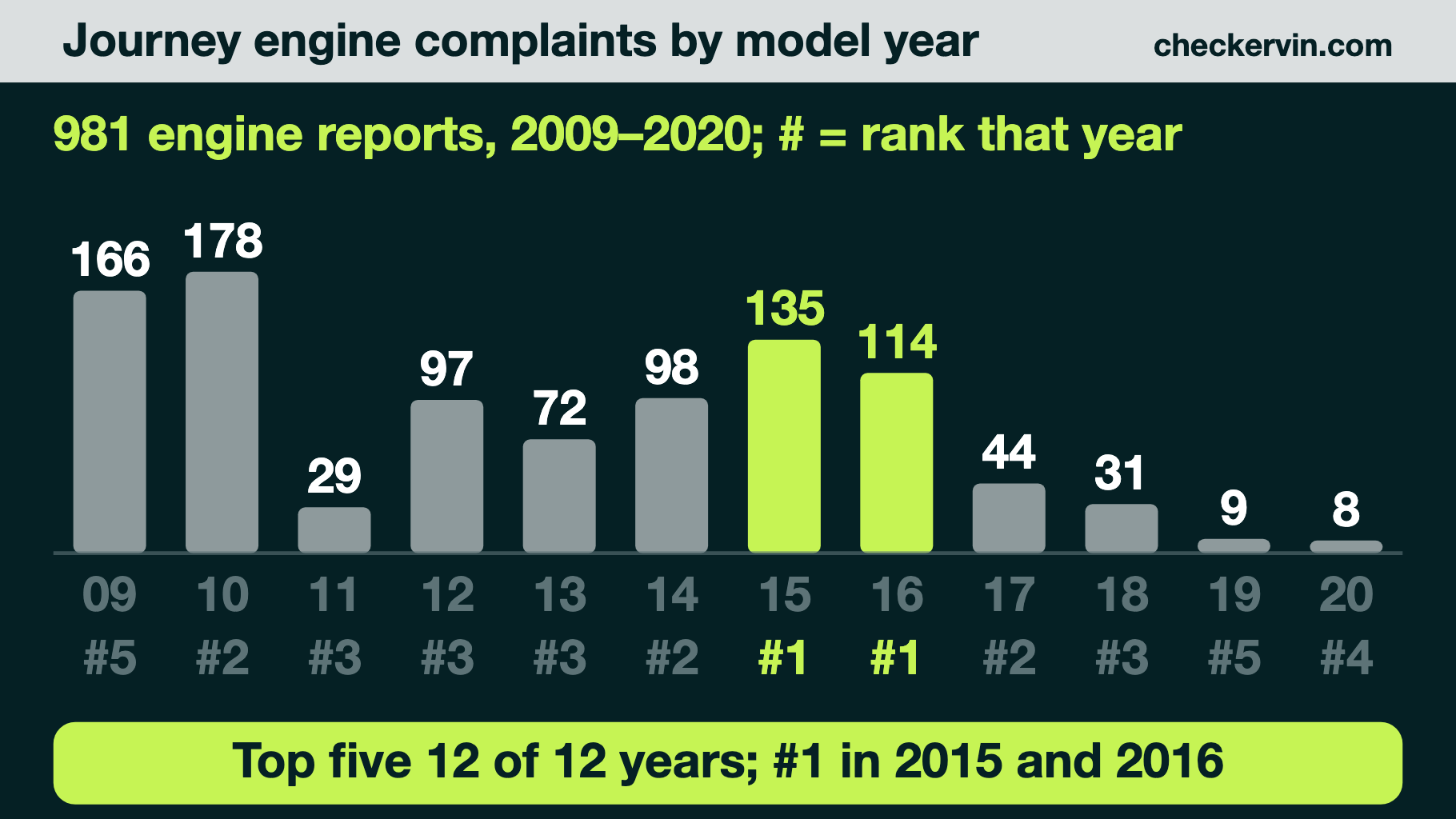
Our corpus of federal NHTSA complaints holds 5,543 reports against the 2009–2020 Journey. 981 of them, about 18%, are filed under ENGINE. That category sits in the top five every one of the 12 model years, which sounds alarming until you look at where it ranks. It is the single largest category only in 2015 and 2016.
The tallest bars tell a different story from the rank row. The 2010 model carries the most engine reports, 178, and 2009 has 166. Together the first two years hold 35% of every Journey engine complaint on file. But those were years with enormous complaint files overall, dominated by electrical reports, so ENGINE ranked only #5 in 2009 and #2 in 2010, at 10% and 16% of each year’s reports. By 2015 the file was much smaller, yet ENGINE made up 24% of it, and 29% in 2016. The 2017–2020 models together hold just 9% of the engine total.
Now the limit. NHTSA has no water pump category. ENGINE covers every engine fault on every engine Dodge fitted that year, from stalling to oil leaks. The closer heading, ENGINE AND ENGINE COOLING, never reaches a Journey model year’s top five. Our data stores only the top five, so its exact count is unknown, but it must sit below each year’s fifth-place category: under 5 reports in 2020, and under 166 even in 2009. The chart shows where engine trouble concentrates. It is not a count of failed pumps.
Three engines, three different pump jobs
Before comparing any quote, find out which engine the Journey has. On the VINs we decoded through NHTSA’s own decoder, the eighth character was B for the 2.4L four-cylinder, V for the 3.5L V6 sold in 2009 and 2010, and G for the 3.6L Pentastar V6 that replaced it from 2011. A Dodge VIN decode confirms it in a few seconds and removes the guesswork.
| Engine | How the pump is driven, and how sure we are |
|---|---|
| 2.4L four (all years) | Aftermarket catalogs list it on the accessory belt with its own pulley; no Stellantis document found |
| 3.5L V6 (2009–2010) | Driven by the timing belt; owners in the federal file describe belt and pump replaced together |
| 3.6L Pentastar V6 (2011–2020; ERB) | Bolted to the chain cover, pulley on the serpentine belt, inferred from a Stellantis Pacifica notice |
The 3.5L is the outlier. Because its pump turns with the timing belt, replacing one means removing the other, and most shops quote both. Owners of 2009 Journeys in the federal complaint file describe exactly that pairing, including one whose dealer found a pinhole leak in the pump and replaced the timing belt with it. The 2.4L and 3.6L jobs should not involve timing parts at all. If a quote for one of those engines includes a timing belt, ask what it is for; the 3.6L, for one, has a timing chain behind its chain case cover.
Is the 3.6 water pump internal?
A third of the search traffic for this repair adds “3.6” to the question, and the worry behind it is reasonable. On some engines the water pump sits behind the timing cover and is turned by the timing chain, which makes a pump replacement a timing job. The Pentastar’s pump does mount at the front of the engine against the timing chain cover, and Stellantis lists the front cover and the water pump as separate leak points in its coolant inspection.
The drive, though, appears to be the serpentine belt. The clearest Stellantis statement we found is in a 2023 customer satisfaction notification, 47A, for 2022–2023 Chrysler Pacifica minivans with the 3.6L hybrid version of the engine. Its belt-replacement procedure warns that the serpentine accessory drive belt must be routed correctly, because otherwise “the engine may overheat due to the water pump rotating in the wrong direction.” A pump whose direction depends on how the accessory belt is threaded is a pump on that belt.
That is a Pacifica document, not a Journey one, and the hybrid’s belt layout is not identical to a Journey’s. We found no Journey-specific Stellantis document that states the drive, so we offer it as an inference rather than a quotation. It fits the prices, too: RepairPal’s labor figure for a 2019 Journey, $220 to $322, is a few hours of shop time, not the front-cover teardown a chain-driven pump would need.
Stellantis's own leak checklist runs to fourteen items
The most useful document for a Journey owner holding a pump quote is a three-page Stellantis STAR Online case, S2307000002, released in August 2023 under the heading “Suspected engine coolant leak.” NHTSA files it against the 2016–2020 Journey, although the document itself names no model. It tells technicians to review every potential leak source in the engine compartment before replacing parts, to pressurize the cooling system and inspect it under UV light, and to add leak-detection dye if the coolant’s own fluorescence has faded.
Then it lists where to look: the radiator, the coolant reservoir, the front cover, the water pump, the thermostat, the front cover coolant crossover, the cylinder head gasket, the block, the heads, the EGR cooler where fitted, the oil filter adapter, the HVAC heater, the transmission oil cooler lines and every hose, gasket and connection. Two instructions matter most to an owner. If residue shows up low in the engine bay, inspect the parts directly above it, because coolant runs downhill. And some residue at the pump’s weep-hole plug may be normal, but coolant should not be dripping from it.
The 3.6's oil filter adapter, one of the fourteen
On the Pentastar, one item on that list has its own paper trail. The oil filter adapter sits in the valley between the cylinder heads, and Stellantis has published several dealer notices about it. One, issue review 9004076 dated May 3, 2019, lists the Journey for 2011–2013 and tells technicians replacing the adapter for an oil leak that a seal kit is available, and that a missing spring-loaded check valve can now be replaced on its own. NHTSA’s record of a later notice, 9003357, files it against 2012–2020 Journeys and says the same thing in more detail: reseal the adapter rather than replace it, except on 2014 models, where the adapter itself is replaced.
Owners in the federal file describe the same part on 2015 and 2016 Journeys, calling the housing plastic and saying it cracked. The practical point for a pump quote is location: fluid from the valley runs down the engine and can puddle where a pump leak would. The details of the dowel test and the 2014 redesign are in our Grand Cherokee water pump post, which shares the engine.
What the 2015 and 2016 engine complaints actually describe
It would be convenient if the years where ENGINE ranks first were full of cooling failures. They are not. Reading the 2015 and 2016 ENGINE narratives, the dominant complaint is the engine stalling or shutting off while driving, often with the steering going heavy, and many of those reports come from four-cylinder cars. Mentions of coolant or overheating are scattered. We found no 2015 or 2016 ENGINE narrative that names the water pump.
Three Stellantis actions help explain the 2015–2016 volume, and none involves the pump. Recall 15V431 covers 2011–2015 Journeys with the 2.4L, whose engine cover could detach and touch the exhaust manifold, a fire risk; many 2015 reports are owners saying the recall part was unavailable. Recall 16V907 covers 2016 Journeys built between May 9 and July 15, 2016, whose crankshaft or camshaft sensor connector could make the engine stall. And bulletin 09-006-16 tells dealers to replace the long block on 2015 Journeys with the 2.4L built between May 5 and June 24, 2015, because of a machining error in the cylinder head; the symptom owners notice is oil consumption.
So the 2015 and 2016peak is a reason to check a specific Journey’s recall and bulletin history, not evidence that those years eat water pumps. Our guide to TSBs versus recalls explains which of those a dealer must fix for free.
Driving on a failing pump
A weeping pump and a failed one are different problems. Stellantis says some residue at the weep-hole plug may be normal; a drip is not, and a pump that has stopped circulating coolant will overheat the engine quickly. How badly is spelled out in a different STAR case, S2109000004 from July 2021, written for overheating after a Mopar replacement engine and filed by NHTSA against 2012–2020 Journeys. Those engines carry heat tabs on the back of the heads. A pink tab means coolant reached 255°F; a red one means it went higher, which the case says “will cause the heads to warp and leak coolant.” It also tells technicians to find the cause of the overheat before going any further.
On the 3.5L there is a second risk. A pump that seizes or a leak that soaks the timing belt can take the belt with it, and the federal file includes 2009 owners describing a broken timing belt and a leaking pump in the same report. If a 3.5L Journey is losing coolant and the timing belt’s age is unknown, price both together.
What the recall record covers, and other puddles
We queried NHTSA’s recall database for every Journey model year from 2009 through 2020. The counts matched our corpus; the 2014 model, for example, returned the same 7 campaigns our data records. No campaign names the water pump, thermostat, radiator or coolant hoses, and we found no Stellantis extended warranty on Journey cooling parts.
One campaign is worth knowing because it produces a puddle at the front of the car. Recall 16V273 covers 2009–2016 Journeys whose power steering return hose may rupture at start-up after cold exposure, costing power steering assist. Dealers replace the return hoses, steel tubes and power steering cooler free. A fresh leak after a cold start with heavy steering points there, not to the pump. A separate 2015 bulletin, 07-002-15, covers 2011–2014 3.6L Journeys whose idler pulley shrieks for about 90 seconds after a start at or below freezing; the fix is a pulley booked at 0.3 hours, not a pump bearing. The recall check by VIN shows which campaigns are still open on a specific vehicle.
Is it worth fixing on a Journey?
Dodge built the Journey through the 2020 model year, so every one on the road is now several years old, and many are worth less than they were when this repair first came up. That makes the pump a proportion question. The published estimates on this page run from under $600 to about $1,250. What overheating can cost is larger: the same Stellantis bulletin that replaced 2015 four-cylinder engines books 7.6 hours of labor just to swap a Journey long block, before the engine itself.
If the Journey is otherwise sound, a confirmed pump failure is usually worth fixing, because the alternative is driving toward a head gasket. If the vehicle has other large repairs pending, look up what it is worth with a car value check by VIN before you authorize anything, and decide on the whole list rather than the pump alone.
Before you authorize the repair
- Confirm the engine by VIN: 2.4L, 3.5L V6 or 3.6L V6
- On a 3.5L, ask whether the timing belt is included and how old the old one is
- On a 2.4L or 3.6L, question any timing parts on the quote
- Ask for a pressure test with UV dye and a photo of the leak source
- Ask whether coolant drips from the weep hole or only shows residue
- On a 3.6L, have the oil filter adapter checked before the pump
The fourth item does the most work, and it is exactly what Stellantis asks of its own dealers. When the system is refilled, use the coolant the factory specified; a coolant type lookup by VIN lists it. If you are shopping for a used Journey rather than repairing one, the Journey years-to-avoid breakdown covers the rest of the record, and a pre-purchase inspection with a cooling-system pressure test costs far less than any repair here.
Where this information comes from
- Stellantis STAR case S2307000002 (NHTSA copy) — suspected coolant leakFiled by NHTSA against 2016–2020 Journey: the 14-point leak inspection and the weep-hole note.
- Stellantis STAR case S2109000004 (NHTSA copy) — overheating heat tabsAbove 255°F the heads warp and leak coolant; filed against 2012–2020 Journey.
- Stellantis notice 9004076 (NHTSA copy) — oil filter adapterLists the 2011–2013 Journey; seal kit and check valve sold separately.
- Stellantis CSN 47A (NHTSA copy) — 3.6L serpentine belt routingA Pacifica hybrid notice: a misrouted belt can spin the water pump backward.
- Stellantis TSB 09-006-16 (NHTSA copy) — 2.4L long block replacement2015 Journey 2.4L built May 5–June 24, 2015; 7.6 hours of labor.
- Stellantis TSB 07-002-15 Rev. A (NHTSA copy) — idler pulley noise2011–2014 Journey 3.6L: cold-start shriek from the idler pulley, not the pump.
- NHTSA — recalls by VINOfficial lookup for 15V431, 16V907, 16V273 and every other Journey campaign.
- RepairPal — 2019 Dodge Journey water pump replacement costThe $579–$727 estimate and parts and labor split, retrieved November 22, 2026.
- Kelley Blue Book — 2018 Journey water pump replacementThe ZIP 98296 fair repair range quoted above, retrieved November 22, 2026.
Keep reading
Frequently asked questions
How much does it cost to replace a water pump on a Dodge Journey?
RepairPal's 2019 Dodge Journey estimate is $579 to $727, with $220 to $322 of labor and $360 to $405 of parts, using Columbus, Ohio as its example location. Its 2010 Journey page lists $674 to $818. Kelley Blue Book's 2018 Journey page, served for ZIP 98296 in Washington state, showed $1,123 to $1,251. All three were retrieved in November 2026. The engine matters: a 2009 or 2010 Journey with the 3.5L V6 drives its pump with the timing belt, so that job usually includes a belt.
Is the Dodge Journey 3.6 water pump internal?
The evidence says no. The 3.6L Pentastar's pump bolts to the timing chain cover, which may be why some owners call it internal, but its pulley appears to run on the serpentine belt. A 2023 Stellantis notice for the same engine in the Chrysler Pacifica hybrid warns that a misrouted serpentine belt can make the water pump spin backward. We found no Journey-specific Stellantis document stating the drive, so treat this as a well-supported inference. The pump that is genuinely tied to timing work on a Journey is the 3.5L V6's, which runs off the timing belt.
Can I keep driving a Journey with a bad water pump?
Not for long, and not once the temperature gauge climbs. A pump that has stopped circulating coolant lets the engine overheat, and Stellantis's own guidance on replacement engines says coolant temperatures above 255°F will cause the cylinder heads to warp and leak coolant. A pump that weeps a little is different from one that drips; Stellantis says some residue at the weep-hole plug may be normal. Have a dripping pump replaced before a long trip, and stop driving if the engine runs hot.
Is it worth fixing the water pump on an older Dodge Journey?
Usually, if the rest of the vehicle is sound, because the pump is a mid-sized repair and overheating damage is not. The published estimates run from under $600 to about $1,250 depending on year and ZIP. An overheated engine can need heads or a whole engine; one Stellantis bulletin books 7.6 hours just to swap a 2.4L Journey long block. Check what the Journey is worth first, and get a pressure test so you are paying for the part that is actually leaking.
Which Dodge Journey years have the most engine complaints?
By raw count, 2010, with 178 engine complaints in the federal record, and 2009, with 166. But those years had huge complaint files overall, and ENGINE ranked only #2 and #5. ENGINE is the single largest complaint category only in 2015 and 2016, at 24% and 29% of those years' reports. These counts cover every engine fault on every Journey engine, not water pumps, and the 2015 and 2016 narratives mostly describe stalling.
Confirm the engine before you price the pump
A free CheckerVIN report shows the factory build, engine, specifications and open recalls for any VIN, so you know whether you are pricing a belt job or a bolt-on pump.
Run a free VIN check