The short answer
- What does it cost?
- RepairPal lists $761–$940 for the Grand Cherokee. KBB's 2022 estimate for one Ohio ZIP was $806–$910, most of it labor.
- Is it really the pump?
- Check first. Stellantis tells dealers to inspect before replacing a 3.6L pump, and the oil filter housing and thermostat housing leak in the same neighborhood.
- Which years carry the risk?
- 2011–2015, the first Pentastar years, hold 66% of the Grand Cherokee's engine complaints on record.
The numbers, and whose numbers they are
Two estimators publish Grand Cherokee figures, and neither is ours. RepairPal’s Jeep Grand Cherokee page lists water pump replacement at $761 to $940, retrieved in October 2026. Kelley Blue Book’s 2022 Grand Cherokee page, as served for ZIP 43085 in central Ohio, showed a fair repair range of $806 to $910, broken into $276 to $324 of parts and $530 to $586 of labor. Load the same KBB page without a ZIP and it shows no local pricing at all, only an FAQ line saying owners can expect $375 to $787. That lower figure appears word for word on every model year’s page, so read it as a generic water pump range rather than a Grand Cherokee number.
The shape is consistent across both sources: parts are the smaller half, labor the larger. Coolant is extra on most invoices, and many shops quote a belt and thermostat alongside the pump because the belt is off anyway. We sell VIN checks, not repairs, and publish no price of our own. What we can add is the part of the decision that does not depend on anyone’s survey: which leaks Stellantis itself says get confused with the pump, and which model years the federal complaint record points at.
What 2,040 engine complaints say about the Grand Cherokee
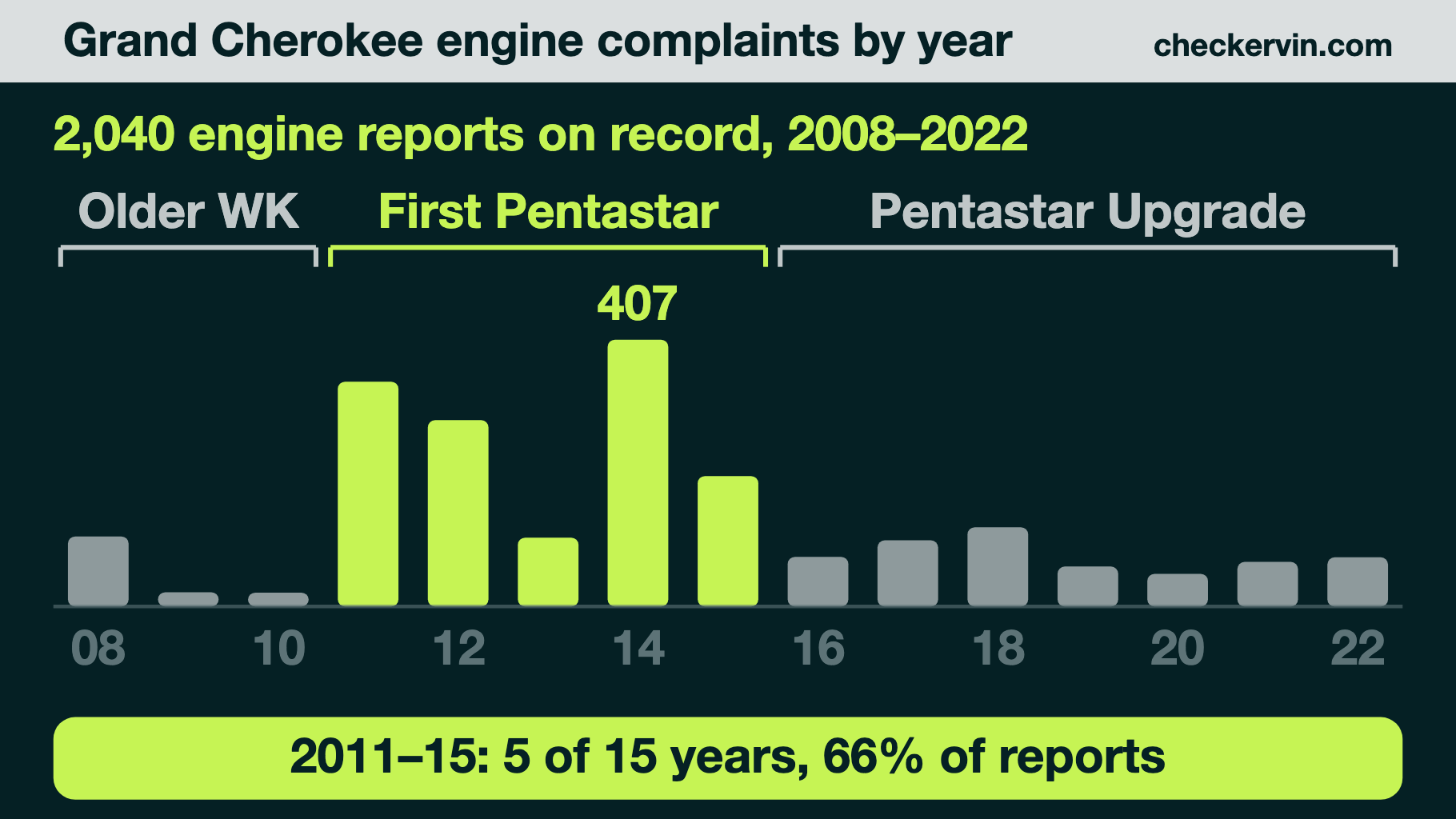
Our corpus of federal NHTSA complaints holds 11,797 reports against the 2008–2022 Grand Cherokee, and 2,040 of them, about 17%, fall in the ENGINE category. Split them by engine era and the pattern is lopsided. The older WK body, 2008–2010, carries 150 (7%). The first five Pentastar years, 2011–2015, carry 1,338, which is 66% of the total. The seven “Pentastar Upgrade” years that follow, 2016–2022, carry 552 (27%). A first-generation Pentastar year averages about 268 engine reports; an upgrade year averages about 79.
The peak is the 2014 model at 407 engine reports. The dip inside the hot window is 2013, at 105, and the record does not explain it, so we leave it visible. 2011 jumps from 21 engine reports on the last older-body year to 343 on the first Pentastar year.
Here is the limit, stated plainly. ENGINE covers every engine Jeep sold that year, the V8s and the diesel included, and every kind of engine fault, not water pumps. NHTSA also has a separate category, ENGINE AND ENGINE COOLING. In our data it reaches a model year’s top five only in 2008 (39 reports). For every other year it ranks below fifth, and our data stores only the top five, so we cannot give its exact count. In 2009, for instance, the fifth-ranked category had just 11 reports, which caps what cooling complaints could have been that year. The chart shows where engine trouble concentrates. It does not prove that any one report is a failed pump.
How the 3.6 pump is driven, and why that keeps the bill moderate
Search results for this repair often warn that the water pump hides behind the timing chain and costs a fortune. On the 3.6L Pentastar that warning does not seem to apply, and the evidence comes from Stellantis. A February 2023 bulletin, 09-004-23 Rev. A, covers a Chrysler Pacifica with the 3.6L hybrid version of the engine and an incorrect belt tensioner. Its stated risk is that the belt could snap, “resulting in water pump and alternator not being driven.” A pump that stops when the serpentine belt breaks is a pump on the accessory drive.
That is a Pacifica document, not a Grand Cherokee one, and the hybrid’s accessory layout is not identical. We looked for a Grand Cherokee-specific Stellantis document that names the drive and did not find one, so we offer the belt drive as a well-supported inference rather than a quotation. It fits the estimates above: $530 to $586 of labor in the KBB figure is, at typical shop rates, a few hours of work, not the full front-cover teardown a chain-driven pump would need.
The practical upshot is that a quote far above the RepairPal and KBB ranges deserves a question. Either the shop is pricing extra parts, which may be reasonable, or it is pricing a different job. A VIN engine lookup confirms which engine the vehicle left the factory with before you compare.
Stellantis's own instruction: inspect before replacing
The most useful document for anyone holding a water pump quote is a short one. Stellantis dealer notice 9100337, dated May 2, 2024 and titled under the part description “PUMP WATER,” covers 2016–2024 vehicles with the 3.6L Pentastar Upgrade and lists the Grand Cherokee among them for 2016–2022. It tells technicians that before performing any water pump replacement they must follow a separate inspection publication and submit photos of the leak area.
It adds a note that matters to owners. Some coolant residue around the pump’s weep-hole plug may be normal, the notice says, but coolant should not be dripping from that spot. A dried crust near the plug is not, by itself, a failed pump. Where a technician is unsure, the notice points to a pressurized cooling-system test.
The housing in the valley that looks like a pump leak
The Pentastar’s oil filter housing, which Stellantis calls the oil filter adapter, sits on top of the engine between the cylinder banks, under the intake. Fluid that escapes there can run down the block, and an owner looking from below sees a wet engine and a puddle, which is how it gets mistaken for the pump.
Stellantis has written about this part repeatedly. Bulletin 09-003-13, dated October 26, 2013, says the adapter was redesigned for the 2014 model year and that the 2011–2013 and 2014-and-later oil filters are not interchangeable. Bulletin 09-008-15, dated August 7, 2015, covers 2014 Grand Cherokees with the 3.6L built on or before January 20, 2014 and describes oil pooling in the engine valley: the area “may hold almost a quart of oil and not show any signs of oil weeping.” Its test is a long wooden dowel pushed into the valley next to the housing. About 10 mm of oil on the tip means the housing may need replacing.
A dealer notice revised March 31, 2021 covers 2012–2021 Pentastar vehicles with adapter leaks. For leaks between the adapter and the block, it tells technicians to check the bolt torque, then replace only the O-rings and gaskets, not the adapter, except on 2014 models, where the adapter itself is replaced. That is a meaningful difference on an invoice: a seal kit job and a whole-housing job are not priced the same.
Those documents describe oil leaks. Aftermarket suppliers sell the part as an oil filter and cooler assembly, and Standard Motor Products, which makes replacement housings, says failures can let oil into the housing’s coolant passage. We found no Stellantis document describing a coolant-side failure, so treat a coolant leak from this housing as possible but not confirmed by the manufacturer. Either way, the housing is in the valley and the pump is not, which is why dye and a pressure test settle the question quickly.
The plastic thermostat housing
The third suspect is the thermostat housing. We found no Stellantis bulletin that names it for the Grand Cherokee, but one for the same engine in another vehicle shows what the part is. Bulletin 07-002-16 Rev. A, dated August 16, 2016, covers 2016 Ram 1500 pickups with the 3.6L V6 (sales code ERB) built between September 9, 2015 and April 17, 2016. The complaint is “a coolant leak at the thermostat housing bleed screw.” The technician removes the throttle body to reach the screw, and the fix, if it will not hold torque, is a new housing, booked at 0.7 hours.
The bulletin’s drawing shows the housing stamped PPA-GF33, a glass-filled polyamide, which is a plastic. A cracked or seeping plastic housing near the top of the engine drips coolant that can land anywhere below it. Because the Ram bulletin is limited to a specific build window on a different vehicle, it does not mean a Grand Cherokee housing is defective. It shows that this coolant leak has a cheap, short repair that should be ruled out before anyone prices a pump.
| Suspect on a 3.6L | What the Stellantis documents say |
|---|---|
| Water pump | Inspect and photograph before replacing; weep-hole residue can be normal, dripping is not (notice 9100337) |
| Oil filter housing | Oil can pool in the valley under the intake; seal kit first, whole housing on 2014 (09-008-15, 9003357) |
| Thermostat housing | Bleed-screw coolant leak; housing swap booked at 0.7 hours on a 2016 Ram 3.6L (07-002-16) |
| EcoDiesel EGR cooler | Can crack and let coolant into the EGR system; free fix under recall 20V699 |
Hemi, SRT and diesel Grand Cherokees
The Pentastar is the volume engine, but not the only one. The 2008–2010 older-body trucks predate it entirely, and V8s, including the 5.7L Hemi, were offered alongside it through the period our corpus covers. We did not find a Stellantis document that states how the Hemi or the SRT V8 pumps are driven, so we will not quote a labor figure for them. The RepairPal and KBB ranges above are not broken out by engine either. Ask any shop to confirm the engine by VIN before it prices the job.
The 3.0L EcoDiesel, sold in the Grand Cherokee from 2014 through 2019 according to Stellantis bulletin 09-005-20, has its own coolant story. Recall 20V699 covers 2014–2019 Grand Cherokees with that engine because the EGR cooler “may crack and allow pre-heated vaporized coolant to enter the EGR system,” which NHTSA’s record says can increase the risk of a fire. Dealers replace the EGR cooler free and inspect the intake manifold. On a diesel losing coolant with no visible leak, that recall is the first thing to check, and paying for a pump before checking it would be a costly mistake.
What the recall record covers, and what it doesn't
We queried NHTSA’s recall database for every Grand Cherokee model year from 2008 through 2022. The query counts matched our corpus; the 2014 model, for example, returned the same 19 campaigns our data records. No campaign names the water pump, the thermostat, the radiator or the coolant hoses.
Several campaigns are filed under NHTSA’s ENGINE AND ENGINE COOLING heading without being cooling faults. Recall 11V487 covered certain 2012 Grand Cherokees with the 3.6L built between August 31 and September 13, 2011, whose connecting rod bearings could fail from debris inside the block; the remedy was a free engine replacement. Recalls 20V475 and 23V411 cover a crankshaft sensor tone wheel on EcoDiesel engines. None of them pays for a water pump. The Jeep recall lookup by VIN shows which campaigns remain open on a specific vehicle.
Before you authorize the repair
- Confirm the engine by VIN: 3.6L Pentastar, a V8, or the 3.0L diesel
- Ask whether coolant is dripping from the pump's weep hole, or only residue around it
- Ask for a pressure test with dye and a photo of the leak source
- On a 3.6L, have the oil filter housing and thermostat housing checked before the pump
- On a 2014–2019 diesel, check recall 20V699 before paying for any coolant repair
- Ask whether the quote includes a belt, thermostat and coolant, and decide on each
The second and third items do the most work. Stellantis’s own notice draws the line between normal residue and a real leak, and asking for the photo the notice requires of dealers is a fair request of any shop. Use the right coolant when the system is refilled; a coolant type lookup by VIN lists what the factory specified.
If you are buying the Grand Cherokee, not repairing it
The same record reads as a shopping map. A 2011–2015 3.6L Grand Cherokee sits in the years with the most engine complaints on file, and a 2014 is the one year Stellantis tells dealers to replace the oil filter housing outright rather than reseal it. Ask for paperwork showing what was done. Then look at the engine valley and the front of the engine with a flashlight, and check the coolant level cold. A Jeep VIN decode confirms the engine and model year before you start.
A pre-purchase inspection with a cooling-system pressure test costs far less than any of the repairs on this page. The Grand Cherokee years-to-avoid breakdown covers the rest of the record, where electrical complaints lead most years. If the same vehicle is due for other service, our Grand Cherokee transmission fluid post covers the power train side.
Where this information comes from
- Stellantis notice 9100337 (NHTSA copy) — 3.6L water pump inspectionCovers 2016–2022 Grand Cherokee: inspect and photograph before any pump replacement; weep-hole residue may be normal.
- Stellantis TSB 09-008-15 (NHTSA copy) — 3.6L oil loss diagnostic aid2014 Grand Cherokee: oil pooling in the valley under the intake, the dowel test, and the oil filter housing.
- Stellantis notice 9003357 (NHTSA copy) — Pentastar oil filter adapter2012–2021: reseal the adapter rather than replace it, except on 2014 models.
- Stellantis TSB 09-003-13 (NHTSA copy) — 3.6L oil filter adapter changeThe 2014 model-year redesign and the non-interchangeable filters.
- Stellantis TSB 07-002-16 Rev. A (NHTSA copy) — 3.6L thermostat housingA 2016 Ram 1500 bulletin on the same engine: bleed-screw coolant leak, 0.7-hour housing replacement.
- Stellantis TSB 09-004-23 Rev. A (NHTSA copy) — 3.6L serpentine beltA Pacifica hybrid bulletin stating a snapped belt leaves the water pump undriven.
- NHTSA — recalls by VINThe official lookup, including recall 20V699 for the EcoDiesel EGR cooler.
- RepairPal — Jeep Grand Cherokee repair costsThe $761–$940 water pump figure quoted above, retrieved October 2026.
- Kelley Blue Book — 2022 Grand Cherokee water pump replacementThe ZIP 43085 range and parts and labor split quoted above, retrieved October 2026.
Keep reading
Frequently asked questions
How much does it cost to replace a water pump on a Jeep Grand Cherokee?
RepairPal's Jeep Grand Cherokee page lists water pump replacement at $761 to $940, retrieved October 2026. Kelley Blue Book's 2022 Grand Cherokee page, served for ZIP 43085, showed a fair repair range of $806 to $910, with $276 to $324 in parts and $530 to $586 in labor. Labor is the larger share in both. Add coolant, and ask whether the quote includes the serpentine belt and thermostat, which shops often replace at the same visit.
Is the 3.6 Pentastar water pump driven by the timing chain?
The evidence points to the accessory belt, not the timing chain. A Stellantis bulletin for a Chrysler Pacifica with a 3.6L hybrid V6 warns that a snapped serpentine belt leaves the water pump and alternator undriven, and a Stellantis water pump notice that covers 2016-2022 Grand Cherokees refers to a visible weep-hole plug a technician can inspect. We did not find a Grand Cherokee-specific Stellantis document stating the drive outright, so treat that as a strong inference rather than a quotation.
Is it the water pump or the oil filter housing leaking?
On a 3.6L Grand Cherokee it can be either, which is why Stellantis tells dealers to inspect before replacing a pump. The oil filter housing sits in the engine valley under the lower intake, where a 2015 Stellantis bulletin says almost a quart of oil can pool without visible weeping. Coolant residue at the pump's weep-hole plug can be normal, according to the same company's 2024 notice; coolant dripping from it is not. A pressure test and dye settle which part is actually leaking.
Is there a recall or extended warranty for the Grand Cherokee water pump?
Not that we could find. We queried NHTSA's recall database for every model year from 2008 through 2022, and no campaign names the water pump, thermostat, radiator or coolant hoses. The one coolant-related recall is 20V699, for 2014-2019 Grand Cherokees with the 3.0L EcoDiesel, whose EGR cooler may crack and let coolant into the intake; dealers replace that cooler free. We found no Stellantis extended warranty on Pentastar cooling parts.
Which Grand Cherokee years have the most engine complaints?
The first five Pentastar years. 2011-2015 hold 66% of the Grand Cherokee's 2,040 engine complaints in the federal record, peaking with the 2014 model at 407. The 2016-2022 trucks average about 79 engine complaints a year against about 268 for the earlier group. Those counts cover every engine and every kind of engine fault, not water pumps alone.
Confirm the engine before you price the repair
A free CheckerVIN report shows the factory build, engine, specifications and open recalls for any VIN, so you know which Stellantis notice or recall applies.
Run a free VIN check