The short answer
- What does it cost?
- RepairPal: $659–$762 for a 2016 Journey. YourMechanic: $413 average ($259 parts, $154 labor). AutoNation: $704 average.
- Is it usually the alternator?
- Often not. Journey owners report replacing the battery, alternator and starter while the no-start continued. Stellantis points technicians at grounds, a sensor and a connector first.
- What should I ask for?
- A charging-system test with printed results, the engine confirmed by VIN, and an open-recall check before any parts are ordered.
12 of 12
Years ELECTRICAL is in the top five
2009–2020 model years
7
Years it ranks #1
Federal NHTSA complaints
60%
Share of 2010 complaints
The category’s peak
0
Recalls naming the alternator
All years 2009–2020
The prices, and whose prices they are
We do not sell repairs, so every dollar figure here belongs to the site that published it. RepairPal’s 2016 Dodge Journey page lists an alternator replacement at $659 to $762. YourMechanic’s Journey alternator page gives a lower average, $413, made up of $259 in parts and $154 in labor. AutoNation Mobile Service lists an average of $704. All three were retrieved on November 22, 2026, from the text those pages served to a search engine; RepairPal and YourMechanic refused our direct requests, so we could not see which engine or location each figure assumes.
Kelley Blue Book’s general alternator guide quotes $747 to $842, but that is a national average across all vehicles, not a Journey number, and we found no ZIP-specific KBB Journey alternator range to set beside it. The gap between $413 and $762 is mostly labor rate and parts choice: a remanufactured unit from a parts store and a new Mopar part are not the same purchase. The larger risk is not which end of that range you pay. It is paying it for a part that was never the problem, and on this vehicle the federal record shows that happening again and again.
What 2,182 electrical complaints say, and what they cannot
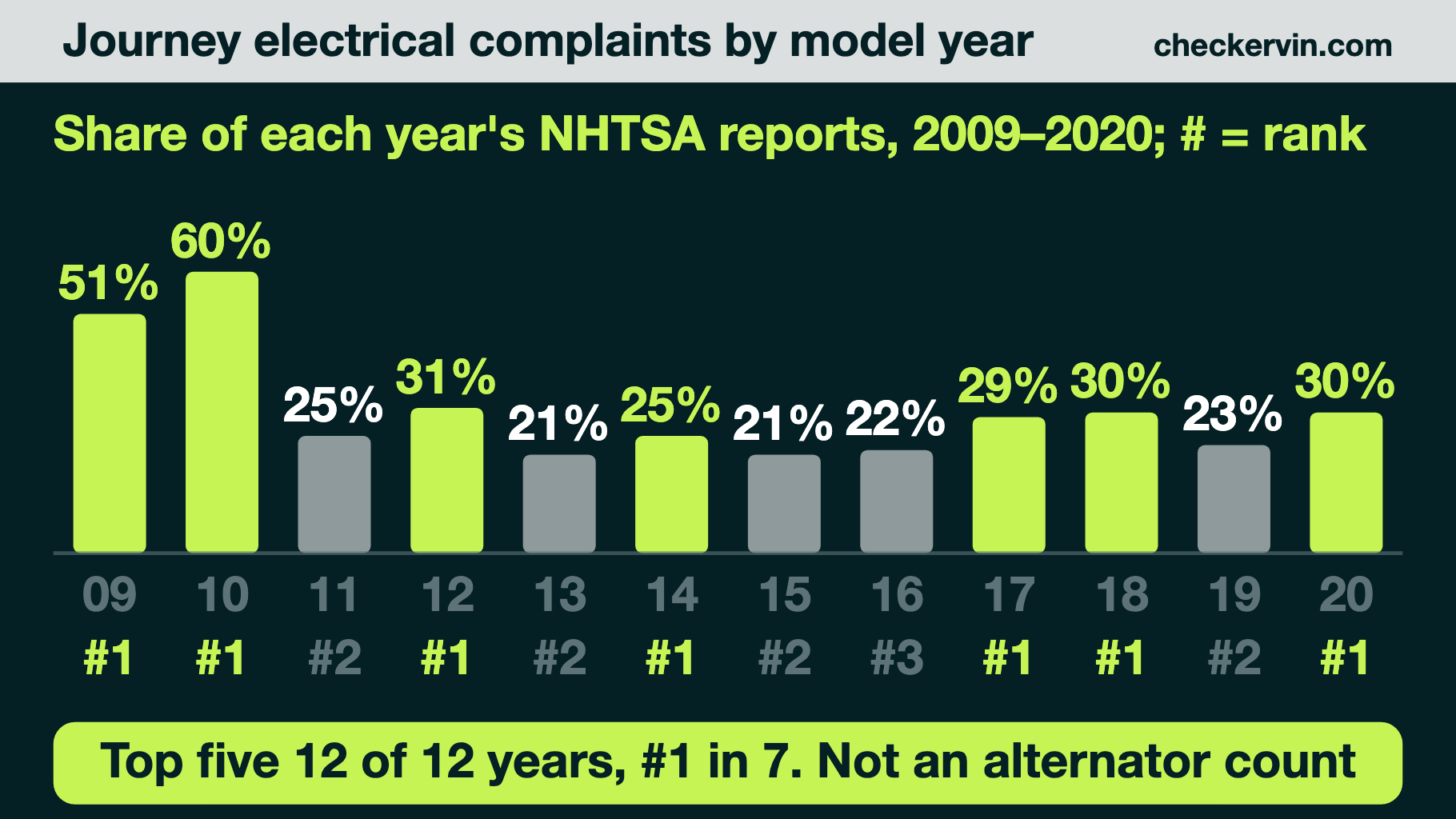
Our corpus of federal NHTSA complaints holds 5,543 reports against the 2009–2020 Journey. At least 2,182 of them, about 39%, are filed under ELECTRICAL SYSTEM. The category is in the top five every one of the 12 model years, and it ranks first in 2009, 2010, 2012, 2014, 2017, 2018 and 2020. Its lowest showing is #3, in 2016.
The weight is lopsided. The 2009 and 2010 models hold 67% of every Journey electrical complaint on file: 814 and 653 reports, or 51% and 60% of everything owners filed for those years. From 2011 on, the category settles between 21% and 31% of each year’s reports, still first in several years even as the files get smaller. The chart plots that share, so a small late file and a huge early one can be compared on the same scale.
Now the limit. NHTSA has no alternator category. ELECTRICAL SYSTEM is the battery, the wiring, the lights, the switches, the fuse and relay boxes and the modules that run them. A tall bar says owners reported a lot of electrical trouble that year. It does not say how many alternators failed, and as the next sections show, most of what sits inside those bars is something else.
Inside the 2009–2010 peak
Reading the 2009 and 2010 electrical narratives, the most common story is the engine shutting off while driving, followed by complaints about keys and fobs, headlights, the vehicle refusing to start, and, on 2010 models especially, a horn that honks by itself with the car parked. Alternators are mentioned, but in a small minority of those reports.
The shut-off stories have a recall behind them, and it sits inside this category. Campaign 14V373 covers 2009–2010 Journeys built from June 2007 to June 2010: a jolt from the road can move the ignition switch out of the run position and turn the engine off. Until it is fixed, Chrysler told owners to carry only the ignition key on the ring. NHTSA codes that campaign as ELECTRICAL SYSTEM, ignition switch, so the stalling reports it drew are part of the early bars. Dealers replace the switch and fobs free, and an older Journey that shuts off over bumps should be checked for it before anyone tests the charging system.
Three new parts, same no-start
The pattern that matters most for anyone holding an alternator quote runs through the 2009–2014 narratives. An owner describes a Journey that will not start, or starts some days and not others. A battery goes in, then an alternator, then a starter. The problem comes back. Several owners write that the only reliable trick is shifting into Neutral before turning the key; others mention jiggling the battery cables or wiring before it will crank.
A Journey that starts in Neutral but not in Park is not telling you about its alternator. The alternator charges the battery once the engine runs; it plays no part in whether the starter engages. When the lights and radio work and the engine will not turn over, the battery has enough charge to run them, and the fault usually lies in the path between the key and the starter. That is exactly where Stellantis sends its own technicians.
What Stellantis tells technicians about a Journey that won’t crank
Two STAR Online cases, Stellantis’s searchable record of past repairs, are filed by NHTSA against the Journey and describe the no-crank complaints above. Neither replaces an alternator.
| Case and years NHTSA links | What it tells the technician |
|---|---|
| S1121000006 Rev. A (2020), 2009–2017 | If the starter clicks, jumper battery negative to the block. If it then cranks, check engine and PCM grounds, check the transmission range sensor plug, add a heavy ground to the bell housing. If not, replace the range sensor |
| S2008000027 (2020), 2013–2018 | No crank with ignition run/start codes: inspect two circuits from the power distribution center C3 connector for spread or pushed-out terminals. No parts required |
The first case explains the Neutral trick. The transmission range sensor tells the computer the shifter is in Park or Neutral, and the starter is only allowed to engage when it does; a corroded plug or a worn sensor can lose that signal. The case’s own fix list runs grounds first, then the sensor, and recommends an 8-gauge or heavier extra ground from the battery to the transmission. The second case ends with a line worth repeating to any shop: no parts required.
STAR cases do not authorize warranty work and they do not claim to diagnose every Journey. They do give you a sequence to ask about. Our post on the Grand Cherokee starter walks through a similar lesson on a related Chrysler platform.
When it really is the alternator
Alternator failures do appear in the Journey file, and they read differently. Owners of 2012 and 2013 models describe the battery light coming on while driving, then accessories cutting out one by one, then the engine stalling on the road; a shop then finds the alternator. That sequence, a warning while the engine runs followed by a slow electrical fade, is the signature of a charging failure. A dead start the next morning with no warning the day before is not.
The right test is a charging-system check with the engine running and a battery test on a charged battery, with the printout handed to you. Some later Journeys may carry an Intelligent Battery Sensor on the negative battery cable; we could not confirm which ones. NHTSA files a Stellantis STAR case about that sensor, S1408000384, against the 2014–2020 Journey, and it says that for most sensors returned under warranty, engineers found nothing wrong, that a replacement is not needed on a vehicle without sensor trouble codes, and that the sensor does not have to be replaced with a new battery. If a quote bundles a battery sensor with an alternator, ask which code justified it.
Where the alternator sits, by engine
The Journey was sold with three engines, and the job is not the same on each. A Dodge VIN decode confirms which one a vehicle has before you compare quotes.
| Engine | What we could verify about alternator access |
|---|---|
| 2.4L four (all years) | No published removal procedure found; not verified |
| 3.5L V6 (2009–2010) | No published removal procedure found; not verified |
| 3.6L V6 (2011–2020) | Reached through the right front wheel well, with coolant drained and the upper radiator hose removed, per a procedure for a 2013 Journey reproduced by 2CarPros |
The 3.6L procedure explains why that engine’s quotes can run higher than a quick belt job would suggest: raise the vehicle, drain the cooling system, pull the right front wheel and inner splash shield, release the belt, then remove a coolant supply line, the upper radiator hose and a harness retainer before the two upper and one lower mounting bolts. Coolant comes out and has to go back in. The 3.6L Pentastar has a reputation, from some Chrysler minivans, for needing the intake manifold removed to reach the alternator. The Journey procedure we found does not include that step, and we found no Stellantis document either way, so treat it as unconfirmed for the Journey. If a 3.6L quote includes intake removal, ask why.
Battery drains that look like charging faults
A battery that is flat every few mornings sends many owners shopping for an alternator. The later Journey narratives point to other suspects: wiring in the liftgate harness that cracks from years of opening and closing, taking the rear wiper and lights with it, and door-jamb wiring that wears through. A short that keeps a circuit awake can drain a good battery overnight while the alternator charges perfectly well once the engine runs.
Stellantis has one drain case for the newer models. STAR case S1708000118, filed against the 2017–2020 Journey, says vehicles with its charging USB hubs can keep powering a device for up to 60 minutes after the ignition is off, drawing roughly 36 milliamps, and that this is normal. It tells technicians to unplug anything in the USB ports before testing for a drain and not to replace the ports for drain complaints. A phone cable left plugged in is a cheaper explanation than an alternator. When a battery does need replacing, a battery size lookup by VIN gives the right group size.
Electrical recalls, and none on the alternator
We queried NHTSA’s recall database for every Journey model year from 2009 through 2020. The counts matched our corpus; the 2014 model, for example, returned the same 7 campaigns our data records. No campaign names the alternator or the charging system. Several are coded as electrical, though, and two can leave a Journey stalled or dead in a way that looks like a charging failure.
Recall 18V524 covers some 2018 Journeys whose powertrain control module may have a voltage regulator chip on its circuit board that can fail, causing a stall or a no-start; dealers replace the module. That regulator is inside the engine computer, not the alternator, and the remedy is free. Recall 14V373, the ignition switch campaign above, covers 2009–2010models. The other electrical campaigns are narrower. Three cover 2009 models only: an engine harness that could rub the transaxle mount on 3.5L models, a corroding unused 115-volt outlet connector, and door harness wires feeding the side airbag sensors. A fourth is a 2014–2018 cruise control software flash. The recall check by VIN shows which of these are still open on a specific vehicle, and our guide to TSBs versus recalls explains what a dealer must fix for free.
Is it worth fixing on a Journey?
Dodge stopped building the Journey after the 2020 model year, so every one on the road is now several years old, and many are worth far less than they were new. That makes an alternator a proportion question, but an easier one than most: the published prices run from $413 to $762, and a Journey with a dead charging system is not drivable for long. If the alternator is confirmed bad and nothing larger is pending, replacing it is usually the sensible call.
The money is lost on the other path, where a battery, an alternator and a starter go in one after another and the no-start stays. Before adding a second large repair to an old Journey, look up what it is worth with a car value check by VIN and weigh the whole list. If you are shopping for a used Journey instead, the Journey years-to-avoid breakdown covers the rest of the record, and a pre-purchase inspection that includes a charging and starting test costs less than any repair here.
Before you authorize the repair
- Confirm the engine by VIN: 2.4L, 3.5L V6 or 3.6L V6
- Ask for printed battery and charging-system test results
- If it starts in Neutral but not Park, ask about the range sensor and grounds
- If the starter clicks, ask whether a jumper to the engine block makes it crank
- Unplug everything from the USB ports before a drain test
- Run an open-recall check for 14V373 on 2009–2010 and 18V524 on 2018
- On a 3.6L, question intake removal on the quote
The second item does the most work. A shop that has tested the charging system can show you the numbers; one that is guessing cannot. The third and fourth come straight from Stellantis’s own case, and they cost minutes, not hundreds of dollars.
Where this information comes from
- Stellantis STAR case S1121000006 Rev. A (NHTSA copy) — no start, no crankFiled against 2009–2017 Journey: grounds, range sensor, redundant ground, in that order.
- Stellantis STAR case S2008000027 (NHTSA copy) — vehicle does not start, no crankFiled against 2013–2018 Journey: power distribution center wiring, no parts required.
- Stellantis STAR case S1708000118 Rev. B (NHTSA copy) — battery drain, USB portsFiled against 2017–2020 Journey: about 36 mA for up to 60 minutes is normal.
- Stellantis STAR case S1408000384 Rev. D (NHTSA copy) — Intelligent Battery SensorFiled against 2014–2020 Journey: most returned sensors had no fault.
- NHTSA — recalls by VINOfficial lookup for 14V373, 18V524 and every other Journey campaign.
- RepairPal — 2016 Dodge Journey repair costsThe $659–$762 alternator range, retrieved November 22, 2026.
- YourMechanic — Dodge Journey alternator replacementThe $413 average and parts and labor split, retrieved November 22, 2026.
- AutoNation Mobile Service — Journey alternator replacementThe $704 average, retrieved November 22, 2026.
- 2CarPros — 2013 Journey 3.6L alternator replacementThe wheel-well removal procedure summarized above; not a Stellantis document.
Keep reading
Frequently asked questions
How much does it cost to replace the alternator on a Dodge Journey?
RepairPal's 2016 Dodge Journey page lists $659 to $762. YourMechanic puts the average Journey alternator job at $413, with $259 of parts and $154 of labor, and AutoNation Mobile Service lists an average of $704. All three were retrieved on November 22, 2026. Kelley Blue Book's general alternator guide gives $747 to $842, but that is a national figure across all vehicles, not a Journey price. Engine, location and parts choice move the number, so get a local quote that names the engine.
Where is the alternator on a 2017 Dodge Journey?
A 2017 Journey has either the 2.4L four-cylinder or the 3.6L V6, so check the engine by VIN first. For the 3.6L, the removal procedure reproduced by 2CarPros for a 2013 Journey reaches it from the passenger-side wheel well: raise the vehicle, drain the cooling system, remove the right front wheel and inner splash shield, take off the belt, then remove a coolant line and the upper radiator hose before unbolting the alternator. We found no Stellantis document confirming the same steps for 2017, and no published procedure for the 2.4L.
How common is it to replace an alternator on a Journey?
There is no federal count of alternator failures. NHTSA files them under ELECTRICAL SYSTEM, which on the Journey totals at least 2,182 complaints across 2009–2020 and also covers the battery, wiring, lights, switches and modules. When we read the Journey's electrical complaint narratives, alternators come up in a small minority. Far more owners describe stalling, no-starts, lights and horns, and many say they replaced the alternator without fixing the problem.
How do I know it is the alternator and not something else?
A failing alternator usually shows up while driving: a battery warning light, dimming lights, then accessories and the engine shutting down. A Journey that clicks but will not crank, or starts only in Neutral, points elsewhere. Stellantis's STAR case S1121000006 tells technicians to check engine grounds and the transmission range sensor in that situation, and another case, S2008000027, traces a no-crank to wiring at the power distribution center with no parts needed. Ask for a charging-system test with printed results before paying for an alternator.
Is it worth replacing the alternator on an older Dodge Journey?
Usually, if the alternator is confirmed bad and the rest of the vehicle is sound. At the published $413 to $762, it is a mid-sized repair, and a Journey cannot run long without a working charging system. The risk is paying for it when the fault is a ground, connector or sensor. Check what the Journey is worth, confirm the diagnosis with test results, and decide on the whole list of pending repairs rather than the alternator alone.
Confirm the engine and open recalls first
A free CheckerVIN report shows the factory build, engine, specifications and open recalls for any VIN, so you know which Journey you are pricing and whether a free recall repair comes first.
Run a free VIN check