The short answer
- What does it cost?
- RepairPal lists $775–$1,113 on average for a Grand Cherokee starter, about 65% of it labor.
- Is it really the starter?
- On a 2011–2013, maybe not. A recalled fuel pump relay in the TIPM causes cranks-but-won't-start no-starts.
- What should I check first?
- An open recall on the VIN, a battery test, and whether the engine cranks. A starter that spins the engine is not the problem.
$775–$1,113
RepairPal Grand Cherokee starter average
Retrieved Oct. 2026, before tax
65%
Share of that range that is labor
From RepairPal's own split
4,143
Electrical reports counted
2008–2022, federal record
48%
Of them in the 2011–2013 TIPM years
Three recalled model years
The numbers, and whose numbers they are
We sell no repairs and publish no price of our own, so the dollar figures here belong to someone else, with the date we read them. RepairPal’s Grand Cherokee starter estimator lists an average of $775 to $1,113, made of roughly $501 to $735 in labor and $273 to $378 in parts. We read it in October 2026 through its search listing, because RepairPal refuses direct requests from our tools, and two separate searches returned the same figures. The range excludes tax and does not adjust for your area.
The split is the unusual part. On many vehicles a starter bill is mostly the part; on the Grand Cherokee, by RepairPal’s own numbers, about 65% of the range is labor. We could not verify a Stellantis labor time for the job, and the figures circulating on repair forums disagree with each other, so we quote none. Kelley Blue Book surfaced no Grand Cherokee starter estimate. RepairPal’s individual model-year pages also disagreed with its own year table in at least one case, so only the overall range appears here.
A labor-heavy job is an expensive one to get wrong. If the starter comes out and the Jeep still will not start, the hours are spent. On the 2011–2013 Grand Cherokee in particular, the federal record says that happened to owners often enough to be worth a page.
What 4,143 counted electrical complaints say
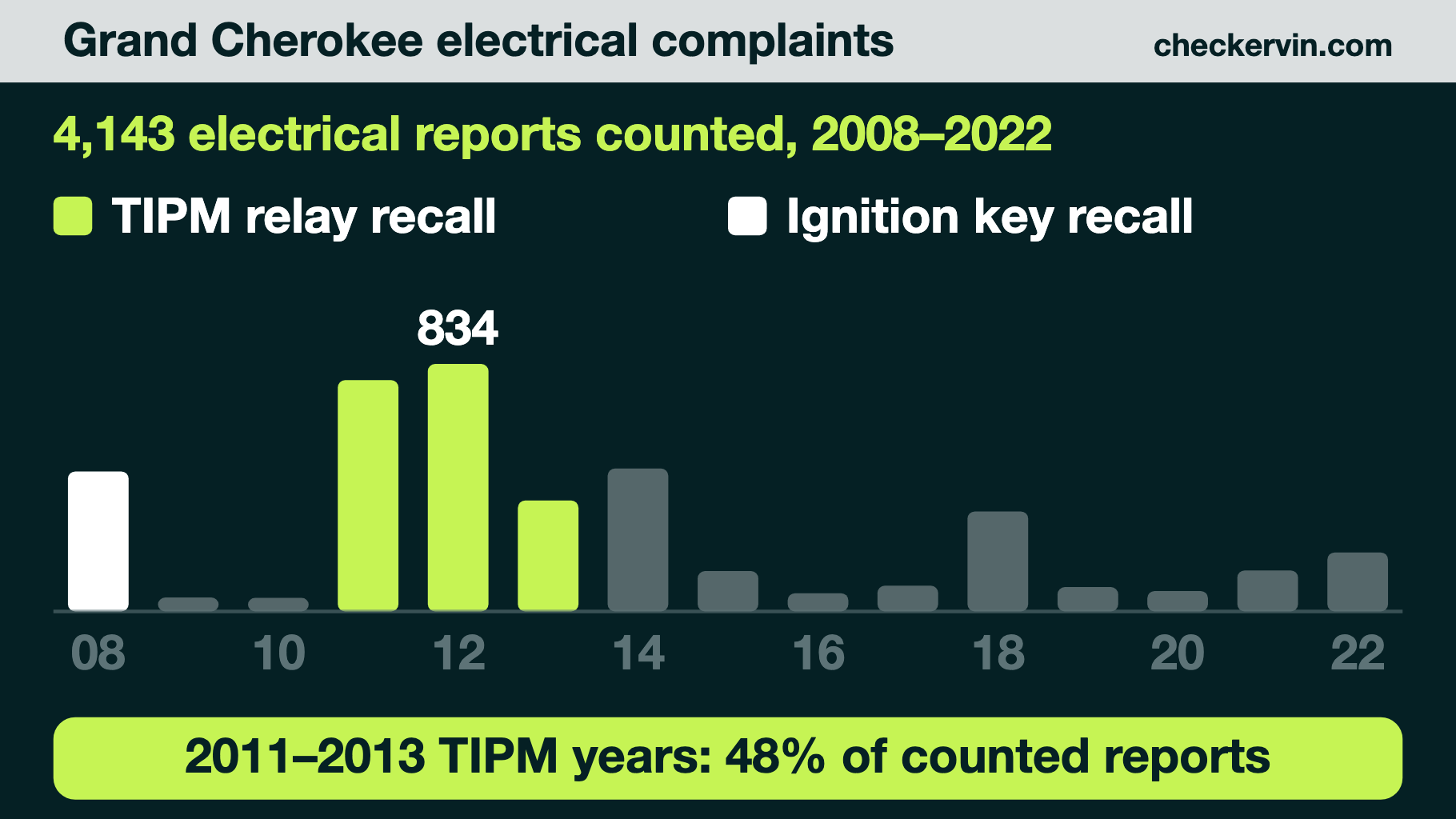
Our corpus of federal NHTSA complaints holds 11,797 reports against the 2008–2022 Grand Cherokee. NHTSA has no starter category. The closest is ELECTRICAL SYSTEM, which takes in the 12-volt battery, wiring, lighting, the body and power modules and whatever else an owner files as electrical; the starter is a small slice of it. The category ranks among the five most-reported components in every model year here, it leads outright in 11 of 15 years, and it adds up to 4,143 reports, about 35% of the total. No other nameplate in our corpus has a larger counted electrical total.
Three model years carry most of it. The 2011, 2012 and 2013 Grand Cherokees hold 1,987 counted electrical reports, 48% of the 2008–2022 total, averaging 662 a year. The 2012 is the peak at 834, about 51% of that year’s complaints. Across the three years, electrical is 49% of everything owners filed. Those are the years built with the TIPM-7 module whose fuel pump relay Chrysler recalled, and reading the 2011 narratives, the TIPM is the part owners name more than any other.
Two other bars stand out. The 2008 model logs 472 electrical reports, 64% of its complaints, and its story is the ignition key, covered below. The 2014 logs 482, ranked first; by 2015 electrical drops to fifth place at 136. The 2018 bump to 337reads mostly as radio and screen faults in the narratives, not starting. NHTSA’s live database matched our snapshot within a few reports for 2008–2018 when we checked in October 2026; for 2021 and 2022 it ran lower than our figures, and we did not establish why. Our pulled figures are used as they are.
The relay that looks like a starter
The Totally Integrated Power Module is the fuse and relay box under the hood, and on these Grand Cherokees it also manages a long list of vehicle functions. One of the relays inside it powers the fuel pump. Chrysler’s defect report for the 2011 models describes what happens when that relay fails: the vehicle “may intermittently or permanently: not start, not start the first time, not stay running upon start, stall, or the fuel pump may stay energized upon vehicle shutdown.”
Read that list as an owner standing in a parking lot. The key turns or the button is pressed, the starter spins the engine at normal speed, and nothing catches. Or it starts, runs a second, and dies. Chrysler’s root cause was physical: a contact spring inside the relay deforming from heat, worse with high battery voltage and a hot under-hood environment. The starter is doing its job the whole time. It is turning an engine that has no fuel.
The federal complaints show where that leads. Owners of 2012 and 2013 Grand Cherokees describe a starter that “keeps cranking” without a start, starters replaced by dealers and independent shops with the problem unchanged, and owners who searched the symptom and found the TIPM before their shop did. Chrysler’s own chronology adds a detail: its investigation began in October 2013 after TIPM-7 parts went on national backorder, which is what happens when a lot of modules are being replaced.
Three recalls for one relay
Chrysler recalled the relay twice and then recalled its own fix. Recall 14V-530, filed in September 2014, covered 2011 Grand Cherokees and Durangos with the 3.6 or 5.7 built from January 2010 to July 2011, about 189,000 vehicles. The remedy left the TIPM in place and installed a more robust fuel pump relay outside it. Recall 15V-115 followed in February 2015 for 2012 and 2013 Grand Cherokees with the 3.6, 5.7 or 6.4 built through August 2013, about 340,000 more; its report adds that “a stall event may be preceded by engine starting issues.”
Then the replacement relays started failing. In late 2018 dealers asked for more recall parts because the original campaign parts were failing, and FCA’s testing found silicon on the relay contacts, traced to silicone weather seals. Recall 19V-813, filed in November 2019, covers every vehicle in the two earlier campaigns whether or not it was fixed: about 528,600 in all, 380,748 of them Grand Cherokees. Its warning sign is the one owners mistake for a starter: “extended engine crank time or require multiple start attempts.” The remedy is a new relay and wiring harness.
| Recall | What it covers on the Grand Cherokee |
|---|---|
| 14V-530 (2014), FCA P54 | 2011, 3.6 and 5.7: external fuel pump relay added |
| 15V-115 (2015), FCA R09 | 2012–2013, 3.6, 5.7 and 6.4: same remedy |
| 19V-813 (2019), FCA V62 | 2011–2013 from both campaigns: new relay and harness |
The recall filing also says FCA has a policy of reimbursing owners who paid for a repair that later became the subject of a recall, on proof of payment. If you paid for a no-start repair on one of these VINs, ask FCA what it covers; we do not know whether a starter bought for a relay failure qualifies. The Jeep recall lookup by VIN shows whether 19V-813 is still open on a given vehicle.
The federal petition and the class action
In August 2014 the Center for Auto Safety petitioned NHTSA to investigate TIPM failures across Chrysler trucks, SUVs and vans from 2007 on, alleging stalls, airbag problems, fires and more. NHTSA opened petition DP14-004 that September and denied it in July 2015. Its review found that the 2011–2013 Grand Cherokee and Durango had “significantly higher complaint rates related to fuel pump relay (FPR) failures” than the other vehicles, that the recalls addressed that condition, and that “the most common effect of this defect condition” was a no-start. The broader claims, NHTSA concluded, were not supported.
The lawsuit ran alongside. Velasco v. Chrysler Group LLC, case 2:13-cv-08080, was filed in federal court in the Central District of California in November 2013, and the docket shows it closed in January 2016. Gibbs Law Group, one of the plaintiffs’ firms, describes the settlement for 2011–2013 Grand Cherokees and Durangos: free relay repair, a warranty on that repair to seven years from the original sale or 70,000 miles, and reimbursement for TIPM replacements, diagnosis, rentals and unnecessary repairs such as batteries, fuel pumps, alternators and WIN modules. The firm says the claims deadline has passed. Its list does not name the starter.
Relay, battery or starter: telling them apart
The symptom sorts most cases before anyone picks up a wrench. A single click or rapid clicking with dim lights points to the 12-volt battery or its cables, since the starter draws more current than anything else in the car. A loud click with bright lights and no cranking, or a grinding noise, points toward the starter or its solenoid. An engine that cranks at normal speed and does not start points away from both, toward fuel, spark or the immobilizer.
On a 2011–2013 Grand Cherokee, the cranks-but-won’t-start case is where the relay lives. A technician can check whether the fuel pump is getting power during cranking, and whether the recall relay and harness are present and current. If the 19V-813 work has not been done, there is no reason to pay for anything until it is. Our Grand Cherokee water pump post makes a similar point about the cooling system: Stellantis tells its own dealers to inspect before replacing.
2012–2014: the alternator recalls
A dead battery is the most common reason any car will not start, and on these years Chrysler recalled the part that charges it. Recall 14V-634 replaced 160-amp alternators on 2012–2014 Grand Cherokees with the 3.6 because they could suddenly fail. Recall 17V-435 covered 2012–2014 models with the 3.6 or 5.7 and electro-hydraulic power steering, adding a fire risk, and 17V-741 added more 2014 3.6-liter vehicles. A failed alternator flattens the battery, and the next morning’s symptom is a click that sounds like a starter.
Owners in the federal record describe what happens when a failing alternator is missed: burned smells, a battery light, and in some accounts a battery, starter and engine computer replaced together. One 2012 owner writes that a dealer charged $189 to diagnose a bad starter and quoted $800 to replace it, days after doing the relay and alternator recalls; a second shop found the starter good and the newly installed alternator miswired and not charging. If a 2012–2014 has a fresh battery and still dies, test the charging system before the starter. The battery size lookup by VIN shows which battery the Jeep should carry. The 2013 model logs 374 counted electrical reports, and the 2014 logs 482.
2008: the key, not the starter
The 2008Grand Cherokee is the older WK body, and its electrical bar has a different cause. Recall 14V-567 covered Grand Cherokees built from March 2007 to May 2008: the ignition key can stick between START and ON, and while driving the ignition can slip to ACCESSORY or OFF and shut the engine down. The remedy, a new ignition switch and keys, did not begin until August 2015. A March 2008 Chrysler bulletin filed with NHTSA is summarized as “no engine crank or no engine start due to electronic lockup of the WCM/SKREEM,” the key-recognition module, with the 2008 Grand Cherokee in its product list; NHTSA links no copy of the bulletin itself.
The 2008 narratives read like a catalog of wrong parts. Owners describe starters replaced, sometimes twice, batteries replaced, and a no-start that came back, while the recall part was on backorder. On a 2008 that intermittently will not crank, or shuts off on the road, ask whether 14V-567 was done before anyone quotes a starter.
Keyless start, Stop-Start and the battery sensor
Push-button Grand Cherokees add a failure that looks like a dead starter but is a radio problem. An FCA technician case from April 2021, filed with NHTSA and listing Grand Cherokees from 2011 on, covers intermittent no-starts that need several presses of the button, with an occasional key-not-detected message. Its first instruction is to check for aftermarket parts that interfere with the key’s low-frequency signal, naming LED replacement bulbs and wireless equipment. For the 2015 model, bulletin 08-079-15 reprograms the radio frequency hub module for a key-not-detected message at the start button.
FCA added Engine Stop-Start to the 3.6-liter Grand Cherokee for 2016, in its September 2015 announcement of the upgraded Pentastar. Every automatic restart is a starter event the earlier Jeeps never made. We found no Stellantis document describing a different or heavier-duty starter on these cars, so this page claims none. What Stellantis does document is the intelligent battery sensor on the negative terminal: a technician case updated in January 2025 lists Grand Cherokees from 2014 on and says the sensor needs “1 crank followed by 2-4 hours of quiescent/sleep time” to learn a new battery, and that it should not be replaced on a vehicle with no fault codes. Stop-Start that will not engage after a battery swap is not a starter fault. The 2016–2022 models average 139 counted electrical reports a year.
Which engine, and why labor varies
The Grand Cherokee in these years came with the 3.6-liter Pentastar V6, the 5.7-liter Hemi V8, the 6.4-liter SRT V8 and, from the 2014 model year, the 3.0-liter EcoDiesel V6. Each has its own starter part number, and 4x4 and 2WD layouts differ underneath, which is part of why a per-vehicle quote can sit far from RepairPal’s average. For the diesel, the summary of a Mopar engine document filed with NHTSA locates a crankshaft locking tool on the “lower rear left side of block under starter location,” so that starter sits low on the driver’s side at the back of the block. We did not find a Stellantis document giving the starter location or labor time for the 3.6 or 5.7, and we do not guess at one.
Our Grand Cherokee transmission fluid post covers the eight-speed behind most of these engines. The engine size by VIN lookup or the Jeep VIN decoder confirms which engine and drivetrain you are pricing, which matters for both the part and the hours.
Before you authorize the starter
- Run the VIN for open recalls: 19V-813 on 2011–2013, the alternator campaigns on 2012–2014, 14V-567 on 2008
- Charge and load-test the battery, and test the alternator's output
- Note whether the engine cranks at normal speed; if it does, the starter is working
- On a 2011–2013, ask whether fuel pump power was checked during cranking
- On a push-button car, remove aftermarket LED bulbs or wireless gear and retest
- Ask whether the quote is new Mopar, remanufactured or aftermarket, and about the core charge
The first three items cost little and settle most cases. A starter justifies its labor only when it fails a current-draw test, clicks loudly with a fully charged battery and bright lights, or grinds. Write down the pattern before the shop sees the Jeep: hot or cold, after a short trip, after sitting, key or button. Owners in the federal record who replaced batteries, starters and modules in turn were often describing a pattern nobody recorded.
A recall is not the same as a service bulletin, and the difference between a bulletin and a recall decides who pays. The relay and alternator campaigns are recalls, free on any VIN where they are open. The technician cases for keyless start and the battery sensor are guidance for dealers, not repairs FCA pays for.
If you are buying the Grand Cherokee, not repairing it
A recent starter receipt on a 2011–2013 is not proof the no-start is fixed. Ask for the 19V-813 completion, which is the relay and harness, and check the VIN for anything still open. A car with an open safety recall can be bought; our guide to buying a car with an open recall explains how. The Jeep Grand Cherokee years-to-avoid breakdown scores each year’s whole complaint record, beyond the electrical system.
What CheckerVIN’s free report gives you is the factory build, engine, specifications and open recalls. It does not include accident, title or odometer history, and it cannot tell you whether a relay is about to fail. Only the recall record and a test drive with a few cold starts do that.
Where this information comes from
- NHTSA — Chrysler Part 573 report, recall 14V-530 (2011 fuel pump relay)Chrysler's own list of no-start symptoms and the heat-deformed relay spring behind them.
- NHTSA — Chrysler Part 573 report, recall 15V-115 (2012–2013 expansion)Extends the relay recall to 2012–2013 and warns that starting issues may precede a stall.
- NHTSA — FCA Part 573 report, recall 19V-813 (replacement relays)Why the recall fix failed, the long-crank warning sign, and FCA's reimbursement policy.
- NHTSA — defect petition DP14-004, TIPM failureThe federal review that found no-starts the most common effect of the relay defect.
- NHTSA copy — FCA STAR case S2008000113, keyless no-startAftermarket LED bulbs and wireless gear interfering with push-button starting.
- NHTSA copy — FCA STAR case S1408000384, intelligent battery sensorThe battery relearn procedure that affects Stop-Start after a battery swap.
- NHTSA — recalls by VINThe official lookup for 19V-813, the alternator campaigns and 14V-567.
- Gibbs Law Group — Chrysler TIPM lawsuit (Velasco v. Chrysler)The plaintiffs' firm's account of the settlement terms; read October 2026.
- RepairPal — Jeep Grand Cherokee starter replacement estimatorThe $775–$1,113 average and labor split quoted above, retrieved October 2026.
Keep reading
Frequently asked questions
How much does it cost to replace the starter on a Jeep Grand Cherokee?
RepairPal's Grand Cherokee starter estimator lists an average of $775 to $1,113, with labor at about $501 to $735 and parts at about $273 to $378, read in October 2026. Labor is roughly 65% of that range, so the shop's time costs more than the part. The figures exclude tax and do not adjust for your area or engine.
Can a bad TIPM make a Grand Cherokee act like it has a bad starter?
Yes, on 2011 to 2013 models. Chrysler's own recall reports say the fuel pump relay inside the TIPM-7 can leave the vehicle unable to start, unable to start the first time, or unable to stay running. The engine cranks normally because the starter works; it never fires because the fuel pump gets no power. Owners in the federal complaint record describe starters replaced with no cure.
Is there a recall on the Jeep Grand Cherokee fuel pump relay?
Yes. Recall 14V-530 covered 2011 Grand Cherokees with the 3.6 or 5.7, and 15V-115 extended it to 2012 and 2013 models with the 3.6, 5.7 or 6.4. Both added a relay outside the TIPM. When those replacement relays failed too, recall 19V-813 replaced the relay and harness again on every vehicle from the first two campaigns, remedied or not. Check the VIN for an open campaign before paying for any no-start diagnosis.
Was there a class action over the Grand Cherokee TIPM?
Yes. Velasco v. Chrysler Group LLC, filed in federal court in Los Angeles in November 2013, covered 2011 to 2013 Grand Cherokees and Durangos. The plaintiffs' firm reports a settlement with free relay repair, a 7-year or 70,000-mile warranty on that repair, and reimbursement for unnecessary no-start repairs. The court docket closed in January 2016, and the firm says the claims deadline has passed.
Does Engine Stop-Start wear out the Grand Cherokee starter faster?
We could not verify that. FCA added Engine Stop-Start to the 3.6-liter Grand Cherokee for the 2016 model year, and each automatic restart uses the starter, but we found no Stellantis document describing a different or heavier-duty starter on these cars. What Stellantis does document is the battery sensor: after a battery swap it needs a crank and two to four hours of sleep to relearn charge, and Stop-Start may not work until it does.
Check the VIN before the starter
A free CheckerVIN report shows the factory build, engine and open recalls for any VIN, so you know whether the relay recall is still open before you pay for a starter.
Run a free VIN check