The short answer
- What does it cost?
- RepairPal lists $973–$1,310 for a 2008 Charger. KBB showed $735–$829 for a 2013 in one Ohio ZIP. Neither splits the figure by engine.
- Which Charger costs the most?
- A 2008–2010 car with the 2.7L V6, whose pump sits behind the timing chain cover. Decode the VIN before you accept a quote.
- Is it really the pump?
- Rule out the 2008 radiator fan campaign, SRT radiator weeps, the Hellcat's second pump and mixed coolant first.
$973–$1,310
RepairPal, 2008 Charger
Estimates dated Nov. 1, 2023
555
Engine reports counted
2008–2022, federal record
32%
Of them on 2008–2010 cars
The 2.7 and 3.5 V6 years
#2
Engine's best rank in any year
Never the top complaint
The prices, and whose prices they are
We sell VIN checks, not repairs, so every dollar figure here belongs to someone else and carries the date we read it. RepairPal’s 2008 Charger page puts water pump replacement at $973 to $1,310, and says its estimates were last updated November 1, 2023. Kelley Blue Book’s 2013 Charger page, served for ZIP 43085 in central Ohio, showed a fair repair range of $735 to $829, and its 2014 and 2015 pages showed the same range for that ZIP. For a 2016 Charger with the 3.6-liter V6, YourMechanic lists an estimate of $716.70 and a shop and dealer range of $825.58 to $1,136.00, while KBB’s 2016 page, served for ZIP 17201 in Pennsylvania, showed $615 to $1,017. All of those were retrieved in November 2026.
Load a KBB Charger page without a ZIP and it shows no local price, only an FAQ line saying owners can expect $375 to $787. That line appears word for word across model years and models, so it is a generic water pump range, not a Charger number. The useful pattern in the Charger-specific figures is the gap between the 2008 estimate and the later ones. None of the sources says which engine it priced, and the Charger was sold with seven different engines over this period. The rest of this page is about why that one fact moves the bill more than the shop does.
What 555 engine complaints say about the Charger
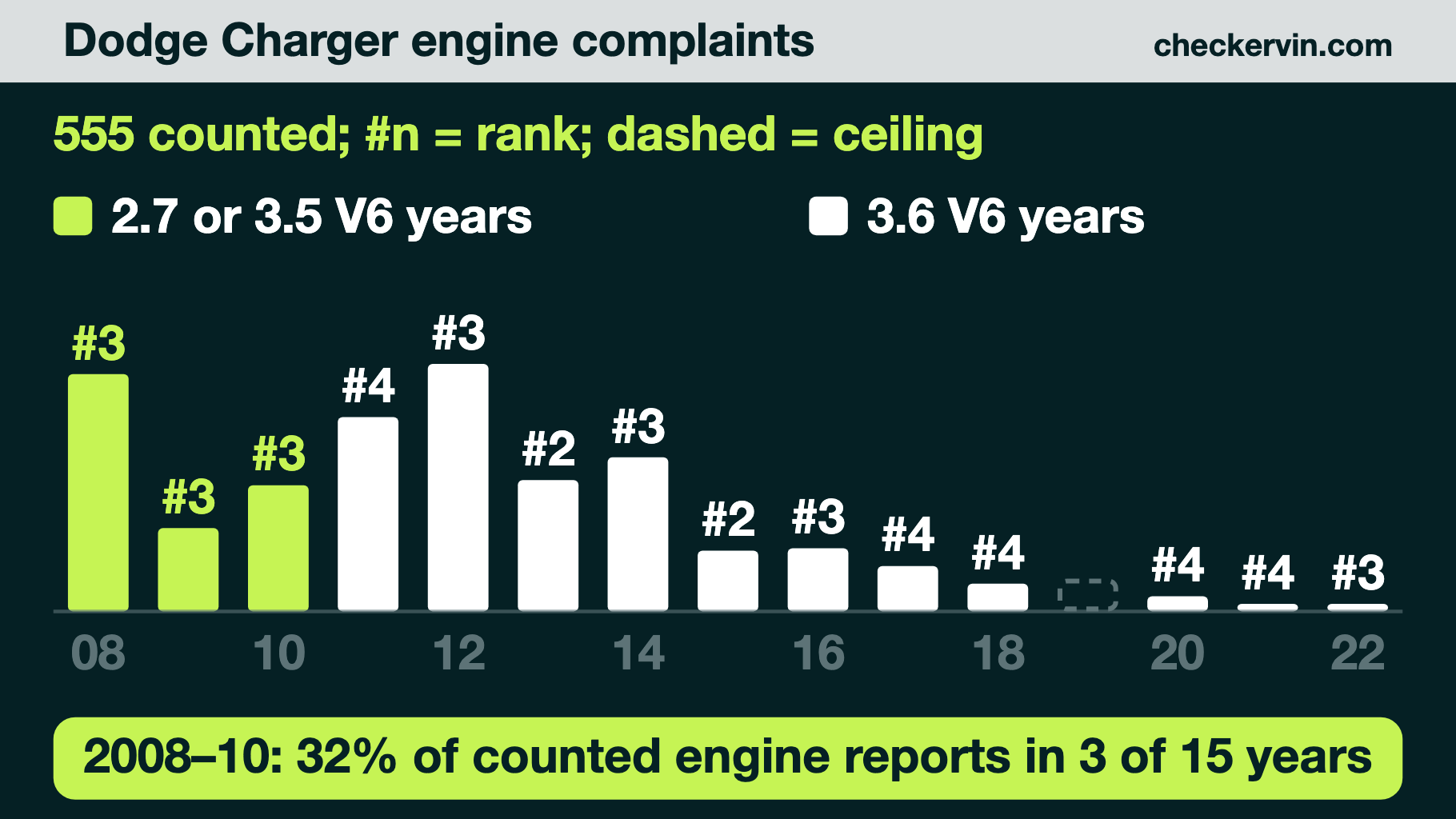
Our corpus of federal NHTSA complaints holds 3,907 reports against the 2008–2022 Charger, police and SRT cars included, because NHTSA files those under separate names and our data pools them. ENGINE reaches the top five complaint categories in 14 of those 15 model years, and we count 555 reports across them, about 14% of the file. That is a floor, not a total, since our data keeps only each year’s top five.
What stands out is the rank, not the size. ENGINE is never the Charger’s first complaint. Its best showing is #2, in 2013 and 2015. 4 categories take first place across the run, and ELECTRICAL SYSTEM leads outright in 8 of the 15 years, with 2009 and 2022 a tie at the top on a small base. The biggest single year is 2012, at 98 engine reports. The 2008–2010 cars, the years sold with the 2.7 and 3.5-liter V6s, carry 177 of the counted reports, 32% of them in three model years. They average about 59 a year against about 32 for the 2011–2022 cars, counting 2019 as zero, though sales volume and car age differ, so read that as where trouble was filed, not as a failure rate.
The limit, stated plainly: NHTSA has no water pump category. ENGINE covers every fault on every engine Dodge sold that year, V8s included. A separate heading, ENGINE AND ENGINE COOLING, reaches the top five only once, in 2010, with 16 reports. In 2019ENGINE itself falls below fifth place, so the chart draws a dashed outline at that year’s fifth-place count of 12. That outline is a ceiling, and it stands taller than the real 2018 bar of 11, which is why we label it rather than let it read as a value. Reading the owner narratives behind these numbers, the pump itself is named rarely. Stalling, ticking lifters and, on 2008 cars, broken radiator fans come up far more often.
Which engine, which pump job
The first question for any quote is which engine the car left the factory with. On the VIN patterns we ran through NHTSA’s own decoder, the eighth character tells you. A Dodge VIN decode settles it in a few seconds.
| Engine (VIN 8th character, on the patterns we decoded) | What we can say about the pump job |
|---|---|
| 2.7L V6, 2008–2010 (R in 2008, D in 2009–2010) | Behind the timing chain cover, driven by the chain, per republished manuals for the same engine family; the big job |
| 3.5L V6, 2008–2010 (G in 2008, V in 2009–2010) | Turned by the timing belt, per republished manuals for earlier Chrysler cars with this engine; no Charger document found |
| 3.6L Pentastar V6, 2011 on (G) | Front of the engine; accessory belt drive inferred from Stellantis documents for the same engine in other models |
| 5.7L, 6.1L and 6.4L Hemi V8s (H or T; W; J) | No Stellantis document found that states the drive; we quote no labor figure |
| 6.2L supercharged Hellcat (9) | A main engine pump plus a separate electric pump for the supercharger's charge air cooler |
The 3.6 row deserves one sentence of caution. Our Grand Cherokee water pump post walks through the Stellantis evidence that the Pentastar’s pump rides on the serpentine belt. That evidence comes from Pacifica documents, and a Stellantis notice telling dealers to inspect before replacing a 3.6 pump is filed by NHTSA against the Grand Cherokee, Durango and other 2016-and-later models, but not against the Charger. The Charger’s own coolant-leak inspection case, S2307000002, is on file for 2016–2022 cars and lists the water pump as one of many places to check.
The 2.7 V6: the pump you cannot see
The 2.7-liter V6 was the base engine in the 2008–2010 cars our record covers; NHTSA’s decoder returns it for all three years. It is the engine where a water pump quote can look wildly out of line and still be honest. Service-manual pages for the Dodge Intrepid and Chrysler Sebring 2.7, republished online, describe the pump as driven by the primary timing chain and bolted to the block behind the chain cover. Getting it out means removing the cover and the chain. Parts sellers advise replacing the chain, guides and tensioner at the same time, since they are already in hand.
The location also changes how a failure shows up. A pump behind the cover can leak where nobody sees it. Parts sellers describe a failed 2.7 pump seal sending coolant into the engine oil, which would show up as milky oil at an oil change rather than a puddle in the driveway. Owners of 2.7 Chargers in the federal file describe oil sludge, timing-chain trouble and mechanics who declined to repair the engine at all. A coolant leak inside a high-mileage 2.7 can turn a pump job into an engine decision.
If the car is a 2008–2010 base model, ask the shop to confirm the engine from the VIN, then ask whether the quote includes the timing chain parts and the labor to open the front cover. A low quote on a 2.7 that does not mention the chain cover is the one to question.
2008: when the fan, not the pump, empties the radiator
The 2008 Charger has the most engine complaints of the three early years, 94 counted, and its owner narratives tell a story that has nothing to do with the pump. Again and again, owners describe a bang under the hood, coolant on the ground and an electric radiator fan that came apart and punched holes in the radiator. Some report it in a drive-through or at a stoplight; some say the engine overheated before they could stop.
Chrysler wrote to owners about it. Customer Satisfaction Notification L08 covers some 2006 through 2008 Dodge Charger, Dodge Magnum and Chrysler 300 cars equipped with the severe duty engine cooling option. The letter says the electric radiator cooling fans “may separate during fan operation and cause damage to the radiator.” Dealers replace both fans free, a job the letter puts at about half an hour, and owners who already paid for the repair were invited to send receipts for reimbursement.
Two lessons follow. On an early Charger that suddenly dumps its coolant, look at the fans and the radiator core before anyone prices a pump. And check whether the VIN was covered: several owners in the federal file say the same failure happened on cars outside the campaign, including one 2009 police-package car. A recall check by VIN shows open safety recalls; L08 was a satisfaction campaign, so ask a dealer to look it up too.
SRT and Hellcat cars: radiators, oil coolers and a second pump
The high-output Chargers have their own coolant paperwork. Stellantis bulletin 07-005-15 Rev. B, dated August 11, 2015, covers 2015 Chargers with the 6.4-liter or 6.2-liter engine built between August 15, 2014 and March 7, 2015. The complaint is a slight coolant weep at the upper radiator hose connection or from the radiator itself. The fix is a torque-limiting hose clamp, booked at 0.6 hours, or on the 6.4 a new radiator plus the clamp, at 2.6 hours. Coolant on the radiator end of that hose is a radiator story, not a pump story.
The Hellcat engine adds a second pump that many owners never hear about. Bulletin 07-003-22, dated April 5, 2022, covers 2021 Chargers with the 6.2-liter supercharged engines built between September 16, 2020 and October 27, 2021. A check-engine light with codes P0EA7 or P026E, or a low coolant message when the auxiliary reservoir is not actually low, can mean the electric charge air cooler pump has failed. That pump is booked at 1.8 hours on the Charger. A Hellcat owner quoted for a “water pump” should ask which one.
Not every fluid under a Hellcat is coolant, either. Recall 17V496 covers 2017 Chargers and Challengers with the Hellcat engine whose engine oil cooler hoses could fail and dump oil quickly; dealers replace the lines free. Recall 15V114 covered a 2015 6.2-liter fuel rail crossover hose. Both sit under NHTSA’s engine and cooling heading, and neither involves the water pump.
The 2013 coolant change, and what mixing does
A detail that rarely makes it into a quote: the Charger changed coolant chemistry partway through its run. Stellantis bulletin 07-004-12 Rev. A, dated November 3, 2012, says 2013 models, the Charger among them, moved to an organic additive technology coolant, purple in the bottle, with a service interval of 10 years or 150,000 miles. The 2000–2012 coolant is a different chemistry, pink or orange.
The bulletin is blunt about mixing them. Coolants of different technologies “are not compatible nor interchangeable,” it says, and mixing can bring accelerated corrosion, debris in the coolant, overheating and leaks. A mixed system has to be flushed. That matters at a pump job because the system is drained and refilled, and a shop topping up a 2011 car with the newer coolant, or the reverse, creates the kind of corrosion that shortens the next pump’s life. The coolant type lookup by VIN lists what the factory specified for a given car.
Ex-police Chargers
Some used Chargers started life as police cars, and the federal record for the Charger includes them. NHTSA files those cars as Charger Police and Charger Pursuit, and our data pools them with the civilian car, so every count on this page includes them. On the VIN patterns we decoded, police Chargers came with both the 3.6 V6 and the 5.7 Hemi.
Police duty means long idling and hard running in heat, and Stellantis has written about what that does to the car’s other fluids. Bulletin 19-003-12, dated December 8, 2012, covers 2011–2012 Chargers with the police package in fleet use. During extended closed-course training above 100°F, the power steering could overheat, and the fix is an external power steering cooler, booked at 1.3 hours. That is a steering-fluid problem, not coolant, but a wet front end on an ex-police car can be either.
On a former police car, ask for the fleet’s service records if the selling agency kept them, and look for a pump or radiator already replaced. A pre-purchase inspection with a cooling-system pressure test costs far less than an overheated engine.
What the recall record covers, and what it doesn't
We queried NHTSA’s recall database for every Charger model year from 2008 through 2022, under the police, pursuit and SRT names as well as the plain one. The counts matched our corpus: the 2011 model, for example, returned the same 12 campaigns our data records. No campaign names the water pump, the thermostat, the radiator or the coolant hoses.
The engine-related recalls on file are not cooling faults. Recall 11V487 covered certain 2012 Chargers with the 3.6 built between August 31 and September 13, 2011, whose connecting rod bearings could fail from debris; the remedy was a free engine. The Hellcat campaigns are described above. Below the recall level, Chrysler ran a 2011 service campaign, L10, for 2011 Chargers, 300s and Challengers whose coolant reservoir hose could leak; NHTSA’s summary is all that is on file, so we cannot add the build dates. On a 2011 car losing coolant, that hose is a cheap first look. Our guide to bulletins versus recalls explains why a bulletin does not pay for a repair the way a recall does.
Before you authorize the repair
- Confirm the engine by VIN: 2.7 or 3.5 V6, 3.6 V6, a Hemi V8 or the supercharged 6.2
- On a 2.7, ask whether the quote includes opening the timing chain cover and the chain parts
- On a 2008 car with sudden coolant loss, check the radiator fans and core before the pump
- On a 2015 SRT car, check the upper radiator hose joint and the radiator itself
- On a Hellcat, ask whether the failed part is the engine pump or the charge air cooler pump
- Ask for a pressure test and a photo of the leak, and refill with the coolant the VIN calls for
The first two items save the most money. A 2.7 Charger is the one car in this lineup where a high quote can be correct, and the cheaper quote can be missing the work that matters. On every other engine, a quote well above the RepairPal and KBB ranges deserves a question about what extra parts it includes. The Charger years-to-avoid breakdown covers the rest of the complaint record, where electrical faults lead.
Where this information comes from
- Chrysler Customer Satisfaction Notification L08 (NHTSA copy) — engine cooling fan2006–2008 Charger with the severe duty cooling option: fans may separate and damage the radiator; both replaced free.
- Stellantis TSB 07-005-15 Rev. B (NHTSA copy) — upper radiator hose or radiator weep2015 Charger 6.4L and 6.2L built Aug. 2014–Mar. 2015; clamp 0.6 hr, radiator 2.6 hr on the 6.4.
- Stellantis TSB 07-003-22 (NHTSA copy) — charge air cooler pump2021 Charger 6.2L supercharged: the second, electric pump; codes P0EA7 and P026E; 1.8 hr.
- Stellantis TSB 07-004-12 Rev. A (NHTSA copy) — OAT coolant release2013 Charger moves to purple OAT coolant; mixing coolant types can cause corrosion, overheating and leaks.
- Stellantis TSB 19-003-12 (NHTSA copy) — police power steering overheat2011–2012 police-package Chargers: external power steering cooler for heat during training.
- NHTSA — recalls by VINThe official lookup, including 11V487, 15V114 and 17V496 discussed above.
- NHTSA vPIC VIN decoderThe source of the engine-by-VIN-character patterns in the table above.
- RepairPal — 2008 Dodge Charger water pump replacementThe $973–$1,310 figure quoted above, estimates dated November 1, 2023; retrieved November 2026.
- Kelley Blue Book — 2013 Charger water pump replacementThe ZIP 43085 range quoted above and the generic no-ZIP FAQ range; retrieved November 2026.
- YourMechanic — Dodge Charger water pump replacementThe 2016 3.6L estimate and shop and dealer range quoted above; retrieved November 2026.
Keep reading
Frequently asked questions
How much does it cost to replace a water pump on a Dodge Charger?
RepairPal puts a 2008 Charger at $973 to $1,310, on estimates its page says were last updated November 1, 2023. Kelley Blue Book showed $735 to $829 for a 2013 Charger at ZIP 43085 in central Ohio. Those figures were retrieved in November 2026 and neither is broken out by engine, which matters most on 2008 to 2010 cars with the 2.7-liter V6, where the pump sits behind the timing chain cover.
How much does a water pump cost for a 2016 Dodge Charger?
YourMechanic lists a 2016 Charger with the 3.6-liter V6 at an estimate of $716.70, and gives a shop and dealer range of $825.58 to $1,136.00. Kelley Blue Book's 2016 Charger page showed a fair repair range of $615 to $1,017 for ZIP 17201 in Pennsylvania. Both were retrieved in November 2026. A V8 car or a Hellcat is a different job, so confirm the engine by VIN before comparing quotes.
How much does it cost to change a water pump on a car in general?
Kelley Blue Book's water pump pages, loaded without a ZIP code, show a generic line saying owners can expect $375 to $787 including parts and labor. The same text appears on every model year's page, so treat it as a broad national range, not a Charger figure. Labor drives the difference: a pump on the accessory belt is a few hours of work, while one driven by a timing chain inside the engine takes far longer.
Is the Dodge Charger 2.7 water pump inside the engine?
Service-manual pages for earlier Chrysler 2.7-liter V6 cars, republished online, describe the pump as driven by the primary timing chain and bolted to the block behind the chain cover, so replacing it means opening the front of the engine. We found no Stellantis document stating this for the Charger itself, so treat it as strong evidence from the same engine family rather than a Charger quotation. The 2.7 was sold in 2008 to 2010 Chargers.
Is there a recall on the Dodge Charger water pump?
Not that we could find. We queried NHTSA's recall database for every Charger model year from 2008 through 2022, police and SRT versions included, and no campaign names the water pump, thermostat, radiator or coolant hoses. Chrysler did run a customer satisfaction campaign, L08, that replaced the radiator fans free on some 2006 to 2008 Chargers with the severe duty cooling option, because a separating fan could damage the radiator.
Confirm the engine before you price the repair
A free CheckerVIN report shows the factory build, engine, specifications and open recalls for any VIN, so you know which pump job, campaign or recall applies.
Run a free VIN check