The short answer
- What does it cost?
- YourMechanic averages about $304; its 3.6-liter quotes run $488.41 (2011) to $760.59 (2017).
- Is it really the starter?
- Often not. Recalled alternators on 2011–2014 cars and a recalled ignition switch on the 2008 cause no-starts first.
- What to do first?
- Run the VIN for open recalls, then test the battery, charging output and grounds before any starter goes in.
$304
YourMechanic Charger starter average
Retrieved Nov. 2026
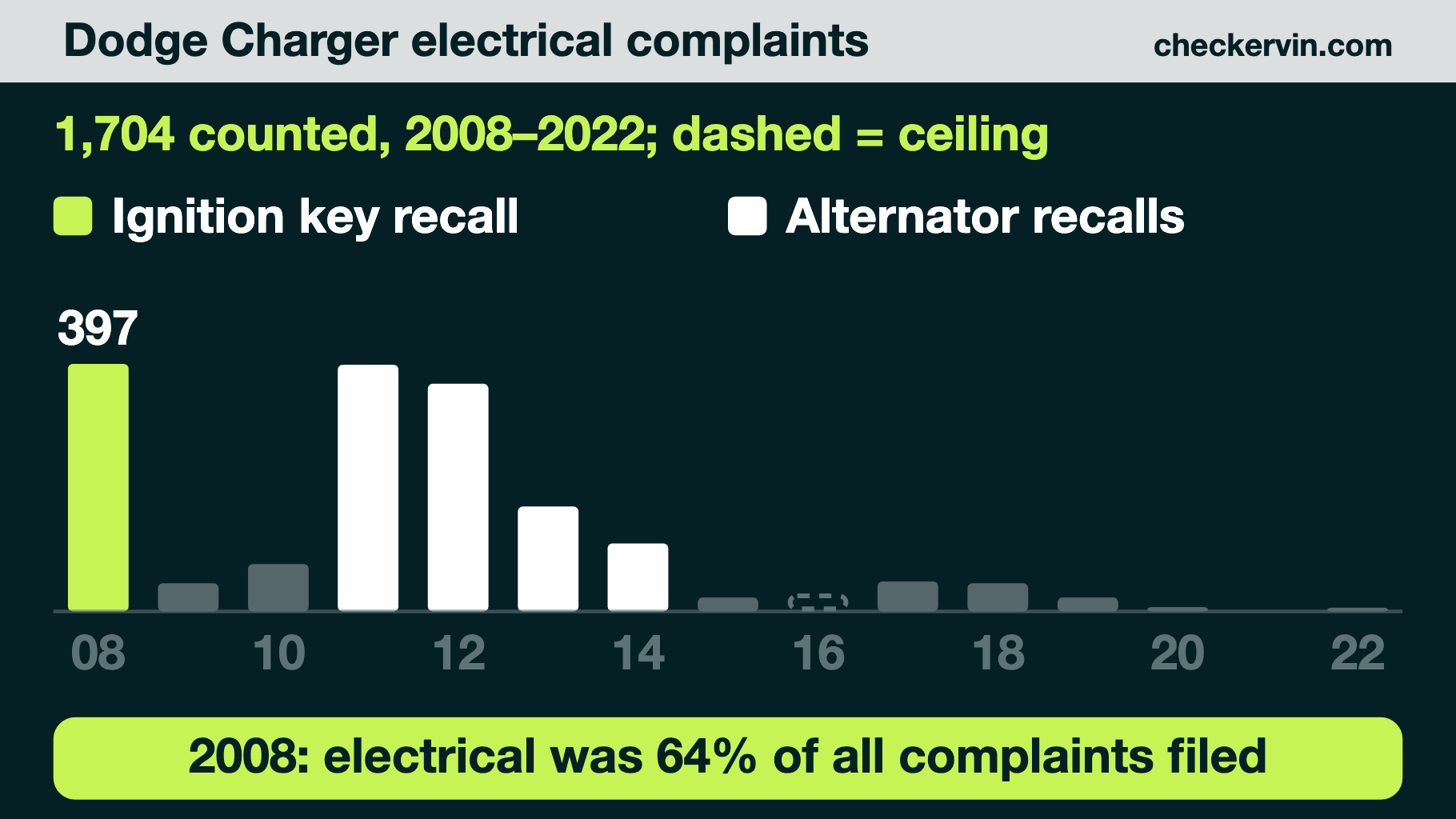
1,704
Electrical reports counted
2008–2022, federal record
64%
Of 2008 complaints were electrical
The ignition key recall year
4
Alternator recalls on 2011–2014 cars
Including one for police cars
The prices, and whose prices they are
We sell no repairs and set no prices, so every dollar figure here is someone else’s, dated. YourMechanic’s Dodge Charger starter page gives an average of about $304, split into roughly $164 for the part and $140 for labor. The same page also prices specific cars, and those run well above the average: $488.41 for a 2011 Charger with the 3.6-liter V6, with a shop and dealer range of $572.41 to $819.80, and $760.59 for a 2017 with the same engine, with a range of $912.63 to $1,364.17.
The gap between the headline average and the per-car quotes is the useful part. The average blends every year and engine; the specific quotes show that a Charger starter priced for a particular car, at a shop or dealer, can cost three or four times the headline figure. YourMechanic refused direct requests from our tools, so we read these numbers through search listings in November 2026, and two separate searches returned the same ones. RepairPal surfaced a starter figure only on its page for the 2026 Charger, an entirely different car, so we quote none of it.
We also looked for a factory labor time. Stellantis publishes service bulletins through NHTSA, and in fifteen model years of Charger bulletins we found none whose summary names the starter. So there is no manufacturer number to hold a quote against, and the rest of this post is about making sure the starter is the right part before you pay for it.
What 1,704 counted electrical complaints say
Our corpus of federal NHTSA complaints holds 3,907 reports against the 2008–2022Charger, pooling the police and Pursuit versions NHTSA files separately. There is no starter category. The nearest is ELECTRICAL SYSTEM, which covers the battery, alternator, wiring, lighting, modules and anything else an owner calls electrical, so the starter is a small slice of it. The category ranks among each year’s five most-reported components in 13 of 15 years and leads outright in 2008, 2010, 2011, 2012, 2013, 2014, 2017 and 2018, with a tie for first in 2009 and 2022 on only 175 complaints in all. Those 13 years add up to 1,704 counted reports, about 44% of all complaints.
The weight sits in two places. The 2008 is the peak at 397 electrical reports, 64% of everything owners filed against that year. The 2011–2014 cars add 1,038 more, about 61% of the counted electrical total, and on the 2011 electrical is 57% of all complaints. For contrast, the 2009, the next model year and outside the 2008-only ignition recall, has 45 electrical reports.
From 2015 the numbers collapse. The highest later year is the 2017, at 48 electrical reports, and in 2016 and 2021 the category falls below fifth place, so all we can say about 2016is that it sat under that year’s fifth-place count of 25. The 2018 still ranks electrical first at 45, but reading those narratives, owners mostly describe radio and Uconnect screen faults. In 2019, 2020 and 2021 air bag complaints lead the list instead.
Why the Jeep and Ram no-start story does not apply
If you have read about Chrysler no-starts, you have probably met the TIPM, a fuse-and-relay module whose built-in fuel pump relay failed on 2011–2013 Grand Cherokees and Durangos and drew three recalls. Our Grand Cherokee starter post covers that story. It is easy to assume the Charger shares it. The federal record says otherwise.
When NHTSA reviewed TIPM failures in 2015 under petition DP14-004, its list of TIPM-7 vehicles covered minivans, the Wrangler, Ram trucks, the Grand Cherokee and Durango, the Liberty, the Nitro and the Journey. The Charger is not on it. The same document notes that the 2008 Chrysler 300 “is not equipped with a TIPM body control module” and that the 2013 Challenger has no TIPM either; both share the Charger’s rear-drive platform. So on a Charger, a cranks-but-won’t-fire no-start does not come with a famous relay to blame, and a mechanic who reaches for the Jeep explanation is guessing. The Charger’s no-start record is about two other parts: the ignition switch on the 2008 and the alternator on 2011–2014 cars.
2008: the key that sticks
Recall 14V-567 covers 2008 Chargers built from May 24, 2007 to May 12, 2008, alongside the 300, Magnum, Commander and Grand Cherokee. The recall summary says the key fob “may not return to the ‘ON’ position after being rotated to the ‘START’ position,” sticking between the two. While driving, the ignition can then slip to accessory or off and shut the engine down. The fix is a new ignition switch and new key fobs, free, and the campaign did not begin until August 2015.
That gap explains the 2008spike. Reading the year’s electrical narratives, the ignition and key dominate: keys that stick, a delay of many seconds before anything happens when the key turns, cars that stall in traffic, and owners told the recall part was unavailable for months. A few owners describe paying for a starter or an “ignition module” along the way. If a 2008 Charger does nothing when the key turns, or starts only after the key is wiggled or cycled, the switch and key come before the starter, and the recall may still be open on that VIN.
2011–2014: four alternator recalls
The redesigned 2011 Charger brought a new problem. Chrysler recalled its alternators three times on civilian cars and once on police cars:
- 14V-634: 2011–2014 Chargers with the 3.6-liter V6 and 160-amp alternator; the alternator “may suddenly fail” and the car may stall; replaced free from February 2015
- 17V-435: 2011–2014 Chargers with electro-hydraulic power steering and the 3.6 or 5.7, 160, 180 or 220 amps; stall and possible short circuit with fire risk; inspected and replaced by part number from February 2018
- 17V-741: 2014 Chargers with the 3.6 and 160-amp alternator; replaced from December 2018
- 16V-739: 2011–2014 Charger Police cars with the 220-amp alternator; stall and fire risk; replaced from December 2016
The complaint narratives for these years read like a manual on alternator failure. Owners describe a battery light or a “battery saver mode” message, then a burning smell or a whine, then a car that dies on the highway or will not crank at all the next morning. Starters come up rarely, and usually in the same sentence as the alternator. The 2011 and 2012 also carry 114 complaints flagged as fires across all components, the most of any Charger years here, which fits a recall that names a short circuit and fire risk, although the fire flag does not say which part burned.
Here is how a starter gets bought for it. A failing alternator stops charging, the battery drains, and the car is left with a click or nothing at all, which sounds exactly like a dead starter. A new battery and starter bring it back to life for a few days, then the alternator drains the new battery too. Every one of these campaigns is a free repair if it is still open on the car.
Alternator, battery or starter on a Charger
Listen before anyone opens the hood. A starter fault shows up as a single click, a rapid chatter, a grind, or silence while the dash lights stay bright. A flat battery shows up as a slow, labored crank and lights that dim when you turn the key. An alternator fault shows up while driving first: a battery warning or the battery saver message, flickering or dimming lights, accessories shutting off, and only later a car that will not crank.
A shop can separate the three in a few minutes. Load-test the battery, measure charging voltage with the engine running, and measure voltage at the starter during a crank. A battery that tests good after a full charge but is flat again in a day points at charging or a parasitic drain, not the starter. On a 2011–2014 Charger, ask the shop to look up the alternator part number against the recalls before buying anything. Our battery size by VIN lookup confirms the battery the car should carry, which is worth knowing before a load test is judged.
Ground cables, a cam sensor and a PCM
Three smaller documents describe slow or failed starts that a new starter would not fix. In November 2009 Chrysler ran customer satisfaction campaign J-21 on the 2009 Charger, 300 and Challenger; NHTSA’s summary says the battery ground cables “may cause slow engine cranking during hot engine starting conditions.” A slow crank on a hot engine is a classic symptom people blame on a tired starter.
Bulletin 18-054-14, from October 2014, covers 2014 Chargers with the 3.6 built between February 3 and July 18, 2014 that show an intermittent extended crank of one to five seconds with no fault codes. The cure is a camshaft position sensor, replaced when its serial number starts with a D. A long crank is the starter doing its job while the engine waits for a signal it needs to fire.
Recall 18V-524 covers some 2018 Chargers among a long list of FCA models. Its summary says the powertrain control module may carry a voltage regulator chip that can fail, “causing a stall or a no start condition,” and dealers replace the module free. It is a narrow campaign, so most 2018 cars are not in it, which is exactly why a VIN lookup is worth the seconds it takes.
What Stellantis tells dealers about no-crank Chargers
Dealer technical notes for the Charger point to connectors and keys more often than starters. For 2020 and 2021 Chargers that sometimes will not crank and show a burst of network communication codes, a 2021 technician case traced the fault to one inline connector behind the passenger side of the dash that was not fully seated; reseating it cleared the no-crank. For push-button Chargers from 2011 on that need several presses to start or flash Key Not Detected, a 2021 case tells technicians to rule out interference from LED replacement bulbs, garage LED lighting and installed wireless equipment before replacing parts.
One more note matters if the car has had fuel work. Bulletin 08-152-23, issued in June 2023 and covering 2011–2016 Chargers, warns that a technician may see a crank and no start after replacing the fuel pump module, because the revised pump moves the electrical pins and needs a new connector pigtail. If a Charger stopped starting right after a fuel pump job, the starter is almost certainly not the reason.
Which engine, which starter
These model years span a lot of engines. The 2008–2010 cars offered the 2.7 and 3.5-liter V6s, the 5.7-liter Hemi and the 6.1-liter SRT8. From 2011 the V6 is the 3.6-liter Pentastar, the 5.7 carries on, the 6.4-liter arrives in the SRT models, and from 2015 the supercharged 6.2-liter Hellcat joins the range. All-wheel drive was offered on both V6 and V8 cars. Each combination can take a different starter and a different amount of labor, so a quote given without the engine is a guess. Our engine size by VIN lookup or the Dodge VIN decoder tells you which one you have before a part is ordered.
We did not find a Stellantis document that shows where the starter sits on any Charger engine or how long it takes to change, and we do not guess. Ask the shop how it reaches the starter on your car, and whether all-wheel drive adds time, before you agree to a number. The spread between YourMechanic’s average and its per-car quotes suggests the answer matters.
Before you authorize the starter
- Run the VIN for open recalls: 14V-567 on a 2008, the alternator campaigns on 2011–2014, 18V-524 on a 2018
- Load-test the battery and check charging voltage with the engine running
- Check the battery cables and engine grounds, especially for a slow crank when hot
- Note whether the engine cranks at normal speed; if it does, the starter works
- On push-button cars with a key message, ask about aftermarket LED bulbs and wireless gear
- Ask whether the quote is for a new Mopar, remanufactured or aftermarket starter
The first three items cost little and settle most cases. Write down the pattern before the shop sees the car: hot or cold, after sitting or after a drive, one click or a full crank, any warning on the dash. A starter has earned the bill when it fails a voltage drop or current draw test, clicks with a charged battery and bright lights, or grinds. The difference between a bulletin and a recall decides who pays: the recalls above are free at a dealer, while the bulletins and technician cases are guidance, and a car outside warranty pays for that work.
If you are buying the car, not repairing it
On a 2011–2014 Charger, a receipt for a new starter is not proof that the starting problem is solved. Ask whether the alternator recall work was done and look for the battery warning on a test drive. On a 2008, turn the key to start more than once and make sure it springs back cleanly. A car with an open recall can still be a sound purchase; our guide to buying a car with an open recall explains how to handle it.
What CheckerVIN’s free report gives you is the factory build, engine, specifications and open recalls. It does not include accident, title or odometer history, and it cannot tell you whether an alternator is about to fail. The recall record, a load test and a couple of cold starts do that.
Where this information comes from
- NHTSA — recalls by VINThe official lookup for 14V-567, 14V-634, 17V-435, 17V-741, 16V-739 and 18V-524 on a specific car.
- NHTSA — DP14-004 petition denial, TIPM failures (July 2015)Lists the TIPM-7 vehicles, which do not include the Charger, and states that the 300 and Challenger siblings have no TIPM.
- NHTSA copy — Chrysler bulletin 18-054-14, intermittent extended crankThe 2014 3.6-liter camshaft position sensor fix for a long crank with no codes.
- NHTSA copy — FCA bulletin 08-152-23, fuel pump connector replacementWhy a 2011–2016 Charger can crank and not start after a fuel pump replacement.
- NHTSA copy — FCA STAR case S2108000001, intermittent no crankAn unseated connector behind the dash causing no-crank on 2020–2021 cars.
- NHTSA copy — FCA STAR case S2008000113, keyless no-startLED bulbs and wireless equipment interfering with the key signal on push-button cars.
- YourMechanic — Dodge Charger starter replacement estimateThe $304 average and the 2011 and 2017 3.6-liter quotes above, retrieved November 2026.
Keep reading
Frequently asked questions
How much does it cost to replace the starter on a Dodge Charger?
YourMechanic lists an average of about $304 for a Dodge Charger starter replacement, roughly $164 in parts and $140 in labor, read in November 2026. Its own per-year quotes for the 3.6-liter V6 run higher: $488.41 for a 2011 and $760.59 for a 2017, with shop and dealer ranges up to $1,364.17. Engine, drivetrain and ZIP code move the price.
Is replacing a starter a big job?
On most cars it is a short job, and YourMechanic's Charger average assumes about $140 of labor. We found no Stellantis document on NHTSA that gives a Charger starter labor time or location for any engine, so we do not quote one. The bigger risk is replacing a starter that was never the problem, which on a 2008 or a 2011–2014 Charger is common.
How long does a replacement starter last?
There is no federal measure of starter life, and NHTSA's complaint data has no starter category, so any mileage figure you see is an estimate. A starter is worn by the number of starts, not miles, and it fails sooner when it is fed low voltage by a weak battery, a failing alternator or a corroded ground. On a Charger, fixing those first is the best way to make a new starter last.
Why won't my Dodge Charger start but the lights come on?
Bright lights with no crank point at the starter, its wiring, or the key and ignition system rather than the battery. On a 2008, a key that sticks or will not register is covered by recall 14V-567. On push-button Chargers, a Key Not Detected message can come from interference by LED bulbs or wireless gear, which Stellantis has told dealers to rule out. If the engine cranks normally but never fires, the starter is fine.
Which Dodge Charger years have starting problems?
In the federal record, electrical complaints peak on the 2008 and on the 2011 and 2012 cars. The 2008 stories are about an ignition key that sticks, which Chrysler recalled. The 2011–2014 stories are mostly alternators that fail suddenly, under four recalls, which leaves a dead battery that looks like a bad starter. Electrical complaints fall sharply from 2015 on.
Check the VIN before the starter
A free CheckerVIN report shows the factory build, engine and open recalls for any VIN, so you order the right starter and know whether an alternator or ignition recall is still open.
Run a free VIN check