The short answer
- What does it cost?
- YourMechanic averages about $294 for a Ram 1500 starter; AutoNation Mobile Service averages $415.
- Is it really the starter?
- If the engine cranks normally, no. On 2011–2012 trucks, a fuel pump relay in the TIPM causes cranks-but-won't-start no-starts.
- What about eTorque trucks?
- They keep a normal starter for key starts. The motor generator handles stop-start restarts and fails differently.
$294
YourMechanic Ram 1500 starter average
Retrieved Nov. 2026
0.5 hr
FCA time to inspect and replace
Bulletin 08-100-20, 2020 5.7L
2,267
Electrical reports counted
2011–2022, federal record
31%
Of 2011 complaints were electrical
The first TIPM-7 year here
The prices, and whose prices they are
We sell no repairs and publish no price of our own, so every dollar figure here belongs to someone else, with the date we read it. YourMechanic’s Ram 1500 starter page lists an average of about $294, made of roughly $154 in parts and $140 in labor. AutoNation Mobile Service lists an average of $415for a Ram 1500 starter motor replacement. Both sites refused direct requests from our tools, so we read their figures through search listings in November 2026; two separate searches returned the same YourMechanic numbers. Neither average is tied to a model year, engine or ZIP code, and mobile-mechanic prices usually sit below a dealer’s.
RepairPal, which many readers check first, surfaced no Ram 1500 starter estimate at all, only the 1500 Classic and older Ram models, so we quote none of it. The one number that comes from the manufacturer is a labor time. When FCA had dealers swap a batch of wrong starters on 2020 Hemi trucks under bulletin 08-100-20, it allowed 0.5 hours to inspect and replace the starter. That is a warranty allowance for one engine, not a retail quote, but it tells you the job on a 5.7-liter is short.
Cheap and quick is the good news. The bad news is that a low price makes the starter an easy first guess, and the federal record for this truck is full of owners who bought one, sometimes with a battery and a fuel pump, and still could not start the engine.
What 2,267 counted electrical complaints say
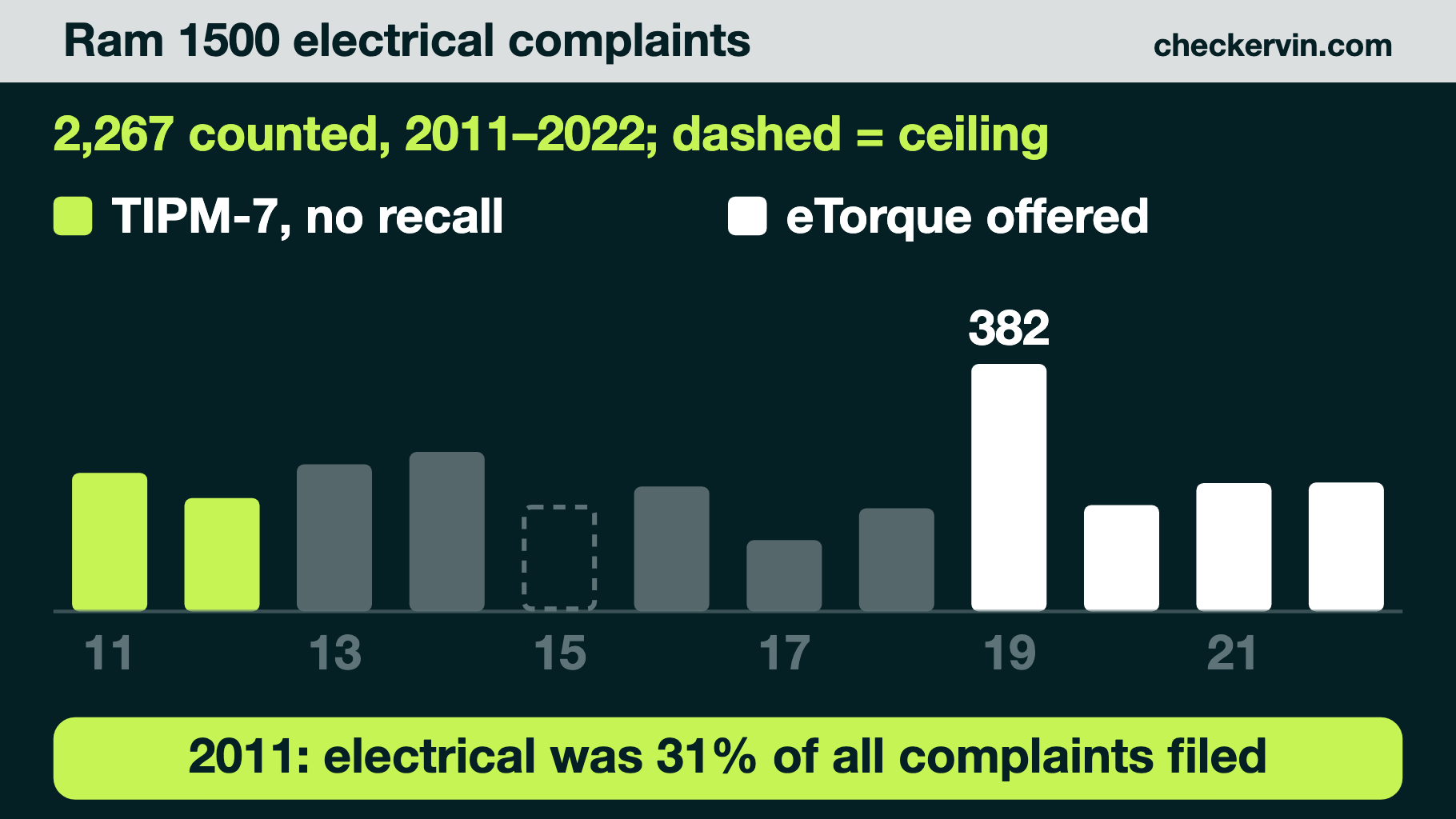
Our corpus of federal NHTSA complaints holds 12,457 reports against the 2011–2022Ram 1500. NHTSA has no starter category. The nearest is ELECTRICAL SYSTEM, which takes in the 12-volt battery, wiring, lighting, the fuse and power modules and anything else an owner files as electrical; the starter is a small slice of it. The category ranks among each year’s five most-reported components in 11 of 12 years and leads outright in 2011, 2012, 2018, 2019 and 2020. Those 11 years add up to 2,267 counted reports, about 18% of the total.
The 2011 and 2012 trucks are where starting dominates. Electrical is 31% of everything owners filed against the 2011, at 214 reports, and 25% of the 2012, at 175, ranking first both years. From 2013 to 2017 steering complaints lead instead and electrical slips down the list; in 2015 it falls below fifth place, so all we can say is that it sat under that year's fifth-place count of 161. The chart draws that year as a dashed outline at the ceiling, not as a value.
The 2018 returns electrical to first at 159, but its narratives are mostly radio and screen faults. The 2019, the first year of the redesigned DT truck, is the peak at 382, and reading it, owners write about lights, screens and batteries far more than starting. From 2019 the rows average 236 counted electrical reports a year, against 189 for the earlier years where the category ranked. Our record pools every truck NHTSA files under the Ram 1500 name, so the 2019–2022 rows include the carried-over 1500 Classic, which never offered eTorque.
2011–2012: the relay in the fuse box
The 2011 and 2012 Ram 1500 use a Totally Integrated Power Module, the fuse and relay box under the hood that also runs lighting, wipers, locks and horn. NHTSA’s 2015 review of these modules lists the 2009–2012 Ram 1500 through 5500 among the trucks built with the TIPM-7 version, and it names what sets that version apart: the fuel pump relay is built into it. When that relay sticks open, the pump gets no power. The starter spins the engine at full speed and nothing catches, exactly like an empty tank.
The 2011 and 2012 complaint narratives read like one long thread on that relay. Owners describe trucks that crank but will not fire, most often on cold mornings, then start on the third or fourth try. Some stall while turning across traffic. A second symptom is the opposite failure: a relay stuck closed keeps the fuel pump running after the key is out, and the battery is flat by morning. That one looks like a battery or charging problem, so batteries and alternators get bought for it, and a dead battery after a night of pump run-on looks like a starter that will not turn.
The repair stories are consistent too. Owners report replacing starters, batteries and fuel pumps before anyone tested pump power during cranking. Dealers and independent shops then either sold a new TIPM, which owners describe as expensive and at times on backorder, or wired an external relay that bypasses the one inside the box. The same failure on the Grand Cherokee and Durango drew three recalls, which our Grand Cherokee starter post walks through. The Ram got none.
Why the Ram was never recalled
In August 2014 the Center for Auto Safety petitioned NHTSA to investigate TIPM failures across Chrysler SUVs, trucks and vans from 2007 on. The agency opened review DP14-004, and NHTSA’s product list for it includes the 2010–2012 Ram 1500. The denial, dated July 24, 2015, explains why only the Jeep and Dodge SUVs were recalled. Chrysler and its supplier traced the relay failure to heat and current, and the 2011–2013 Grand Cherokee and Durango had the highest fuel pump current draw of the group. In Chrysler’s durability testing, relays from the other TIPM-7 platforms outlasted relays run in a simulated Grand Cherokee setup.
The complaint table backed that up at the time. Among complaints identified before NHTSA’s October 2014 information request, the agency counted no confirmed fuel pump relay failures on the Ram trucks. Its separate count of stalls possibly tied to the TIPM found a handful of Ram cases against a 2011 Ram population in the hundreds of thousands. NHTSA denied the petition and said the existing recalls adequately covered the defect, adding that the denial does not amount to a finding that no defect exists.
The timing matters for anyone reading the record now. Most of the 2011 Ram complaints that name the relay or the TIPM were filed in 2015 or later, after the window NHTSA’s table covered, as the trucks aged past warranty. The petition outcome tells you there is no free fix to ask a dealer for on a 2011 or 2012 Ram. It does not tell you the relay is reliable.
Relay, battery or starter on a 2011–2012
The three failures sound different if you listen before anyone picks up a wrench. A starter problem shows up as a single click, a rapid chatter, a grind, or silence while the dash lights stay bright. A battery problem shows up as a slow, labored crank and lights that dim when you turn the key. A relay problem shows up as a healthy crank that never turns into a running engine, or as a fuel pump humming under the bed with the truck off.
A shop can separate them in minutes: load-test the battery, check voltage at the starter during a crank, and check for fuel pressure or pump power while cranking. If the pump gets no power and the pump itself tests good, the relay is the suspect. On 2013 and 2014 trucks, a Stellantis parts note from 2020 says a failed internal fuel pump relay in the power distribution center can now be serviced with a separate relay kit instead of a whole new module. We found no equivalent note for the 2011–2012 TIPM, which is why external relay kits are what owners describe.
Owners of key-start 2011–2012 trucks also describe the wireless ignition node failing to read the key in the cold, which produces a no-crank that a starter will not cure either. If the dash shows a key or security message, start there.
2018: a small PCM recall worth one lookup
Recall 18V-524, FCA campaign U87, covers certain 2018 Ram 1500 trucks along with a long list of other 2017–2019 FCA models. Its summary says the powertrain control module may carry a voltage regulator chip that can fail, “causing a stall or a no start condition,” and the fix is a new PCM at no cost. It is a small campaign, under 13,000 vehicles across every model named, so most 2018 trucks are not in it. That is the point of checking: a VIN-specific lookup takes seconds, and on a truck that is in it, the no-start is a free repair.
Beyond that recall, the 2018 electrical complaints are mostly about the radio and screen. Starting is a small share of what owners wrote.
eTorque: two motors that can start the engine
From the 2019 model year the redesigned Ram 1500 offered eTorque, a 48-volt mild hybrid. A belt-driven motor generator replaces the alternator, charges a small lithium-ion pack, and restarts the engine when stop-start shuts it off at a light. Ward’s, in its 2019 test drive, reported FCA’s claim that restart time is half that of a normal starter, and noted that a conventional starter is still on board for the first key-turn start. Consumer Guide’s first drive made the same point from the other side: the motor generator cannot start the engine initially if the 12-volt battery or the starter fails.
FCA’s own paperwork confirms the starter is there. Bulletin 08-100-20, from November 2020, replaces a batch of starters built with the wrong part on 2020 trucks with the 5.7-liter Hemi, naming both the plain engine and the eTorque version. So an eTorque Ram that will not crank on a cold morning is a normal starter-and- battery diagnosis. One that restarts roughly at lights is a different system: for the 2020 3.6-liter eTorque, bulletin 08-028-20 reflashes the hybrid control processor for a bump or shudder during stop-start.
The 2020 complaint narratives carry the costlier eTorque failure. Owners describe the motor generator’s bearing whining or grinding, then a battery light, then a truck that loses charging and stalls, followed by weeks or months waiting on a backordered part. That is a charging failure, not a starter failure. Stellantis has told dealers to avoid unnecessary motor generator replacements for whining noise and a common fault code, to save a scan report first, and to call its engineers before removing the unit. If a shop quotes a starter on an eTorque truck with a battery warning and a dying charge, ask whether the motor generator was tested.
Rear-window leaks and the 48-volt pack
On eTorque trucks the 48-volt battery pack sits behind the rear seat. Recall 19V-142 describes it there when it covered a batch of 2019 trucks whose pack terminals could overheat, and Ward’s describes the power pack mounted inside the rear cab bulkhead. Several 2020 owners blame water from a leaking rear window for dead batteries and failed modules, including the pack’s controller and the keyless start hub.
Stellantis did extend coverage on the leak itself. Bulletin 23-042-24 gives 2019–2021 DT trucks built through September 30, 2020 with a sliding rear window an 8-year or 150,000-mile warranty extension for a cracked or leaking back-glass frame, repaired with urethane. The bulletin is about the seal only; it says nothing about electrical damage, and we found no Stellantis document that pays for modules or batteries a leak may have ruined. A damp carpet behind the seat is still a reason to look there before buying a starter for an intermittent no-start.
What Stellantis tells dealers about no-crank trucks
FCA’s technician notes for the DT truck point at grounds and wiring more often than starters. Bulletin 08-033-20 covers 2020 diesel trucks built from September to December 2019 with an incorrect bolt on the battery-to-engine ground, which causes intermittent no crank or no start; the fix is a shorter bolt. A 2020 technician case for a truck that will not crank with a good battery says to clean and secure the two main grounds. For a no-crank with an auto shutdown relay fault code on 2019–2021 trucks, another case says to inspect one connector for damaged pins before normal diagnosis. And for a no-start with an open starter control circuit code on 2020–2022 trucks, a 2022 case sends technicians to the harness where it can chafe against the engine support bracket near the starter.
Two recalls fit the same theme. On some 2019 trucks, 19V-020 secures a battery ground fastener on the driver’s fender, though its stated risk is lost power steering assist, not starting. On 2014–2015 diesel 4x2 trucks, 15V-517 inspects a battery harness that can rub against an engine mount bracket and short. A starter is the right answer only after the grounds, the harness and the codes say so.
Which engine, and where the starter sits
These model years used the 3.6-liter Pentastar V6, the 4.7-liter V8 on early trucks, the 5.7-liter Hemi V8 and, from 2014, the 3.0-liter EcoDiesel, with eTorque versions of the V6 and Hemi on the DT from 2019. Each takes its own starter, so a price quoted without the engine is a guess. Our engine size by VIN lookup or the Ram VIN decoder settles which one you have before you order a part.
On the 2020 Hemi, FCA’s bulletin has technicians read the starter’s date code by turning the front wheels right and looking between the tire and the frame, with or without a lift, which puts the starter low on the engine where it can be seen from the wheel well. We did not find a Stellantis document locating the starter on the 3.6 or the diesel, and we do not guess at one. One more early-truck note: 2012–2013 trucks with the 4.7-liter V8 had a hard-start and surge complaint traced to the EGR valve, under bulletin 09-010-16 and a six-year, 100,000-mile extension that has long since run out on trucks sold when new. The Ram 1500 engine replacement post covers the bigger engine faults on these trucks.
Before you authorize the starter
- Run the VIN for open recalls, including 18V-524 on a 2018
- Load-test the battery and check the main grounds and cables
- Note whether the engine cranks at normal speed; if it does, the starter works
- On a 2011–2012, ask for fuel pump power to be checked while cranking
- On an eTorque truck with a battery light, ask whether the motor generator was tested
- Ask for any stored codes and whether the quote is a new Mopar, remanufactured or aftermarket starter
The first three items cost little and settle most cases. Write down the pattern before the shop sees the truck: cold or hot, after sitting or after a short drive, one click or a full crank. A starter justifies the bill when it fails a voltage-drop or current-draw test, clicks with a charged battery and bright lights, or grinds. A recall is not the same as a bulletin, and the difference between a bulletin and a recall decides who pays; the technician cases above are guidance for dealers, not free repairs.
If you are buying the truck, not repairing it
On a 2011 or 2012, a receipt for a starter is not evidence the no-start is solved. Ask whether the TIPM was replaced or an external fuel pump relay added, and start the truck cold more than once. On a DT, ask about rear-window leaks and look behind the seat. A truck with an open recall can still be a sound purchase; our guide to buying a car with an open recall explains how to handle it.
What CheckerVIN’s free report gives you is the factory build, engine, specifications and open recalls. It does not include accident, title or odometer history, and it cannot tell you whether a relay or a motor generator is about to fail. Only the recall record, a few cold starts and a shop’s tests do that.
Where this information comes from
- NHTSA — DP14-004 petition denial, TIPM failures (July 2015)Lists the 2009–2012 Ram trucks as TIPM-7 vehicles and explains why only the Jeep and Dodge SUVs were recalled.
- NHTSA copy — FCA bulletin 08-100-20, incorrect starter motorConfirms a conventional starter on 5.7L eTorque trucks, shows how to reach it, and gives FCA's labor time.
- NHTSA copy — FCA bulletin 08-033-20, intermittent no crank no startA wrong ground bolt on 2020 diesel trucks causing no-starts that look like a starter fault.
- NHTSA copy — Stellantis parts note 9004484, motor generator unitTells dealers to avoid unnecessary eTorque motor generator replacements and to call engineering first.
- NHTSA copy — FCA bulletin 23-042-24, back glass water leak extensionThe 8-year, 150,000-mile coverage for the 2019–2021 rear-window leak.
- NHTSA — recalls by VINThe official lookup for 18V-524 and every other Ram 1500 campaign.
- Ward's — 2019 Ram 1500 eTorque test driveFCA's restart claim and the note that a conventional starter remains for key starts.
- YourMechanic — Ram 1500 starter replacement estimateThe $294 average and parts-labor split quoted above, retrieved November 2026.
- AutoNation Mobile Service — Ram 1500 starter motor replacementThe $415 average quoted above, retrieved November 2026.
Keep reading
Frequently asked questions
How much does it cost to replace the starter on a Ram 1500?
YourMechanic lists an average of about $294 for a Ram 1500 starter replacement, roughly $154 in parts and $140 in labor, and AutoNation Mobile Service lists an average of $415, both read in November 2026. Dealer prices with a new Mopar starter run higher, and the engine and model year change the part. We found no Ram 1500 starter estimate on RepairPal.
Where is the starter on a Dodge Ram 1500?
On the 2020 Ram 1500 with the 5.7-liter Hemi, an FCA service bulletin has technicians read the starter's date code by turning the front wheels to the right and looking between the tire and the frame, so it sits low on the engine and can be reached from the wheel-well side. We did not find a Stellantis document that locates the starter on the 3.6-liter V6 or the 3.0-liter diesel, so we do not guess.
What year Ram 1500 should you avoid for starting problems?
For no-starts specifically, the 2011 and 2012 trucks stand out. Electrical complaints lead both years in the federal record, and owners name a fuel pump relay inside the TIPM fuse box that Chrysler recalled on the Grand Cherokee and Durango but never on the Ram. The 2019 has the most electrical complaints overall, but those are mostly lights, screens and batteries.
Does a Ram 1500 with eTorque still have a starter?
Yes. The eTorque motor generator on the 2019 and later Ram 1500 restarts the engine during stop-start, but a conventional starter handles the first key or button start. FCA's own bulletin 08-100-20 replaces the starter motor on 2020 trucks with the 5.7-liter eTorque engine. A failed motor generator causes charging and stalling problems, which is a different repair from the starter.
How can you tell if a truck starter is bad?
A bad starter usually clicks once or does nothing while the dash lights stay bright, or it grinds or whines. If the engine cranks at normal speed but never fires, the starter is working and the problem is fuel, spark or a relay. On a 2011 or 2012 Ram, listen for the fuel pump running with the key off; that points at the relay in the TIPM, not the starter.
Check the VIN before the starter
A free CheckerVIN report shows the factory build, engine and open recalls for any VIN, so you order the right starter and know whether a no-start recall is open.
Run a free VIN check