The short answer
- What does it cost?
- YourMechanic lists a $613 average ($375 parts, $238 labor) and AutoNation Mobile Service a $738 average. Those are their national figures, not ours.
- Which year stands out?
- 2021. Electrical is the single most-reported category for that model year, 24% of its complaints, and its narratives are mostly alternator and charging-system failures at modest mileage.
- Is there a recall?
- No Traverse recall from 2009 to 2022 names the alternator or charging system. GM's 2012 bulletin PI0839 says oil spilled on the alternator can stop it charging.
The estimates, and whose they are
YourMechanic’s Traverse alternator page lists an average of $613, split as $375 for parts and $238 for labor, and notes that prices vary by location. AutoNation Mobile Service lists an average of $738 for the same job. Both sites refuse a direct fetch from our tools, so we read those figures on November 22, 2026 from the text search engines serve for each page; two separate searches returned the same numbers. Neither average is broken out by model year or engine on the text we could see.
We looked for RepairPal’s Traverse alternator estimate and could not read it; a range credited to RepairPal circulates on a third-party blog, and since we could not trace it to a current RepairPal page we leave it out. We sell VIN checks, not repairs, and publish no price of our own. What we can add is what the federal complaint file and GM’s service bulletins say about which Traverses have charging trouble, and which symptoms send owners to an alternator they did not need.
What 751 counted electrical complaints hold
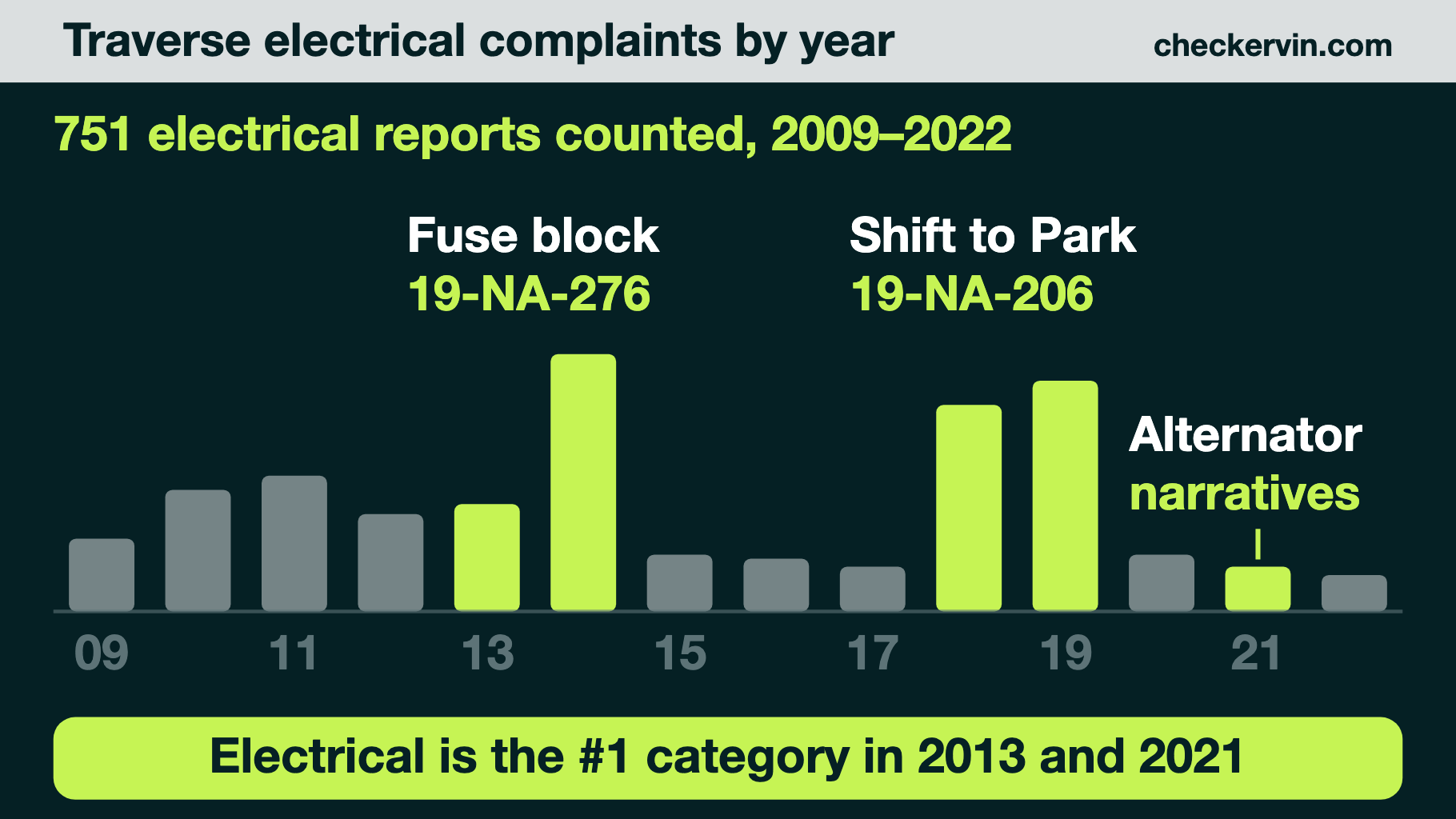
Our corpus of federal NHTSA complaints holds 5,057 owner reports against the 2009–2022 Traverse. For each model year it keeps the five most-reported components. ELECTRICAL SYSTEM makes that list in all 14 years, for 751 counted reports, and it is the single most-reported category in 2013 and 2021. The count is highest for 2014, at 127. Reports keep arriving against every year, so treat each figure as a floor.
The category is wide. It covers the 12-volt battery, wiring and connectors, fuse blocks, lighting, body and control modules, shifter switches and the charging system. A tall bar says owners had electrical trouble that year; it does not say their alternators failed. On the Traverse, the two tallest clusters turn out to be a fuse-block terminal and a shifter switch, and GM has a bulletin for each. The alternator story is in a short bar near the right edge.
GM's bulletin: oil on the generator
The most useful document for a Traverse owner facing a charging warning is a two-paragraph GM preliminary information bulletin from October 2012, PI0839. It covers 2010–2013 Traverses with the 3.6-liter LLT V6, along with the Enclave, Acadia and several other GM models sharing that engine family. The symptom is the one owners describe: a charging light or “Service Battery Charging System” message, with a charging test showing less than the specified 12.6 to 15.0 volts, or no output at all.
GM’s stated cause is engine oil spilled on the generator, which the bulletin places directly below the engine oil fill cap. It names two ways that happens: oil splashed while topping off, and used oil running down when the oil filter is removed at a change. The instruction to technicians is simply to keep any oil off the part. The bulletin does not cover a repair or extend any warranty.
The 2010–2013 model years hold 228 counted electrical reports between them, most of them about other things. We found no GM document saying the later 3.6-liter keeps the alternator in the same position. One 2021owner writes in NHTSA’s file that it does, and asks for a shield; that is an owner’s account, not a GM statement.
2013-2014: the stall that is a fuse block terminal
The 2013–2014 Traverses carry 180 counted electrical complaints, 24% of the whole record. Read the narratives and very few mention the alternator. The repeated story is a dash full of warnings, “Engine Power Reduced,” “Service StabiliTrak” and “Traction Control Off,” then limp mode or a stall, sometimes at highway speed. Several owners quote code P1682, and several describe dimming lights and a voltage gauge dipping, which is why the alternator gets blamed.
GM’s preliminary information PIT5643, from November 2018, names the 2013–2014 Traverse, Enclave and Acadia and traces intermittent reduced power or stalls with codes P0689 and P1682 to loose tension and arcing corrosion on terminal 51 of the X3 connector at the underhood fuse block. GM booked 0.6 hours for a fuse block and terminated lead under that document. Bulletin 19-NA-276, from December 2019, widens the range to 2013–2017 and tells dealers to inspect that terminal and replace the lead if it is damaged or burnt.
GM also recalled the 2014 Traverse twice under ELECTRICAL SYSTEM: campaign 14V614000 replaced a chassis electronic module that could short internally and stall the engine, and 14V223000 reprogrammed engine software that could make the fuel gauge read wrong. Neither is a charging fault, and neither is fixed by an alternator.
2018-2019: the dead battery that is a shifter switch
The redesigned Traverse arrived for 2018, and the 2018–2019 cars hold 216 counted electrical complaints, 29% of the total. The dominant narrative is the “Shift to Park” message: the lever is in Park, the driver presses the button, and the vehicle refuses to shut down, leaving the radio and lights on. Some owners come back to a flat battery, and a few replaced the battery and then the alternator before anyone looked at the shifter.
GM bulletin 19-NA-206 covers it, and NHTSA indexes it against the 2018 and 2019 Traverse. GM puts the cause in the park switch inside the shifter assembly, which fails to pull the body control module’s signal low, and the fix is cleaning the switch contacts, a wiring jumper, and in some cases a new shifter. Owners of 2020–2022 Traverses report the same message in the complaint file; we did not find a version of the bulletin that lists those years, so we do not claim one exists.
2021: where alternator reports take over
The 2021 Traverse has a small complaint file, 92 reports, and electrical is the single most-reported category with 22 of them, 24% of the year. Only 2013 and 2019 have a higher electrical share. What sets 2021apart is what the reports say. More of these narratives describe the alternator itself than in any other Traverse year we read, and the pattern is consistent: a “Service Battery Charging System” or “Battery Saver Active” message, then a stall and heavy steering, usually somewhere between about 23,000 and 60,000 miles.
Owners report dealers and parts stores confirming a failed alternator or voltage regulator, and one describes a second alternator failure after the first replacement. We found no GM bulletin, special coverage or recall on the 2021Traverse’s alternator in NHTSA’s index. With a car this young, the useful step is the warranty: GM’s bumper-to-bumper coverage and its powertrain coverage are separate, so ask the dealer in writing which one the alternator falls under for your car’s in-service date and mileage before paying.
2009-2012 and 2015-2017: other categories dominate
The first-generation cars from 2009 to 2012 add up to 211 counted electrical complaints, but electrical never leads those years. STEERING is the most-reported category in 2009 and 2010, and engine complaints lead the next two years, a record our Traverse timing chain post covers. The few charging narratives from those years describe what PI0839 describes: a voltage gauge sagging below its normal reading, then a charging message.
From 2015 through 2017 the Traverse’s electrical count drops to 76 counted reports across three years, while AIR BAGS is the top category in 2014–2017, years GM later recalled for driver airbag inflators. If you are pricing an alternator for one of these years, the record gives no reason to expect anything beyond a normal wear-out repair.
Which engine, which part
An alternator is matched to its engine. These are the Traverse engines EPA’s fuel-economy listings show by model year.
| Traverse model years | Engines listed by EPA |
|---|---|
| 2009-2017 | 3.6L V6, 6-speed automatic (RPO LLT per GM bulletin PI0839) |
| 2018-2019 | 3.6L V6 (RPO LFY per GM coverage N232395300) or 2.0L turbo four (FWD only), 9-speed automatic |
| 2020-2022 | 3.6L V6, 9-speed automatic |
EPA lists the 2.0-liter turbo only for front-wheel-drive 2018 and 2019 Traverses; every all-wheel-drive car and every 2020–2022 car has the V6. Parts catalogs list alternators by engine, so a parts quote should be tied to the VIN rather than to the model year alone.
We could not verify book labor hours for the Traverse alternator from a named source, so we print none. Ask each shop for the labor time its estimating guide lists for your engine and drive type, and compare quotes on that basis. The engine lookup by VIN tells you which engine you have, and the GM build sheet guide explains how to read the option codes, including the engine code, from the factory record.
Test before you buy the part
Every one of the four Traverse patterns above ends with an owner looking at a charging warning or a dead battery. Two of them end at the alternator; two do not. A written test result is what separates them, and GM’s own bulletin gives the number to test against: 12.6 to 15.0 volts with the engine running.
- A charging-system test with the engine running and loads on, with the voltage written down
- A separate battery load test, so a weak battery is not blamed on the alternator
- On a 2010-2013 car: a look for oil residue on the alternator under the fill cap
- On a 2013-2017 car that stalls with P1682 or P0689: the underhood fuse block terminal 51 inspected first
- On a 2018-or-later car with repeat dead batteries: whether it shows Shift to Park at shutdown
Most parts stores will test the battery and alternator for free. A shop that wants to replace the alternator on a Traverse without a written charging test, or after a test that passed, is guessing with your money.
No charging recall on record, but check the VIN anyway
We queried NHTSA’s recall database for every Traverse model year from 2009 through 2022. No campaign’s summary, consequence or remedy mentions the alternator, generator, charging system or battery. The same pull does return three electrical-coded recalls, the 2009 heated-washer module and the two 2014 campaigns above, so a charging recall would have appeared if one existed.
Bulletins are a different thing from recalls: they tell technicians how to fix a condition, but they do not make the repair free. Our explainer on how a service bulletin differs from a recall covers why it is still worth printing PI0839 or 19-NA-276 and handing it to the shop. Run the Chevrolet recall check before the car goes in, so any open campaign is handled on the same visit at no cost.
If you are buying the Traverse, not repairing it
A recent alternator receipt on a used Traverse proves little on its own. Ask what was tested before it was replaced, and on a 2021, ask whether it was the first alternator or the second. A Chevrolet VIN decode confirms the model year, trim and engine. The battery size lookup helps if the real fault is the battery, and a warranty check by VIN shows whether factory coverage remains on a newer car.
For the wider picture, see which Traverse model years draw the most complaints overall. Cross-shopping GM’s midsize sedan as well? The Malibu alternator post shows how a different GM charging setup produced a very different complaint spike.
Where this information comes from
- NHTSA — Traverse complaint databaseThe federal complaint record this page's figures are computed from, and whose electrical narratives we read for every model year.
- NHTSA-hosted GM bulletin PI0839 — oil spilled on the generatorRead in full: 2010-2013 Traverse with the LLT V6; charging message, 12.6-15.0V spec, generator directly below the oil fill cap.
- NHTSA-hosted GM PIT5643 — reduced power or stall, P0689/P1682Read in full: 2013-2014 Traverse; arcing corrosion on terminal 51 of the underhood fuse block X3 connector; 0.6 h labor.
- NHTSA-hosted GM bulletin 19-NA-276 — fuse block terminal 51Read in full: widens the same condition to 2013-2017 Traverses; inspect and replace the terminated lead.
- NHTSA-hosted GM bulletin 19-NA-206 — Shift to Park messageRead in full (February 2020 and March 2024 versions): park switch in the shifter; indexed to the 2018-2019 Traverse.
- NHTSA recalls API — Traverse by model yearQueried for every model year 2009-2022; no alternator or charging campaign, checked against electrical-coded campaigns that do appear.
- EPA fueleconomy.gov — Traverse engine listings by yearQueried for model years 2009-2022; source of the engine table (2018 FWD shown with both engines).
- YourMechanic — Chevrolet Traverse alternator replacementThe $613 average ($375 parts, $238 labor), read from search-served page text on November 22, 2026.
- AutoNation Mobile Service — Traverse alternator replacementThe $738 average, read from search-served page text on November 22, 2026.
Keep reading
Frequently asked questions
How much does it cost to replace the alternator on a Chevy Traverse?
YourMechanic lists an average of $613 for a Traverse alternator, $375 in parts and $238 in labor, and AutoNation Mobile Service lists an average of $738. We read both on November 22, 2026 from the text search engines serve for those pages, because both sites block automated fetches. They are the publishers' national averages, before taxes and without your ZIP code. We sell VIN checks, not repairs, and publish no price of our own.
Is it expensive to replace an alternator?
On a Traverse it is a mid-sized repair, well below an engine or transmission job: the two published averages above sit between $600 and $750. What makes it expensive is replacing the wrong part. GM has told its technicians that oil spilled on the alternator can stop it charging, that a fuse-block terminal can cause stalls on 2013-2017 cars, and that a shifter switch can keep 2018-2019 cars from shutting off, which owners say drains the battery. None of those is fixed by a new alternator.
How common is it to replace an alternator on a Traverse?
Nobody publishes a failure rate, and NHTSA has no alternator category. Computed from our NHTSA corpus, ELECTRICAL SYSTEM is in the Traverse's top five complaint categories in every model year from 2009 to 2022, at least 751 reports counted. That category covers the battery, wiring, lighting and modules too. Read year by year, alternator and charging-system reports cluster in the 2021 model year, where electrical is the single most-reported category at 22 reports.
Is it OK to drive with a bad alternator?
Only as far as the nearest safe stop or shop. Once the alternator stops charging, the Traverse runs on the battery alone. Owners in NHTSA's complaint file describe a Service Battery Charging System or Battery Saver Active message, then dimming systems, heavy steering and a stall, sometimes within minutes. If that message appears, turn off what you can and get the vehicle tested rather than planning a long drive.
Is there a recall on the Chevy Traverse alternator?
No. We queried NHTSA's recall database for every Traverse model year from 2009 through 2022 and no campaign mentions the alternator, generator, charging system or battery, after confirming the same pull returns three other electrical-coded recalls. GM did issue a 2012 bulletin about oil spilled on the alternator of 2010-2013 Traverses, but a bulletin is repair guidance, not a free repair.
Confirm the engine before you price the alternator
A free CheckerVIN report shows the factory build, engine, specifications and open recalls for any VIN, so you know exactly which Traverse you are quoting before anyone orders a part.
Run a free VIN check