The short answer
- What does it cost?
- RepairPal lists $2,701–$3,541 for a 2019 Traverse chain and gear set. GM books 9.5 to 9.7 labor hours for the 2009–2012 job.
- Which years carry the risk?
- 2009–2012, the years GM's chain bulletin names, hold 52% of the Traverse's engine complaints on record.
- Will GM pay?
- Not anymore. The only special coverage, 11340C, was for certain 2009 models and ran 10 years or 120,000 miles.
The numbers, and whose numbers they are
The published estimates for this SUV come from RepairPal, and they are its figures, not ours. RepairPal’s 2019 Traverse page lists a timing chain and gear set replacement at $2,701 to $3,541. Its 2018 Traverse page lists a timing chain tensioner replacement at $2,541 to $3,464, and its 2023 tensioner estimator, marked as updated September 3, 2026, lists $2,970 to $4,100, of which $2,342 to $3,437 is labor and $628 to $663 is parts. All three were retrieved in October 2026.
Notice what those pages cover. Every one is a 2018-or-later Traverse, the generation with the newer engine. We could not read a RepairPal chain estimate for a 2009–2017 Traverse, which is the generation the problem actually belongs to. Kelley Blue Book publishes a 2019 Traverse page titled timing belt replacement for an engine that has a chain; we could not read its figure on the page, so we quote none. For the older SUVs, the most reliable number turns out to be the one GM wrote down for its own dealers.
GM's labor clock for the job
A GM service bulletin lists the time the company reimburses a dealer for a warranty repair. That figure is the nearest thing to an objective floor on what a shop will bill, because independent labor guides are built from the same teardown. Two GM documents price the Traverse chain job, and both were read in full:
| GM document | Traverse job and labor time |
|---|---|
| Bulletin 12-06-01-009E (2009–2012, LLT) | Install timing chain kit — 9.5 hours FWD, 9.7 hours AWD |
| Same bulletin, add-ons | Camshaft thrust washers +0.5 hour; oil life monitor calibration +0.4 hour |
| Special Coverage 11340C (certain 2009s) | Replace timing chain — 9.0 hours FWD, 9.2 hours AWD, including A/C recharge and fluid refills |
The 11340C procedure explains where those hours go: it notes that an alignment is not needed afterward because the frame is only lowered and reinstalled. Getting the timing cover off this V6 means lowering that frame, draining coolant and recovering the A/C charge, which is why the parts list in GM’s own bulletin includes engine oil, coolant, power steering fluid, transmission fluid, RTV sealant and refrigerant alongside the chain kit. Take the hours from the table, multiply by your shop’s posted rate, and add those consumables; a quote far above that product is pricing more parts or a different job.
What GM said caused it
Most cost pages treat a stretched chain as bad luck. GM was more specific. Its special coverage bulletin says that on these engines, “under certain driving conditions, and with the vehicle’s original oil change intervals, the timing chain could wear prematurely” and turn on the Service Engine Soon light. The customer letter attached to it adds that chain wear “can be affected by the age of the engine oil.”
The remedy followed from that. An earlier program, Customer Satisfaction Program 10287, reprogrammed the engine computer to head off premature chain wear; GM’s letter says that program ran until October 31, 2012 and that further analysis showed the reprogramming “may not fully correct this condition for all vehicles.” Bulletin 12-06-01-009E later folded an oil life monitor calibration update into the chain repair itself. Put plainly: GM’s documents tie the wear to oil left in service too long, and its fix included changing the software that tells the driver when to change it.
What 5,003 complaints say about four model years
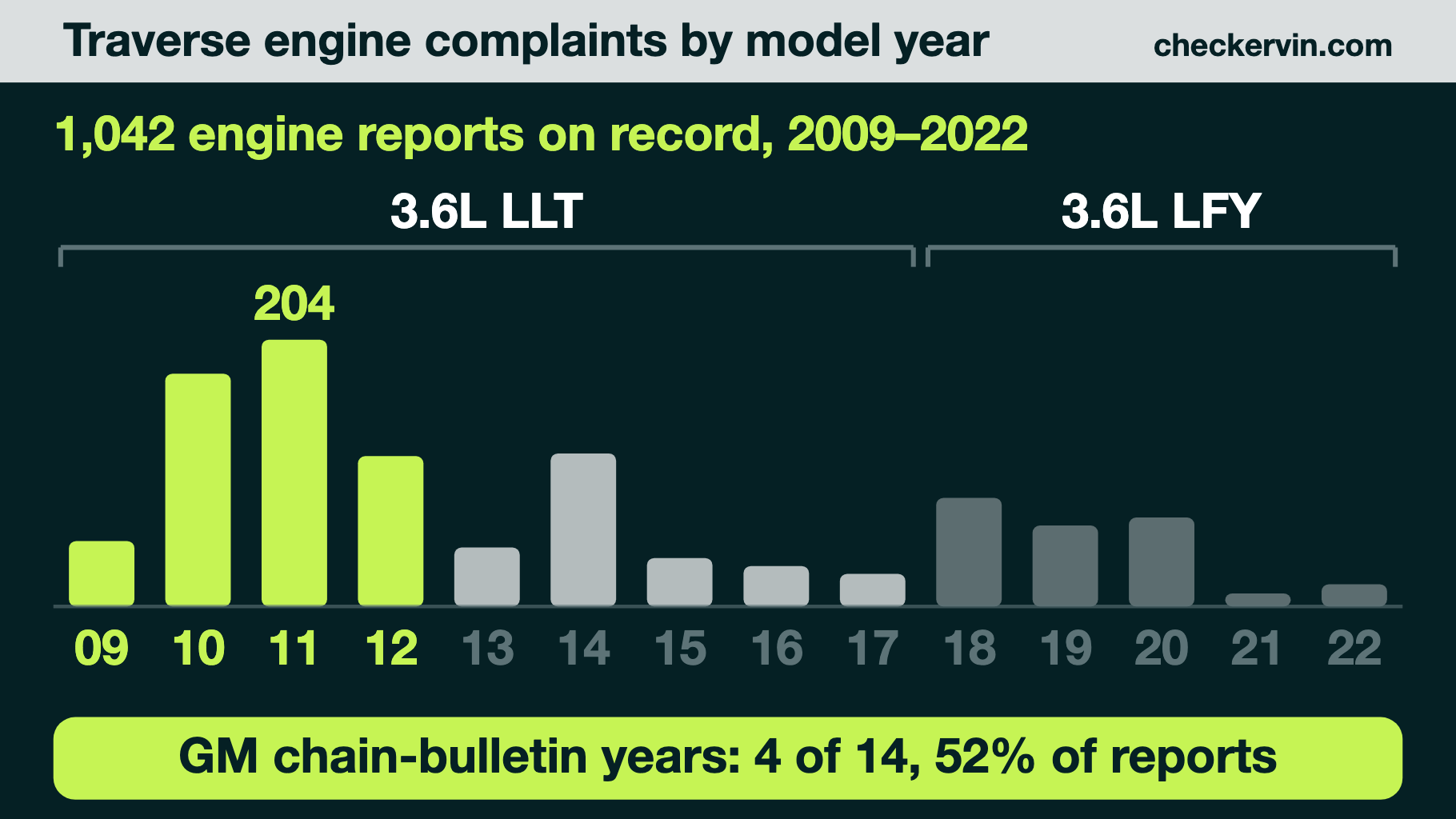
Our corpus of federal NHTSA complaints holds 5,003 reports against the 2009–2022 Traverse, and 1,042 of them fall in the ENGINE component category. Laid out by model year, those engine reports are lopsided. 2009–2012, the four years GM’s chain bulletin names for the Traverse, hold 547 of them, or 52%. The peak is the 2011 model at 204 engine reports, about 34% of every complaint filed against that year; across the whole series, ENGINE is the single most-reported component only in 2011 and 2012 and 2020.
The whole LLT era, 2009–2017, accounts for 802 engine reports, 77% of the total. A bulletin-year Traverse averages about 137 engine reports; a 2013–2017 model with the same engine averages about 51; an LFY-era model averages about 48.
Two limits keep that honest. NHTSA has no timing-chain category, so ENGINE counts every engine fault an owner reported, from oil leaks to stalls; the chain is one part of that number, not all of it. And complaints are unverified owner reports, not a measured failure rate. ENGINE is among the five most-reported components in every Traverse model year in our data, so each bar in the chart below is a real count, not a placeholder.
The 2009 special coverage, and why it has ended
Special Coverage Adjustment 11340C, dated November 2012, is the only GM program we found that paid for a Traverse timing chain outside the normal warranty. It applies to “certain” 2009 Traverses with the 3.6L LLT, alongside the 2009 Enclave, Acadia and Outlook and some older Cadillac and GMC models. The coverage ran 10 years or 120,000 miles from the date the vehicle was first placed in service, whichever came first, regardless of ownership, and dealers were to replace the chain at no charge or, if the chain was still within spec, reprogram the engine computer.
Every 2009 Traverse was first placed in service more than ten years ago, so the clock has run out on all of them. The coverage is a historical fact now, useful in two ways. It proves GM acknowledged the condition on this nameplate, and it means a 2009 Traverse may already have had a dealer-installed replacement chain, which service records or a dealer’s warranty history lookup can show. The 2009 model carries only 50 engine reports against 178 for the 2010; the record does not say whether the coverage, a shorter first sales year or something else explains that gap, and we would rather leave it visible.
What the bulletin tells the shop to replace
Bulletin 12-06-01-009 is an information bulletin, not a coverage program: it tells technicians how to repair the condition and pays only when the vehicle is still under warranty. Its model list includes the 2009–2012 Traverse with RPO LLT, and it applies when the engine sets one or more of codes P0008, P0009, P0016, P0017, P0018 or P0019. The January 2013 revision A briefly withdrew the content because of a parts shortage; revision E, from April 2014, is the version we read for the procedure.
Its instructions are useful for checking a quote. The GM kit for the Traverse LLT is a single part number covering chains and related service parts, and the bulletin says idler sprockets, camshaft actuators, crankshaft gears and chain guides “should not be replaced” for a stretched chain setting those codes. Guides are replaced only when the wear surface is worn into the base material. Engines built before June 5, 2009 also get a camshaft thrust washer inspection, and 2009–2011 Traverses get a PCV tube or bank-2 camshaft cover service. A quote that includes new cam phasers and guides as a matter of course is pricing more than GM’s own procedure calls for. That can still be a reasonable choice on a high-mileage engine, but it should be your choice.
2013–2017: the same engine, a quieter record
The LLT did not leave the Traverse in 2012. NHTSA’s VIN decoder returns the 3.6L LLT for 2013, 2015 and 2017 Traverse VIN patterns, so the first-generation SUV kept the engine to the end of its run. Those later years are simply not on bulletin 12-06-01-009’s model list, which was written in 2012 and stops at that model year.
The complaint record is lighter for these five years: 255 engine reports in total. The 2014 model is the exception at 117, closer to the bulletin years than to its neighbors. Our data cannot tell how many of those are chain-related. What it does say is that a 2013–2017 Traverse with an unknown oil-change history deserves the same cold start listening test as an earlier one, because nothing in GM’s documents says the chain or the oil-life logic changed when the bulletin’s model list ended. The same LLT went into the GMC Acadia, Buick Enclave and Saturn Outlook of this period, and GM’s bulletin gives those SUVs the same 9.5- and 9.7-hour labor times as the Traverse, so a quote for any of the four should look similar.
2018 on: the LFY generation
GM’s new-model bulletin for the 2018 Traverse, 17-NA-176, lists a 3.6L V6 with RPO LFY as the standard engine and a 2.0L turbocharged four, RPO LTG, on the RS trim with front-wheel drive only. NHTSA’s VIN decoder returns LFY for a 2018 Traverse pattern as well. We found no GM timing-chain bulletin or special coverage for the LFY, and we do not claim one.
The 2018–2022 Traverse accounts for 240 engine reports, 23% of the nameplate’s total. That is the generation RepairPal’s indexed estimates describe, so if you own a 2018 or later Traverse those figures are the closer match. If you own a 2009–2017 model, GM’s 9.5 to 9.7 hours is the better anchor. Two GM siblings show how differently the same make’s chain jobs can price: the Malibu timing chain cost post follows a turbo four whose complaints bunch in three later years, and the Equinox timing chain cost post covers a four-cylinder whose chain fails alongside an oil-burning problem, a different repair from the Traverse’s.
What the recall record covers, and what it doesn't
We queried NHTSA’s recall database for every Traverse model year from 2009 through 2022. No campaign names the timing chain, tensioner, guides or camshafts. The engine-bay recalls that do exist, such as a 2020 fuel pump campaign, are unrelated. Chain wear was treated as a durability condition, which is why GM handled it through a satisfaction program, a special coverage and a bulletin rather than a safety recall. The difference between a TSB and a recall decides who pays:
| Program | What it actually pays for |
|---|---|
| Recall | Safety defect — free fix at any dealer, no expiry on the remedy |
| Special coverage | GM pays within its stated years and miles — 11340C has run out |
| Technical service bulletin | Repair instructions and labor time — pays nothing outside warranty |
| Goodwill | Dealer and GM discretion, usually only near the end of warranty |
Most Traverse years still carry several recall campaigns on other systems, from seat belts to air bags. The Chevrolet recall check shows which remain unrepaired on a specific VIN.
Before you authorize the repair
- Scan for codes and keep the printout — P0008, P0009 and P0016 through P0019 are the bulletin's entry conditions
- Confirm the engine code by VIN: LLT for 2009–2017, LFY for most 2018 and later models
- Ask whether the quote follows GM's kit or adds phasers, guides and sprockets the bulletin says are usually not worn
- Compare quoted labor with GM's 9.5 hours (FWD) or 9.7 hours (AWD) for the matching job
- Ask the dealer to confirm the oil life monitor calibration is current before the vehicle leaves
The third and last items matter most. GM’s bulletin is unusually direct that chain guides and actuators are being replaced unnecessarily, and the oil life calibration addresses the cause GM named. A Chevrolet VIN decode confirms the engine and model year before any of that, and a GM build sheet shows the drivetrain, which decides whether the FWD or AWD labor time applies.
If you are buying the Traverse, not repairing it
Read the record as a shopping map. On a 2009–2012 Traverse, ask for paperwork showing the chain was replaced, or price the job into your offer. On a 2013–2017 model, oil-change receipts at reasonable intervals are worth more than a clean dashboard. A Chevrolet warranty check by VIN settles whether any factory powertrain coverage remains on a newer one.
Then do the test no report replaces: start the engine cold, after it has sat overnight, and listen for rattle in the first seconds. Ask the seller not to warm it up before you arrive, and check for stored codes with a basic scanner. The Chevrolet Traverse years-to-avoid breakdown covers the rest of the complaint record, including the air bag and power train reports that outnumber engine complaints in several model years, and the timing belt or chain lookup by VIN confirms which drive a given engine uses.
Where this information comes from
- GM Special Coverage 11340C (NHTSA copy) — timing chain wearCertain 2009 Traverses; the oil-change-interval cause in GM's words; 10 years or 120,000 miles; 9.0–9.2 labor hours.
- GM Bulletin 12-06-01-009E (NHTSA copy) — High Feature V6 timing chain kits2009–2012 Traverse (LLT), DTCs P0008–P0019, what not to replace, and 9.5–9.7 labor hours.
- GM Bulletin 12-06-01-009A (NHTSA copy)The January 2013 revision that temporarily withdrew the procedure for a parts shortage.
- GM Bulletin 17-NA-176 (NHTSA copy) — 2018 Traverse new model featuresConfirms the 3.6L LFY as the 2018 standard engine and the 2.0L LTG on the FWD RS.
- NHTSA vPIC — VIN decoder APIDecodes 2013–2017 Traverse VIN patterns as 3.6L LLT and 2018 as LFY.
- NHTSA — recalls by VINThe official lookup; our year-by-year query found no recall naming the Traverse timing chain.
- RepairPal — 2019 Chevrolet Traverse repair costsThe $2,701–$3,541 chain and gear set figure quoted above, retrieved October 2026.
- RepairPal — 2023 Traverse timing chain tensioner estimateThe $2,970–$4,100 tensioner figure and its labor and parts split, updated September 3, 2026.
Keep reading
Frequently asked questions
How much does it cost to replace the timing chain on a Chevy Traverse?
RepairPal's 2019 Traverse page lists a timing chain and gear set replacement at $2,701 to $3,541 — its figure, retrieved October 2026. GM's own bulletin explains why the bill is mostly labor: it pays a dealer 9.5 hours to install the timing chain kit on a front-wheel-drive 2009-2012 Traverse and 9.7 hours on all-wheel drive, because the job involves lowering the frame to reach the front of the engine. Multiply those hours by your shop's posted rate, then add the kit, oil, coolant and A/C refrigerant to check a quote.
What years of the Chevy Traverse have timing chain problems?
GM's timing chain bulletin 12-06-01-009 names the 2009-2012 Traverse with the 3.6L LLT V6, and its special coverage 11340C singled out certain 2009 models. Those four model years hold 52% of the Traverse's engine complaints in the federal record. The same LLT engine stayed in the Traverse through 2017, and those later years carry fewer engine reports. The 2018 redesign moved to the LFY V6, and we found no GM timing-chain bulletin for it.
Is there a recall or extended warranty for the Traverse timing chain?
There is no safety recall: we checked NHTSA's recall database for every Traverse model year from 2009 through 2022 and none names the timing chain. GM did issue Special Coverage Adjustment 11340C for certain 2009 Traverses, covering premature chain wear for 10 years or 120,000 miles from the in-service date. Every 2009 Traverse has now passed the ten-year limit, so that coverage no longer pays for anything. Later years were covered only by the regular 5-year/100,000-mile powertrain warranty.
What are the symptoms of a stretched timing chain on a Traverse?
GM's documents describe a Service Engine Soon light with one or more of codes P0008, P0009, P0016, P0017, P0018 or P0019, which are camshaft-to-crankshaft position correlation faults. A scan tool reading of those codes is the useful first step, because GM's bulletin uses them to define when the chain kit applies.
Does the 2018 and newer Traverse have timing chain problems?
The 2018 redesign replaced the LLT with the 3.6L LFY V6, confirmed in GM's 2018 new-model bulletin and in NHTSA's VIN decoder. We found no GM timing-chain bulletin or special coverage for the LFY, and the 2018-2022 Traverse averages about 48 engine complaints per model year in the federal record against about 137 for 2009-2012. That is not proof of a trouble-free chain, only that the record does not show the earlier pattern.
Confirm the engine before you price the repair
A free CheckerVIN report shows the factory build, engine, specifications and open recalls for any VIN, so you know whether GM's LLT bulletin applies.
Run a free VIN check