The short answer
- Where is the GM build information?
- On a modern vehicle, the Service Parts Identification label — usually the glove box, sometimes the console or cargo area. On a classic, the cowl tag under the hood. Original assembly build sheets, where they survive, are hidden inside the car.
- Can a dealer pull it from the VIN?
- For reasonably recent vehicles, yes — a parts department can retrieve the factory build record. Coverage does not extend indefinitely into the past, so on older vehicles the documents attached to the car become the primary source.
- Why does it matter?
- Because option content and trim claims drive value, and codes recorded when the car was built are the only thing badges and aftermarket parts cannot fake.
Three
Different documents
By era of the vehicle
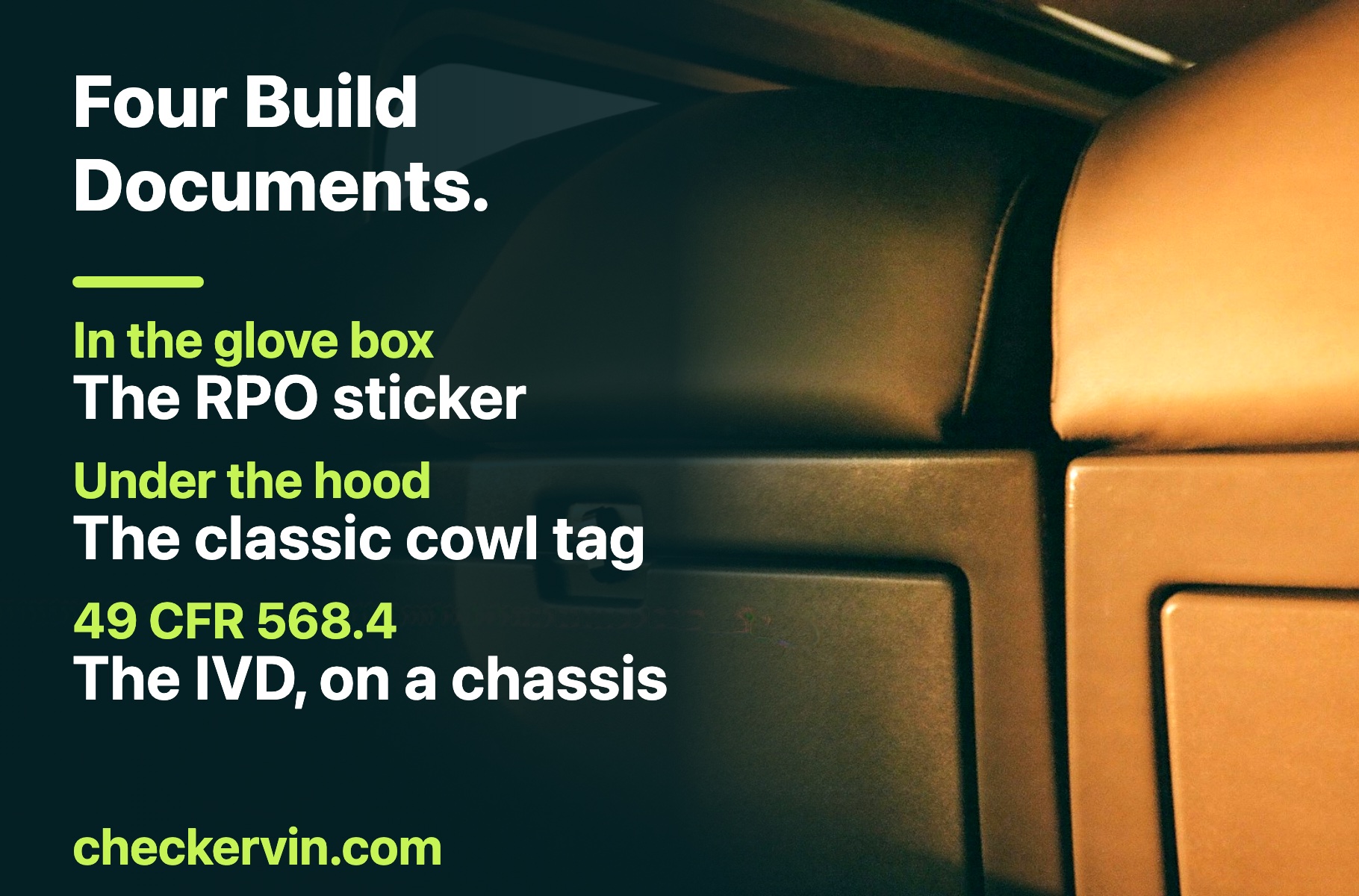
Glove box
Where the RPO sticker starts
Then console and cargo
Cowl
Where classic tags live
Under the hood
IVD
Required by federal law
49 CFR 568, on a chassis
Three documents, and which one you need
| Document | Era, location and what it gives you |
|---|---|
| RPO / Service Parts Identification sticker | Modern vehicles. Attached in the glove box, console or cargo area. Lists every factory option by three-character code, including paint and axle ratio. |
| Cowl tag / body tag | Classic vehicles. A metal plate in the cowl area under the hood. Carries body style, paint, trim and build codes in a format decoded with marque references. |
| Original assembly build sheet | Any era, if it survived. Paper documentation left inside the vehicle during assembly. Found under seats, above the fuel tank, behind panels or under carpet. |
| Dealer-retrieved build record | Reasonably recent vehicles. Pulled from the manufacturer's systems against the VIN by a parts department. |
The modern RPO sticker
General Motors describes factory equipment using Regular Production Option codes, and prints the full list for each vehicle on a label attached to it. This is the document most owners need and most never look at.
The system works the same way across GM divisions, so the detail is covered once — the Chevrolet page explains RPO codes in full, and everything there applies to a GMC, Buick or Cadillac equally.
- Check the glove box first — the most common location across the range
- Then the center console lid, the cargo area, and under the spare tire cover
- Photograph the entire label rather than the codes you recognize
- The paint code is on it, and so is the axle ratio
- A dealer can tell you what any specific code represents for that model year
The corporate picture sits alongside it: GM VIN decoder covers how one identifier carries division, build country and vehicle class at once.
The cowl tag on classic GM vehicles
Before the RPO sticker system, GM fitted a metal tag carrying build information — commonly called a cowl tag, body tag or trim tag depending on the division and era. It normally sits in the cowl area under the hood, near the base of the windshield.
Its format is nothing like a modern sticker. It carries codes for body style, paint, interior trim, build date and plant, in an abbreviated scheme that changed across divisions and model years. Decoding one means using a reference specific to that division and that year.
What a dealer can retrieve
For reasonably recent vehicles, a GM dealer parts department can pull the factory build record against the VIN. That gives you the option content without needing to find any label on the car.
Coverage does not extend indefinitely backward. On older vehicles the records become patchy and then unavailable, at which point the documents physically attached to the car are your primary source. Where the label is missing on an older vehicle, marque references and owner registries fill the gap.
Why build documentation drives value
On any GM vehicle where trim or equipment carries a premium, the build record is what separates a claim from a fact. Badges, grilles, wheels, interior trim and even engines can be changed. Codes recorded when the vehicle was built cannot.
| Claim | What the documentation settles |
|---|---|
| A premium trim level | Whether the equipment codes for that trim were recorded at build, or the badges were added later. |
| An off-road or towing package | Whether the suspension, differential and cooling content was factory-fitted. |
| A performance variant | Which engine and drivetrain the vehicle actually left with. |
| Original paint | The factory color code, against what the car currently wears. |
| A rare configuration on a classic | Whether the combination claimed is what the tag and sheet actually record. |
Reproduction tags exist
Reproduction cowl tags and data plates are manufactured and sold openly, and they serve a legitimate restoration purpose when an original is damaged or corroded beyond reading.
They are also the mechanism by which a common car gets presented as a rare one. On a vehicle where the configuration claimed carries a large premium, tag authenticity is specialist work — rivet type, finish, stamping characteristics and the condition of the surrounding metal all form part of it.
Using build documentation when buying
- 1Decode the VIN firstIt establishes the model year, which tells you which document to look for.
- 2On a modern vehicle, ask for a photo of the RPO stickerBefore you travel. It settles every equipment claim at once.
- 3On a classic, photograph the cowl tagThen decode it against a reference for that division and year.
- 4Ask whether an original build sheet was ever foundOn a restored car this is a fair question and the answer is informative either way.
- 5Ask a dealer to pull the build recordWhere the vehicle is recent enough for the records to exist.
- 6Walk the vehicle against the documentationEquipment claimed but not coded was added later, whatever the badge says.
- 7Authenticate anything carrying a large premiumTags can be reproduced. On a rare configuration, expert verification is worth the cost.
The fourth document, and the only one federal law requires
Everything above is GM's own paperwork. The company chose to make it, chose what to put on it, and could stop tomorrow. There is one build document that works the other way around: it exists because a federal regulation says it must, its contents are specified line by line, and it is keyed to the VIN.
It is called the Incomplete Vehicle Document, and it lives in 49 CFR Part 568, which governs vehicles manufactured in two or more stages. If you have never heard of it, that is because it does not appear on an ordinary car. It appears on the class of vehicle GM sells in enormous numbers and almost never gets asked about: the cutaway van, the chassis-cab, the stripped chassis that leaves the plant without a body.
The definitions that make this work sit in 49 CFR 567.3, which Part 568 adopts wholesale. An incomplete vehicle is an assemblage of at minimum a chassis and frame, power train, steering, suspension and braking system, in the state those systems will be in on the finished vehicle, but still needing further manufacturing to become a completed vehicle. A chassis-cab is an incomplete vehicle with a finished occupant compartment that needs only cargo-carrying, work-performing or load-bearing components added. A final-stage manufacturer is whoever performs the operations that turn it into a completed vehicle.
In plain terms: GM built the part you drive with, and somebody else built the part you use. Both facts are recorded, and the recording is not optional.
What an Incomplete Vehicle Document has to say
Section 568.4(a) requires the incomplete vehicle manufacturer to furnish an IVD for each incomplete vehicle at or before the time of delivery, containing a specified list of statements in a specified order. It reads like a build sheet because that is effectively what it is.
| 49 CFR 568.4(a) | What it requires |
|---|---|
| (1) and (2) | Name and mailing address of the incomplete vehicle manufacturer, and the month and year of its last manufacturing operation on the vehicle |
| (3) | Identification by VIN, or by groups of VINs, specifically so a person can tell the document applies to a particular vehicle after it has been removed from that vehicle |
| (4) and (5) | GVWR of the intended completed vehicle, and the GAWR for each axle listed front to rear |
| (6) | The vehicle types the chassis may appropriately be built into — truck, MPV, bus, trailer |
| (7) | Every Federal Motor Vehicle Safety Standard that applies, each with a Type 1, Type 2 or Type 3 conformity statement |
| (8) and (9) | A table of contents summarizing those standards, and a certification the statements are accurate and may be relied on by later manufacturers |
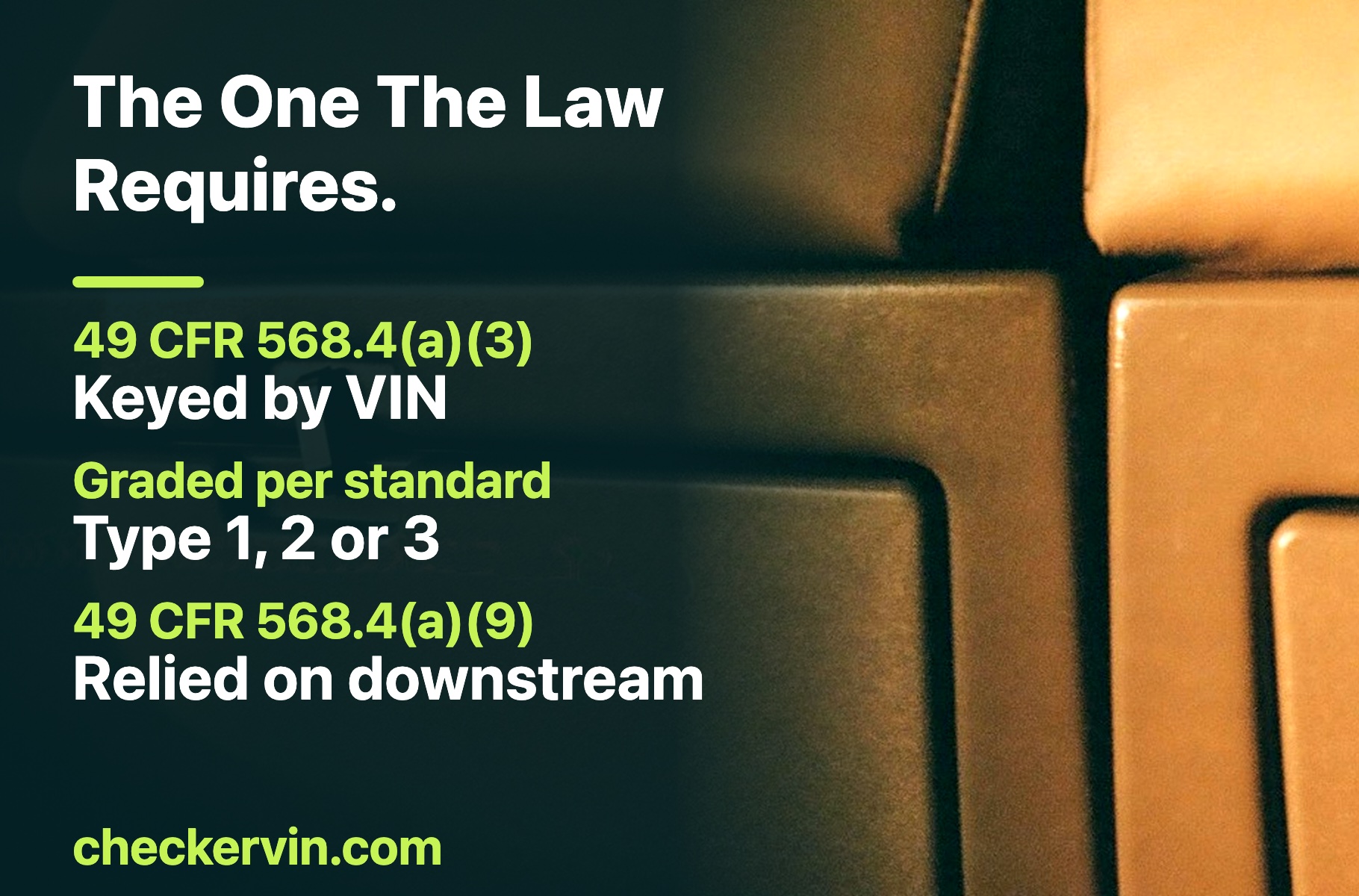
Clause (3) is the one worth reading twice. The regulation anticipates that the document will be separated from the vehicle, and requires the VIN identification precisely so the paperwork can be matched back to the metal afterwards. That is the exact problem every classic-car buyer has with a loose build sheet, addressed in a federal rule decades ago for a different class of vehicle.
The three conformity statements in clause (7) are the other thing to understand, because they are a graded admission of certainty. A Type 1 statement says the completed vehicle will conform to the standard if no alterations are made to identified components. A Type 2 statement sets out specific conditions of final manufacture under which it will conform. A Type 3 statement says conformity cannot be determined from the components supplied, and that the incomplete vehicle manufacturer makes no representation about it at all.
Who actually built the vehicle, and why the VIN can mislead
This matters to a buyer for one concrete reason. On a two-stage vehicle, the badge, the VIN and the driving experience all point at GM, and a meaningful part of the vehicle was not made by GM at all.
Under 568.6, the final-stage manufacturer must complete the vehicle so that it conforms to the applicable standards in effect on a date it selects — the date the incomplete vehicle was manufactured, the date of final completion, or any date between the two. So the compliance date of the box, the lift or the camper body is not necessarily the compliance date of the chassis underneath it.
There is also a route by which the paperwork disappears entirely. Section 568.7 says that if the incomplete vehicle manufacturer assumes legal responsibility for all the duties and liabilities the Vehicle Safety Act imposes with respect to the finished vehicle, then the IVD requirements in 568.4, 568.5 and 568.6 do not apply — instead a label is affixed under 49 CFR 567.5(f). An intermediate manufacturer can do the same under 567.5(g), though that does not relieve the incomplete vehicle manufacturer of its own obligations under 568.4.
The chain can also be longer than two links. Section 568.5 covers the intermediate manufacturer — anyone who works on the vehicle between the chassis builder and the final-stage builder. That party has to pass the IVD along to the final-stage manufacturer, and if anything it did affects the validity of the statements already in the document, it must furnish an addendum carrying its own name and mailing address and setting out every change that should be made to the IVD to reflect the work it performed. The addendum carries its own certification, accurate as of the date of that manufacturer's work and relied on by everyone downstream.
So a fully documented two-or-more-stage vehicle can arrive with a small stack: the original IVD from the chassis builder, an addendum from each intermediate manufacturer that changed something material, and the final-stage manufacturer's own certification label on the vehicle. That stack is the closest thing in American practice to a build sheet with legal force behind it, and it is worth asking about before you buy a converted vehicle rather than after.
- Ask who the final-stage manufacturer was, by name, not just who made the chassis
- Ask whether the Incomplete Vehicle Document came with the vehicle
- Check the certification label for a second manufacturer alongside the chassis maker
- Treat the body, lift or conversion as separate equipment with its own history
- Remember the RPO sticker describes the chassis, not what was built onto it
Where this information comes from
- 49 CFR 568.4 — requirements for incomplete vehicle manufacturersThe nine required IVD statements, including VIN identification and the Type 1/2/3 conformity grades
- 49 CFR 567.3 — definitionsIncomplete vehicle, chassis-cab and final-stage manufacturer, as Part 568 uses them
- NHTSA vPIC — public VIN decoderConfirms model, year and plant before you hunt for build documents
- NHTSA recall lookupFree open-recall check by VIN while you have the number to hand
Keep reading
Frequently asked questions
How do I get a GM build sheet by VIN?
For a modern vehicle, start with the RPO sticker attached to the car and ask a dealer parts department to pull the build record against the VIN. For a classic, the cowl tag on the vehicle and marque references are the route, since GM's retrievable records do not extend indefinitely backward.
What is a GM cowl tag?
A metal plate fitted to older GM vehicles, usually in the cowl area under the hood, carrying body style, paint, trim and build codes. It predates the modern RPO sticker system and is decoded using marque references specific to the division and model year.
Where do original build sheets hide in a GM car?
Assembly-line build sheets were sometimes left inside the vehicle during construction — commonly under seat springs, above the fuel tank, behind door panels or under carpet. Restorers find them regularly, and an original sheet is strong documentation.
What is the difference between an RPO sticker and a build sheet?
The RPO sticker is a label attached to the vehicle listing option codes. A build sheet is the assembly documentation for that specific car. They overlap in content, but the sticker is what you can read yourself while the build record generally comes from the manufacturer.
Does a build sheet prove a car is genuine?
It is strong evidence, not proof on its own. Tags can be reproduced and sheets can be moved between cars. On a high-value vehicle, documentation should be corroborated by physical inspection and, where the premium is large, by a marque authenticator.
Start with the VIN
Decode any VIN free for the factory build, specifications and open safety recalls. No account required.
Run a free VIN check