The short answer
- Is Autotrader legit?
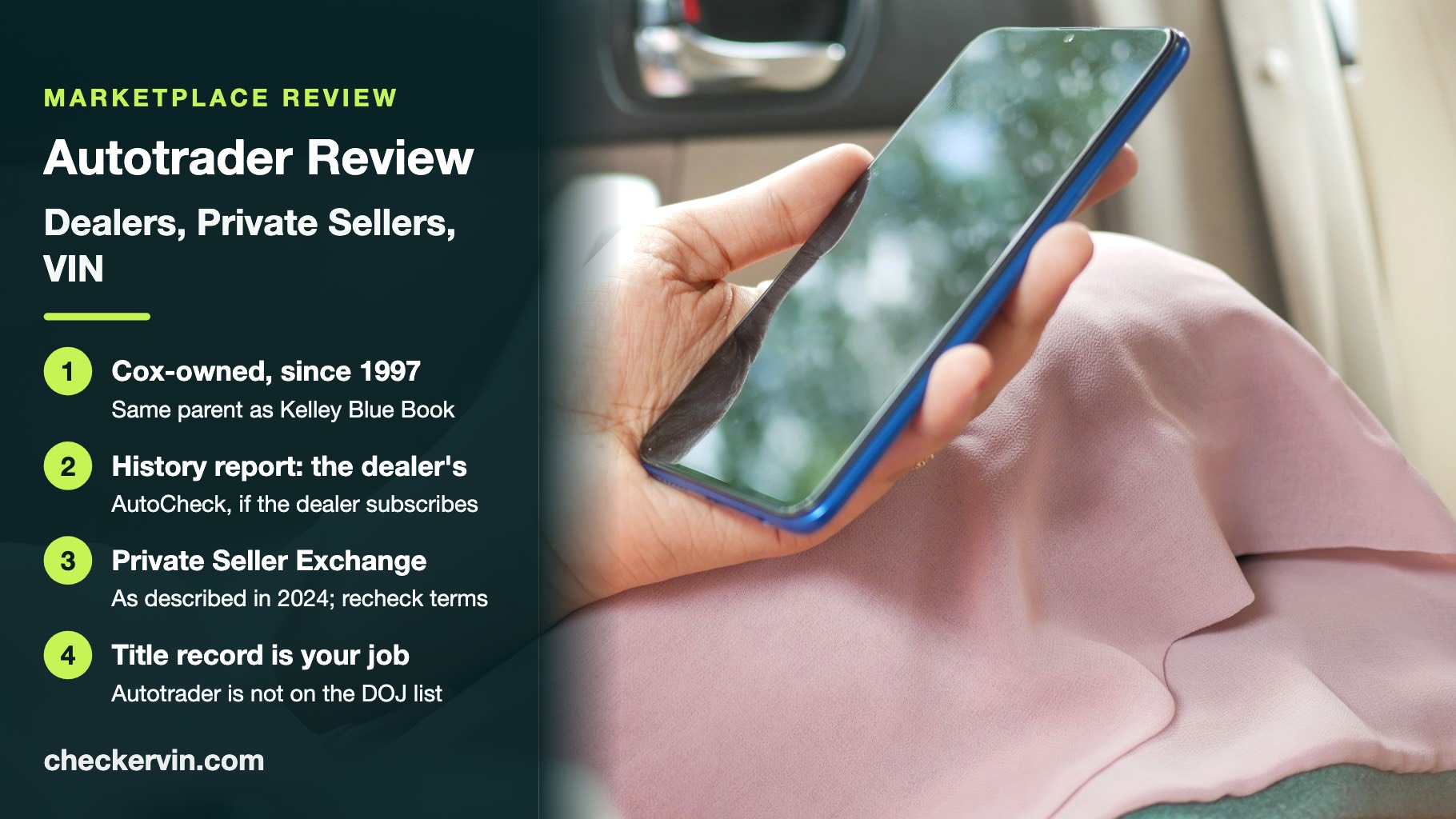
- Yes. It has run since 1997 and belongs to Cox Automotive, which also owns Kelley Blue Book. It sells listings and marketing to dealers. It does not sell, inspect or title-check the cars.
- Where does the history report on a listing come from?
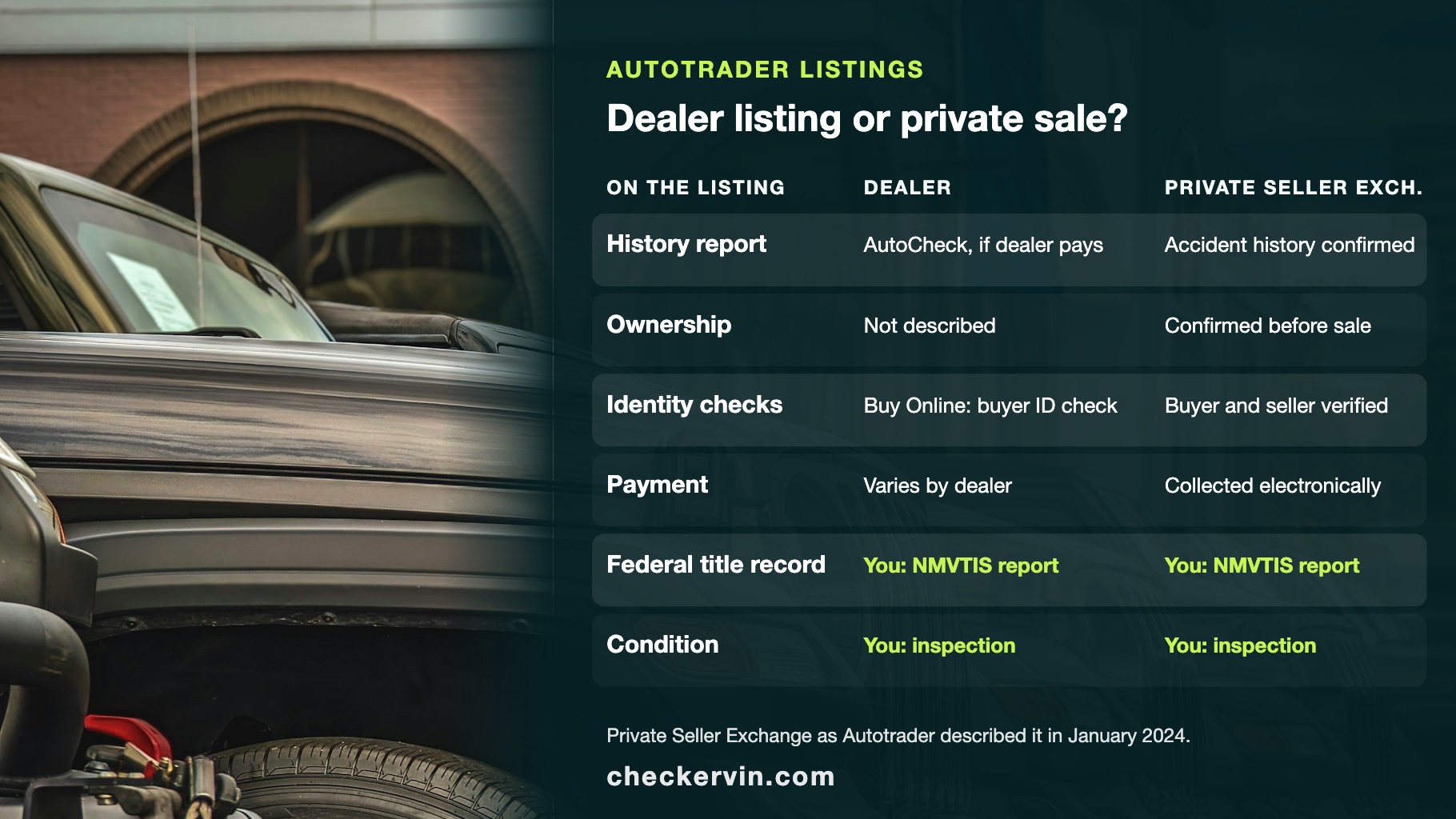
- From the dealer. Autotrader and KBB co-brand Experian AutoCheck reports that dealers provide on eligible listings through a paid subscription. A listing without one tells you nothing either way.
- Can private sellers use Autotrader?
- Yes. Autotrader's own media room describes private-party sales through Private Seller Exchange. Its current terms and fees could not be verified because autotrader.com blocked us.
1997
Year Autotrader was established
Per its own media room
Cox
Parent company
Privately owned, so no SEC filings
3
Sites one dealer listing can reach
Autotrader, KBB.com, Car and Driver
Not listed
DOJ NMVTIS provider status
A marketplace, not a title-data seller
Bottom line
Autotrader is one of the oldest car listings sites in the United States, with a claimed audience of over 28 million visitors a month, and it is a reasonable place to shop. Two things about it are worth knowing before you trust a listing. First, it is a dealer marketing business: the company that runs it also sells dealers their history reports, their inventory software and, through Kelley Blue Book, the valuations shoppers use. Second, the most reassuring item on many listings, a free vehicle history report, is an Experian product the dealer chose to pay for and attach.
That does not make anything on Autotrader untrue. It tells you where its responsibility stops, which is at the listing. The car, its title and its paperwork belong to the seller, and checking them is up to you.
Who owns Autotrader, and who pays for it
Autotrader describes itself as a Cox Automotive brand, and Cox Automotive as a subsidiary of Cox Enterprises, a privately owned company in Atlanta that reported $23 billion in annual revenue in the boilerplate of Autotrader’s July 2026 press release. On Cox Automotive’s own brand page, Autotrader sits beside:
- Kelley Blue Book
- Manheim
- Dealertrack
- vAuto
- Dealer.com
- NextGear Capital
- VinSolutions
- Central Dispatch
The paying customer is the dealer. Autotrader’s dealer site sells “flexible listing packages across Autotrader and KBB.com,” digital advertising, and digital retailing tools that let a shopper start a purchase online. Cox’s brand page tells dealers that over 28 million people visit Autotrader every month. Our Kelley Blue Book value guide covers what it means that the valuation book and the wholesale auction share that parent; here the practical point is simpler. When you shop on Autotrader, the listing, the price guidance beside it and the history report on it can all come from one corporate family, paid for by the seller.
Is Autotrader legit? What the public record shows
On whether the business is real and accountable, yes. Autotrader’s media room says it was established in 1997as the first nationwide online car shopping site, and it has operated under Cox ownership with a public press office and named media contacts. What it does not have is a public filing trail. Because Cox Enterprises is privately owned, there is no Autotrader 10-K to read for revenue, dealer counts or legal proceedings, which is why this review leans on the company’s own releases rather than audited figures.
We searched the FTC, the CFPB and state attorney general sites for enforcement action naming Autotrader and found none. That is a search result, not a clean bill of health for every dealer advertising on it. Dealers write their own listings, and the remedies for a misleading one run against the dealer first.
One dealer listing, several storefronts
A dealer’s car on Autotrader does not stay on Autotrader. According to the company’s own pages, the same listing can be shown on:
| Where it appears | What Autotrader says |
|---|---|
| Autotrader.com | The dealer's listing package |
| KBB.com | Packages give exposure on both Autotrader and KBB.com (B2B Autotrader) |
| Car and Driver Marketplace | Most Autotrader clients' listings syndicated automatically (Aug 18, 2025) |
The August 2025 release says a vast majority of current Autotrader clients would have their listings syndicated to the Car and Driver Marketplace automatically. For a shopper that has two consequences. Seeing the same car on three well-known sites is not three independent confirmations of anything; it is one dealer feed. And because the VIN is the one thing that does not change between copies, it is the right key for comparing them. If the mileage, trim or photos differ between two copies of the same VIN, ask the dealer which is right before you travel.
The vehicle history report on an Autotrader listing
The history report you are most likely to see on an Autotrader dealer listing is an Experian AutoCheck report branded with Kelley Blue Book. In a June 10, 2025 release, Kelley Blue Book and Autotrader announced they would co-brand AutoCheck reports on KBB.com and Autotrader listings, available “on all eligible listings,” allowing dealerships to provide buyers with history information. The same release describes the reports as free to shoppers and mentions the proprietary AutoCheck Score, which predicts reliability.
Autotrader’s dealer page explains the other half. A dealer gets these reports by buying an AutoCheck subscription through its Autotrader representative, and can syndicate them to its own website and other sites. So the report on a listing exists because the dealer pays for it, and a listing without one may simply be from a dealer, or a private seller, without the subscription.
| Question | Answer, from Cox and Autotrader's own pages |
|---|---|
| Whose data is it? | Experian's AutoCheck, branded with Kelley Blue Book |
| Who provides it on a listing? | The dealer, through a paid subscription |
| Which listings get it? | "Eligible listings"; the release does not define eligibility |
| Is it the federal NMVTIS report? | No. The DOJ lists Experian as commercial-only for NMVTIS |
That last row matters. The Justice Department’s NMVTIS page says consumers cannot receive NMVTIS vehicle history reports from Carfax, DMVDesk or Experian, which provide that information only to car dealerships. A free AutoCheck report is useful context, but it is not the consumer NMVTIS report the department describes. For that, use one of the 12 businesses it listed for the public when we checked on November 26, 2026:
- Bumper.com
- Carsforsale.com
- Carvertical.com
- Checkthatvin.com
- Clearvin.com
- EpicVin.com
- GoodCar.com
- Titlecheck.us
- Vinaudit.com
- Vindata.com
- VinReport
- Vinsmart.com
Our page on reading an NMVTIS report explains each line of the federal record and why a blank result is not proof that nothing happened.
Price context on Autotrader listings
Autotrader has leaned on its sister brand for price guidance rather than building a deal badge of its own. Its September 2019 release said Autotrader was the only third-party site to feature the Kelley Blue Book Fair Market Range on all eligible inventory listings. We could not open a listing to confirm how that range is shown today, so treat the 2019 description as history, not a current feature list.
A market range is a fair way to judge an asking price, with two limits. It is an estimate for a typical car of that description, and it reads the price the seller typed in, so fees or add-ons outside that number are invisible to it. Ask a dealer for the out-the-door price in writing. And the range knows nothing about this specific car’s title, open recalls or damage that was never reported, which is where the VIN comes in.
Buy Online: what Autotrader says it does
Autotrader has been pushing a Buy Online feature. Its January 6, 2026 release says buyers can purchase a car completely online and pick it up at the dealership or have it delivered, and lists what the process covers:
- Toggle between finance and cash options
- Apply incentives and trade-ins
- Complete credit applications, ID and insurance verification
- Choose dealership pickup or home delivery
The July 2026 release adds the qualifier that matters: available features and transaction capabilities vary by dealer and vehicle. Autotrader is the software in the middle; the dealer is still the seller, the contract is still the dealer’s, and your rights after the sale are the ones the dealer and your state give you. Before you sign anything online, get the VIN, run the checks below and read our guide to whether you can return a used car, because an online purchase does not automatically come with a return window.
Autotrader private sellers and Private Seller Exchange
Autotrader also carries cars from private owners. The clearest description from the company itself is a January 18, 2024 release about a charity sale through Private Seller Exchange on Autotrader, which it called a safe, convenient way to buy and sell between private parties. The release said:
- Both buyers and sellers are verified
- The car's ownership and accident history are confirmed before every sale
- Payment is collected electronically
For that charity listing, the steps for a buyer were to sign in to a MyATC account, submit an offer and get ID-verified to make the offer official. That is a more structured process than a classified ad, and on paper it handles two of the biggest private-sale risks: a seller who does not own the car and a payment that does not clear.
We could not confirm that it still works that way. autotrader.com blocked us, and when we checked on November 26, 2026, the Autotrader Private Seller Exchange help center we found said it had no articles yet. We could not read Autotrader's own fee page either, so this page prints no private-seller listing or transaction fees. Check the current terms and fees on Autotrader before you list or buy.
Whatever the platform confirms, a private seller owes you less than a dealer does, and our comparison of buying from a private seller or a dealer sets out the federal rule that draws that line. The meeting, inspection and payment advice in our Facebook Marketplace buying guide applies to any private sale that leaves the platform.
Selling your car on Autotrader: the overpayment scam
If you are the private seller, the scam to know about targets you, not the buyer. In a consumer alert dated February 27, 2025, the FTC describes a buyer who says they are not local, sends a check for more than the asking price, then claims it was an accident and asks you to send back the difference. The check can show up in your account, but the FTC warns it can take the bank weeks to discover it was fake, and then the bank takes the money back. Its advice to people selling a car online:
- Don't accept a check for more than the selling price
- Never send money back to someone who says they overpaid you by check
- Don't move money from that check into gift cards, money orders, crypto or wire transfers
- Consider an escrow or online payment service when you sell a car online
Report these attempts at ReportFraud.ftc.gov. A platform that collects payment electronically, as Private Seller Exchange was described in 2024, removes the paper check from the deal; if a buyer pushes to move off the platform and pay another way, treat that as the warning sign.
Autotrader vs Cars.com
People comparing Autotrader vs Cars.com usually want to know which to shop on. Both are dealer-paid listings marketplaces that do not sell the car, and Cars.com’s own 10-K names Autotrader among its direct competitors. Using the facts in our Cars.com review, here is how they differ:
| Point | Autotrader / Cars.com |
|---|---|
| Owner | Autotrader: Cox Automotive, privately owned. Cars.com: public, NYSE symbol CARS |
| Public filings | Autotrader: none, as part of a private group. Cars.com: audited 10-K and 10-Q |
| Price guidance | Autotrader: Kelley Blue Book Fair Market Range (as of 2019). Cars.com: three deal badges, none says overpriced |
| History on listings | Autotrader: KBB-branded AutoCheck, provided by subscribing dealers. Cars.com: the dealer's own Carfax or AutoCheck results in a dealer condition report |
| Private sellers | Autotrader: Private Seller Exchange, as described in 2024. Cars.com: not confirmed |
| On the DOJ NMVTIS list? | Neither |
| Readable for this review? | Neither site; both blocked our requests |
The useful difference for a buyer is the price opinion each one leans on. Shopping the same car on both and comparing the two views of its price is a cheap way to test a deal, and our CarGurus review adds a third. After that the checks are identical, because a price range, a badge and a dealer-supplied report are all opinions about a car. The title record, the recall list and an inspection are facts about it.
Checks to run on any Autotrader listing
- Copy the VIN from the listing and decode it; confirm year, trim, engine and body match the ad
- Compare that VIN across every site where the car appears; differences in mileage or photos are questions for the seller
- Check open recalls on the VIN with NHTSA; safety recall repairs are generally free at a franchised dealer
- Buy an NMVTIS report from a DOJ-listed consumer provider, whatever history badge the listing shows
- Book an independent inspection, and get a dealer's out-the-door price in writing
Here is what our free scan returns today, next to what an Autotrader listing provides.
| CarCheckerVIN today | An Autotrader listing |
|---|---|
| Free VIN decode: factory build and specifications | Details entered by the seller |
| Open NHTSA safety recalls by VIN | Not described as a listing feature in what we read |
| Factory warranty terms | Whatever the seller lists |
| Market and listing prices | Kelley Blue Book price guidance on eligible listings |
| Title, damage and odometer history: launching soon | An AutoCheck report, when the dealer subscribes |
What our free scan returns today:
- Factory build and specifications decoded from the VIN
- Factory warranty terms
- Open NHTSA safety recalls
- Photos filed against the VIN
- Market and listing prices
Paste the VIN from an Autotrader listing
Decoded from official manufacturer and NHTSA records
Where this information comes from
- Autotrader Media Room — Company OverviewAutotrader as a Cox Automotive brand; Cox Automotive as a subsidiary of Cox Enterprises; read November 26, 2026
- Autotrader — Private Seller Exchange release (January 18, 2024)Verified buyers and sellers, confirmed ownership and accident history, electronic payment, buyer ID verification
- Autotrader — New-year advice and Buy Online release (January 6, 2026)What the Buy Online process covers
- Autotrader — Buy Online campaign release (July 21, 2026)Features vary by dealer and vehicle; Cox Enterprises described as privately owned with $23 billion in annual revenue
- Autotrader — Car and Driver Marketplace release (August 18, 2025)Autotrader clients' listings syndicated to the Car and Driver Marketplace
- Autotrader — "Finally, It's Easy" campaign release (September 3, 2019)Kelley Blue Book Fair Market Range on eligible listings, as of 2019
- Autotrader — 20th anniversary release (October 16, 2017)Established in 1997 as the first nationwide online car shopping site
- Kelley Blue Book Media Room — KBB and Experian co-brand vehicle history reports (June 10, 2025)AutoCheck reports on eligible Autotrader and KBB.com listings, provided by dealerships
- B2B Autotrader — Experian AutoCheck offered by Kelley Blue BookDealers buy AutoCheck subscriptions through an Autotrader rep and can syndicate the reports
- B2B Autotrader — dealer solutionsListing packages across Autotrader and KBB.com, advertising and digital retailing
- Cox Automotive — Autotrader brand pageMonthly visitor claim and the Cox Automotive brand list; read November 26, 2026
- FTC — Fake check scam targets online car sellersConsumer alert dated February 27, 2025
- NMVTIS — approved data providers (DOJ / BJA)The public-tier list and the Carfax, DMVDesk and Experian notice; retrieved November 26, 2026
- NHTSA recall lookupOpen recalls by VIN, free from the regulator
- How we made this pageWritten by the CarCheckerVIN editorial team with AI assistance from Autotrader's media room and dealer pages, Kelley Blue Book and Cox Automotive pages, an FTC consumer alert and the Department of Justice's NMVTIS list; facts checked November 2026. autotrader.com blocked our requests and is not a source. The Cars.com comparison uses our own Cars.com review.
Keep reading
Frequently asked questions
Is Autotrader legit?
Yes, as a business. Autotrader was established in 1997 and is a brand of Cox Automotive, part of the privately owned Cox Enterprises. It is a listings marketplace paid mainly by dealers, and it does not sell the cars. Because Cox is private, Autotrader files no SEC reports, so there is less public financial detail than for a listed rival. We found no FTC, CFPB or state attorney general action naming Autotrader.
Who owns Autotrader?
Cox Automotive, which is a subsidiary of Cox Enterprises, a privately owned company based in Atlanta. Cox Automotive also owns Kelley Blue Book, Manheim, Dealertrack and vAuto, among other brands.
Is the vehicle history report on an Autotrader listing free?
Many dealer listings carry an Experian AutoCheck report co-branded with Kelley Blue Book, and Cox describes these as free to shoppers on eligible listings. The dealer provides it through a paid subscription, so not every listing has one. Experian is on the Justice Department's commercial-only NMVTIS list, so for the federal title record buy a report from a provider listed for consumers.
Autotrader vs Cars.com: which is better?
Neither sells you the car, and both are paid mainly by dealers, so your checks are the same on both. The differences are in ownership and tools: Cars.com is a public company with three deal badges, while Autotrader is privately owned, shares a parent with Kelley Blue Book and runs AutoCheck reports on eligible dealer listings. Both sites blocked our requests in November 2026.
How does Autotrader work for private sellers?
In January 2024 Autotrader described Private Seller Exchange as a way for private parties to buy and sell with verified buyers and sellers, confirmed ownership and accident history, and electronic payment. We could not confirm how it works today: autotrader.com blocked us and the Private Seller Exchange help center we found was empty. Read the current terms and fees on Autotrader before you list.
How do I avoid scams when selling a car on Autotrader?
The FTC warns of a fake check scam aimed at online car sellers: a remote buyer sends a check for more than the price and asks for the difference back. Don't accept an overpayment, never send money back from a check, and consider an escrow or online payment service. Report scams at ReportFraud.ftc.gov.
Whatever the listing badge says, read the VIN.
Decode any VIN free for the factory build, specifications and open safety recalls. Full vehicle history reports are launching soon.
Run a free VIN check