The short answer
- Is buying a car on Facebook Marketplace safe?
- It is as safe as the checks you run. Meta does not inspect the car, and its payment protection is tied to its own checkout, which an in-person car sale does not use.
- What should I do before meeting the seller?
- Ask for the VIN, decode it against the listing, look up open recalls and pull the NMVTIS title record. If the seller will not share the VIN, do not make the trip.
- How do I meet and pay safely?
- Meet in daylight at a police exchange zone or a bank, bring someone, and pay only after the VIN, the title and the seller's ID agree. Never pay by wire, gift card or crypto.
17 characters
A modern VIN
Readable through the windshield by federal rule
26,967
Online vehicle-sale fraud complaints
FBI IC3, May 2014 through December 2017
12 providers
Sell NMVTIS title records to the public
Department of Justice list
In person
How a Marketplace car is paid for
Outside Meta's checkout
Is it safe to buy a car on Facebook Marketplace?
Plenty of good cars change hands this way, and private sellers often price below what a dealer would ask. The catch is structural. On Facebook Marketplace, cars are listed by individuals, you message them through Messenger, and the money and the keys change hands wherever the two of you agree to meet. Nobody between you and the seller looks at the car, checks the title or holds the money.
So the honest answer to “is it safe to buy a car on Facebook Marketplace” is that the platform makes it easy to find a car and leaves every protective step to you. The rules that do or do not apply to the seller, such as the FTC’s Buyers Guide and the as-is question, are set out on our private seller vs dealer page. This page covers the parts specific to buying from a stranger you met through a listing: what Meta stands behind, the scams federal agencies describe, getting the VIN before you drive, where to meet, how to pay, and the paperwork.
What Meta stands behind, and what it does not
Meta’s Payment Protection policy is explicit about its scope. It says the policy currently applies only to transactions made through a short list of Meta payment products: Onsite Checkout in the US and UK, WhatsApp Payments to Merchants in Brazil, and Instagram Payments to Merchants in the US. Purchase Protection is the part that covers purchases made through Onsite Checkout, and eligible listings show a shield marked “Covered by Purchase Protection.” The same policy lists customer remorse, mistakes and negligence as ineligible.
Messenger and person-to-person payment apps are not on that list. A used car you test drive, inspect and pay for in a parking lot does not go through Onsite Checkout, so nothing in the policy reaches it. That is our reading of the policy’s scope, not a sentence Meta wrote about cars.
Meta’s Commerce Policies restrict the sale of certain vehicle parts and accessories and say buyers, sellers and traders are also responsible for complying with Meta’s other terms. We found no Meta page saying it verifies a seller’s ownership of a vehicle, the VIN, the mileage or the title, and no page saying it does not. In practice the listing is whatever the seller typed.
The scams aimed at car buyers, in the government's words
The FBI’s Internet Crime Complaint Center issued a public service announcement on fraudulent online vehicle sales, I-011718-PSA, on January 17, 2018. It counted about 26,967 complaints with adjusted losses of $54,032,396 from May 2014 through December 2017. The pattern it describes still fits many fake Marketplace car listings:
- The car is advertised by someone who has never had it. The photos are real; the seller's connection to them is not.
- The price is low and there is a story for it: a move or military deployment, a divorce settlement, a car inherited from a relative who died.
- The seller claims a partnership with a well-known company and says a third-party buyer program protects the sale.
- You are given a toll-free number that impersonates that company and told to buy prepaid gift cards for the price, then share the codes.
- After payment the seller stops answering or asks for more money. The vehicle never arrives.
The FTC’s alert on phony online car sales lists the same warning signs from the buyer’s side: sellers who rush the sale, sellers who cannot or will not meet in person or let you inspect the car, demands for gift cards or wire transfers, and extra charges for “shipping” or “transportation” after the sale. On the payment demand the FTC is blunt: “If anyone tells you to pay that way, it’s a scam. Every time.” It also names the check that exposes many of these: the VIN you are sent does not match the car you are looking at.
Meta’s own help page on Marketplace scams adds one directly aimed at cars. It tells buyers not to send deposits for high-value items, naming cars, without first confirming they are real. It also warns against moving the conversation off Facebook early, trusting a screenshot as proof of payment, and paying with gift cards.
Reading a Facebook Marketplace car listing before you message
A Marketplace car listing is a form the seller filled in: year, make, model, mileage, a price, a few photos and a description. Treat each field as a claim to test. Before you send a message, note four things, because you will compare them with the VIN and the paperwork later.
| In the listing | What to note |
|---|---|
| Year, make, model and trim | Write them down exactly. The VIN decode will either agree or not. |
| Mileage | The figure the seller typed. It should be close to the odometer and to the latest reading on the title record. |
| Photos | Is a plate or the dash VIN visible? Are the photos all from the same place and season? Stock or dealer-style photos on a private listing are worth asking about. |
| Price | Compare it with market prices for the same year and model. The FBI's tip is plain: a deal that looks too good to be true probably is. |
| Seller profile | How long the account has existed and what else it is selling. Several cars at once from one person is a question to ask, not proof of anything. |
The description matters too. “Clean title” is the seller’s word, not a record. A line such as “rebuilt, runs great” tells you a brand exists that you should read on the title itself, and our title washing guide explains how a brand can disappear when a car moves between states.
Ask for the VIN before you drive out
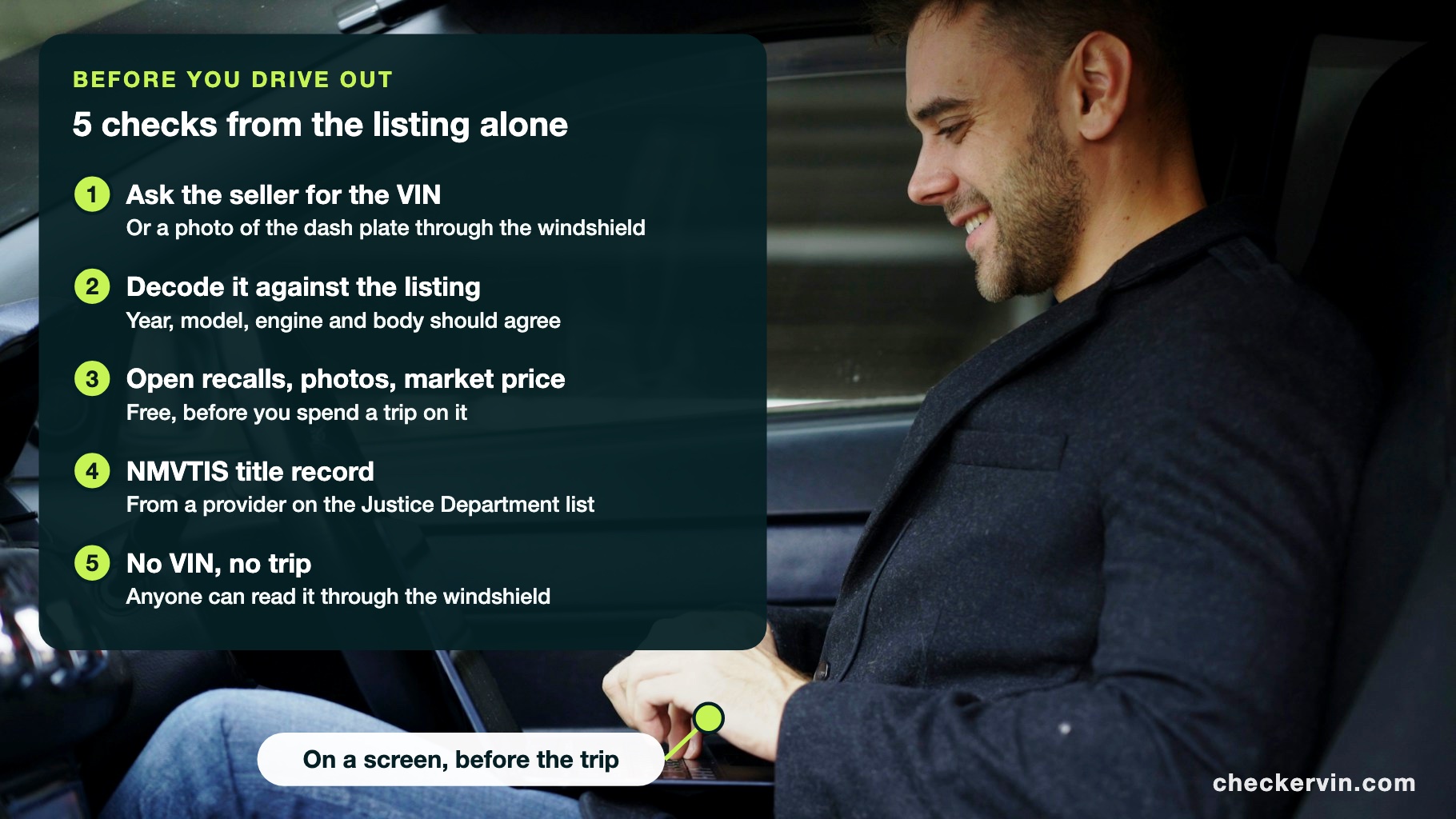
The single most useful message you can send a Marketplace seller is a request for the 17-character VIN. The FBI’s tips for online vehicle purchases tell buyers to ask for the VIN, the license plate where possible, and the registered owner’s name. With the VIN you can run every check in the next section before you spend an afternoon driving to see the car.
Some sellers hesitate, usually because they have heard a VIN can be misused. It is worth knowing that the VIN is not a secret. Federal rule 49 CFR 565.13 requires the VIN on cars, SUVs and light trucks to sit inside the passenger compartment, readable through the glass by someone standing outside next to the left windshield pillar. Anyone walking through the parking lot where the car sits can read it.
If the seller still refuses, you have learned something before it cost you a trip. Lots of honest sellers share the VIN without being asked; a seller who will not share a number anyone can read through the windshield is withholding something that is not private.
What to run on the VIN from your couch
Do the free checks first, and pay for a title record only on a car that survives them. None of this needs the seller’s help once you have the number.
- 1Decode the VIN against the listingYear, make, model, body, engine and drive should match what the seller typed. Listing fields are typed by the seller, so a wrong trim is often a typo, but a wrong engine or body style means the VIN and the photos may belong to two different cars.
- 2Look up open recallsAn open recall is a free dealer repair that comes with the car, and some are the kind you want finished before the drive home.
- 3Compare photos and pricePhotos filed against the same VIN from earlier sales show what the car looked like then, and market prices tell you whether this one is priced like bait. Both are free on our scan.
- 4Pull the NMVTIS title recordBuy a report from a provider on the Department of Justice list and read the title state, brands, odometer and total-loss lines before you agree a time to meet.
Check a Marketplace car's VIN free, no card
Decoded from official manufacturer and NHTSA records
The FTC points buyers to vehiclehistory.gov for free information about a vehicle’s title, most recent odometer reading and condition. That address forwards to the Department of Justice’s NMVTIS consumer portal, which lists the approved providers. An NMVTIS report is built on 5 indicators: current state of title and last title date; brand history; odometer reading; total loss history; salvage history. The DOJ page also says consumers cannot get NMVTIS reports from Carfax, DMVDesk or Experian, which supply them only to dealers. Repair histories and recall information are not meant to be part of NMVTIS, so the recall lookup and the inspection stay separate steps. Our NMVTIS report guide explains who reports what.
At the car: one VIN, three places
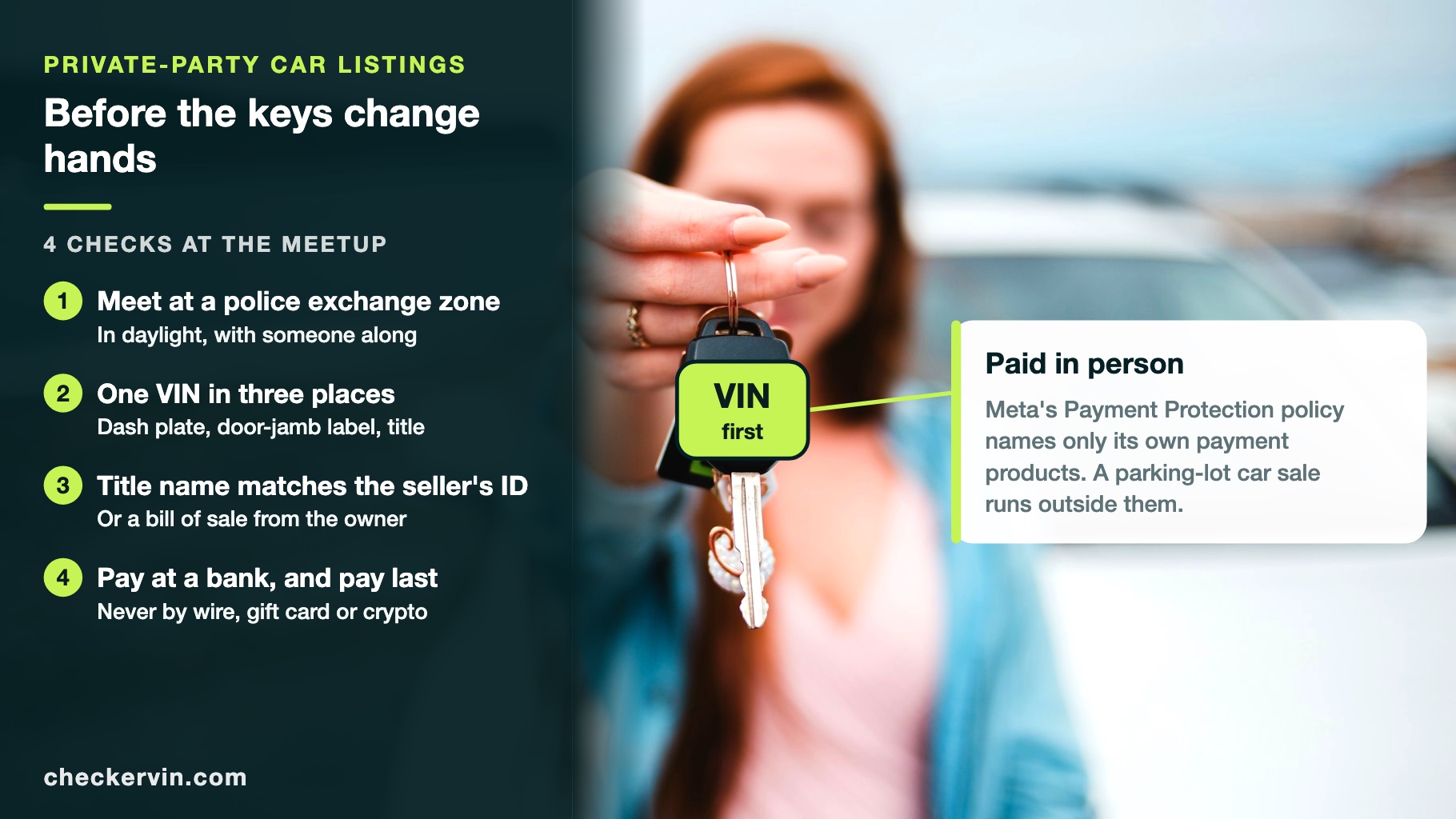
A VIN that checks out online only proves the number is real. It does not prove this car owns it. When you get to the car, read the VIN yourself in three places and hold them up against the number the seller sent you.
| Where | What you are looking at |
|---|---|
| Dash plate, through the windshield | The plate 49 CFR 565.13 requires, readable from outside at the driver's side windshield pillar. |
| Door-jamb label | The manufacturer's certification label, which 49 CFR 567.4 places on the hinge pillar, door-latch post or door edge next to the driver and which must include the VIN. |
| The title | The VIN printed on the seller's title, which must match both of the above character for character. |
| The message thread | The VIN the seller sent. If it differs from the car, stop: you were sent a number from another vehicle. |
A mismatch anywhere ends the deal. A matching set is good news but not proof, because the most serious version of this fraud copies a real car’s VIN onto plates fitted to a stolen one. Our VIN cloning guide covers the physical signs to look for, such as tampered rivets and labels, and what else to compare.
Where to meet: police exchange zones
Many police departments set aside parking spaces for exactly this kind of meeting. They are a good default for a Marketplace car, partly for safety and partly because a seller who refuses to meet at one has told you something. Two official examples show what to expect, and how much varies.
| Department | What its page says |
|---|---|
| Prince William County Police, Virginia | Exchange Zone spaces at all 3 district stations. The lots and lobby have video surveillance, but the cameras are not actively monitored at all times, an officer will not stand by during the transaction, and the spaces allow parking for up to 15 minutes. |
| Albany Police, Oregon | Two spots in the department's parking lot under 24/7 video surveillance. Police will not assist with transactions. Its tips: do not go alone, deal in daylight, be extra cautious with valuable items, and be wary of anyone unwilling to come to the department to complete a sale. |
Prince William County specifically tells people to be extra cautious when buying or selling valuable items such as vehicles. Note the time limit, too: a 15-minute space is fine for the handover but not for an inspection. Look at the car and take the test drive first, somewhere public and in daylight, then use the exchange zone or a bank for the paperwork and the payment.
Search your own city or county police site for “exchange zone” or “safe exchange”. Tell someone where you are going, bring a friend, and do not let the seller take the car out of your sight with your license or your money.
Is the seller the owner?
The person in the parking lot should be the person on the title. Ask to see the title and a photo ID together, and compare the names. If the seller is selling for a relative or a friend, that is not automatically a problem, but the paperwork has to say so.
California’s DMV puts it in rule form. When the person selling is not the owner named on the title, the buyer needs a bill of sale signed by both the seller and the titled owner. Without that, you would be handing money to someone with no recorded right to sell. Other states have their own forms and rules, and our bill of sale guide covers what one should say.
- The name on the title matches the seller's ID, or there is a bill of sale signed by the titled owner.
- The title is the original, not a copy, and nothing on it has been erased or written over.
- Any lienholder shown on the title has signed a release, or the seller can show the loan is paid off.
- The title brand, if any, matches what the seller told you and what the NMVTIS record shows.
A lien is the one that most often surprises Marketplace buyers, because a car with an unpaid loan can be sold with the lender still holding the title. Our vehicle lien check guide explains how to confirm it is clear.
How to pay a private seller safely
Payment is the step you cannot undo, so it comes last: after the inspection, after the VIN match and after the title and ID check. The FTC’s guidance on online marketplaces says not to pay by wire transfer through companies like MoneyGram or Western Union, and not to use gift cards, cash reload cards or cryptocurrency, because once that money is gone you generally cannot get it back. It favors payment methods with legal protections, such as credit cards, but a private car seller rarely takes one. That leaves a short list.
| Payment method | What to know |
|---|---|
| Gift cards, reload cards, crypto, wire | Never. Every one of these appears in the FTC's and the FBI's scam descriptions, and the FTC calls a gift card or wire demand a scam every time. |
| Cashier's check from your bank | Common, and the seller can call the issuing bank to confirm it. Get it made out on the day, for the agreed amount, once you have seen the car. |
| Payment inside a bank branch | Meeting at your bank, or the seller's, lets the bank confirm funds and produce a receipt. It also doubles as a public meeting place. |
| Cash | Leaves the least record and puts a large sum in your pocket at a meetup. If you use it, count it out inside a bank and get a signed, dated receipt. |
| Payment apps | Fine for small purchases between people who know each other. For a car, check the app's own terms on purchase protection and limits before you rely on it. |
Whatever you choose, keep the trail: the listing, the message thread, a photo of the seller’s ID next to the title, and the signed bill of sale. If something goes wrong, those are what a police report, a bank or a court will ask for.
Deposits, shipping and the seller who is out of town
The same few requests run through the fake car listings the FBI, the FTC and Meta describe, and each has a simple answer.
| The request | The answer |
|---|---|
| "Send a deposit to hold it, lots of people are interested" | Meta's own scam page says not to send deposits for cars without confirming they are real first. See the car, read the VIN on it, then decide. |
| "I'm deployed / relocating, so the car will be shipped to you" | This is the story in the FBI's PSA. A local Marketplace listing whose seller cannot meet locally is not a local sale. |
| "The sale is protected by a buyer program, call this number" | The FBI describes fake toll-free numbers that impersonate real companies. If you want to check, find the company's contact details yourself. |
| "There's a shipping or transport fee after all" | The FTC lists demands for more money after the sale as a warning sign. Stop paying. |
| "Let's move this to text or WhatsApp" | Meta's scam page warns about requests to leave Facebook or Messenger, especially early on. |
The common thread is distance. Every one of these depends on you paying for a car you have not stood next to. Craigslist’s help pages put the cure in one line: deal locally, face to face, and you avoid the vast majority of scam attempts.
Paperwork after a Marketplace car purchase: two state examples
Title transfer rules belong to your state, and the deadlines are short. Two state agencies show how differently the same step can be described. Check your own DMV before you buy, so you know what the seller needs to sign on the spot.
| State | What the DMV page says |
|---|---|
| Texas (TxDMV) | Take down the VIN and run Title Check before you buy. Never leave a private sale without the title. The seller signs and prints a name, the sale date and the odometer reading on the title, and signs Form 130-U with the sales price. The seller keeps the plates; a Vehicle Transit Permit gives you 5 days to drive to the county tax office. Apply for a new title within 30 days or face financial penalties. |
| California (DMV) | The buyer has 10 days to transfer ownership and the seller 5 days to report the sale. Bring the title signed by the seller, an odometer record if the vehicle is less than 10 years old, a smog certification, and the fees and use tax. A bill of sale is required when the seller is not the titled owner. |
TxDMV also tells buyers to have a trusted mechanic look over the vehicle before signing anything or paying any money, including a down payment. That is the step most Marketplace buyers skip, and on a private sale it is the only one that tests the car itself.
Buying a car from Craigslist: the same risks, the same checks
Buying a car from Craigslist is the same private-party transaction: a listing, a message, a meeting and a payment in person. The VIN, the meetup and the payment steps above apply unchanged, and so does the rule that nobody but you checks the car.
Craigslist’s own help pages are short and direct. Its scam page says requests to wire money and to pay with gift cards are scams, that requests to deposit a cashier’s check are scams, and that requests to use an escrow service can be a scam. Its in-person safety page says to insist on a public meeting place like a bank or police department, notes that some police departments have buy and sell areas set aside, and tells users to be especially careful with high-value items.
The cashier’s check line is written from the seller’s side: it warns people who are asked to deposit a check, typically for more than the price, and send back the difference. As a buyer you may be the one offering a cashier’s check, which is why meeting at the issuing bank helps both of you.
If a Marketplace car deal goes wrong
Act quickly and in writing. The FTC says to report a dishonest seller to the marketplace, report fraud at ReportFraud.ftc.gov and to your state attorney general, and, if you paid by credit or debit card, dispute the charge with the card company. The IC3’s vehicle-sale PSA asks complainants to include the other party’s names, phone numbers, email addresses and websites, the accounts and financial institutions that received the money, and the dates, advertisement sites and vehicle types involved.
- 1Save everything before you confront anyoneScreenshot the listing and the seller's profile, export the message thread, and keep receipts, the bill of sale and photos of the paperwork. Listings and accounts disappear.
- 2Report the seller to MetaMeta's help center explains how to report a Marketplace seller. Do it so the account can be reviewed before someone else pays it.
- 3Call your bank or card issuer the same dayAsk what can be stopped or disputed. A cashier's check or bank transfer is hard to reverse, which is why speed matters.
- 4File with the FTC, the IC3 and local policeIf the car turns out to be stolen or its VIN does not match its paperwork, police need to know regardless of the money.
The Facebook Marketplace car-buying checklist
The steps above in the order they happen. Our how to buy a used car guide covers the wider process, and used car red flags covers what to look for during the inspection itself.
- Note the listing's year, model, mileage and price; compare the price with the market.
- Ask for the VIN, or a photo of the dash plate, before you agree to meet.
- Decode the VIN, look up open recalls and compare earlier photos and prices.
- Pull the NMVTIS title record from a Department of Justice listed provider.
- Meet in daylight, bring someone, and inspect and test drive in a public place.
- Match the VIN on the dash plate, the door-jamb label and the title.
- Check the seller's ID against the title, and any lien release.
- Get a mechanic's inspection before any money changes hands.
- Pay at a bank or with a cashier's check, never by wire, gift card or crypto.
- Get the signed title and bill of sale, and file with your DMV inside its deadline.
Where this information comes from
- Meta — Payment Protection policyApplies only to listed Meta payment products (Onsite Checkout in the US and UK); Purchase Protection for Onsite Checkout; remorse, mistakes and negligence ineligible
- Meta — Commerce PoliciesRestriction on certain vehicle parts and accessories; buyers and sellers responsible for complying with other terms
- Meta Help Center — About scams on Facebook MarketplaceDeposits for cars, off-platform requests, payment screenshots and gift cards (read in its English UK edition)
- FTC — Buying From an Online MarketplacePayment methods to avoid, paying outside the marketplace, disputes and where to report (November 2024)
- FTC — Put the brakes on phony online car salesWarning signs, gift card and wire demands, VIN mismatches and post-sale shipping charges
- FTC — What to know when buying a used car onlinevehiclehistory.gov for title and odometer information, and an independent mechanic (July 2, 2024)
- FBI IC3 — Fraudulent Online Vehicle Sales (I-011718-PSA)Complaint and loss figures for May 2014 to December 2017, the gift-card scheme, and buyer tips including asking for the VIN
- NMVTIS — approved data providersThe Department of Justice list of providers open to the public, and which companies supply dealers only
- NMVTIS — Understanding a Vehicle History ReportThe five indicators, and that repair histories and recall information are not meant to be included
- eCFR — 49 CFR 565.13VIN length, and the dash VIN readable through the windshield at the left pillar
- eCFR — 49 CFR 567.4Location and contents of the certification label, including the VIN
- Texas DMV — Title Check: Look before you buyTitle Check, never leaving without the title, Form 130-U, transit permit and the 30-day title deadline
- California DMV — How to Register Vehicles Purchased in Private SalesBuyer and seller deadlines, signed title, odometer record, smog certification and the bill of sale rule
- Prince William County Police (VA) — Exchange ZonesLocations, camera monitoring, no officer standby and the parking time limit
- Albany Police (OR) — Safe Exchange ZonesSurveillance, no police assistance, and the department's tips
- craigslist — avoiding scamsDeal locally and face to face; wire, gift card, cashier's check and escrow requests
- craigslist — in-person transactionsPublic meeting places such as banks and police departments
- How we made this pageWritten by the CarCheckerVIN editorial team with AI assistance from public records: Meta's and craigslist's own published pages, the FTC, the FBI's IC3, the Department of Justice NMVTIS pages, the eCFR, the Texas and California DMVs and two police departments; facts checked November 2026. Meta's US Purchase Protection article and NICB's pages could not be read.
Keep reading
Frequently asked questions
Is it safe to buy a car on Facebook Marketplace?
It can be, but the safety comes from your own checks, not from Facebook. A Marketplace car sale is a private deal between you and the seller. Get the VIN before you travel, check it against the listing and the NMVTIS title record, confirm the same VIN on the dash, the door-jamb label and the title, meet somewhere public such as a police exchange zone, and pay in a way that leaves a record.
Does Facebook Marketplace purchase protection cover cars?
Not for a car you inspect and pay for in person, as far as Meta's published policy shows. Meta's Payment Protection policy says it currently applies only to transactions made through listed Meta payment products, which in the US are Onsite Checkout and Instagram Payments to Merchants. Messenger and person-to-person payment apps are not on that list. Meta's US Purchase Protection help article would not load for us in November 2026, so read it yourself before relying on any coverage.
Should I ask a Facebook Marketplace seller for the VIN before seeing the car?
Yes. The FBI's Internet Crime Complaint Center tells buyers to request the VIN, and federal rules put the VIN on a plate readable through the windshield, so anyone walking past the car can already read it. A seller who will not share it by message is withholding something that is not private.
What is the safest way to pay for a car from Facebook Marketplace?
Pay only after the inspection and the paperwork check, never before. Avoid wire transfers, gift cards, reload cards and cryptocurrency, which the FTC says work like cash and are hard to get back. A cashier's check drawn at your own bank, or completing the payment inside a bank branch with the seller present, keeps a record and lets the bank confirm the funds.
Is buying a car from Craigslist different from buying one on Facebook Marketplace?
The risks are the same, because both are private-party sales arranged online and paid for in person. Craigslist's own help pages say to deal locally and face to face, and that requests to wire money, pay with gift cards or deposit a cashier's check are scams.
How can I tell if a Marketplace car is stolen or has a cloned VIN?
No single lookup proves it. A cloned car carries a real VIN copied from another vehicle, so a records check can come back clean. Match the VIN on the dash plate, the door-jamb certification label and the title, make sure the name on the title matches the seller's ID, and treat a price far below market as a warning, as the FBI does.
Get the VIN, then check it before you go
Decode any Marketplace or Craigslist car's VIN free for the factory build, specifications, open recalls, photos and market prices. No account, no card. Full vehicle history reports are launching soon.
Run a free VIN check