The short answer
- Can you get a window sticker from a VIN?
- Yes. The Monroney label is built from the manufacturer's build record for that specific VIN, so it can be regenerated long after the paper sticker was removed. Decoding the VIN returns the same factory data: engine, trim, drivetrain, factory-fitted options and assembly plant.
- What does a window sticker legally have to show?
- Under the Automobile Information Disclosure Act, the label must carry the manufacturer's suggested retail price, standard equipment, each optional item and its price, the destination charge, and the total. Later rules added EPA fuel economy, NHTSA safety ratings and parts content.
- Why does it matter on a used car?
- It is the only document that states how the car was actually built. It settles disputes about trim level and options, exposes badges and wheels added later, and gives you the original MSRP as an anchor when you negotiate.
1958
Automobile Information Disclosure Act
Made the label mandatory
Every
New car sold in the US
No exemption by price or class
By VIN
Retrievable years later
Built from the factory record
Birth
It is a snapshot at build
Not a history report
What a window sticker actually is
The sticker taped inside the glass of every new car on a dealer lot is a legal disclosure, not marketing. It exists because Congress decided in 1958 that buyers could not compare prices honestly when dealers controlled what a car was said to include and what it was said to cost.
The document is named after Senator Almer Stillwell “Mike” Monroney, who sponsored the Automobile Information Disclosure Act. Manufacturers generate it per vehicle from the build record attached to that VIN, which is the reason it can be reproduced decades later while the original paper is long gone.
What federal law requires it to show
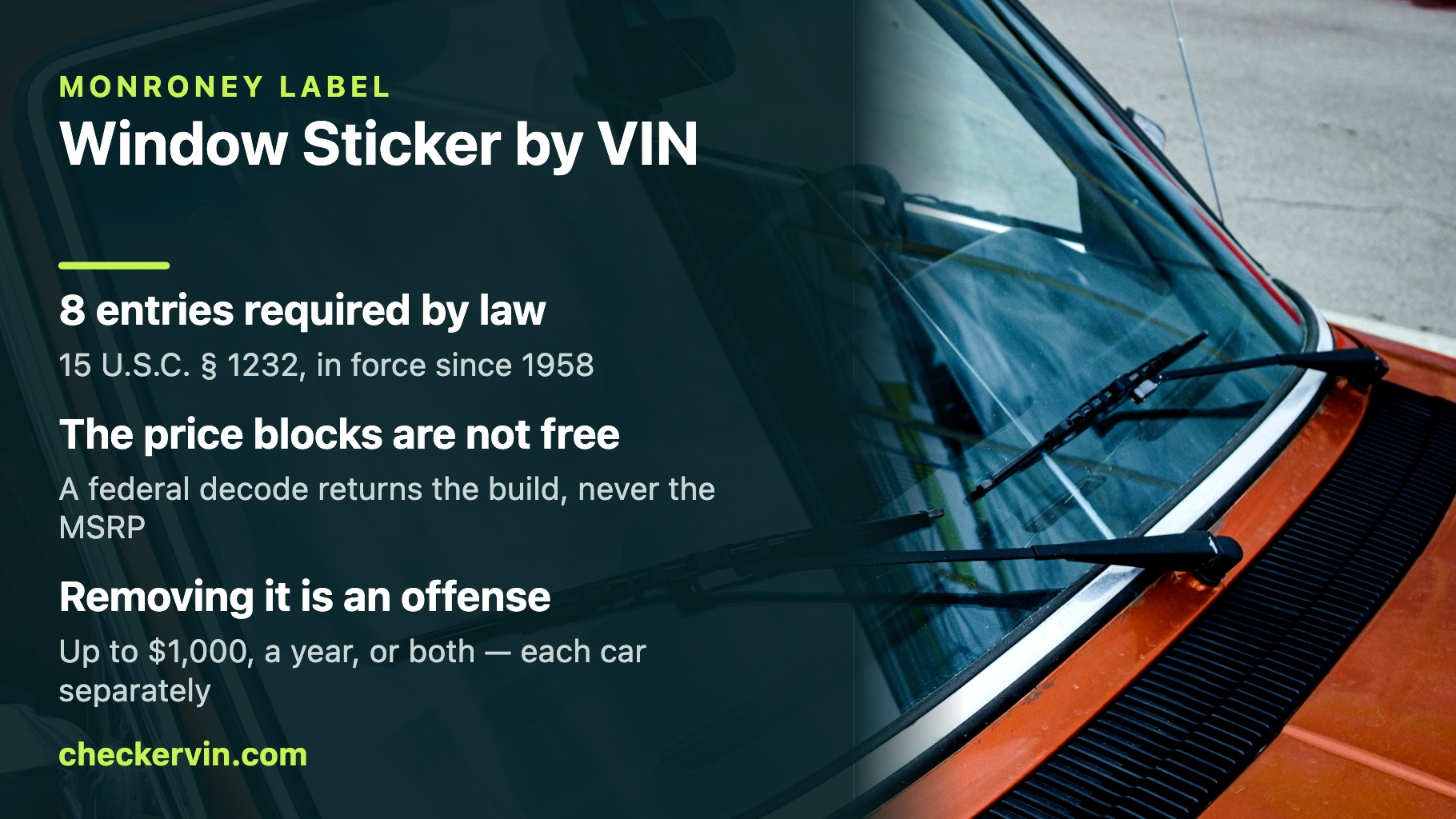
The label is not a marketing document that manufacturers happen to produce. It is compelled by statute. The Automobile Information Disclosure Act of 1958 — 15 U.S.C. § 1232, still the operative text — requires every manufacturer of new automobiles, before delivering any of them to a dealer, to “securely affix to the windshield, or side window” a label endorsed “clearly, distinctly and legibly” with a specific list of entries.
That list is worth reading literally, because it explains why the sticker carries some things people find odd. The statute enumerates the make, model and identification number; the final assembly point; the name and place of business of the dealer the car is going to; the city or town of delivery; and the method of transportation used to get it there. Only then does it reach the money: the suggested retail price of the vehicle, the suggested price of every accessory or item of optional equipment physically attached at delivery, the transportation charge to the dealer, and the total of those three.
The safety block was bolted on much later. Congress added it in 2005 and amended it in 2012, and it is unusually prescriptive about presentation: the ratings must appear as a graphic depiction of stars against the maximum possible rating, must name the test categories, must point the reader to further vehicle safety resources, and must be “legible, visible, and prominent” — covering at least 8 percent of the label, or an area at least 4½ inches long and 3½ inches high. If a vehicle was never crash tested, the statute requires the label to say so rather than leave a blank.
| Block | What it must contain |
|---|---|
| Base price | The manufacturer's suggested retail price for the model with standard equipment only |
| Standard equipment | What every example of that trim includes at no extra cost |
| Optional equipment | Each factory option fitted to this vehicle, itemized, with its individual price |
| Destination charge | The cost of transporting the vehicle from the plant to the dealer |
| Total MSRP | Base plus options plus destination — the figure the label is famous for |
| Fuel economy | EPA city, highway and combined estimates for that configuration |
| Safety ratings | NHTSA's 5-star crash ratings where the vehicle has been tested |
| Parts content | US/Canadian parts content, final assembly point, engine and transmission origin |
Taking it off before delivery is a federal offense
One clause explains why the sticker is still on the glass when you walk the lot, and why a missing one on a nominally new car is worth a question. Under 15 U.S.C. § 1233(c), any person who willfully removes, alters or renders illegible a label affixed under § 1232 — or any endorsement on it — before the automobile is delivered into the actual custody and possession of the ultimate purchaser commits an offense punishable by a fine of up to $1,000, up to one year in prison, or both.
Two details in that sentence do real work. The first is per vehicle: the statute states that removal with respect to each automobile constitutes a separate offense, so the exposure scales with the number of cars, not the number of decisions. The second is ultimate purchaser. The prohibition runs until the car reaches the buyer, which is why the label is yours to peel off and nobody else’s. There is one carve-out, for a manufacturer relabeling a vehicle it has rerouted, repurchased or reacquired.
The same section fines a manufacturer up to $1,000 for willfully failing to affix the label, and again for failing to endorse it clearly or for making a false endorsement — each vehicle a separate offense in both cases. The practical consequence for a used buyer is the reason the reproduced label is worth anything at all: the figures on it were produced under a legal duty of accuracy backed by criminal penalty, which is not true of the seller’s description, the badges on the tailgate, or the listing.
Why it matters most on a used car
On a new car the sticker is a price list. On a used car it becomes something more valuable: independent proof of what the vehicle actually is. Ten years and four owners later, the seller's description is a claim, the badges are removable, and the paperwork rarely mentions trim detail. The build record does not change.
That matters commercially. Two cars of the same year and model can differ by thousands of dollars in original equipment — a tow package, a safety suite, a larger engine, a premium interior — and the difference persists into the used market. Buying the lesser car at the price of the better one is an expensive mistake that one lookup prevents.
How to pull the window sticker from a VIN
- 1Take the VIN off the vehicleWindshield plate on the driver's side, or the sticker in the driver's door frame. Confirm both match the title document before you look anything up.
- 2Try the manufacturer's own lookup firstSeveral brands publish a free window sticker tool for their own vehicles, usually covering recent model years. When it works it returns the original label as a PDF.
- 3Decode the VIN for the build recordWhere no manufacturer tool exists — or the car is too old for it — decoding the VIN returns the same underlying data: engine, trim, drivetrain, body, factory options and assembly plant.
- 4Compare it against the car in front of youThis is the step people skip and the reason to do any of it. Walk the vehicle with the build data open and check that what is fitted matches what was ordered.
Which blocks a free decode reproduces — and which it cannot
“Free window sticker by VIN” is the most common way this is searched, and it deserves a straight answer rather than a signup form. The label is not one dataset. It is several, and they do not come from the same place or cost the same thing.
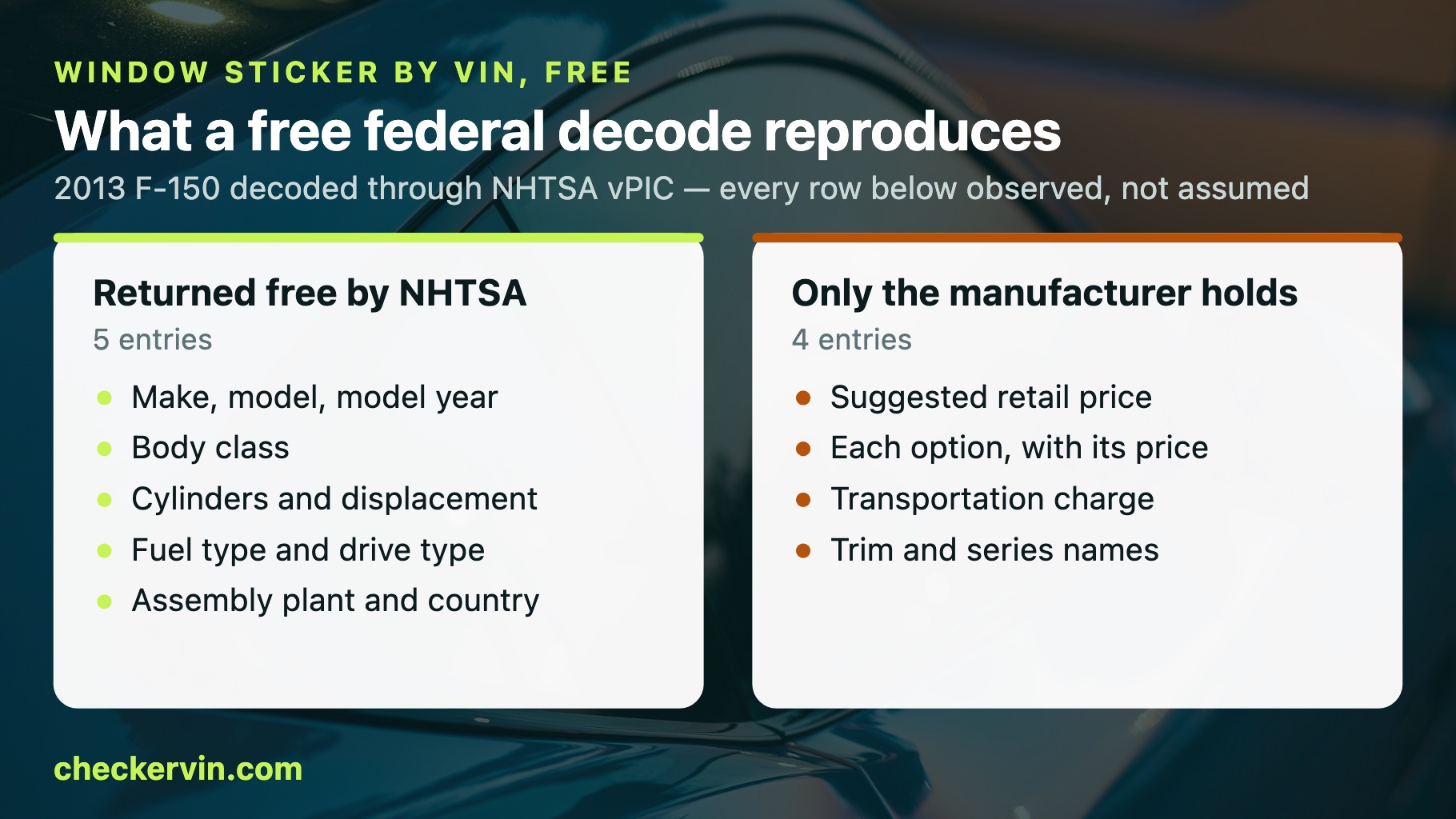
The identity and build entries — the ones § 1232 lists first — are published federally. NHTSA’s vPIC decoder is free, needs no account, and returns them from the VIN alone. The price entries are not published anywhere federally. They live in the manufacturer’s build record, which is why every service that sells a reproduced sticker is selling access to that half and not the other.
Decoding a 2013 F-150 through vPIC shows the split precisely. Make, model, model year, body class, cylinder count, displacement, fuel type, drive type, manufacturer and assembly plant all come back populated. Base price comes back empty.So do trim, series and destination market.
| Monroney entry, per 15 U.S.C. § 1232 | Free federal decode |
|---|---|
| (a) Make, model, identification number | Yes — returned by NHTSA vPIC |
| (b) Final assembly point | Yes — plant city and country returned |
| Engine, fuel, drivetrain, body class | Yes — returned as built |
| (f)(1) Suggested retail price | No — the field returns empty |
| (f)(2) Each option, itemized, with price | No — manufacturer build record only |
| (f)(3) Transportation charge to dealer | No — manufacturer build record only |
| (g) NHTSA safety ratings | Yes — published free, separately, by NHTSA |
| Trim and series names | No — often empty even where the car has one |
Read that table as a buying decision rather than a limitation. If the question is what is this car— which engine, which drivetrain, which plant, was it really the four-wheel-drive version — a free decode answers it from the same build record the sticker was printed from, and answers it in seconds. If the question is what did it list for and which options were ticked, no free federal source holds that, and anyone claiming to give you the price blocks for nothing is either reproducing them from a manufacturer feed or estimating.
Manufacturers that publish their own lookup
The price blocks live with the manufacturer, and several manufacturers hand them back for nothing. This is the route most guides gesture at without naming, and it is worth trying before paying anyone, because when it works you are reading the maker’s own regenerated label rather than somebody’s reconstruction of it.
Stellantis brands — Chrysler, Dodge, Jeep and Ram — expose a window sticker endpoint on their own domain that takes a VIN and returns the label as a PDF. Ford documents its own route through the owner support site, which is where its dealer-facing PTS OASIS lookup surfaces for consumers. Those two are the ones this page can point at with confidence; several other makers run equivalents that appear and disappear with website redesigns, so the durable instruction is the pattern rather than a URL that will rot.
- 1Start at the maker's own owner portalSearch the brand's site for 'window sticker' or 'Monroney' rather than a general web search, which surfaces resellers above the manufacturer. Registering the VIN to an owner account often unlocks it even when no public lookup is advertised.
- 2Expect a model-year floorManufacturer lookups are built on the current build-record system, so coverage usually stops somewhere in the 2000s or 2010s. Older vehicles fall back to reproduction services or to the free decode above.
- 3Ask the selling dealerFranchised dealers can pull the original label for a VIN through the manufacturer's dealer system. On a car they are trying to sell you, asking costs nothing and the answer is informative either way.
- 4Fall back to the build recordWhere no sticker is available at any price, the free decode still settles engine, drivetrain, body and plant — the facts that change what the car is worth.
The entries nobody reads, and what they tell a used buyer
Everyone reads the price and the options. The statute mandates four more entries that almost nobody looks at, and on a used car they are often the most interesting lines on the sheet, because they describe the vehicle’s first few weeks rather than its specification.
| Entry required by § 1232 | What it tells you years later |
|---|---|
| (b) Final assembly point | Which plant built it — useful when a model ran on two lines and they are not regarded as equal |
| (c) Dealer name and place of business | The dealership the car was originally shipped to, by name |
| (d) City or town of delivery | Where it entered service, which is the first real evidence of a salt-belt or coastal start |
| (e) Method of transportation | Whether it was driven or towed from the assembly plant to the dealer |
The delivery city is the one worth pausing on. A used listing tells you where the car is now; the label tells you where it began. A vehicle that spent its first winters in a state that salts its roads carries a different corrosion history from an identical one delivered somewhere that does not, and the underside is where that shows up rather than the paint. It does not settle the question — cars move, and a single owner can relocate twice — but it tells you which parts of the car to look at hardest.
The transportation entry exists because the statute distinguishes a car driven from the plant from one carried. Where it records that a vehicle was driven, those are miles the odometer holds that predate any owner, which is the mundane explanation for a nominally new car showing more delivery mileage than its neighbor on the lot.
Reading each block of the label
The layout varies by manufacturer but the anatomy is consistent. The top identifies the vehicle — model, trim, VIN, exterior and interior color codes, and the assembly plant. The left column lists standard equipment. The right column lists the options actually fitted, each with a price. The pricing block totals them.
Two smaller blocks carry the regulated ratings: EPA fuel economy with the familiar large city and highway numbers, and the NHTSA star ratings where the vehicle was crash-tested. The parts content statement usually sits at the bottom in small print.
MSRP is not what the car sold for
The total on the label is the manufacturer's suggested price. What the first owner actually paid could have been well below it in a slow market or well above it in a tight one, and dealer-added items were never part of it at all.
Use it as an anchor rather than a valuation. A high original MSRP tells you the vehicle was well equipped when new, which supports a higher used price today; it does not tell you what today's price should be. Current market value depends on mileage, condition, title status and what comparable cars are selling for now.
Standard versus optional — the expensive distinction
Buyers routinely pay for equipment the car never had. A trim name implies a package, the listing repeats it, and nobody checks. The option list on the window sticker is the record that settles it, because it itemizes only what was actually built into that VIN.
- Tow packages — frequently claimed, often just a hitch someone bolted on
- Safety suites such as adaptive cruise or blind-spot monitoring
- Upgraded audio, which changes the amplifier and speaker count
- Sunroof, panoramic roof and convenience packages
- Drivetrain and axle ratio options that affect capability and economy
- Appearance packages that changed wheels, trim and badging at the factory
Spotting badges and wheels added later
Badge swaps are cheap, common, and not always dishonest — plenty of owners simply like the look. They become a problem when the car is resold and the badge is taken as evidence of the trim.
The build record ends the argument in seconds. If the sticker says the car left the plant as a mid-level trim with the smaller engine, that is what you are buying, whatever is written on the tailgate. Check the engine displacement, the drivetrain and the wheel size against what is physically on the vehicle.
The fuel economy block, and why yours differs
The EPA figures on the label are produced under standardised test conditions for that exact configuration — engine, transmission and drivetrain combination. They are useful precisely because they are comparable between vehicles, not because they predict your commute.
Real-world economy on a used example depends on age, maintenance, tires, load and driving style. Treat a large gap between the label figure and what the car achieves as a prompt to investigate maintenance, not as proof of a fault.
Safety ratings printed on the sticker
NHTSA's New Car Assessment Program star ratings appear on labels for vehicles that were crash-tested. They cover frontal and side impact and rollover resistance, combined into an overall rating.
Two caveats matter on a used car. The rating describes the model as tested when new, not the condition of this particular example after a decade — and testing protocols have tightened over the years, so stars are not directly comparable across generations.
Parts content and assembly information
A separate law requires the label to state the percentage of US and Canadian parts content, the final assembly point, and the countries of origin for the engine and transmission. It was written for buyers who care where their money goes.
For a used-car buyer it has a second use: the assembly point is a fact you can check against the VIN itself, where one character encodes the plant. When the label and the VIN disagree about where a car was built, something is wrong with one of them.
What the window sticker will not tell you
The label is a birth certificate, not a life story. It is silent on everything that happened after the car left the factory, which is most of what determines whether a used vehicle is a good buy.
- Accidents, insurance claims and structural repairs
- Title brands such as salvage, flood, lemon or rebuilt
- Odometer readings and any rollback
- How many owners the car has had
- Open safety recalls issued after the sale
- Liens, theft records and auction history
Where this information comes from
- 15 U.S.C. § 1232 — label and entry requirementsThe Monroney statute itself: every entry the label must carry, and the 8 percent / 4½-by-3½-inch rule for the safety block
- 15 U.S.C. § 1233 — violations and penaltiesWhy the label stays on the glass: removal before delivery to the ultimate purchaser is a fine, up to a year, or both — per vehicle
- NHTSA — vehicle safety ratings and recallsThe source of the star ratings printed on the label
- EPA fuel economy dataOfficial city, highway and combined estimates by configuration
- NHTSA vPIC VIN decoderPublic build data decoded from the VIN
Keep reading
Frequently asked questions
Can I get the window sticker for a used car?
Yes. The Monroney label is generated from the vehicle's build record, so it can be reproduced from the VIN long after the original paper sticker was thrown away. What you get is the factory configuration as the car left the assembly plant.
Is a window sticker lookup free?
It should be. Several manufacturers publish their own free lookup for their vehicles, and a VIN decode will give you the same underlying build data — engine, trim, drivetrain, factory options and assembly plant — at no cost.
Why is it called a Monroney sticker?
After Senator Almer Stillwell “Mike” Monroney of Oklahoma, who sponsored the Automobile Information Disclosure Act of 1958. The law made the price and equipment label mandatory on every new car sold in the United States.
Is it illegal to remove a window sticker?
Federal law makes it an offense for any person to willfully remove, alter or render illegible the label before the car reaches the ultimate purchaser, punishable by a fine, up to a year in prison, or both — with an exception where the manufacturer relabels a car it has rerouted or reacquired. Once you own the car you can take it off — which is why so few used cars still have one.
Does the window sticker show accidents or owners?
No. It is a snapshot of the vehicle at birth: how it was built, what it cost new, and what it was rated for. Everything that happened afterwards — accidents, title brands, odometer readings — lives in vehicle history records instead.
See how the car left the factory
Decode any VIN for the factory build — engine, trim, drivetrain, assembly plant and open recalls. Free, no account.
Run a free VIN check