The short answer
- What does a rebuilt title mean?
- It means an insurer previously declared the vehicle a total loss, the car was subsequently repaired, and a state inspection certified it as roadworthy enough to be registered again. The brand records that history permanently on the title.
- Is a rebuilt title bad?
- It is a permanent discount and a permanent question mark. A well-repaired rebuilt car can be a genuine bargain; a badly repaired one can be dangerous. The title says which stage the paperwork reached, not how good the repair was.
- What is the difference between salvage and rebuilt?
- A salvage title marks a vehicle written off and generally not legal to drive on public roads. A rebuilt title is what that same vehicle receives after repair and a passing state inspection, which restores its ability to be registered.
Permanent
The brand never comes off
It follows the VIN for life
20–40%
Typical value discount
Versus a clean-title equivalent
Varies
Total-loss threshold by state
Often 70–100% of value
1992
Anti-Car Theft Act created NMVTIS
The national brand database
What a rebuilt title actually certifies
Two separate things happen to make a rebuilt title, and conflating them is where buyers get hurt. First, an insurance company decided the vehicle was not economically worth repairing and paid out a total loss. Second, somebody repaired it anyway and a state inspector agreed it could go back on the road.
What the state certified is narrow. The inspection typically confirms the vehicle meets basic roadworthiness requirements and that the parts used in the repair were not stolen. It is not an engineering assessment of structural integrity, and it is not a guarantee that the repair was done to any manufacturer standard.
How a vehicle earns a salvage title first
Every rebuilt title starts as a salvage title. An insurer assesses the damage against the vehicle's actual cash value, and when the repair estimate crosses the state's threshold, the vehicle is declared a total loss. The insurer takes ownership, the title is branded, and the car usually goes to auction.
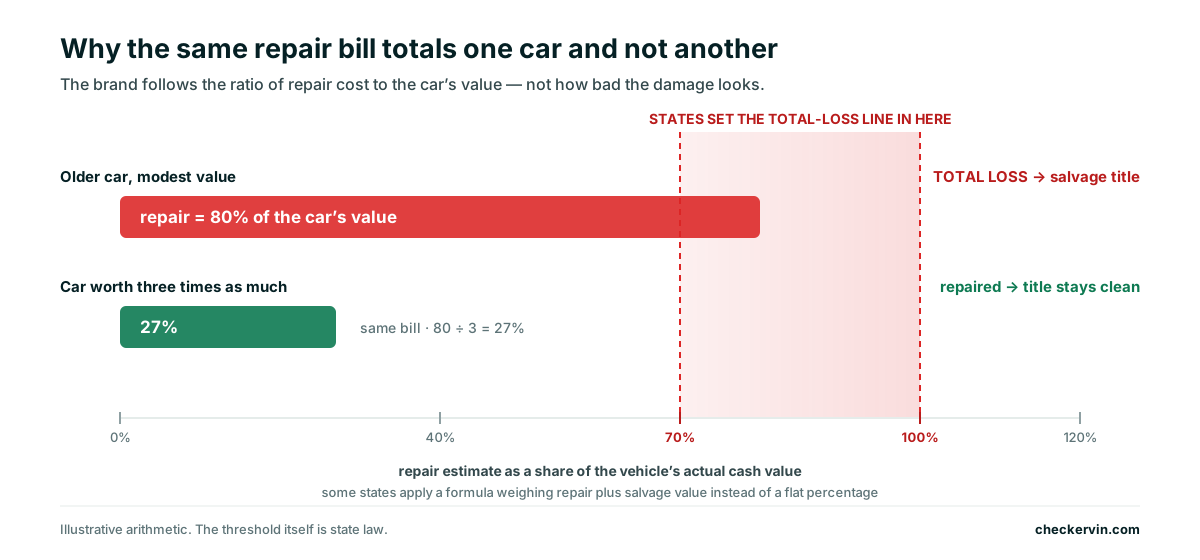
The threshold is a matter of state law and varies considerably — commonly somewhere between 70% and 100% of the vehicle's value, with some states applying a formula that weighs repair cost plus salvage value against actual cash value instead of a flat percentage. The practical consequence is that an identical crash can total a car in one state and not in the next.
Age matters as much as damage. A twelve-year-old car with modest value is totaled by a repair bill that a new vehicle would shrug off, which is why so many rebuilt-title cars on the market suffered relatively minor-looking damage.
Salvage, rebuilt and clean side by side
| Title status | What it means |
|---|---|
| Clean | No brand recorded. The vehicle has never been declared a total loss or otherwise flagged. |
| Salvage | Declared a total loss. Generally cannot be registered or legally driven on public roads until repaired and re-inspected. |
| Rebuilt | Previously salvage, since repaired and passed a state inspection. Can be registered and driven. The brand stays. |
| Flood / water damage | Damaged by immersion. Often the underlying cause of a salvage brand, and the hardest damage type to repair reliably. |
| Junk / non-repairable | Cannot legally be rebuilt or re-registered. Fit only for parts or scrap. |
| Lemon / manufacturer buyback | Repurchased by the manufacturer under a state lemon law after repeated unfixed defects. |
The state inspection that converts salvage to rebuilt
The rebuild inspection exists primarily as an anti-theft measure. Its historical purpose was to stop criminals from buying a wrecked car, stealing an identical one, and reissuing the stolen vehicle under the wreck's legitimate VIN.
- 1Proof of ownership and partsThe rebuilder must produce the salvage title and receipts for major components used in the repair, so each part can be traced to a lawful source.
- 2VIN and component verificationAn inspector confirms the VIN plates are intact and unaltered, and cross-checks major part numbers against theft records.
- 3Basic roadworthiness checkLights, brakes, steering, tires, glass and safety equipment are checked to state requirements. Depth of inspection varies widely by state.
- 4Branded title issuedOn passing, the state issues a new title carrying the rebuilt brand. The vehicle can be registered and insured, with the brand permanently attached.
Why the brand follows the car forever
Title brands are designed to be permanent and portable. The Anti-Car Theft Act of 1992 directed the creation of the National Motor Vehicle Title Information System, administered by the US Department of Justice, precisely so that a brand applied in one state could not be shed by moving the vehicle to another.
Insurance carriers, salvage yards and junk yards are required to report to NMVTIS, and state motor vehicle agencies check it before issuing a title. The system is not perfect and reporting lags exist, but the design intent is clear: once branded, always branded.
What a rebuilt title does to resale value
The discount is real, immediate and durable. A rebuilt-title vehicle commonly trades 20% to 40% below a comparable clean-title example, with the gap widening on desirable models where buyers have plenty of unbranded alternatives to choose from.
The part buyers underestimate is that the discount is inherited, not consumed. You save on the way in and give it back on the way out, because your buyer will apply the same discount you did. A rebuilt car only makes financial sense if you plan to keep it long enough for the saving to be worth the reduced liquidity — or if you never intend to sell it at all.
Trade-in is where it bites hardest. Dealers price branded vehicles conservatively because they are harder to retail, and some franchise dealers will not take them in at all, sending them straight to wholesale auction instead.
Insuring a rebuilt-title vehicle
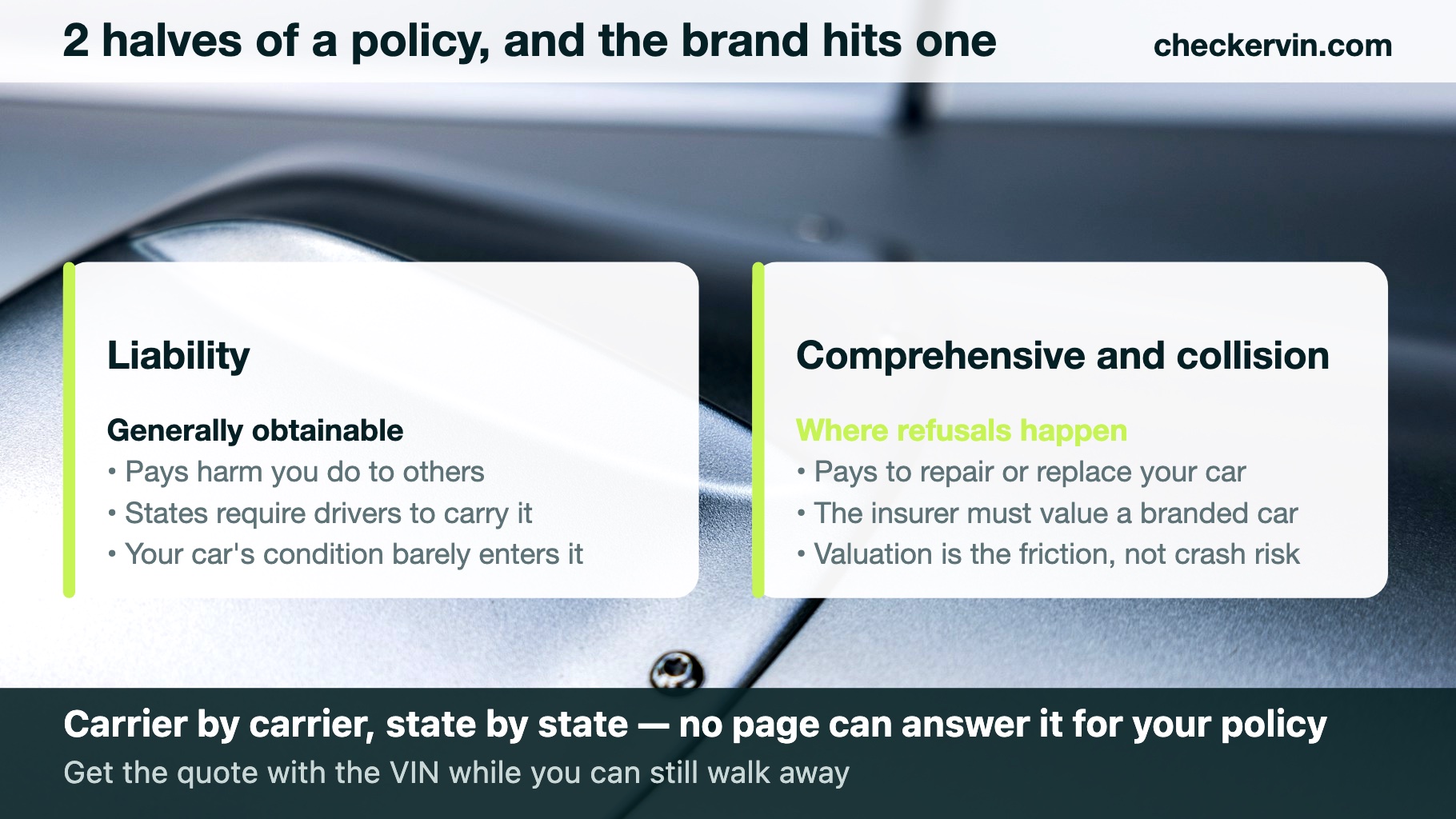
This is the question that decides whether a rebuilt car is usable at all, and it is worth separating into the two halves of a policy, because they behave completely differently.
| The coverage | How a rebuilt brand affects it |
|---|---|
| Liability — damage you do to others | Generally obtainable; states require drivers to carry it and insurers write it |
| Comprehensive and collision — damage to your own car | Where the friction is, and where refusals happen |
The asymmetry is not arbitrary. Liability pays for harm to somebody else, and the condition of your car barely enters the calculation. Physical damage coverage pays to repair or replace yourvehicle, so the insurer has to put a value on a car whose value is genuinely contested — and that is the whole problem.
We are deliberately not going to tell you what your premium will be, whether “most insurers” will cover you, or how much more a branded car costs to insure. Those answers are carrier-by-carrier and state-by-state, they change, and a national page that guessed at them would be worse than useless to somebody making a decision on one specific car in one specific state.
What we can give you is the structure, and the questions that get you a real answer rather than a reassuring one.
- Will you write liability on this VIN — and will you write comprehensive and collision?
- If you write physical damage, on what basis is the vehicle valued at claim time?
- Does the brand itself reduce the settlement, and by what mechanism?
- Is there a deductible or a coverage limit that differs from an unbranded car?
- Would you insure it for an agreed value instead, and what does that require?
- Ask for the answer in writing, or at least note the date, the name and the reference
The second question is the load-bearing one. Physical damage settlements generally turn on what the vehicle was worth immediately before the loss, and a rebuilt-title car was worth less than its clean-title twin on the morning of the accident. You are insuring the discounted car, not the car it resembles.
If the car is totaled a second time
Worth thinking through before you buy rather than after, because it is the scenario that decides whether physical damage coverage is worth carrying at all.
A rebuilt-title car that is written off again is valued as what it was: a branded vehicle. The settlement reflects the discounted market the brand created, not the clean-title price of the same model. So the payout you are insuring toward is smaller than an owner of an unbranded twin would receive, while the premium is not obviously smaller in proportion.
That is not an argument against coverage — a smaller payout is still a payout, and a total loss with no coverage is the whole purchase price gone. It is an argument for working out the numbers on the actual car before you commit, and for asking the valuation question above rather than assuming.
Financing a rebuilt-title vehicle
Most mainstream lenders will not finance a branded vehicle, for a simple reason: the car is their collateral, and branded collateral is worth less and harder to liquidate. Credit unions are sometimes more flexible, particularly for members with strong credit, and specialist lenders exist at higher rates.
In practice, rebuilt-title purchases are frequently cash transactions. Budget for that, and treat any seller offering unusually easy financing on a branded car with suspicion.
The original damage matters more than the brand
“Rebuilt” covers wildly different histories, and the title does not distinguish between them. Working out what actually happened is the single most valuable thing you can do before buying one.
| Original cause | What to worry about |
|---|---|
| Hail | Usually cosmetic panel damage. Among the lowest-risk causes, provided glass and seals were properly replaced. |
| Theft recovery | Depends entirely on what was stripped. A recovered car missing wheels and an infotainment head unit is very different from one with a cut harness. |
| Collision — front or rear | Check for frame or unibody straightening, airbag deployment and replacement, and radiator support alignment. |
| Collision — side impact | Higher concern. Side structures are engineered for a single impact and are difficult to restore to specification. |
| Fresh-water flood | Serious. Electronics, connectors and control modules corrode over years, producing faults long after purchase. |
| Salt-water flood | Effectively terminal. Salt-water immersion causes progressive corrosion that no repair reliably reverses. |
The federal plumbing that makes the brand stick
The section above says a brand is permanent. It is worth seeing the machinery, because knowing how it works tells you where it can fail.
Two reporting duties do the work. Under 28 CFR 25.54, each state must send titling information to the federal system once every 24 hours, and what it sends must include any description on the certificate of title including any and all brands associated with the vehicle. That phrase is the mechanism: a brand applied in one state travels into a record the next state checks.
Underneath that, 28 CFR 25.52 defines a salvage automobile as one designated a total loss by an insurer under the terms of its policies, regardless of whether or not the ownership of the vehicle is transferred to the insurance carrier. An owner who keeps a totaled car rather than surrendering it has still had a total loss designated, and the reporting duty is unaffected.
| The duty | What it means for a brand |
|---|---|
| State titling data, every 24 hours | A brand becomes visible nationally within about a day |
| “Any and all brands” must be included | A state cannot forward a clean-looking record for a branded car |
| Insurer and salvage-yard reporting | The loss is recorded even if no new title is issued yet |
| Total loss counts regardless of ownership transfer | Keeping the car does not keep it off the record |
What a dealer has to tell you, and what they do not
Buying a rebuilt car from a dealer brings the federal Used Car Rule into play, and it is worth knowing its shape because it is narrower than buyers expect and sharper in one specific place.
Under 16 CFR 455.2, a dealer must display a Buyers Guide on the vehicle. Under 16 CFR 455.3, the information on the final window form is incorporated into the contract of sale and overrides any contrary provision in it. And under 16 CFR 455.1, it is a deceptive act or practice for a used vehicle dealer to misrepresent the mechanical condition of a used vehicle.
That last one is the sharp edge, and it is not switched off by an as-is sale. A dealer who tells you a branded car was “only cosmetic” or “never really damaged” is making a statement about the vehicle’s condition, and the As Is box has nothing to say about a statement.
- Ask what the vehicle was branded for, and ask for it in writing on the Buyers Guide
- A verbal reassurance that contradicts the form is worth less than the form
- Private sellers are outside the Rule entirely — the five-vehicle test decides who is a dealer
- Whatever you are told, the state inspection that produced the brand is a records question you can pursue
Title washing, and how to catch it
Title washing is the practice of moving a branded vehicle through states with weaker or differently-worded branding rules until the brand drops off a reissued title. The car then appears clean while carrying exactly the same damage history.
Two signals give it away. The first is a title history that hops between states in quick succession with no plausible reason. The second is a mismatch between the paper title in front of you and what the national record holds for that VIN — which is the entire reason to check the VIN rather than trust the document.
- Multiple state transfers in a short window with no corresponding owner change
- A recent title issued in a different state from where the car is being sold
- A seller reluctant to let you run the VIN, or who supplies a report screenshot rather than the VIN itself
- A clean title on a vehicle with obvious repair evidence — mismatched panel gaps, overspray, replaced structural components
- An unusually low price on a clean-title car with no explanation
How to inspect a rebuilt car before you buy
Never buy a branded vehicle on a test drive alone. The cost of a proper inspection is trivial against the cost of discovering a bent unibody after the money has changed hands.
- 1Run the VIN before you travel to see itConfirm the brand, the states involved, and whether anything on the record contradicts the seller's story.
- 2Ask for the rebuild documentationThe salvage title, the repair invoices, the parts receipts and the inspection certificate. A legitimate rebuilder keeps all of it. Refusal to produce it is an answer in itself.
- 3Pay an independent shop for a pre-purchase inspectionNot the seller's mechanic. Specify that you want the vehicle on a lift, with frame and structural inspection, and a scan for stored fault codes.
- 4Verify the airbag systemConfirm the warning light performs its normal self-test and extinguishes. Deployed airbags that were never properly replaced are one of the most dangerous shortcuts in the rebuild trade.
- 5Check for water lines and corrosionUnder carpets, in the spare wheel well, on seat rails and inside connectors. Silt and rust in places that never get wet indicate flood exposure.
- 6Confirm insurance and financing before signingGet a bindable quote with the actual VIN, and secure funding. Discovering the car is uninsurable after purchase is a costly lesson.
When a rebuilt title is genuinely worth it
There is a real case for buying branded, and it is not a rare one. If you keep cars for a decade, pay cash, use liability-only coverage on an older vehicle anyway, and you have documentation plus an independent inspection confirming the repair quality, the discount is money you keep.
The case collapses when any of those conditions fails. If you need financing, need full coverage, plan to trade the car in three years, or cannot verify what was damaged and who fixed it, the discount is compensation for risk you are taking blindly.
Reconstructed, revived, prior salvage — the words differ, the meaning does not
States use different words for the same status, which makes listings harder to read than they should be. You will encounter “rebuilt”, “reconstructed”, “revived salvage” and “prior salvage” among others, all describing a vehicle that was written off and put back on the road.
Treat any of those words as the same warning. What varies between states is the label and the rigor of the inspection behind it — not the underlying fact that an insurer once decided this vehicle was not worth repairing.
“Reconstructed” is the variant people most often assume means something milder, and it is worth being direct: a reconstructed title is a rebuilt title under a different state’s vocabulary. Searching for one returns results about the other, because that is how the market and the state agencies actually use them.
There is a reason the naming is this inconsistent, and it is not carelessness. Federal law defines the way intothe branded population and says nothing about the way out. 28 CFR 25.52 defines a “salvage automobile” and a “junk automobile” precisely — but the words “rebuilt” and “assembled” do not appear anywhere in Part 25, and neither does “reconstructed” in the vehicle sense. The federal system records that a vehicle was written off; what it is called after it is repaired is left entirely to the states, which is exactly why fifty answers exist.
The practical consequence for a buyer is that the label tells you which state issued it, not how badly the car was damaged or how well it was put back together. Those questions are answered by the damage record and an inspection, not by the word on the title.
Where this information comes from
- eCFR — 28 CFR Part 25 subpart B, NMVTIS25.52 defines a salvage automobile as a total loss regardless of whether ownership transfers to the carrier; 25.54 requires states to send titling data every 24 hours including any and all brands
- eCFR — 16 CFR Part 455, the FTC Used Car Rule455.1 makes misrepresenting a vehicle's mechanical condition a deceptive practice; 455.2 requires the Buyers Guide; 455.3 puts the window form into the contract
- NMVTIS — National Motor Vehicle Title Information SystemThe US Department of Justice system that makes title brands portable between states
- NHTSA recall lookupFree open-recall check by VIN, independent of title status
- NICB VINCheckFree theft and salvage lookup covering participating member insurers
Keep reading
Frequently asked questions
Can you insure a rebuilt-title car?
Liability is generally obtainable, because states require drivers to carry it and insurers write it. Comprehensive and collision — cover for damage to your own vehicle — is where refusals happen, because the insurer has to put a value on a car whose value is genuinely contested. Availability is carrier-by-carrier and state-by-state, so get a quote with the VIN before you buy rather than after.
Does a rebuilt title reduce an insurance payout?
Physical damage settlements generally turn on what the vehicle was worth immediately before the loss, and a rebuilt-title car was worth less than its clean-title equivalent on the morning of the accident. You are insuring the discounted car. Ask your carrier directly on what basis the vehicle would be valued at claim time, and whether an agreed value is available.
Can a rebuilt brand be removed by moving states?
It is designed not to be. Under 28 CFR 25.54 each state must send titling information to the federal system once every 24 hours, and that data must include any description on the certificate of title including any and all brands. Reporting lags exist, which is a reason to re-check close to purchase, but the design intent is that a brand travels with the VIN.
Does an as-is sale let a dealer hide a rebuilt title?
No. Under 16 CFR 455.1 it remains a deceptive act or practice for a used vehicle dealer to misrepresent the mechanical condition of a used vehicle, and the As Is box disclaims warranties rather than licensing statements. A dealer telling you a branded car was only cosmetic is making a statement about condition, and the box has nothing to say about it.
Is it safe to buy a car with a rebuilt title?
It can be, but the title alone tells you nothing about repair quality. State inspections generally confirm the vehicle is roadworthy and that no stolen parts were used — they are not a warranty. Whether a specific rebuilt car is safe depends on what was damaged, who repaired it, and what an independent mechanic finds on a lift.
Can a rebuilt title be changed back to clean?
No. Once a title carries a salvage or rebuilt brand, that brand is permanent and follows the vehicle for the rest of its life, including across state lines. Any seller claiming a brand can be legitimately removed is describing title washing, which is fraud.
How much less is a rebuilt-title car worth?
Commonly 20% to 40% less than a comparable clean-title vehicle, though the gap varies by model, age and how visible the original damage was. The discount tends to persist — you inherit it again when you sell.
Will insurance cover a rebuilt-title vehicle?
Liability coverage is usually available. Comprehensive and collision are the problem: some carriers decline them outright, others require an inspection and photographs first, and payouts on a future total loss are calculated from the vehicle's reduced branded value.
Does a rebuilt title mean the car was in a crash?
Not necessarily. Vehicles are written off for flood, fire, hail, theft recovery and vandalism as well as collision. The cause matters enormously — hail damage and salt-water flooding produce very different long-term risks — and it is not printed on the title.
Check the title before you check the tires
Run any VIN free and see what the record holds — build data, open recalls and title status. No account required.
Run a free VIN check