The short answer
- Is VinFreeCheck really free?
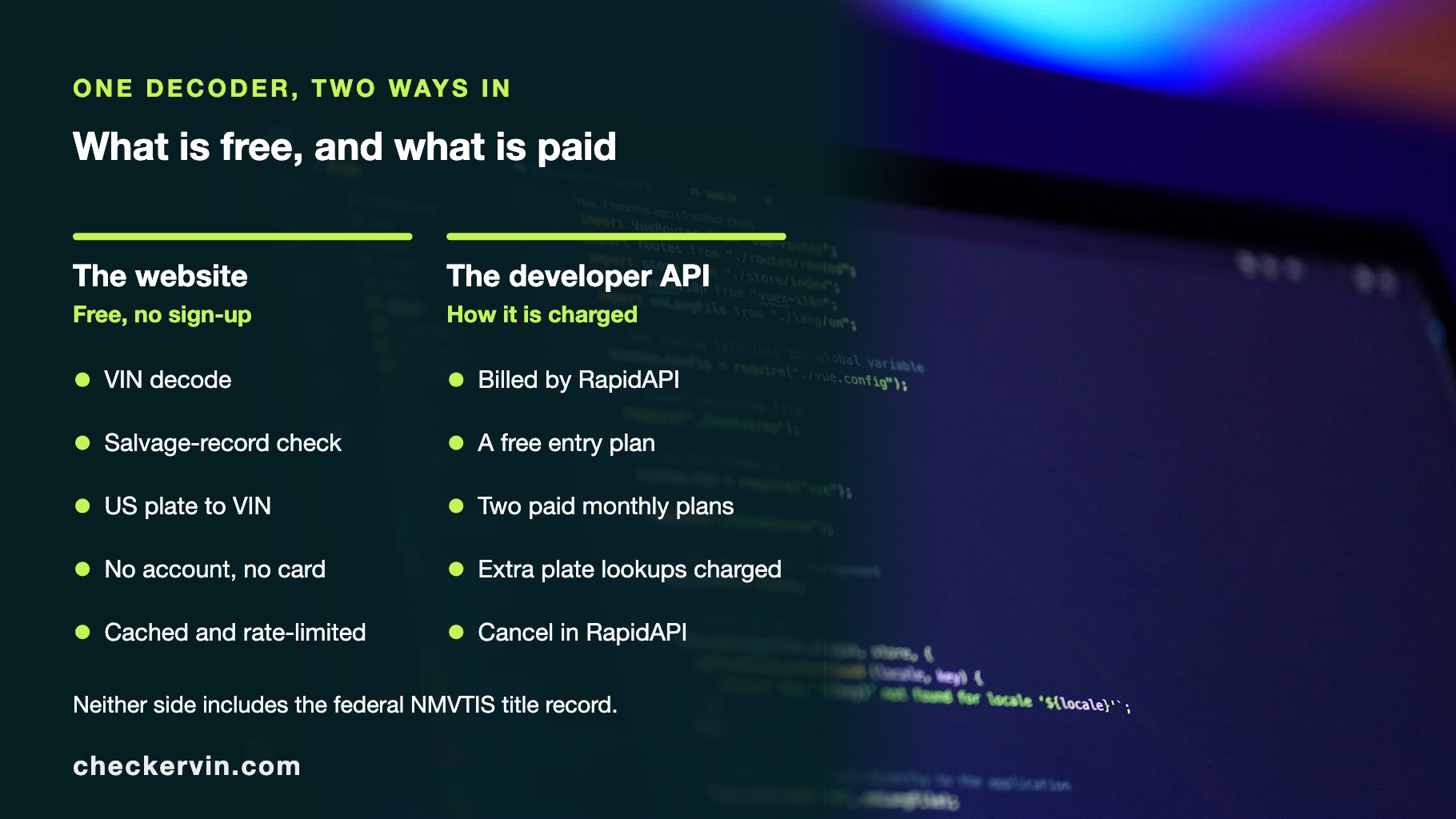
- Yes for the website: the decoder, salvage check and plate lookup need no sign-up and no card. The paid product is a developer API sold through RapidAPI.
- Who runs it?
- Its privacy policy says VinFreeCheck.com is owned by VinFreeCheck, LLC. Its terms do not name a state or an address.
- Is it an NMVTIS provider?
- No. It is not on the Department of Justice's approved list, and none of its pages we read claims federal title data. It is a decoder with its own salvage records.

Free
Website VIN, salvage and plate tools
No sign-up, rate-limited
RapidAPI
Where the paid API is sold
Free entry plan, two paid plans
LLC
Named owner
VinFreeCheck, LLC, per its privacy policy
Not listed
DOJ NMVTIS provider status
And it does not claim to be
The short verdict
VinFreeCheck is honest about what it is. The site is a free front end for a VIN decoding API, and the API is the business. You can decode a VIN, look up a US plate’s VIN and check its salvage records without an account, a card field or, according to its privacy policy, a single cookie.
The limit is scope, not money. VinFreeCheck does not sell or show the federal NMVTIS title record, does not check recalls, and answers its free lookups only from VINs already in its cache. Its salvage check searches records it does not source on the page. So it is a good first look at what a car is, and a partial look at what has happened to it.
Who runs VinFreeCheck
The answer is in the privacy policy rather than the terms. Its opening line reads that VinFreeCheck.com is owned by VinFreeCheck, LLC, and the rest of the policy uses “we” for that company. The policy shows a first publication date of February 19, 2020 and was last updated on October 31, 2026. The terms and conditions page, first published June 9, 2025 and updated October 30, 2026, refers only to “VinFreeCheck” and does not name a state of organization, a mailing address or a governing jurisdiction.
The site has no about page in its navigation. Its footer describes it in one line: free VIN checks, salvage lookups and US plate searches, with the decoder behind them sold as an API for developers. That framing runs through every page we read, which is useful: it tells you that the people behind the site make money from developers, not from a consumer upsell.
Is VinFreeCheck really free? The answer from its own pages
This is what most people searching the name want to know, and the site answers it in plain words. Its homepage FAQ says decoding a VIN, checking its salvage records and looking up a US plate are free, with no sign-up. Its pricing page repeats it: the free VIN check and the other free tools are free with no sign-up, rate-limited, and answered from its cache.
The privacy policy backs that up with something checkable. It says the website has no accounts, sign-up forms or mailing lists and never asks for your name, email address or payment details. A site that never collects a card cannot bill one, which is a firmer promise than the word “free” on its own.
| Free on vinfreecheck.com | Paid, through RapidAPI |
|---|---|
| VIN decode on the website | VIN decoding from your own code, beyond the free plan's quota |
| Salvage check on the website | Salvage checks from your own code, beyond the free plan's quota |
| US plate-to-VIN lookup on the website | Plate lookups past a plan's allowance, charged per lookup |
| No account, no card, rate-limited | A RapidAPI subscription, key and invoice |
So the honest one-line answer is yes, with two qualifiers. The free tools are rate-limited and only return VINs already in its cache, and they cover specifications, its salvage records and plates rather than a vehicle’s full history. If you want to compare that with other genuinely free routes, our free vehicle history report guide lays out what costs nothing anywhere.
The four free tools, in its own words
The homepage lists four tools under “Four free tools.” Here they are with the site’s description of each, condensed:
| Tool | What VinFreeCheck says it returns |
|---|---|
| VIN decoder | Year, make, model, engine and factory specifications from a 17-character VIN |
| License plate lookup | The VIN behind a US plate in any of the 50 states, then decoded |
| Motorcycle VIN check | Motorcycle VIN decoding, with a page per brand |
| Salvage check | Whether the VIN is in its own salvage records, with title, mileage, damage and loss type if so |
The 4 tools sit alongside make pages that explain how each brand builds its VINs, motorcycle brand pages and a plate page for every state. The homepage FAQ adds a technical limit worth knowing: it validates the North American check digit in position 9, so it is built for 17-character VINs on vehicles sold in the US and Canada. A European or Japanese-market VIN that does not use that check digit is outside what it says it handles.
The plate lookup is a route to a VIN, not to a person. VinFreeCheck says it finds the VIN for the plate and then decodes it, US plates only. Nothing on the pages we read suggests it returns owner details, and our own license plate lookup guide explains why owner information from motor-vehicle records is restricted.
The cache and the rate limit: the real catch
The one place where “free” comes with a condition is the cache. The homepage FAQ says the free tools answer from VINs the site has already decoded, and that if yours is not there yet, the API can decode it live. Every tool page carries the same label above the input: cached lookups, rate-limited.
In practice that means a common late-model car is likely to decode, because somebody will have looked one up before, while a rare trim, an older import or a fresh VIN may come back as not in the cache. That is not a trick, and the site explains it plainly. It does mean a miss on the free tool tells you about its cache, not about the car.
What “our salvage records” means, and what it does not
The salvage check is the tool most likely to be mistaken for a history report, so it is worth reading precisely. The page says you enter a VIN to see whether it is in “our salvage records,” and that a match returns:
- The title recorded at the time of the loss
- The mileage on record
- Primary damage
- Secondary damage
- Loss type
The sample on the page shows exactly that shape: a title line, an odometer reading, a primary damage area and a loss type such as collision. It reads like a record from the point where a damaged car changed hands, which is useful if the car you are looking at is in it.
Two things are missing from the page. The first is a named source: the salvage page does not say where the records come from, and the terms say only that the site gathers and aggregates information from government agencies, industry sources and other non-profit organizations. The second is completeness, and here the site is candid. Directly under the input it says that not being listed does not prove a vehicle was never salvaged. Take that sentence at its word. A clean result here is the absence of a record in one company’s collection, not a statement about the title.
The record that is built to answer the title question is NMVTIS, which state titling agencies, insurers and junk and salvage yards must report into. Our salvage title VIN check guide shows how the free and federal routes fit together.
The paid part: a developer API sold on RapidAPI
VinFreeCheck’s paid product is not a report. It is the decoder itself, sold to developers who want to decode VINs, check salvage records and look up plates from their own software. The API page describes three endpoints behind one key and a decode that returns 22 fields, from year and make to dimensions, fuel economy and a features list.
We do not print other companies’ prices, because they change and we cannot vouch for them. Here is how the pricing page says the API is charged:
- Three plans, all sold and billed through RapidAPI, not on VinFreeCheck itself
- The entry plan costs nothing and carries small monthly quotas
- Two paid plans bill monthly and count decodes and salvage checks per day
- Plate lookups past a plan's monthly allowance are charged per lookup
- Every plan covers all three lookups (decode, salvage, plate) on one key
- Upgrades, downgrades and cancellation happen in your RapidAPI account
The billing arrangement is worth a sentence because it is unusual. The pricing page says RapidAPI takes the payment, issues the key and tracks usage, that there is no VinFreeCheck account to manage, and that VinFreeCheck never sees your card. Disputes, invoices and cancellations therefore go through RapidAPI. Check its listing for current plan prices before subscribing.
Privacy and terms: what you agree to
The privacy policy is short and specific. Here is what it says the website does and does not do:
- No accounts, sign-up forms or mailing lists
- Never asks for your name, email address or payment details
- Sets no cookies and runs no third-party analytics or advertising
- Logs requests (IP address, page, time, browser) like most web servers
- Sends the VIN, plate or state you type to its servers to look it up
- Loads a Cloudflare bot check only when you run a lookup
The bot check is Cloudflare Turnstile, which the policy says runs in your browser, sends Cloudflare technical signals such as your IP address and user agent, and is not loaded until you run a lookup. That is also why we could not test the tools automatically.
The terms add three things a buyer should know. Use of the site is offered for personal, non-commercial purposes, and reselling it or using it commercially is not allowed; the product the site offers for commercial volume is the API. The disclaimer says the accuracy of the data depends on its sources and that no entity involved accepts liability for errors. And the terms can change without notice, so the dates above are the versions we read.
Is VinFreeCheck on the NMVTIS approved-provider list?
No. On November 24, 2026, the Department of Justice’s page of approved NMVTIS data providers named 12 businesses for public and commercial customers, plus the additional websites some of them own, and a separate tier for commercial customers only. VinFreeCheck does not appear in any of those places.
Fairness matters here. Being off the list is only a problem for a site that sells NMVTIS reports or implies it does, and VinFreeCheck does neither: none of the pages we read mentions NMVTIS, and it never describes its output as a title report. It is a decoder with its own salvage records, and the approval does not govern decoders. What the absence does tell you is that the federal title record is not something VinFreeCheck can give you, because only listed providers can sell it.
The department says an NMVTIS report is intentionally concise and covers five indicators: the current state of title and last title date, brand history, the latest odometer reading, total loss history and salvage history. For those, go to a listed provider. Our NMVTIS report guide explains each indicator, and our VinCheck.info review covers a free site that, unlike this one, is owned by a listed provider.
What VinFreeCheck does not check
Put the pieces together and the gaps are clear. None of these is hidden; they are simply outside what the site offers:
| Question about the car | Does VinFreeCheck answer it? |
|---|---|
| What year, make, model and engine is it? | Yes, if the VIN is in its cache |
| Is it in a salvage record? | Only its own records; not listed is not proof of a clean history |
| Has a state branded the title? | No; that is the NMVTIS title record |
| Is the odometer reading consistent over time? | No; one mileage figure appears only on a salvage match |
| Does it have open safety recalls? | No recall tool among its four |
| How many owners, and any liens? | Not offered |
| Is it a non-North American VIN? | Outside what its check-digit validation is built for |
Recalls are the easiest gap to fill, because they are free from NHTSA and on our recall check by VIN page. The title questions cost a small fee from a listed provider. Our cheap VIN check guide covers which low-cost reports carry that record.
Is VinFreeCheck legit? Weighing what can be checked
“Legit” is really three questions: is it a real business, does it do what it says, and is it safe to type a VIN into. Here is what the record supports.
| What we checked | What we found |
|---|---|
| Named owner | VinFreeCheck, LLC, per its privacy policy |
| Published, dated terms and privacy policy | Yes, both updated in October 2026 |
| Asks for payment on the website | No, per its privacy policy |
| Cookies, ads or third-party analytics | None, per its privacy policy |
| Approved NMVTIS provider | No, and it does not claim to be |
| Source of its salvage records | Not stated on the pages we read |
| Accuracy of a live lookup | Not tested; each lookup is behind a human check |
On that evidence it reads as a legitimate small data business whose consumer site is a showcase for its API, with marketing that matches what it sells. What we cannot vouch for is the depth of its salvage records, because the site does not say where they come from, or how a given lookup performs. Treat its answers as one input, not a clearance.
VinFreeCheck and CarCheckerVIN, compared fairly
Both sites decode VINs for free, and neither sells a full history report today. Here is the straight comparison.
| CarCheckerVIN today | VinFreeCheck |
|---|---|
| Price: free, no card field | Price: free on the website; API billed through RapidAPI |
| Factory build and specifications: yes | Factory build and specifications: yes, from its cache |
| Open safety recalls: yes | Open safety recalls: not offered |
| Factory warranty terms: yes | Factory warranty terms: not offered |
| Value: market and listing prices | Value: not offered |
| Salvage records: no | Salvage records: its own collection, source not stated |
| Title brands and odometer history: launching soon, not available yet | Title brands and odometer history: not offered |
| Plate to VIN: see our plate lookup guide | Plate to VIN: yes, US plates |
What our free scan returns today:
- Factory build and specifications decoded from the VIN
- Factory warranty terms
- Open NHTSA safety recalls
- Photos filed against the VIN
- Market and listing prices
Free decode and recall check, no card
Decoded from official manufacturer and NHTSA records
Where VinFreeCheck fits in a used-car check
- Decode the VIN free and confirm the year, model and engine match the listing and the title
- Check open recalls free, which VinFreeCheck does not do
- Run a salvage lookup, VinFreeCheck's included, and treat a miss as no record found rather than a clean bill
- Buy one NMVTIS report from a listed provider for the car you are serious about
- Have an independent mechanic inspect it, which no database replaces
The Department of Justice puts the same advice in its own words, encouraging buyers to get an independent inspection and an NMVTIS report and to consult other available vehicle information. VinFreeCheck can be one of those other resources; it cannot be the report.
Who VinFreeCheck suits
It suits two kinds of user well. A developer who needs VIN decoding, salvage lookups or plate-to-VIN in an app gets a free plan to test with and clear billing through RapidAPI. A buyer who wants a quick, private check of what a car is, without handing over an email address, gets exactly that.
It suits less well anyone who reads “free VIN check” as “free history report.” Title brands, odometer history, ownership and recalls are not in it, and its salvage result is only as complete as records it does not source on the page. For other services assessed the same way, see Carfax alternatives.
Where this information comes from
- U.S. Department of Justice — approved NMVTIS data providersVinFreeCheck does not appear in either tier or among the additional websites; read November 24, 2026
- NMVTIS — understanding a vehicle history reportThe five indicators a federal title report covers, and who must report into it
- VinFreeCheck — homepageThe four free tools, the cache explanation and the check-digit limit
- VinFreeCheck — pricingHow the API plans are structured and billed through RapidAPI; no figures printed here
- VinFreeCheck — privacy policyNames VinFreeCheck, LLC as owner; no accounts, cookies or ads; updated October 31, 2026
- VinFreeCheck — terms and conditionsPersonal-use clause and data disclaimer; updated October 30, 2026
- VinFreeCheck — salvage checkThe fields a match returns, and its own caveat on unlisted VINs
- VinFreeCheck — VIN decoding APIThe three endpoints and what a decode returns
- NHTSA vPIC — public VIN decoderThe free federal decoder to use when a VIN is not in VinFreeCheck's cache
- How we made this pageWritten by the CarCheckerVIN editorial team with AI assistance from the Department of Justice's NMVTIS pages, VinFreeCheck's own published pages and other public records; facts checked November 2026.
Keep reading
Frequently asked questions
Is VinFreeCheck really free?
The website's tools are. Its homepage and pricing page both say the VIN decoder, salvage check and US plate lookup are free with no sign-up, and its privacy policy says the site never asks for payment details. What costs money is the developer API, which is sold through RapidAPI on a free entry plan and two paid monthly plans.
Is VinFreeCheck legit?
It is a real, named business: its privacy policy says VinFreeCheck.com is owned by VinFreeCheck, LLC, and it publishes dated terms and a privacy policy. It is not on the Department of Justice's list of approved NMVTIS data providers, and it does not claim to be. It sells a decoder and its own salvage-record lookup, not a federal title report.
Does VinFreeCheck give a full vehicle history report?
No, and it does not say it does. The pages we read offer a factory-spec decode, a check against its own salvage records, a plate-to-VIN lookup and a motorcycle decoder. There is no title-brand history, odometer history, ownership history or recall check among its tools.
Where does VinFreeCheck get its salvage data?
Its salvage-check page calls them "our salvage records" without naming a source. Its terms say, in general, that it aggregates information from government agencies, industry sources and non-profit organizations. The site also warns that a VIN not being listed does not prove the vehicle was never salvaged.
Why does VinFreeCheck say a VIN is not in its cache?
Its FAQ explains that the free tools answer only from VINs it has already decoded. If yours has not been looked up before, the free tool may not have it, and the site points you to the paid-capable API, which can decode it live.
Do I need an account or a card to use VinFreeCheck?
Not for the website. Its privacy policy says the site has no accounts and never asks for payment details. The API is different: you subscribe on RapidAPI, which issues the key and, on a paid plan, bills your card. VinFreeCheck says it never sees the card.
Start with the free layer
Decode any VIN free for the factory build, specifications and open safety recalls. Full vehicle history reports are launching soon.
Run a free VIN check