The short answer
- What is the cheapest real VIN check?
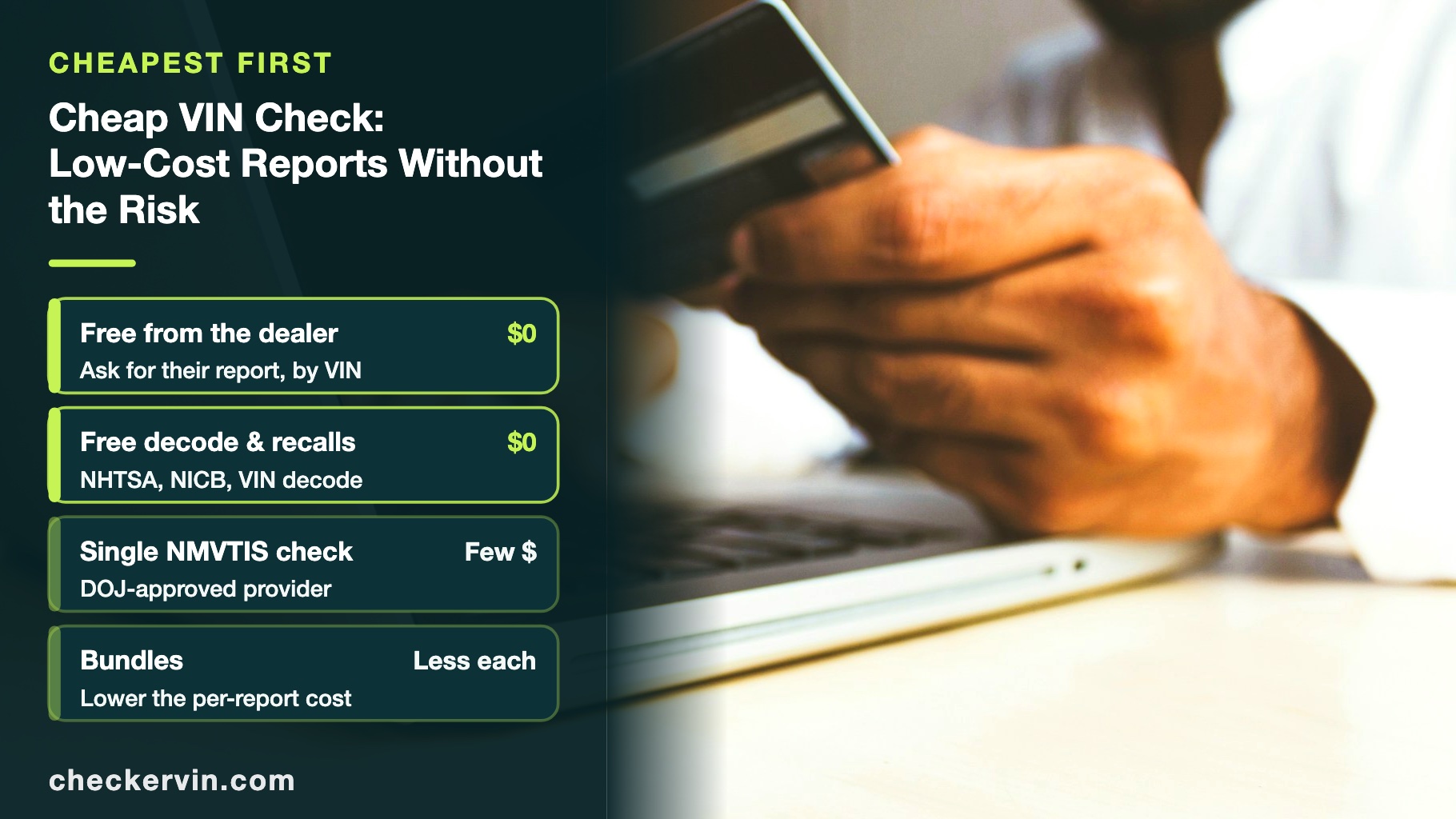
- Free first: NHTSA recalls, the NICB theft screen and a VIN decode. Then a federal NMVTIS title record from a DOJ-approved provider, bought singly or in a bundle that lowers the cost per report.
- Is a cheap Carfax safe to buy?
- A free one from a dealer, yes. A copy resold by a stranger for a few dollars is a report you cannot verify: not the VIN it was run on, not its date, not whether it was edited.
- What does a cheap report miss?
- Service records and minor accidents. The federal record covers title, brands, odometer, total loss and salvage, which are the costly frauds.
$0
Recalls, theft screen, decode
NHTSA, NICB, and this site
Few $
Federal NMVTIS title record
From a DOJ-approved provider
Bundles
Lower the per-report cost
Offered by some approved providers
Dealers only
Carfax on the federal list
Commercial customers in California
Cheap is fine. Whose data it is decides everything
Most buyers searching for a cheap Carfax are not trying to cut corners. They are looking at four or five cars, they know a premium report on each would cost more than a tank of gas several times over, and they want to know whether the car is worth driving to see. That is a sensible instinct, and the market has a legitimate answer to it.
The answer is not “Carfax, but less.” It is a different product. The federal government runs a title database that states, insurers and salvage businesses have to report into, and it licenses a short list of companies to sell reports from it. Those reports cost a few dollars because the data is mandated rather than gathered one dealer at a time. They hold less than a premium report, but what they hold is the part that catches the expensive frauds: washed titles, rolled odometers, cars an insurer already wrote off.
So the useful question is never “what is the cheapest report?” It is “which cheap report comes from someone allowed to sell it?” Get that right and the cheapest VIN check is also a good one. Get it wrong and the low price is the least of what you lose.
What a cheap vehicle history report can and cannot include
The Department of Justice describes an NMVTIS report as intentionally concise, built around five indicators. That list is the honest ceiling of what a few-dollar federal report gives you, and it is worth knowing before you compare one against a premium report and feel short-changed.
| In an NMVTIS report | Not in NMVTIS, by design |
|---|---|
| Current state of title and the last title date | Repair history from garages and dealers |
| Brand history: junk, salvage, flood and other state brands | Routine maintenance and service visits |
| Odometer readings as reported at title events | Recall information, which NHTSA publishes free anyway |
| Total loss history reported by insurers | Minor damage that never led to a total loss |
| Salvage history from yards and recyclers | Ownership type, usage and the detail premium networks assemble |
The left column comes from state titling agencies, junk and salvage yards, auto recyclers and insurance carriers. The right column is what commercial networks charge more for, and the Department of Justice says so directly: repair histories, recall information and maintenance data are items private providers offer that are not intended to be part of NMVTIS.
The legitimate low-cost routes, cheapest first
Four routes cost little or nothing and come from sources entitled to provide the data. Run them roughly in this order, because each one is cheaper than the next and can end your interest in a car before you spend anything.
| Route | What it costs and what it gives you |
|---|---|
| Free government and industry checks | Nothing. NHTSA open recalls, the NICB theft and total-loss screen, and a factory decode |
| The seller's own report | Nothing to you. Many dealers link a report they already paid for; ask by VIN |
| A single NMVTIS title report | A few dollars from a DOJ-approved provider, each of which sets its own fee |
| An NMVTIS bundle | Several reports bought together, which lowers the cost of each one |
The free routes are covered step by step in our free vehicle history report guide, and the question of getting a seller’s report without paying for it has its own page on free Carfax reports. What this page adds is the paid end of the cheap range: where it starts, and how low it legitimately goes.
The cheapest VIN report is often a bundle, not a single report
People who have been looking at reseller offers advertising a Carfax for a few dollars are often surprised by this: the legitimate federal record can come close on cost per car, as long as you buy it for more than one. Approved providers price in two ways. A single report is the simple option for one car. A multi-report bundle costs more up front and less per report, and the larger the bundle, the lower each report works out.
| How it is sold | When it is the cheapest choice |
|---|---|
| Single NMVTIS report | You are checking one car you are already serious about |
| Small bundle | You have a shortlist of a few cars and expect to view most of them |
| Larger bundle | You are shopping actively for weeks and checking every listing you call about |
| Unlimited window or trial | A burst of checks in a few days, if you cancel before any renewal |
That is how to get the cheapest vehicle history report with federal title data, and it fits how people actually shop: you rarely check one car. Pull the title record on every serious candidate and the cost per car drops well below the price of a single report.
Why the federal title record has a price floor
If the data is mandated, why is it not free? Because the program is paid for by the people who use it. The Department of Justice’s NMVTIS FAQ says each approved provider sets its own fees and that the system is funded through user fees rather than federal money. The same FAQ gives a historical range: as recently as May 2020, fees ran from $8 to $12.99 per report. That is the government’s figure, dated by the government; current prices are set by each provider.
That is useful for spotting nonsense. A single report with genuine federal data sold for well under the approved providers’ own single-report prices should make you ask where the data came from. Bundles explain some of the gap. A one-off “full history” for pocket change from a seller who is not on the DOJ list is not explained by anything on the government’s page.
It also explains why there is no truly free full report. The FAQ says consumers request NMVTIS information by choosing an approved provider; there is no public counter at the Department of Justice. Our NMVTIS report guide covers the system itself.
What a few-dollar “cheap Carfax” actually is
Search for a cheap Carfax and much of what comes back is not Carfax. It is browser extensions, social-media pages and review listings for services that sell Carfax or AutoCheck reports for a few dollars. None of them is the company that compiled the report.
Start with what the federal record says, because it is the one source in this argument with no commercial interest. The DOJ provider page lists Carfax under commercial customers only, and only for California, and lists Experian’s AutoCheck under commercial customers. The same page states that consumers cannot receive NMVTIS vehicle history reports from Carfax or Experian, which provide that information only to car dealerships.
So a cheap Carfax bought from a third party is, at best, a copy of a report that someone else bought for their own use and is now selling on. We tried to read Carfax’s own terms of use to tell you what they say about that, and its website refused our requests, so we are not going to characterize them. Read them yourself on carfax.com before you buy a resold report, and know that whatever they say, the reseller is the only party you are dealing with.
Five things you cannot check on a resold report
The risk with a resold report is not that it is always wrong. It is that you have no way to know when it is. Set a reseller’s copy next to a report you pulled yourself and the differences are all about verification:
- Which VIN it was run on. A report for a similar car, or the same model with one digit changed, reads perfectly normally
- When it was run. A copy from months ago misses any title action, brand or total loss recorded since
- Whether it was edited. A PDF or screenshot can be altered, and nobody stands behind the copy you received
- Who you can complain to. The publisher did not sell it to you, so any guarantee it offers its own customers is not yours
- Where your payment details went. Paying an individual or an extension you know nothing about is its own exposure
Every one of those disappears when you buy from the source, whether that source is an approved NMVTIS provider or the premium company itself. The extra few dollars buy a report you know was run on this car, recently, by someone accountable for it.
Browser extensions, pages and groups selling reports
The cheap-Carfax search results show the shapes this trade takes: extensions in a browser store, pages and groups on social media, and review-site listings for small storefronts. We are not naming them, because the risk is the same whichever one you pick, and the names change faster than any page can track.
Two things are worth thinking through before you engage with any of them. A browser extension asks for permissions on the pages you visit, which is a lot of trust to extend for a few dollars saved. And a payment sent to a person through a social platform rarely carries the protections a checkout on a company’s own site does. A review score on a third-party site does not change either point: it measures whether past buyers received a file, not whether the file was accurate.
If the reason you are looking is that one car has caught your eye and you want its history, the cheapest safe move is to ask the seller for their report. If they are a dealer, they may well have one already.
How to sanity-check any cheap report before you rely on it
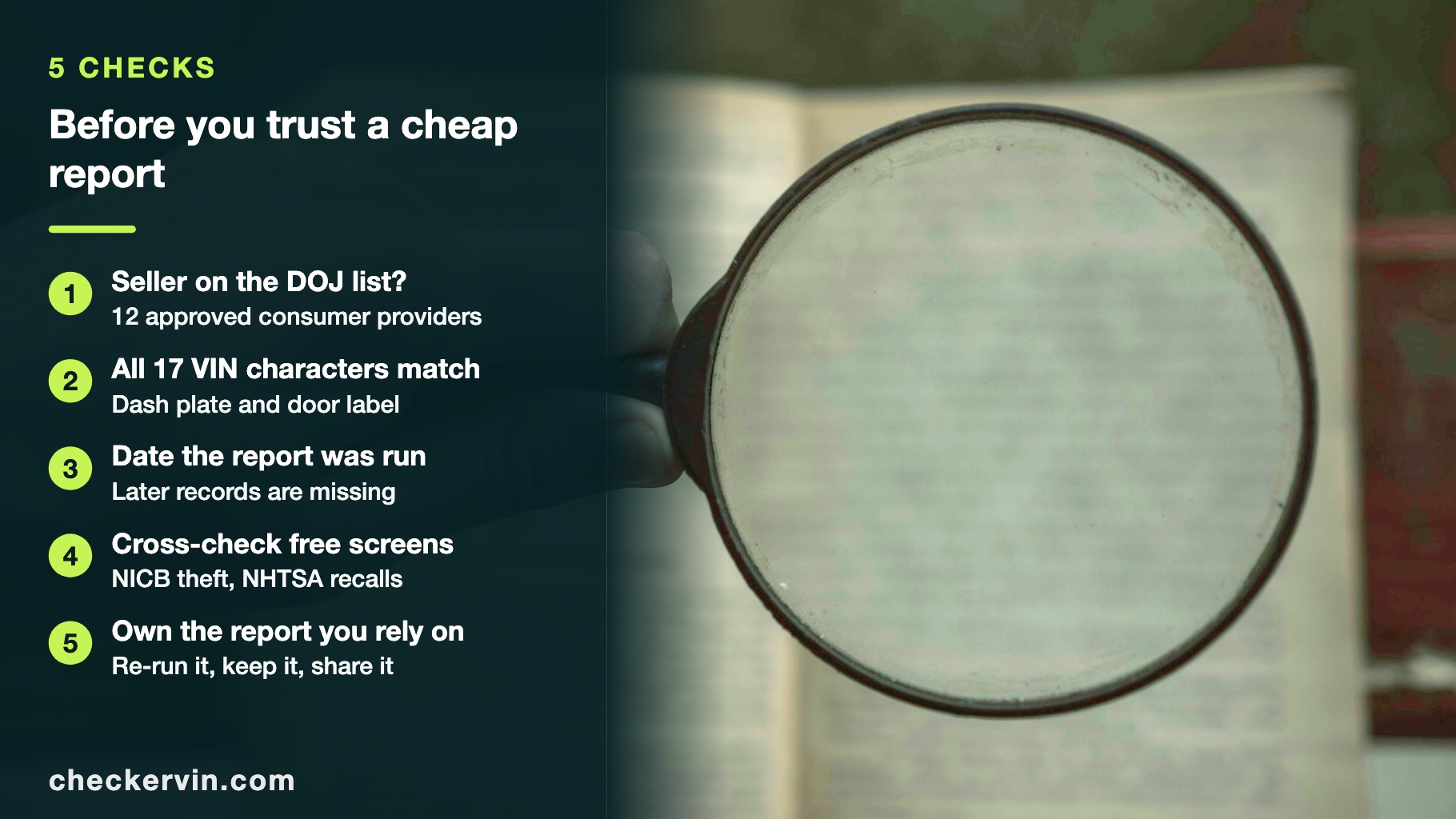
- 1Look the provider up on the DOJ listThe approved-provider page takes half a minute to read. The public tier currently names 12 providers. If the seller is not on it and is not the publisher, treat the report as unverified.
- 2Match all seventeen charactersCompare the VIN printed on the report with the plate on the dashboard and the door-jamb label, not with the listing.
- 3Read the date the report was runAnything recorded after that date is missing. For a car that has sat on a lot, a recent date matters more than a long report.
- 4Cross-check against the free screensRun the NICB theft and total-loss lookup and the NHTSA recall check yourself. A report that contradicts either one is wrong somewhere.
- 5Get a report you own if the car is a real candidateA few-dollar NMVTIS report in your own name is the one you can re-run, keep, and hand to a mechanic or lender.
The DOJ’s public tier, as read on November 24, 2026:
- Bumper.com
- Carsforsale.com
- Carvertical.com
- Checkthatvin.com
- Clearvin.com
- EpicVin.com
- GoodCar.com
- Titlecheck.us
- Vinaudit.com
- Vindata.com
- VinReport
- Vinsmart.com
The department lists them alphabetically and says the order indicates no preference. Several also sell the same data under other names, which we lay out on how to choose a VIN check.
Carfax price, Carfax cost, and whether Carfax is worth it
A lot of people searching for a cheap Carfax really want to know how much a Carfax is, and whether that is worth paying. We do not quote the figure here: Carfax sets and changes its own prices, and its site would not let us read them in November 2026. Our vehicle history report cost guide places premium reports against the free checks and the federal title record, which is the comparison that matters.
Whether Carfax is worth it depends on the car, not the brand. A premium report earns its cost where documented service history and accident detail change the price you should pay: a newer, low-mileage car at a premium price, or one with a maintenance story you need to confirm. On an older private-party car, the frauds that cost the most are title frauds, and the few-dollar federal record covers those. The money left over is better spent on an independent inspection.
If you are choosing between the two premium names, our AutoCheck vs Carfax comparison covers what each holds. If you want the wider field, including services between the cheap and premium ends, see Carfax alternatives.
Low entry prices that are really memberships
Not every low price is a single report. Some providers, including at least one on the DOJ public list, lead with a short window of unlimited lookups for a small fee. The homepage we read for one of them did not state what billing, if any, follows the window, so read the checkout terms before you enter a card.
That is the general rule for any cheap VIN check priced below a single report: find out whether it renews, at what price, and how you cancel, before you pay. If a short unlimited window suits a busy week of car shopping, set a reminder for the day it ends. If you need one report, buy one report.
What CheckerVIN gives you, and what it costs
You arrived looking for a cheap report, so here is ours in plain terms. Enter a VIN on this site and the free scan returns what is live today, at no cost, with no account, no card and no trial that converts:
- Factory build & specifications
- Factory warranty terms
- Open NHTSA safety recalls
- Photos filed against the VIN
- Market & listing prices
Still launching soon, and not in the report yet: title timeline & title brands, damage records, odometer readings, ownership & service records.
We would rather say that here than have you discover it after a search for a cheap vehicle history report: we do not sell a title, accident or odometer record today. Until those land, the honest place to buy the federal title record is one of the approved providers listed above, and the decode and recall check here are the free first step before you spend anything.
Free decode and recall check, no card
Decoded from official manufacturer and NHTSA records
The cheapest sequence that still protects you
- 1Decode the VIN and check open recalls: freeConfirms the car matches the listing and shows any open safety campaign, which the dealer fixes at no charge.
- 2Run the NICB theft and total-loss screen: freeTakes a couple of minutes and ends the conversation on the cars that should never get a viewing.
- 3Ask the seller for their report: free to youRead it for dates and locations to test against the car. Treat it as the seller's document, not your check.
- 4Buy the NMVTIS title record on your shortlist: a few dollarsOne report for the car you are serious about, or a bundle if several cars are still in play. Bundles lower the cost per report.
- 5Pay for a premium report only if the car calls for itNewer, pricier, or a service history that changes the value. Buy it from the publisher, not a reseller.
Where this information comes from
- NMVTIS: approved data providers (U.S. Department of Justice)The public and commercial tiers, and the statement on Carfax and Experian
- Understanding an NMVTIS vehicle history reportThe five indicators, and what NMVTIS is not meant to include
- NMVTIS frequently asked questionsProvider-set fees, the May 2020 fee range, and how consumers get reports
- FTC: buying a used car from a dealerWhy a history report does not replace an independent inspection
- NHTSA recall lookupFree open-recall check by VIN, from the regulator
- NICB VINCheckFree theft and total-loss screen from participating insurers
- How we made this pageWritten by the CarCheckerVIN editorial team with AI assistance from the Department of Justice's NMVTIS pages, providers' own pages and other public records; facts checked November 2026.
Keep reading
Frequently asked questions
What is the cheapest VIN check?
The cheapest useful checks are free: the NHTSA recall lookup, the NICB theft and salvage screen, and a VIN decode, including the one on this site, which also returns warranty terms and listing prices. History records here are launching soon. The cheapest paid report that carries federal title data comes from a provider on the Department of Justice's approved NMVTIS list. Each provider sets its own fee, and several sell multi-report bundles that bring the cost per report down further, which suits anyone checking a shortlist of cars.
Where can I get a cheap Carfax report?
The legitimate low-cost route is a dealer who has already bought one: many dealer listings link a report at no charge to you. Carfax does not appear on the federal list as a consumer source of NMVTIS reports, and a copy sold by an unrelated third party for a few dollars is a report somebody else bought, which you have no way to verify or recourse on. If what you actually need is the title record, a few-dollar NMVTIS report from an approved provider is the honest cheap substitute.
Are few-dollar Carfax reports legit?
You cannot tell from the outside, and that is the problem. A reseller is not the company that compiled the report, so you cannot confirm the report was run on the VIN in front of you, how old it is, or that nobody edited it. We could not read Carfax's own terms of use to say what they permit, because its site blocked our requests. Check those terms yourself before buying, and treat any resold report as unverified.
How much is a Carfax?
Carfax publishes its own prices and changes them, and its site blocked our attempts to read them in November 2026, so we do not quote a figure here. Our vehicle history report cost guide sets out where premium reports sit against the free checks and the few-dollar federal title record, and that comparison is what decides whether the price is worth paying.
Is Carfax worth it?
On a late-model car where documented service and accident history change what you should pay, a premium report often is. On an older private-party car, the free checks plus a few-dollar NMVTIS title record usually cover the risks that cost buyers the most, and the money is better spent on an independent inspection. Ask the seller for their report first. It costs you nothing.
What does a cheap vehicle history report leave out?
An NMVTIS report is built around five indicators: current title and title date, brand history, odometer reading, total loss history and salvage history. The Department of Justice says plainly that repair histories, recall information and maintenance data are not part of NMVTIS, which is why commercial reports cost more. Recalls you can get free from NHTSA, so the real gap is service and minor-accident records.
The cheapest check is free. Run it first
Decode any VIN free for the factory build, specifications, warranty and open safety recalls. No account, no card. Full vehicle history reports are launching soon.
Run a free VIN check