The short answer
- Is it redundant with the factory marking?
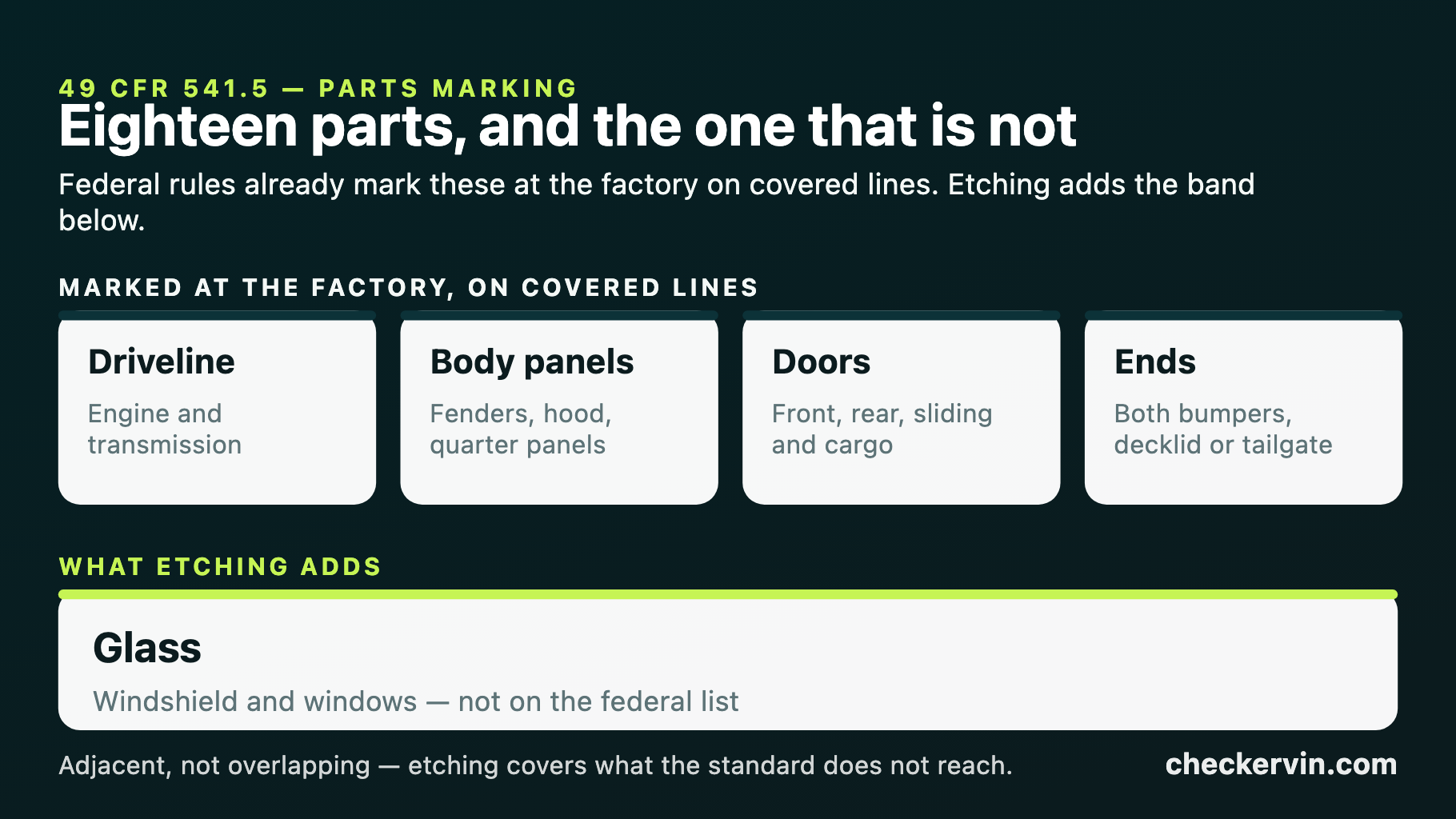
- No. The federal standard covers 18 major parts and glass is not one of them, so etching adds coverage rather than repeating it.
- Is it worth the dealer price?
- That is the whole question. The benefit is fixed and modest; the price is negotiable and varies widely. Judge the charge, not the concept.
- Can I decline it?
- Yes. It is an optional add-on, never a requirement of sale, financing or registration.
18
Parts marked at the factory
On covered lines, 49 CFR 541.5
Not glass
What the 18 leave out
The gap etching fills
Exempt lines
Some cars are unmarked
Appendix A-I, via 49 CFR 543
Optional
The dealer add-on
Never required to buy or register
What etching actually is
The procedure is simple enough that knowing it changes how you value it. A stencil bearing the VIN is placed on the glass, an etching compound is applied through it, and after a few minutes the number is left permanently frosted into the surface. It is done on the windshield and usually the side and rear windows too.
There is no electronics, no registration with any authority, and no record created anywhere. The car does not become traceable in a database because of it. The mark exists on the glass and nowhere else, which is worth holding on to when the pitch implies something broader.
It is also permanent in the ordinary sense — removing it means replacing the glass, which is the point. A thief who wants unmarked glass has to buy new glass.
What the factory already marked
This is the part almost no discussion of etching includes, and it reframes the pitch considerably.
The Federal Motor Vehicle Theft Prevention Standard requires an identifying number to be affixed or inscribed on eighteen specified parts of a covered passenger motor vehicle, where the part is present. The list runs through the engine and transmission, both front fenders, the hood, all the doors, both bumpers, the rear quarter panels, side assemblies, the cargo box and the decklid or tailgate.
That number is the VIN itself in the ordinary case — manufacturers who were already marking engines and transmissions with a derivative of at least the last eight characters back in 1984 may continue with the derivative. The marking has to meet the size and style requirements set for vehicle certification labels, and it must be either indelibly printed on a permanently affixed label or inscribed directly.
The gap etching fills
Read that list again and the case for etching becomes clear, and it is narrower and more defensible than the way it is usually sold.
Glass is not on it. Not the windshield, not the side windows, not the rear screen. The federal standard marks structure and body panels and driveline; it does not reach glazing at all.
So etching is not a duplicate of something you already paid for in the purchase price. It covers a category of part the standard leaves out — and glass is genuinely stolen, because it is valuable, easily removed and easily resold into a repair market that consumes a lot of it.
Not every car is marked
One more provision matters before you assume your car left the factory covered, and it explains why two people can both be right when they disagree about this.
Part 541 carries an appendix listing vehicle lines that are exempted from the parts-marking requirements because they are equipped with antitheft devices, under a separate federal exemption process. Manufacturers can apply for that exemption line by line. So whether a particular model carries factory parts marking depends on the line and the year.
The practical consequence for a buyer is small but real: if your car sits on an exempted line, it has an antitheft device instead of parts marking, and the glass is unmarked either way. Etching adds the same thing in both cases.
How it is supposed to deter theft
The mechanism is worth understanding because it tells you which thefts etching plausibly affects and which it does not.
- 1It raises the cost of reselling the car intactA vehicle with etched glass carries a visible link to its original VIN in several places at once, which complicates passing it off under another identity.
- 2It raises the cost of reselling the glassMarked glass is worth less to a buyer who does not want a traceable part, so the glass becomes a liability rather than an asset.
- 3It is visible before the theft, not afterUnlike most security, the deterrent works by being seen — a thief choosing between two cars can see the marks on one of them.
- 4It does nothing once the car is goneThere is no tracking, no alert and no registry. If the vehicle is taken, etching contributes at recovery and identification, not at prevention of that particular theft.
If a recovered vehicle is what you are researching rather than a new purchase, our theft recovery guide covers what happens to a car between theft and recovery.
What it does not do
Being precise about the limits is the only way to price the benefit, and the limits are substantial.
- It does not prevent a determined theft — glass can be replaced, and a car can be taken for parts regardless
- It creates no record in any database, so no lookup will ever show that a car is etched
- It does not mark the components most commonly stripped: wheels, airbags, catalytic converter, modules
- It does not affect a car's title, its history record, or anything a report will carry
- It has no effect on the resale value of the vehicle in any documented way we can point to
None of that makes it worthless. It makes it a small, one-time, physical deterrent — which is exactly how it should be priced.
Why it appears at the finance desk
Understanding where in the transaction this appears explains the pricing, and knowing that is most of what you need.
Etching is an add-on, sold alongside paint protection, fabric treatment and extended service contracts, at the point in the purchase where the vehicle price has already been agreed. That position in the process is not an accident: the numbers involved are small relative to the car, the customer is fatigued, and each add-on is presented as a modest increment on a figure that is already large.
Sometimes it has already been applied before you arrive and appears as a line on the sheet. That framing is worth resisting on its own terms — work already done is a reason the dealer incurred a cost, not a reason you agreed to pay for it. It remains negotiable.
Judging the price
We do not print prices for anything on this site, because a number would be stale before long and every market differs. What is durable is the pricing model, and that is the part worth knowing.
| Where it is bought | How the price is built |
|---|---|
| A dealer add-on at the finance desk | Priced as a product with margin, often bundled with other add-ons, and quoted as a line item rather than against a cost. Highly negotiable, and sometimes removable outright. |
| A retail kit you apply yourself | Priced as a consumable — a stencil set and a tube of compound. The cheapest route by a wide margin, and the same result on the glass. |
| A third-party service or a community event | Sometimes offered free or at cost by police departments or insurers running theft-prevention events. Availability is local and occasional. |
Compare the quote against the kit rather than against nothing. That comparison — the same marked glass, achieved two ways — is the honest basis for deciding, and it is the one the pitch will not make for you.
If the car is already etched
Two situations, and they call for opposite responses.
On a new purchase where the dealer applied it before you arrived, the work existing does not create an obligation. Ask for the line to be removed or reduced. If the answer is that it cannot be removed because it is already done, the answer to that is that the price can still change.
On a used car you are considering, etched glass is a small positive. It suggests a previous owner who took some care, and it gives you a free consistency check: read the etched number and confirm it matches the VIN on the dash, the door jamb and the title. A mismatch is a serious finding, and our VIN cloning guide covers what it can mean.
Doing it yourself
Since the comparison decides the purchase, it is worth being clear that the alternative is real rather than theoretical.
- Kits are sold for the purpose and include stencils and the etching compound
- The work is stencil, apply, wait, clean — closer to applying a decal than to skilled work
- Do the windshield and every window, since partial marking weakens the point
- Check your VIN character by character against the dash plate before you apply anything
- Take a photograph of each finished window, which is a useful record if the car is ever stolen
If you are not sure you have the VIN right, decode it first — our guide to reading a VIN covers what each character means and where to find the number on the car.
The insurance question
The pitch frequently mentions an insurance discount, and this is where we are going to be less definite than the sales sheet, on purpose.
Whether an insurer reduces a premium for an antitheft measure is that insurer’s decision, varies by company and by state, and is not something a federal rule requires. We are not going to tell you a discount exists or quantify one, because we would be guessing and you would be the one who found out.
What is worth doing takes five minutes: ask your own insurer, before you agree to the charge, whether they offer anything for it on your policy in your state. An answer from the company that would actually pay is worth more than any general claim, including ours.
How to decide
Reduced to its parts, the decision is not complicated.
- 1Accept that the benefit is real but smallIt marks glass, which the federal standard does not cover and which is genuinely stolen. That is the whole of it.
- 2Price it against the kit, not against zeroThe comparison that matters is dealer add-on versus doing it yourself, because the outcome on the glass is the same.
- 3Ask your insurer before you agree, not afterIf a discount exists on your policy it changes the arithmetic; if it does not, you have lost five minutes.
- 4Treat it as negotiable in every caseIncluding when it has already been applied. Work done is the dealer's cost, not your obligation.
- 5Spend the attention on the car insteadThe checks that change what a used car is worth are structural and record-based, and they matter more than any add-on.
The check sequence
If you are buying, the add-on conversation is the least consequential part of the day. Decode the VIN free for the factory build and specifications. Check open recalls through NHTSA at no cost. Screen for theft and total-loss records through the NICB. Buy the federal NMVTIS record for title brands. Then look at the car — the structure and the restraint system decide value in a way etching never will.
Where this information comes from
- 49 CFR Part 541 — Federal Motor Vehicle Theft Prevention Standard§541.5 requiring an identifying number on 18 specified parts, the VIN-derivative allowance for engines and transmissions, the size and style requirement, and the labeling or inscription methods
- 49 CFR Part 543 — exemption from vehicle theft prevention standardThe process by which whole vehicle lines are exempted from parts-marking where they carry antitheft devices, listed in Part 541 Appendix A-I
- NICB — VINCheckFree screen for theft and total-loss records reported by participating insurers
- NHTSA recall lookupOpen safety recalls by VIN, free — worth more of your attention at purchase than any add-on
Keep reading
Frequently asked questions
Is VIN etching worth it?
It depends almost entirely on what you are asked to pay, because the benefit is modest and fixed while the price varies enormously. The security argument is real but narrow: it marks glass, which is a part the federal parts-marking standard does not cover and which thieves do strip for resale. Treat it as a small, optional deterrent priced as a negotiable add-on rather than as a safety feature.
Does my car already have VIN markings from the factory?
Very possibly. Federal rules require an identifying number on 18 specified major parts of covered passenger motor vehicles — engine, transmission, fenders, hood, doors, bumpers, quarter panels and more. But whole vehicle lines are exempted where they carry qualifying antitheft devices, so it depends on the line. Glass is not among the 18 in any case.
Can I refuse VIN etching at the dealership?
Yes. It is an optional add-on, not a requirement of sale, registration or financing. If it has already been applied to the car before you arrived, that is a pricing conversation rather than a fact you have to accept — ask for the charge to be removed or the price reduced, and be prepared to walk.
Can I etch the VIN myself?
Yes. Kits are sold for the purpose and the job is stencil-and-etch rather than skilled work. Doing it yourself costs a fraction of a dealer add-on and produces the same marked glass, which is the honest comparison to make before agreeing to the charge.
Does CheckerVIN check whether a car is etched?
No, and no lookup can — etching is a physical mark on the glass, not a record anywhere. Our free lookup returns the factory build, specifications and open safety recalls. Look at the bottom corners of the windows to see whether a car is etched.
Start with the VIN
Decode any VIN free for the factory build, specifications and open safety recalls. No account, no card.
Run a free VIN check