The short answer
- Which cars top the theft lists?
- Full-size Ford and Chevy pickups and the Civic-Accord axis perennially; the immobilizer-era Hyundai and Kia models and Dodge's Hellcat family in the recent waves. NICB's Hot Wheels report is the scoreboard.
- Why those cars?
- Economics: missing immobilizers made some trivial to take, horsepower carries street value, ubiquitous models feed parts demand, and converters carry precious metals.
- What does it mean for a buyer?
- Verify theft history on the exact VIN — NICB's free check, matching VIN plates, the national title record — and read a fresh converter or new ignition parts as questions to ask.
NICB
Who keeps the scoreboard
The annual Hot Wheels report
2011–21
The immobilizer-gap Kias & Hyundais
Turn-key models, specific trims
Parts
Why ubiquitous models rank
Demand for what fits everything
Free
The theft screen for buyers
NICB VINCheck, by VIN
Why the list looks like it does
Every year’s ranking mixes two different phenomena. Raw-count lists are dominated by whatever America owns most of — full-size pickups, Civics, Accords, Camrys — because a million targets produce thousands of thefts even at low rates. Rate-based spikes tell the sharper stories: a security flaw, a horsepower fad, a parts shortage. Reading the list means asking which force put each name there, because the answer changes what a buyer or owner should actually do about it.
The Kia-Hyundai wave — a missing chip, a national spike
The defining theft story of the decade: many 2011–2021 Hyundai and Kia models with physical-key ignitions shipped without engine immobilizers — the transponder handshake that had been near-universal elsewhere for years. A social-media method for exploiting the gap turned the cars into a wave that distorted national theft statistics, triggered insurer surcharges and refusals, class settlements, and free software updates that add an ignition kill unless the fob is present.
For used-car buyers the wave left homework. Affected cars are model, year and ignition-type specific — a VIN decode pins the build — and the questions that matter are whether the anti-theft update was installed, whether the steering column has been repaired (the attack breaks it), and how the insurance quote looks before you commit, not after.
Muscle-car economics — horsepower as street value
Dodge’s Hellcat-era Chargers and Challengers became theft targets at rates far beyond their numbers for straightforward reasons: enormous power, strong resale, and key-cloning attacks that beat their electronics. The pattern generalizes — performance trims of common cars are taken disproportionately, and they are also the cars most likely to resurface cloned, wearing a donor’s VIN. On any high-value performance buy, matching the VIN across the dash, door jamb, title and glass etching is not paranoia; it is the market’s posted price of admission.
Trucks, tailgates and cars as parts
Full-size pickups anchor raw-count lists every year — ubiquity, open beds full of tools, and a parts market that absorbs tailgates, wheels and beds without questions. The same parts logic explains the Civic-Accord axis’s decades on the lists and the catalytic-converter epidemic: converters carry platinum-group metals, hybrids carry lightly-used ones, and a reciprocating saw harvests them in minutes. A used car with a suspiciously new converter, hood, or tailgate and a vague story has a history worth one more question and one more record pull.
How the list is actually built
The best-known ranking comes from the National Insurance Crime Bureau, and its method is simpler than most people assume. An analyst pulls every valid vehicle theft report filed by law enforcement into the FBI-managed National Crime Information Center for a given year, and counts them.
That is the whole equation: a theft report in NCIC counts as a theft. No weighting, no modeling, no adjustment for how many of each model are on the road.
Why two respected lists disagree
Search for the most stolen vehicles and you will find rankings that contradict each other. Both can be right, because they are counting different events.
| Measure | What it counts |
|---|---|
| NICB theft counts | Whole vehicles reported stolen to police, entered into NCIC |
| Insurance theft claim rates | Theft claims filed — which can be a part rather than the car |
| The practical difference | A stolen mirror can register as a theft claim, but not as a stolen vehicle |
| Insurance status | Irrelevant to the police-report count; essential to the claims count |
That last row does real work. Many older vehicles carry no theft coverage at all, because owners drop comprehensive as the car depreciates. Those thefts are invisible to any claims-based measure and fully visible to a count built from police reports.
The third list, and the only one with legal force
Every annual roundup you will read is built from insurance-industry theft counts. There is a second kind of list entirely, it is maintained by the federal government, and it almost never gets mentioned — partly because it does something different from counting.
Federal regulation sets a Theft Prevention Standard whose stated purpose is to reduce theft by making it easier to trace and recover parts from stolen vehicles. It applies to passenger cars, to multipurpose passenger vehicles rated at 6,000 pounds gross weight or less, and to light-duty trucks at or under that weight that the regulator has determined to be high theft. That determination is the list.
| The list | What it is actually measuring |
|---|---|
| Insurance theft counts | How many of a model were reported stolen last year — a volume ranking, so common cars rise up it |
| Insurer rate tables | Claims frequency against how many are insured — a rate, which is why it disagrees with the count |
| The federal designation | A regulatory finding that a line is high theft, which switches on a manufacturing requirement |
The three answer different questions and none of them is wrong. But only the third has a consequence attached: once a line is designated, its parts have to be marked, and that obligation follows the vehicle onto the used market where you will meet it.
The ceiling at 6,000 pounds
One boundary in the rule connects the two halves of this page, and it is easy to miss because it is expressed as a weight rather than a model name.
The standard reaches passenger cars, multipurpose passenger vehicles rated at 6,000 pounds gross vehicle weight or less, and light-duty trucks at or under the same rating. Above that line a vehicle sits outside it — not because it is rarely stolen, but because the rule was drawn around a class. Rating, not size or price, decides which side of the line a given truck falls on.
You can check where any specific vehicle sits without taking anyone’s word for it. Gross vehicle weight rating is printed on the certification label in the driver’s door area, alongside the figures our tire and loading placard guide works through. Read the rating there and you know whether the parts-marking rule ever applied to that vehicle, which is the first thing to establish before drawing any conclusion from markings you do or do not find.
How a model gets onto the federal list, and who decides
If the federal designation switches on a manufacturing obligation, it is worth knowing who makes the call. The answer is not what most people would guess, and it explains the list’s character better than anything else in the rule.
For a new light-duty truck line, the manufacturer evaluates its own model. It applies criteria published in the standard’s own appendix, reaches a conclusion about whether the line is likely to have a theft rate above or below that 1990 and 1991 median, and submits the evaluation with the underlying factual information to the regulator not less than fifteen months before the vehicle goes on sale.
The agency then makes preliminary determinations. A manufacturer that disagrees has thirty days to ask for reconsideration, setting out the facts and arguments behind its objection, and may ask for a meeting. Absent such a request, the preliminary determination becomes final forty-five days after the agency’s letter.
| Stage | What happens |
|---|---|
| 15 months before sale | The manufacturer evaluates its own new line against the published criteria and submits it |
| Agency review | The regulator issues preliminary determinations on the submission |
| 30 days | The manufacturer may request reconsideration, with facts and arguments |
| 45 days | The preliminary determination becomes final where no request was made |
There is a second route for a truck line whose theft rate is low but whose major parts are interchangeable with most of the covered parts on a passenger line. That one exists because a thief steals a part, not a badge: if a low-theft truck shares panels with a high-theft car, marking the car alone would leave an obvious gap.
Read together, the process explains the shape of the list. It runs ahead of a model reaching the road rather than after thefts are counted, it is anchored to a benchmark from the early nineties, and its first assessment is made by the company with the most to lose from a yes. That is a reasonable design for a parts-tracing rule and a poor one for a risk ranking, which is the whole reason a used-car buyer should read it as the former.
The eighteen parts the standard marks
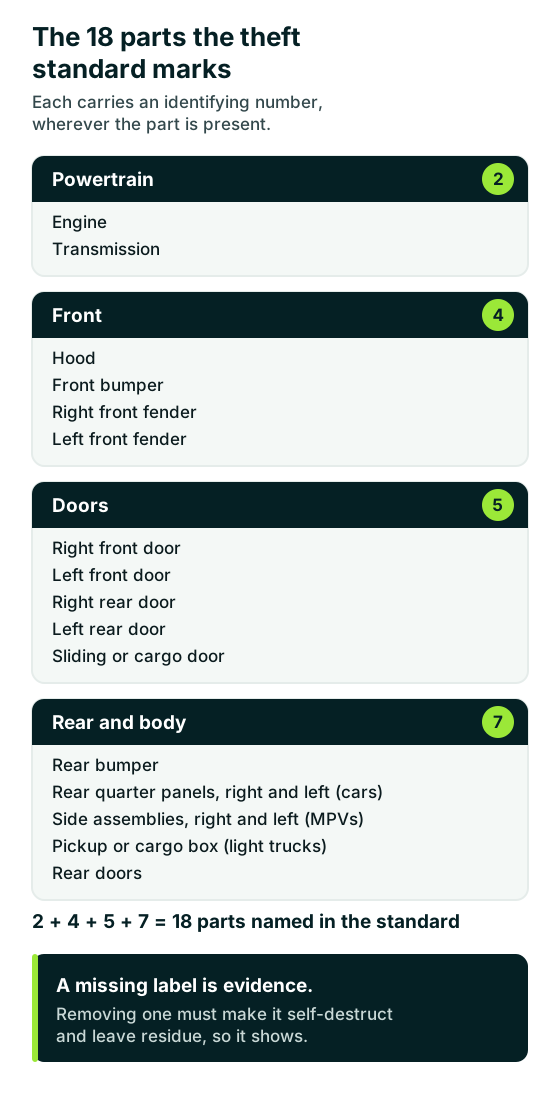
Where the standard applies, an identifying number must be affixed or inscribed on each of eighteen named parts, wherever that part is present on the vehicle. The list is worth reading once, because it is a list of exactly the components a stripped car is worth money for.
| Group | Parts named in the standard |
|---|---|
| Powertrain (2) | Engine, transmission |
| Front (4) | Hood, front bumper, right front fender, left front fender |
| Doors (5) | Right and left front doors, right and left rear doors, sliding or cargo doors |
| Rear and body (7) | Rear bumper, right and left rear quarter panels on cars, right and left side assemblies on MPVs, pickup or cargo box on light trucks, rear doors |
Two things follow for somebody buying used. A marked part carries a number that should correspond to the vehicle it is bolted to, so a mismatch between a door and the car around it is visible without tools to anyone who knows to look. And because the marking exists to trace parts, its presence tells you the regulator once judged this line worth protecting — which is a statement about the model, not about the individual car in front of you.
Why unmarked parts prove nothing at all
The obvious inference is the wrong one. Finding no markings does not mean the car is a low-theft model, and it is worth understanding why before drawing any conclusion from their absence.
- A line can be exempted from parts marking entirely if the manufacturer equips it with a qualifying antitheft device
- The standard excludes manufacturers building fewer than 5,000 vehicles a year for sale in the United States
- Light trucks are covered only where the regulator determined the line to be high theft, so many are outside it
- Vehicles built before the requirement reached their class carry nothing
- A replaced panel may be a legitimate repair part rather than an original, marked one
The exemption route is the one that inverts the intuition completely. A manufacturer can be released from marking a line by fitting an antitheft device to it, so an unmarked car may be unmarked because its maker built theft protection into it. Absence of marking is therefore not evidence of low risk, and it is not evidence of tampering either. It is evidence that you need to know which of five explanations applies.
The benchmark inside the rule has not moved since 1991
One detail explains why the federal designation and the annual theft headlines can look so unrelated, and it is sitting in the regulation in plain sight.
The standard’s appendices still measure light-duty truck lines against the median theft rate for 1990 and 1991. That is the reference point a modern list is calibrated against — a benchmark fixed before a large share of the vehicles now being stolen were designed, in an era before immobilizers were common and before the relay and software attacks that drive current thefts existed at all.
This is not a scandal and it is not an argument for ignoring the standard, which does the tracing job it was written to do. It is an argument against reading a regulatory list as a current risk ranking. For what is being stolen this year, the insurance counts are the better instrument; for whether a given part on a given car should carry a number, the regulation is the only one that answers.
Where the marking is, and why a missing one is the finding
The standard does not simply require a number somewhere. It specifies where the marking goes and how it has to behave when someone interferes with it, and those details are what make it useful to a buyer rather than only to an investigator.
A label has to be printed indelibly and permanently affixed. Where practicable it goes on an interior surface of the part — defined as a surface not directly exposed to sun and precipitation — and it must sit somewhere that will not be damaged by the tools needed to fit or remove the part, is unlikely to be damaged in a collision, and will survive normal dealer preparation including rustproofing and undercoating. It must also be placed so the number stays visible, without further disassembly, once the part has been taken off the vehicle.
Then comes the part that matters most. Removing the label must cause it to self-destruct, tearing or rendering the number illegible, and must discernibly alter that area of the part by leaving residue or fragments behind, so that investigators have evidence a label was originally there. Altering the number must leave traces of the original or visibly damage the label material, and both label and number are required to resist counterfeiting.
None of this replaces the checks that come first. Run the free theft and salvage screen, get the federal title record, and read the physical condition of the car. Marked parts are a supporting instrument: they are most informative on a vehicle whose line carries them, least informative in the many cases covered above where nothing was ever marked at all, and they answer a narrow question well rather than the whole one badly.
The buyer's angle — what theft history looks like
- NICB VINCheck — the free theft-and-salvage screen; minute one on any candidate from a theft-prone model
- VIN plate matching — dash, door jamb, title and glass etching must agree; mismatches are the cloned-car signature
- Theft-recovery in the title record — written-off recoveries appear in NMVTIS; priced right, they can be honest buys
- Ignition and column condition — repaired columns on immobilizer-gap Kias and Hyundais tell you the car was attacked
- Insurance quote before purchase — theft-wave models carry surcharges that change the ownership math
If you own a target
- 1Close the software gapAffected Hyundai and Kia models have free anti-theft updates — dealers install them, and window stickers advertise the fix to would-be thieves.
- 2Make the easy steal hardWheel locks for the wheels, a column lock for the wave models, etched glass for the cloners, lighting and cameras for the driveway.
- 3Guard the converterShields and cages price the harvest out of a parking-lot timeline for the high-risk hybrids and trucks.
- 4If it happens, move fastPolice report, insurer, and the VIN into NICB's system — recovery odds decay by the hour, and the paper trail protects your claim.
Decode any VIN free
Decoded from official manufacturer and NHTSA records
Where this information comes from
- 49 CFR 542.1 — selecting new light-duty truck linesThe manufacturer evaluates its own new line against the 1990/91 median and files 15 months ahead; the agency's preliminary determination becomes final after 45 days
- 49 CFR 541.5 — Federal Motor Vehicle Theft Prevention StandardThe eighteen parts that must carry an identifying number, the interior-surface placement rule, and the requirement that removing a label makes it self-destruct and leave residue
- NICB — Hot Wheels annual theft reportThe authoritative most-stolen rankings, year by year
- NICB — Hot Wheels versus theft claim rate reportsWhy a police-report count and an insurance-claim rate produce different lists
- NICB VINCheckThe free theft and salvage screen for buyers
- NHTSA — vehicle theft preventionFederal theft-prevention standards and guidance
- NMVTIS — national title recordWhere written-off theft recoveries surface
Keep reading
Frequently asked questions
What are the most stolen cars in America?
Full-size pickups from Ford and Chevrolet and high-volume sedans like the Honda Civic and Accord anchor the list every year, joined in recent years by Hyundai and Kia models targeted for their missing immobilizers and by Dodge's Hellcat-era muscle cars. NICB's annual Hot Wheels report is the authoritative ranking.
Why were Kia and Hyundai models stolen so much?
Many 2011–2021 models with turn-key ignitions shipped without engine immobilizers — the chip check most competitors made standard years earlier. A viral method for exploiting it turned those cars into a national theft wave, forcing software updates, insurer restrictions and settlements. The vulnerability is model-and-trim specific, which is exactly the kind of thing a VIN decode helps pin down.
Does theft history show up on a vehicle check?
Recovered-theft vehicles usually leave a trail: NICB's free VINCheck screens for theft and salvage records from participating insurers, and a theft-recovery that was written off appears in the national title record. A stolen-and-recovered car can be a fine buy — verified, inspected and priced as what it is.
Why are catalytic converters stolen?
The metals inside — platinum, palladium, rhodium — trade at precious-metal prices. High-clearance vehicles and hybrids with lightly used converters are the preferred donors, and a car sold with a fresh converter and a vague story deserves the question of what happened to the original.
How do I check if a car was stolen before I buy it?
Run the VIN through NICB's free VINCheck for theft and salvage records, confirm the VIN on the dash, door jamb and title all match, and pull the national NMVTIS record. Mismatched or tampered VIN plates are the cloned-car red flag — walk away and let police untangle it.
Thieves pick by model — you verify by VIN
Decode any VIN free for the factory build, specifications and open safety recalls. No account, no card.
Run a free VIN check