The short answer
- Will it have a salvage title?
- Often not. Texas excludes paid theft claims from salvage unless the car was damaged beyond its value during the theft.
- Is it a bad buy?
- The label is an event, not a condition. A joyride recovery and a stripped shell carry the same description.
- What is expensive?
- Keys and immobilizer programming, cut wiring, interior trim and control modules — not the broken lock everyone looks at.
Unless
The word the rule turns on
Texas theft-claim exclusion
Clean
The title, frequently
By design, not by concealment
Keys
The underestimated cost
Immobilizer programming, modules
18
Parts carrying a number
On lines subject to the standard
A category, not a condition
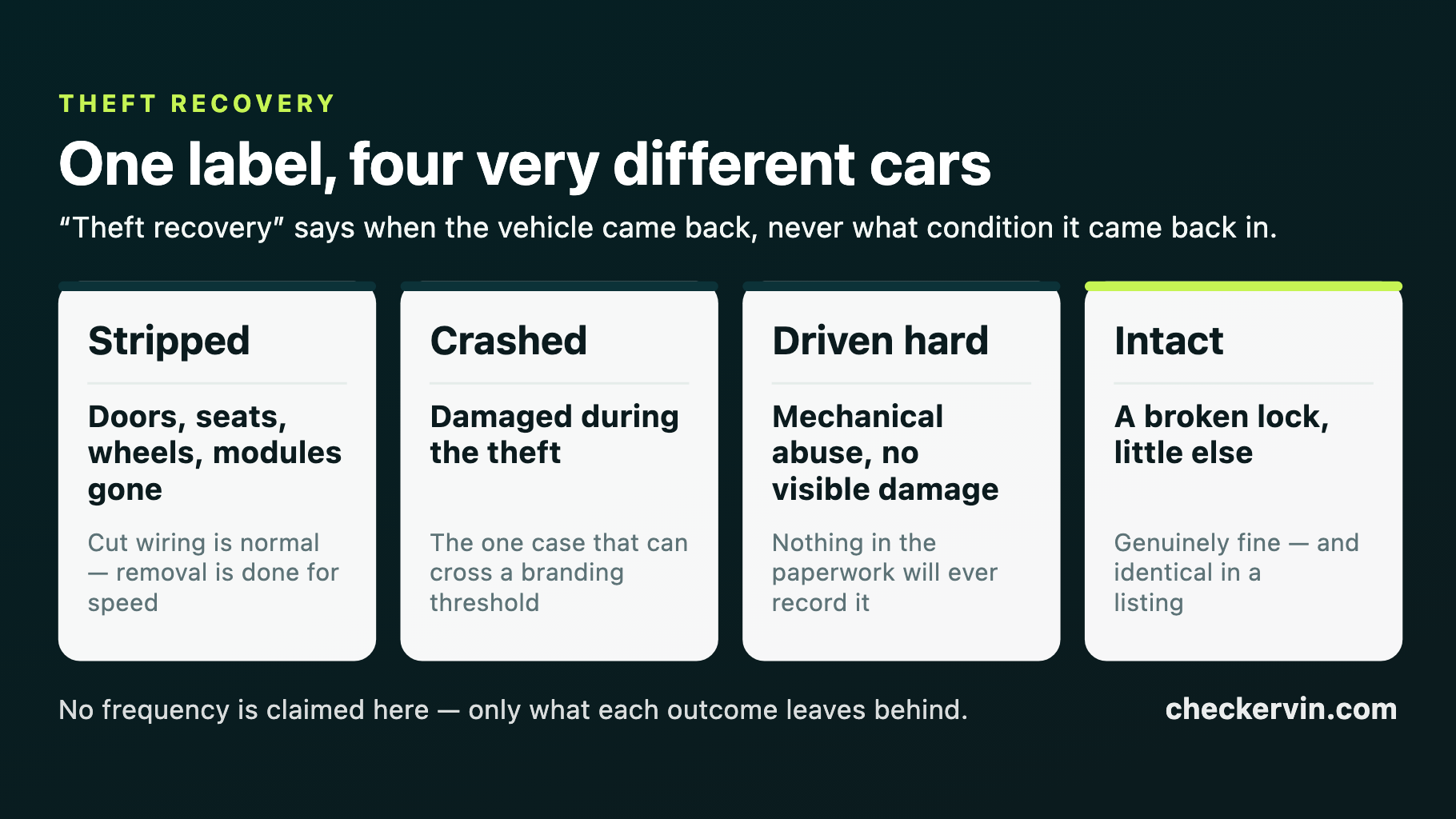
The first thing to fix is the assumption buried in the phrase. “Theft recovery” describes an event in the car’s ownership history — it was taken, and it came back. It says nothing at all about what state it was in when it came back, and the range covered by those two words is wider than for almost any other history a car can have.
At one end is a vehicle taken from a parking lot, driven for an evening, abandoned and recovered within a day with a broken lock and nothing else wrong. At the other is a car that disappeared into a garage and came back as a shell with the doors, seats, wheels and engine gone. Both are theft recoveries. Both may be described in a listing with the same two words.
That is why the usual approach — read the label, apply a discount — fails here. The label does not carry enough information to price. What you need is what happened in between, and the good news is that a surprising amount of it is findable.
Why the title is often clean
Buyers routinely assume a stolen car must end up branded, and that assumption is what makes this category dangerous. Read a state’s salvage definition and you will see why it is wrong.
Texas lists what a salvage motor vehicle does not include, and among the exclusions is a motor vehicle for which an insurance company has paid a claim for theft — with one condition attached, which the next section is about. The plain reading is that a paid theft claim, in itself, does not put the vehicle in the salvage category at all.
That is a deliberate and defensible rule. A car that was stolen and recovered undamaged has not been structurally harmed by the theft; branding it would mark a vehicle nothing is wrong with. The rule is doing the right thing. The consequence for a buyer is simply that the title stops being a signal.
The word the exclusion turns on
The exclusion is not unconditional, and the condition is where the whole question actually lives.
Texas excludes a vehicle for which an insurer has paid a theft claim unless the motor vehicle was damaged during the theft and before recovery to the extent that the cost of repairs exceeds the actual cash value of the motor vehicle immediately before the damage.
Unpack that and three separate tests have to be met before a theft recovery becomes salvage in that state. The damage has to have happened during the theft. It has to have happened before recovery. And the repair cost has to exceed the vehicle’s value immediately before the damage — the same over-100-percent comparison Texas applies to collision damage generally, covered on our total loss threshold guide.
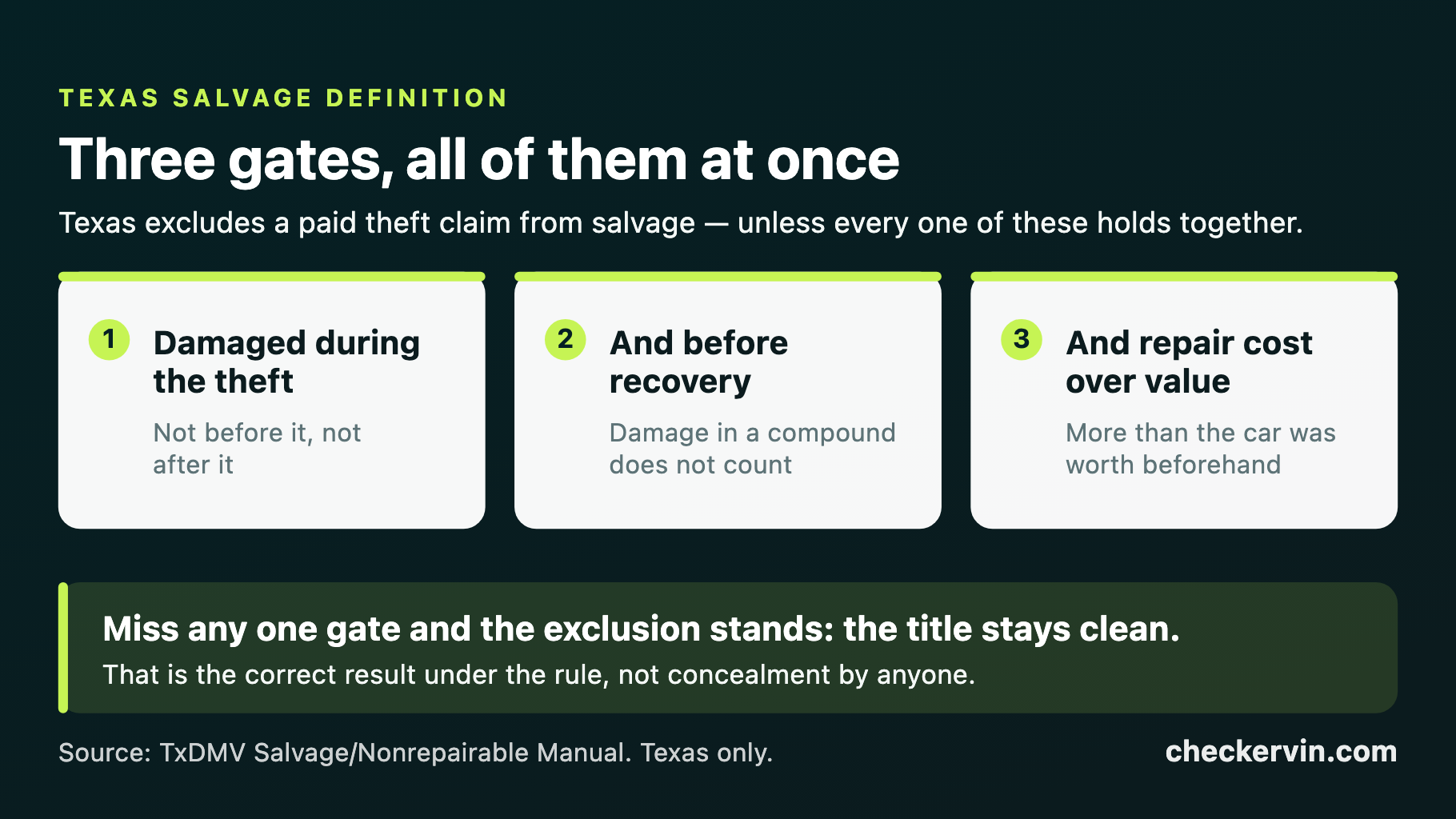
So a car stripped of ten thousand dollars of parts, on a vehicle worth more than that, does not meet the test. A car damaged after recovery — sitting in a compound, or during transport — does not meet the test on its face. The bar is high, which is precisely why so many recovered vehicles reach the retail market with unremarkable paperwork.
What happened while it was gone
Since the paperwork will not tell you, it is worth knowing the shapes these events take, because each leaves a different signature on the car.
| What happened | What it leaves behind |
|---|---|
| Taken and abandoned quickly | Forced entry damage, a broken lock cylinder or damaged column, possibly nothing else. Often the cheapest outcome and the most common. |
| Driven hard before abandonment | Mechanical abuse that does not show on inspection — clutch, transmission, engine run without oil pressure. Nothing in the paperwork will record it. |
| Crashed during the theft | Collision damage, and the one case that can push the vehicle over the branding threshold. Structural questions apply in full. |
| Stripped for parts | Doors, seats, wheels, airbags, catalytic converter, infotainment or engine removed. Cut wiring is common because removal is done for speed, not tidiness. |
| Used in another crime | Often damage of no obvious pattern, plus a longer time in police custody. Interior condition can be poor for reasons unrelated to wear. |
| Recovered essentially intact | Genuinely fine, and a real outcome rather than a hopeful one. The trouble is it looks identical in a listing to everything above. |
Where the money actually goes
Buyers price the visible damage — the punched lock, the scratched door — and that is usually the smallest line on the bill.
- Cut and spliced wiring, where a component was removed at speed rather than unplugged properly
- Control modules, which are expensive individually and frequently need coding to the vehicle
- Interior trim and seats, which are hard to source in matching condition and color
- Airbags and restraint components, which are a favorite target and are dangerous to replace badly
- Catalytic converters, replaced with parts that may not meet the original specification
- Keys and immobilizer programming, which is its own section below because it is the one people miss
Airbags deserve particular attention. Restraint components are stolen because they are valuable, and the replacements fitted afterwards are not always genuine or appropriate. Our airbag check guide covers how to have the restraint module scanned rather than trusting the warning lamp, and it applies here even though no collision occurred.
Keys, immobilizers and modules
On a modern car this is the item that turns a cheap-looking recovery into an expensive one, and it is invisible on a walk-round.
A vehicle taken without its keys has usually had its security system defeated somehow, and putting it back together properly means more than cutting a new blade. Transponder keys have to be programmed to the vehicle. An immobilizer or body control module that was replaced or manipulated has to be matched to the rest of the car. Steering lock assemblies are frequently destroyed in the taking.
The specific thing worth asking is how many keys exist and whether all previously programmed keys were removed from the system. A car returned to service with an old key still authorized is a car somebody else can still start, and that is a question about the repair rather than about the theft.
The descriptors that give it away
If the vehicle passed through a salvage auction — and stripped recoveries frequently do — the listing is the most informative record that exists on it.
Two things to look for. The damage descriptors on a theft recovery are often vandalism or stripped rather than a directional collision code, which by itself tells you the shape of the event. And the keys field matters more here than on any other kind of lot, for the reasons above.
But the photographs are the real product. A stripped car photographed at intake shows exactly what was missing before anyone sourced replacements, which is the single piece of information a seller of a repaired theft recovery is least likely to volunteer. Our auction history guide covers where to search those archives free and how to read a listing.
One caution, the same as everywhere: most cars never went to auction, so finding nothing is the ordinary case and proves nothing at all.
Why the parts carry numbers
There is a federal standard in the background here that is worth knowing exists, because it is what makes some of this checkable at all.
The Federal Motor Vehicle Theft Prevention Standard requires an identifying number to be affixed or inscribed on specified major parts of passenger motor vehicles subject to it, with a parallel requirement for replacement parts. The point is to make stolen components traceable and to make assembling a car from parts of unknown origin harder.
For a buyer, the practical value is that major parts on a covered vehicle can be checked against the vehicle they are attached to, and a mismatch is a real finding. Our VIN cloning guide sets out the standard in full, including the complete list of parts it names, and that is the page to read if you want to run the check yourself.
Insurance and financing afterwards
This is the part that makes the category quietly attractive to a reseller, and it is worth being clear-eyed about.
Where the theft did not produce a brand, the vehicle carries a clean title and behaves like any other clean-title car for insurance and financing. There is no branded-title conversation with a lender, no restricted market on resale, and no obvious reason for a buyer to look harder. The friction that normally slows down a damaged car simply is not there.
Where the theft did produce enough damage to cross a threshold, everything changes and the ordinary branded-title questions apply — narrower insurance options, harder financing, and a permanent mark. Our rebuilt title buying guide covers that side.
The asymmetry is the point. The version of this car that is hardest to assess is also the version that meets the least resistance on its way to you.
What to check on the car
Most of this costs nothing but attention, and it is aimed specifically at what a theft does rather than what a collision does.
| Where to look | What you are looking for |
|---|---|
| Door locks, handles and the ignition surround | Replaced or mismatched lock cylinders, tool marks, a steering column cover that does not sit right, or trim that has clearly been off. |
| The driver's door jamb and window frame | Pry marks and distorted weatherstrip, the classic signature of forced entry. |
| Under the dash and behind the kick panels | Cut, spliced or taped wiring, connectors that do not match, or a loom that has obviously been disturbed. |
| Seats, trim and infotainment | Parts that do not match each other in wear, color or specification — a strong sign of replacement from another vehicle. |
| The interior against the mileage | Wear that is inconsistent with the odometer in either direction, and our odometer guide for how to line the readings up. |
| Major part numbers against the vehicle | On a covered line, the identifying numbers on major parts should belong to this car. A mismatch is a finding, not a curiosity. |
| The restraint system, by scan | Airbags are a theft target. The module scan is the check, not the warning lamp. |
What to ask the seller
Direct questions, and the useful information is as much in the manner of the answer as in its content.
- 1Was this vehicle ever reported stolen, and when was it recovered?Establishes what they are claiming, and gives you two dates to line up against everything else.
- 2What was missing or damaged when it came back?A seller who bought it knowingly will have an answer. A vague answer to a specific question is itself information.
- 3How many keys are there, and were the old ones removed from the system?The question almost nobody asks, and the one a proper repair can answer immediately.
- 4Do you have the repair invoices, including any security or module work?An invoice covering body and trim but silent on keys, wiring and modules describes an incomplete repair.
- 5Any objection to an independent inspection and a module scan?The standard closing question, and the standard answer if they decline.
Is it worth buying
Frequently yes, and the honest position is that this category is over-feared in the easy cases and under-feared in the hard ones.
A car recovered intact, with documented security work and a clean scan, is a perfectly ordinary used car whose history happens to include an unpleasant few days for its previous owner. There is no structural damage to worry about, no repair quality to second-guess, and the discount that sometimes attaches to the phrase is money you are being handed.
A stripped and reassembled car is a different proposition entirely — a vehicle rebuilt from components of uncertain origin, often quickly, with the wiring disturbed and the security system rebuilt by somebody whose work you cannot see. That car may also carry a clean title.
Since both wear the same label, the only sound approach is to establish which one you are looking at before you price it. That is what the auction photographs, the invoices and the scan are for.
The check sequence
Decode the VIN free for the factory build and specifications, so you know what the car left the line with and can spot what does not match. Screen free through the NICB VINCheck, which is the tool built for theft records. Check open recalls through NHTSA at no cost. Buy the federal NMVTIS record for brands and reported total losses. Search the auction listing archives for pre-repair photographs. Then inspect the car and scan the restraint module.
Where this information comes from
- TxDMV — Salvage/Nonrepairable Motor Vehicle ManualThe salvage definition and its exclusion of paid theft claims unless the vehicle was damaged during the theft, before recovery, beyond its actual cash value
- 49 CFR Part 541 — Federal Motor Vehicle Theft Prevention StandardThe requirement for identifying numbers on specified major parts, and the parallel requirement for replacement parts
- NICB — VINCheckFree screen for theft and total-loss records reported by participating insurance companies
- NMVTIS — official vehicle history recordFederal title brands and reported total losses, and the approved provider list
- NHTSA recall lookupOpen safety recalls by VIN, free, and repaired regardless of how the vehicle is titled
Keep reading
Frequently asked questions
Does a recovered stolen car get a salvage title?
Often not, and in at least one state that is written into the definition. Texas excludes from its salvage category a vehicle for which an insurer paid a theft claim, unless the vehicle was damaged during the theft and before recovery beyond its actual cash value. So a car can be stolen, paid out, recovered and returned to the road with a clean title, correctly, with nobody concealing anything.
Is a theft recovery vehicle a bad buy?
It depends entirely on what happened while it was gone, and the range is enormous. A car taken for a joyride and recovered a day later intact is a different vehicle from one stripped to a shell in a locked garage. The label describes an event, not a condition, and the only way to tell them apart is the pre-repair photographs and a careful inspection of what was replaced.
What is usually damaged on a recovered stolen car?
Entry and ignition are the common ones — a broken lock cylinder, a damaged steering column, a forced door. Beyond that the expensive items are the ones people underestimate: keys and immobilizer programming on a modern car, wiring cut during a rushed removal of components, interior trim, and control modules. Body damage from being driven hard or crashed during the theft is also common.
Can I insure and finance a recovered theft vehicle?
If the title is clean, usually yes and on ordinary terms, which is part of why the category is easy to under-price as a risk. If the theft produced enough damage for a brand to attach, the vehicle is then a branded car and the harder insurance and financing questions that come with any branded title apply.
Does CheckerVIN show theft records?
No. Our free lookup returns the factory build, specifications and open safety recalls, and accident, title and odometer history are launching soon. For a theft and total-loss screen right now, use the NICB's free VINCheck, then buy the federal NMVTIS record from an approved provider.
Start with the VIN
Decode any VIN free for the factory build, specifications and open safety recalls. No account, no card.
Run a free VIN check