The short answer
- Is there a standard to check?
- No. Unlike engine oil and brake fluid, the specification is the manufacturer's own — there is no independent referee.
- Why does the VIN matter here?
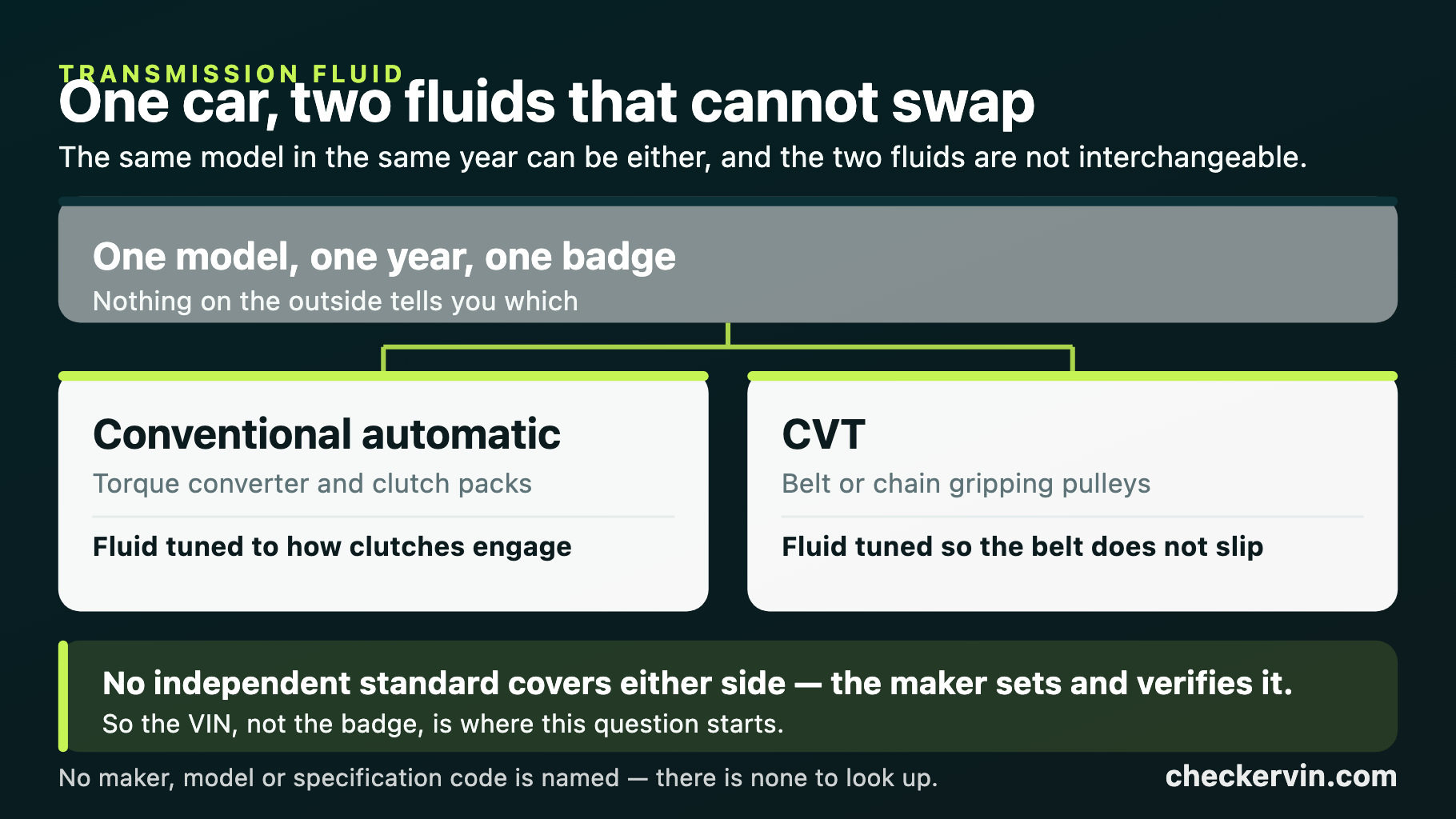
- The same model and year can be a conventional automatic or a CVT, and those take non-interchangeable fluids.
- Is lifetime fill really lifetime?
- It is a claim about the maker's design life for the vehicle, not a promise to a second owner keeping it another decade.
None
Independent standard
Unlike oil and brake fluid
Same model
Can take two fluids
Automatic or CVT
The maker
Who sets the spec
And who verifies it
Design life
What lifetime means
Not your ownership
There is no standard to check
It is worth putting this beside the other two fluids on this site, because the contrast is the most useful thing on the page.
| Fluid | What independently verifies it |
|---|---|
| Engine oil | Industry service categories, licensed by a body that does not sell oil. A bottle carries the category and you can check it against what your manual requires. Covered on our oil type guide. |
| Brake fluid | A federal standard that sets numerical minimum boiling points for each grade, dry and wet. The requirement is law, and it is quotable. Covered on our brake fluid guide. |
| Automatic transmission fluid | Essentially the manufacturer's own specification. There is no equivalent independent category system, so a product either carries the maker's approval or claims compatibility with their specification. |
We are being straight about the sourcing here: unlike our brake fluid guide, which quotes a federal standard directly, this page rests on technical and industry sources. That is not a weakness in the writing. It reflects that the thing itself is not federally standardized — the absence is the subject.
Same car, two different fluids
Here is the fact that makes this a VIN question rather than a model question, and it surprises people who assume a model has a fluid.
A conventional automatic and a CVT can be offered in the same model, from the same manufacturer, in the same model year — and they take completely different, non-interchangeable fluids. Not different brands of the same thing. Different products for different mechanisms.
Nothing on the outside of the car reliably distinguishes them. The badge is the same, the brochure listed both, and a shop working from year, make and model alone has a coin flip in front of it unless somebody checks properly.
Why the VIN matters more here
Across this family of pages the VIN plays the same indirect role — it identifies the hardware, and the specification attaches to the hardware. The difference is how much rides on getting that identification right.
The federal decoder returns a build record and holds no fluid data, exactly as with oil and coolant. What it does return includes transmission information, and our transmission by VIN guide covers reading that.
So the sequence is: decode the VIN, establish which transmission you actually have, and only then look up a fluid. Skipping the middle step is the failure mode this whole page is about, and it is the step people skip because they believe they already know the answer.
ATF, CVT and dual-clutch
Three broad families, built around three different mechanisms, and the mechanism is what dictates the fluid.
| Transmission type | What the fluid has to do |
|---|---|
| Conventional automatic | Transmit torque through a converter and operate clutch packs and hydraulic control. Friction behavior is tuned to how those clutches are meant to engage. |
| CVT — continuously variable | Carry torque through a belt or chain gripping pulleys. The friction requirement is close to the opposite of a slippery lubricant, because grip is the mechanism. |
| Dual-clutch | Serve clutches and, on some designs, gears and actuators together. Formulated for that specific arrangement, and not interchangeable with either of the above. |
Reading those side by side makes the incompatibility intuitive. A fluid engineered so clutches engage smoothly and a fluid engineered so a belt does not slip on a pulley are being asked for different things.
What multi-vehicle fluid claims mean
Shelves carry products described as universal, multi-vehicle or full-synthetic multi-purpose, and it is worth understanding what kind of statement that is.
Because there is no independent category system here, such a product is not saying it passed a common test. It is saying the blender believes it is suitable across a list of manufacturer specifications, and that list is on the back of the bottle. The claim may well be sound. It is a claim by the seller rather than a certification by a third party, which is a different thing from an engine oil carrying a licensed category.
- Read the back label for the specific specification your manual names, not the marketing on the front
- Where the manufacturer publishes its own approval, a product carrying that approval is the stronger position
- A long list of covered specifications is not the same as an independent standard
- On a CVT or a dual-clutch, be markedly more conservative — these are the cases where substitution goes wrong fastest
The lifetime fill question
Many modern transmissions are described as filled for life, and the phrase does a great deal of work that deserves unpacking.
It is a statement about the manufacturer’s design life for the vehicle — the period they engineered and warranted it for. It is not a claim that the fluid does not degrade, and it is not a commitment made to a second or third owner who intends to keep the car for another decade beyond that horizon.
Reasonable people land differently on what to do about that. Plenty of owners and independent shops change the fluid anyway on high-mileage or hard-use vehicles; plenty of manufacturers hold that it is unnecessary. What this page will not do is tell you your manual is wrong.
What the wrong fluid does
The consequences differ by mechanism, which is worth knowing because it changes how urgent a mistake is.
- In a CVT: risk of belt or chain slippage, because grip is the operating principle and the fluid is what provides it
- In a conventional automatic: shift quality changes — shudder, flare, harshness — as clutch engagement behaves differently from the design intent
- In a dual-clutch: clutch behavior and actuation can both be affected, since the fluid may serve several jobs
- Across all three: accelerated wear that is invisible until it is not, because these are sealed assemblies you cannot inspect
The common thread is that a transmission is an expensive, largely non-serviceable assembly. The cost of being wrong is not a fluid change — it is a rebuild or a replacement.
Why it takes months to show
This page joins a pattern that several others on this site have now landed on, and naming it is the most portable thing here.
Fill a transmission with the wrong fluid and it drives away. It shifts, it moves, nothing warns you. The damage accumulates over thousands of miles and surfaces as a shudder or a slip that gets diagnosed as a failing transmission — which by then it is.
It is the same shape as a battery of the wrong construction, a wheel with a mismatched lug seat, brake fluid that quietly absorbed water, and a key that was cut but never programmed. Nothing punishes the shortcut at the moment it is taken. That delay is why these steps get skipped, and why the check has to come before the work rather than after the symptom.
Where the answer actually is
Four sources, and given the absence of an independent standard, staying close to the manufacturer matters more here than elsewhere.
- 1Decode the VIN and establish the transmissionThe step that is specific to this fluid. Confirm whether you have a conventional automatic, a CVT or a dual-clutch before looking up anything.
- 2The owner's manualThe authority on both the specification and the service schedule, including whether your usage counts as severe.
- 3A dealer parts desk, given the VINThey resolve the exact transmission from the number and supply the fluid the maker specifies. On a CVT or dual-clutch this is the conservative default.
- 4The back label, matched to the specification by nameNot the front of the bottle, and not a shelf tag. The specification your manual names should appear on the product.
- 5Ask what a shop intends to use, before the workA reasonable question, easily answered by anyone doing the job properly, and the last cheap moment to catch a substitution.
Checking the level is not simple either
A practical note, because the assumption carried over from engine oil does not hold.
Many modern transmissions have no dipstick. Checking the level can require the vehicle at a specified fluid temperature, level, running, with a fill plug removed — a procedure rather than a glance. Getting the level wrong in either direction causes its own problems.
The practical consequence is that this is less of a driveway job than it used to be, and that a shop declining to check it casually is often being accurate rather than unhelpful.
Buying used, with unknown history
A real inspection point, though a harder one than the fluids you can see.
On a car with no records you cannot know what was put in the transmission or when. Where a dipstick exists, fluid that is very dark or smells burnt is a finding. Where it does not, the test drive carries more weight: shudder at light throttle, flare between shifts, hesitation when pulling away, or a CVT that drones oddly under load are all worth investigating rather than explaining away.
Our pre-purchase inspection guide covers what an examination reaches, and our maintenance report guide covers why service history is so often missing. On a vehicle with a CVT and no records, that missing history is worth more caution than it would be on a conventional automatic.
The check sequence
Decode the VIN free and establish the transmission variant — the step that is specific to this question. Read the manual for the specification and the schedule, including whether your driving counts as severe. Match the specification by name on the back label, or buy the maker’s own fluid where a CVT or dual-clutch is involved. And check open recalls through NHTSA at no cost while you have the number in front of you.
Where this information comes from
- ATF, CVT and DCT fluid requirements — automotive technical training materialTechnical training material on why CVT and dual-clutch systems require fluids formulated for their specific operating characteristics
- Jalopnik — CVT versus automatic transmission fluidOn the same model in the same year taking completely different and non-interchangeable fluids depending on transmission type
- NHTSA recall lookupOpen safety recalls by VIN, free — transmission components appear among them
Keep reading
Frequently asked questions
Can I find my transmission fluid type from the VIN?
Indirectly, and this is the fluid where the VIN matters most. There is no fluid field in any decoder, but the VIN identifies the exact transmission variant — and the same make, model and year can be sold with a conventional automatic or a CVT, which take completely different and non-interchangeable fluids. The badge cannot tell you which you have; the number can.
Is there an industry standard for transmission fluid like there is for engine oil?
Not in the same way. Engine oil has API and ILSAC categories you can check a bottle against, and brake fluid has a federal standard that sets numerical requirements. Automatic transmission fluid specifications are largely the manufacturer's own, which means there is no independent standard to verify a product against — only the maker's specification and whether a product claims to meet it.
Can I put ATF in a CVT?
No. A CVT transmits torque through a belt or chain against pulleys and depends on the fluid having specific friction characteristics. Conventional automatic transmission fluid is formulated for a different mechanism. Using it in a CVT risks belt slippage and damage, and it is not a matter of degree.
What does lifetime fluid actually mean?
It is a claim about the manufacturer's design life for the vehicle, not a statement that the fluid never degrades. It is also not a promise made to a second or third owner planning to keep the car another decade. Many owners and independent shops change it anyway on high-mileage or hard-use vehicles — check what your manual specifies and decide with that in front of you.
Does CheckerVIN return a transmission fluid specification?
No. Our free lookup returns the factory build, specifications and open safety recalls from the federal decoder, which has no fluid fields. What it does return is the transmission information, which is the part of this question the VIN can genuinely settle.
Start with the VIN
Decode any VIN free for the factory build, specifications and open safety recalls. No account, no card.
Run a free VIN check