The short answer
- Why two boiling points?
- Because the standard expects the fluid to absorb water, and sets a minimum for how it must perform once it has.
- So what is the interval based on?
- Time. Absorption happens with age, not with use, so a car that sits is still losing margin.
- Is DOT 5 just a better DOT 4?
- No. DOT 5 is a silicone base fluid — a different chemistry, not a higher grade of the same thing.
Two
Boiling points per grade
Dry at S5.1.1, wet at S5.1.2
Time
What drives replacement
Absorption, not mileage
Silicone
What DOT 5 actually is
Not a higher DOT 4
The cap
Where the answer usually is
Backed by the manual
The standard names two numbers
Federal rules govern brake fluid directly, and reading them settles most of the arguments people have about it.
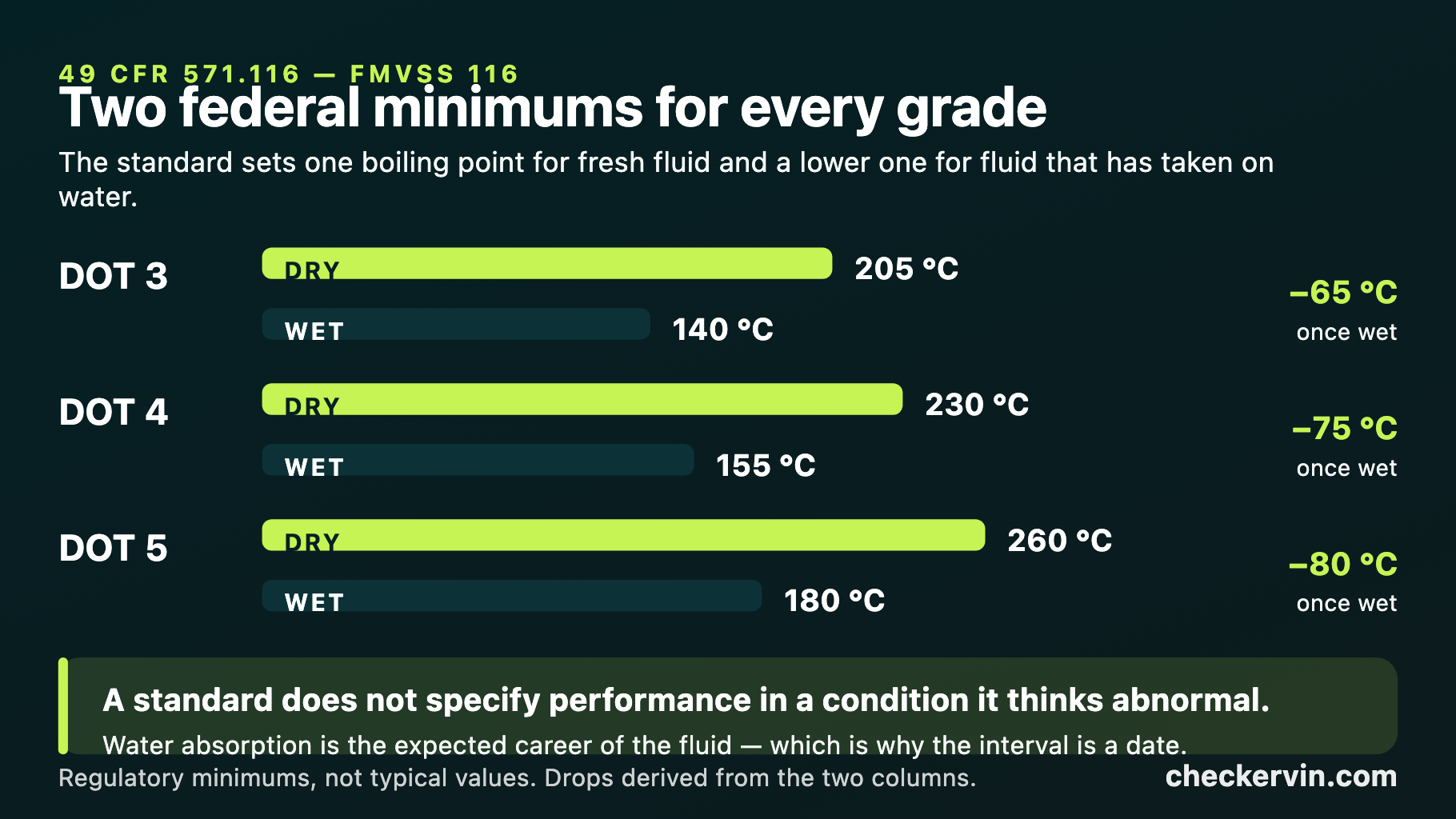
The standard sets a minimum equilibrium reflux boiling point for each grade — the temperature at which the fluid begins to boil under test. For fluid as manufactured, the minimums are 205 °C for DOT 3, 230 °C for DOT 4 and 260 °C for DOT 5.
Then it does something unusual. In the very next provision it sets a second, lower requirement: the wet boiling point, measured on fluid that has taken on water. Those minimums are 140 °C for DOT 3, 155 °C for DOT 4 and 180 °C for DOT 5.
What the gap is telling you
The interesting figure is not either number on its own. It is the distance between them.
For DOT 3 the required minimum falls from 205 °C to 140 °C. For DOT 4, from 230 °C to 155 °C. For DOT 5, from 260 °C to 180 °C. Those are drops of 65, 75 and 80 degrees — and they are the minimums the standard still demands from wet fluid, not a worst case it warns against.
So the margin you have on the day the car is serviced is not the margin you have three years later, and the reduction is large. A fluid that comfortably exceeded its dry requirement when new can be sitting near its wet minimum by the time anybody thinks about it.
How the water gets in
The obvious question, since a brake system is closed and nobody pours water into it.
Glycol-based brake fluid is hygroscopic — it attracts and holds water. It does not need a leak to do this. Moisture reaches the fluid gradually through flexible hoses, past seals, and through the reservoir every time it is opened or the fluid level moves as the pads wear.
This is a property of the fluid rather than a defect in the system, and it is deliberate: water that is dispersed through the fluid is water that is not pooling somewhere as free liquid and corroding a caliper from the inside. The trade is that the whole volume slowly loses boiling margin.
Replaced by time, not mileage
This is the correction the page exists for, and it follows directly from everything above.
Nearly all vehicle maintenance is expressed in miles, so brake fluid gets mentally filed alongside oil and forgotten on a car that is not driven much. But absorption is a function of exposure and time, not of use. A car that covers four thousand miles a year is absorbing moisture at broadly the same rate as one covering twenty thousand.
A low-mileage vehicle can therefore have fluid in worse condition than a high-mileage one of the same age. Our mileage guide makes the general version of this point — that time damages a car in ways the odometer does not record — and brake fluid is the cleanest single example of it.
What boiling fluid actually does
Worth being concrete, because the consequence is specific and it arrives at the worst possible moment.
A hydraulic brake system works because liquid does not compress. Push the pedal, and the force travels through the fluid to the calipers. If a portion of that fluid boils, the vapor produced is compressible — so the pedal now compresses a gas pocket instead of moving the pistons.
The symptom is a pedal that goes long or drops toward the floor, with braking that returns once things cool. And the conditions that boil fluid are exactly the conditions that demand braking: a long descent, repeated hard stops, a heavily loaded vehicle, towing. The failure selects for the moment you can least afford it.
The grades, and the odd one out
Three grades appear in the boiling-point tables, and one of them is not what its number suggests.
| Grade | What it is |
|---|---|
| DOT 3 | Glycol-based. Minimum dry boiling point 205 °C, minimum wet 140 °C. Long-standing and still specified on many vehicles. |
| DOT 4 | Glycol-based, with higher required boiling points — minimum dry 230 °C, minimum wet 155 °C. Common where braking loads are higher. |
| DOT 5 | The exception. A silicone base brake fluid, which the standard defines as not less than 70 percent by weight of a diorgano polysiloxane. Higher required boiling points, and a different chemistry entirely. |
The numbering invites people to read DOT 5 as an upgraded DOT 4, and that reading is wrong in a way that matters. It is a separate fluid family. Fit it where a glycol fluid is specified and you are not buying headroom — you are changing what is in the system.
A further grade, DOT 5.1, appears elsewhere in the standard’s text and is glycol-based despite the number. We are not quoting boiling figures for it here, because the tables we read set them for DOT 3, DOT 4 and DOT 5.
Topping up and mixing
The practical question, answered with the same care the grades deserve.
- Use what the manual and the reservoir cap specify — that is the requirement, not a starting suggestion
- DOT 3 and DOT 4 are both glycol-based, and topping a DOT 3 system with DOT 4 is commonly permitted where the manufacturer allows it
- Do not treat that as extending to DOT 5, which is a silicone base fluid and a separate chemistry
- Brake fluid absorbs moisture from the air in the bottle too — an opened container that has sat around is not fresh fluid
- Buy the smallest sensible quantity and use it, rather than keeping a part-used bottle for years
The opened-bottle point catches people who are otherwise careful. A fluid whose defining property is that it attracts water does not improve in a garage with the cap half on.
What the VIN is doing here
The same indirect role as elsewhere in this family, and worth stating plainly.
The federal decoder returns a build record — make, model, model year, body class, displacement, cylinders, fuel type. There is no fluid field in it, and there never has been, because fluid specification is an engineering requirement the manufacturer publishes rather than a registration fact. Our oil type guide covers the same limitation in more detail.
What the VIN gives you is certainty about which vehicle and trim you are dealing with, which matters because braking hardware can differ across trims of one model. In practice, though, brake fluid is one of the few specifications printed on the component itself — so the reservoir cap usually answers the question before any lookup does.
Where the answer actually is
Three sources, and the first one is under the hood right now.
- 1The reservoir capMost vehicles carry the required grade molded or printed on the brake fluid reservoir cap. It is the fastest answer available and it is on the car itself.
- 2The owner's manualThe authority, and the place the replacement interval lives. If the cap and the manual disagree, follow the manual.
- 3A dealer parts desk, given the VINFor a vehicle whose manual is missing and whose cap is unreadable, they resolve the trim from the number and read the specification from the manufacturer's system.
- 4Then note the date, not the mileageWhatever you do, record when the fluid was changed. That date is what the next decision depends on.
Testing what is in there now
Unlike most fluid questions, this one can be measured rather than guessed.
Shops use test strips that react to moisture content, and electronic testers that estimate the boiling point of the fluid in the reservoir. Neither is perfect — a reservoir reading may differ from fluid sitting down at the calipers, which is the hottest and often the worst part of the system — but both are far better than an assumption.
Color is a weak signal here and worth treating with the same suspicion this site applies to coolant color. Fresh fluid is typically light and clear and darkens with age and contamination, so very dark fluid is a reason to investigate. But fluid can be badly degraded on moisture content while still looking acceptable, because water is colorless.
Buying used, with unknown history
A short, genuine inspection point on any used car, and one of the cheapest items on the list.
Open the hood and look at the brake fluid reservoir. Note the grade on the cap, and look at the fluid — dark, murky fluid on a car with no service records is a finding, and residue around the cap is worth noting too.
More importantly, ask when it was last changed, and treat “it has low mileage” as a non-answer rather than a reassurance. On this particular item, low mileage is not protective. Our pre-purchase inspection guide covers what a proper examination reaches, and the maintenance report guide covers why service history is so often missing in the first place.
The check sequence
Decode the VIN free to confirm the exact vehicle and trim. Read the grade off the reservoir cap and check it against the manual. Find out when the fluid was last changed — the date, not the odometer. Have it tested if nobody can tell you. And check open recalls through NHTSA at no cost while you have the number in front of you, since braking components are a frequent subject of them.
Where this information comes from
- 49 CFR 571.116 — FMVSS 116, motor vehicle brake fluidsS5.1.1 dry equilibrium reflux boiling point minimums, S5.1.2 wet ERBP minimums, the water-content analytical methods at S7.2, and the definition of a silicone base brake fluid
- NHTSA — Federal Motor Vehicle Safety StandardsThe standards series this requirement belongs to, and how FMVSS are structured
- NHTSA recall lookupOpen safety recalls by VIN, free — braking components are a frequent subject
Keep reading
Frequently asked questions
How often should brake fluid be changed?
By time rather than by mileage, and your manual gives the interval. The reason is in the federal standard itself: it specifies a boiling point for fresh fluid and a lower one for fluid that has absorbed water, because absorption happens with age rather than with use. A car that sits still is still losing margin.
What is the difference between DOT 3, DOT 4 and DOT 5?
DOT 3 and DOT 4 are glycol-based and differ in required boiling points — the standard sets minimum dry figures of 205 °C for DOT 3 and 230 °C for DOT 4. DOT 5 is the odd one: a silicone base brake fluid, defined in the standard as not less than 70 percent by weight of a diorgano polysiloxane. It is a different fluid, not a higher grade of the same one.
Can I mix DOT 3 and DOT 4?
They are both glycol-based, and DOT 4 carries the higher required boiling points, so topping a DOT 3 system with DOT 4 is generally tolerated where the manufacturer permits it. What you should not do is treat that as a rule covering DOT 5, which is silicone-based and a different chemistry. Use what your manual specifies.
Can a VIN tell me which brake fluid my car takes?
Not directly — there is no fluid field in any VIN decoder. What the VIN does is identify the exact model and trim, which is what the requirement attaches to. In practice the answer is usually printed on the reservoir cap, and the manual is the authority.
Does CheckerVIN return fluid specifications?
No. Our free lookup returns the factory build, specifications and open safety recalls from the federal decoder, which holds no service data. Decode the VIN to confirm the vehicle, then read the cap and the manual.
Start with the VIN
Decode any VIN free for the factory build, specifications and open safety recalls. No account, no card.
Run a free VIN check