The short answer
- What is stat.vin?
- A site whose pages describe Copart and IAAI auction history by VIN. It refused our requests, so we could not check its prices or terms.
- Is it a title history report?
- No. It is not on the Department of Justice list of approved NMVTIS providers (checked November 24, 2026), so whatever it shows is not the federal title record.
- Does no auction record mean no damage?
- No. It only means no salvage auction listing turned up. Many damaged cars never reach Copart or IAAI.
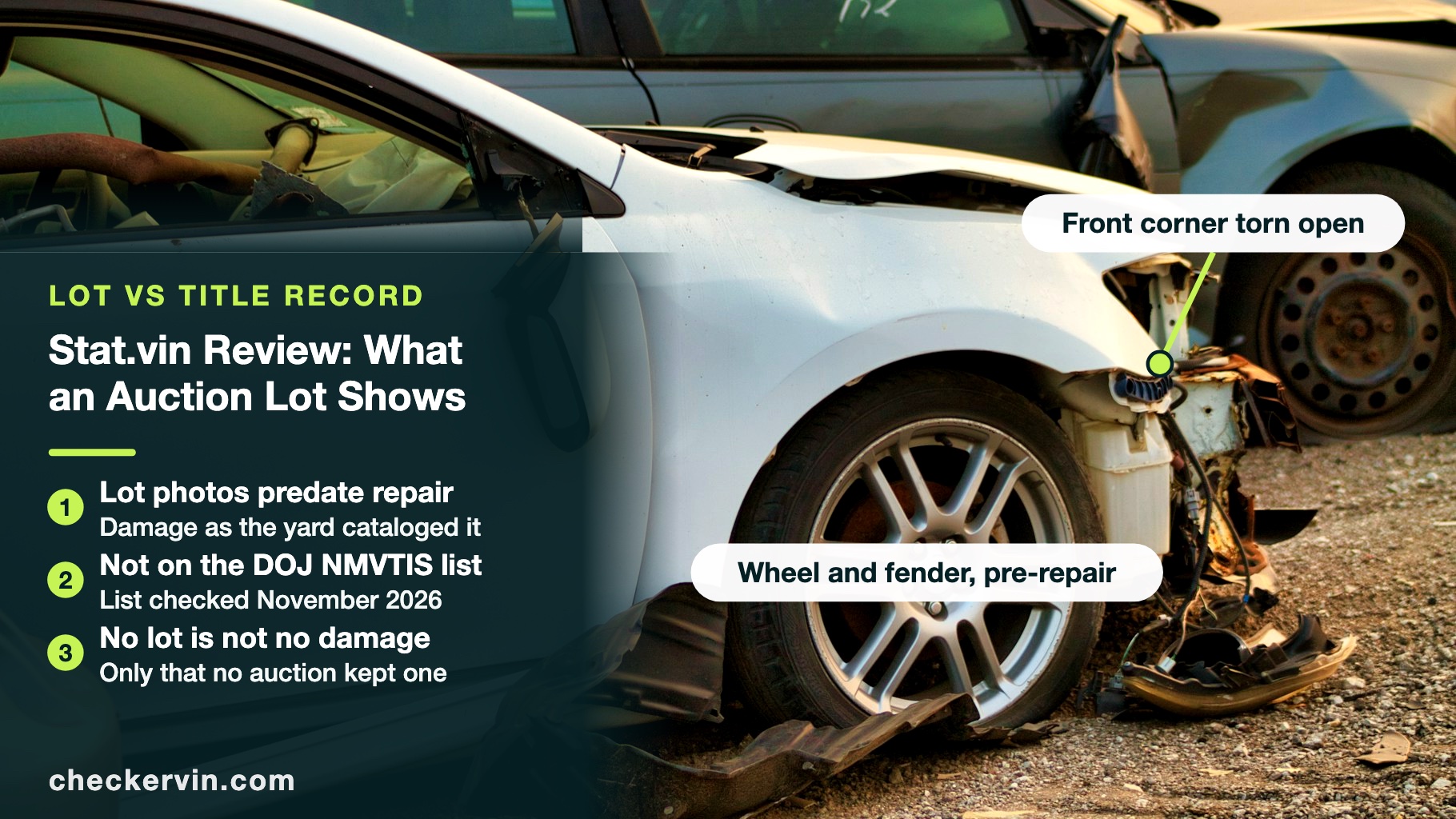
Not listed
DOJ NMVTIS provider status
Checked November 24, 2026
One sale
What a lot record describes
Photographed on intake
Five
Indicators in an NMVTIS report
Per the federal consumer page
Unverified
Stat.vin prices and terms
Its site blocked our requests
The short verdict
If a car you are considering went through a Copart or IAAI salvage sale, the lot listing is worth finding, and an archive like Stat.vin is one place people look for it. Use it for what a lot record is good at: pre-repair photographs and the damage as the auction described it. Do not use it as a substitute for a title history. It is not an approved NMVTIS provider, and a missing auction record tells you very little about whether a car has been damaged.
What stat.vin is, as far as we could verify
Stat.vin is a VIN lookup for the auction and sale history of US cars sold through Copart and IAAI. Its site refused our requests in November 2026, so everything beyond that, including its prices, its operator and its terms, is outside what we could check. Much of the demand for salvage auction data comes from buyers who import damaged American cars, and from the people who later buy those cars and want to know where they came from.
Whether you search “stat vin”, “vin stat” or “stat.vin copart”, you arrive at the same thing: an archive of auction listings keyed to the VIN. The underlying listings were written by the auction houses, which publish photographs and condition notes so that professional buyers can bid on damaged cars they cannot inspect in person. Our auction history guide covers how those listings are produced and how to read their damage codes; this page sticks to the Stat.vin-specific questions.
What we could not check, and why
A review should be built from the company’s own pages. We tried. On November 24, 2026, every stat.vin page we requested, including the home page, FAQ, pricing and terms, returned an access-denied response from its bot protection, and we did not try to get around it. That leaves gaps we would rather name than fill with guesses:
- What a Stat.vin report costs, and which parts are free
- Who operates the site and where it is registered
- Its terms of use and its policy on removing listings
- Exactly which fields each of its records includes
Prices you may see quoted elsewhere for this service, in forum threads or search snippets, are not repeated here because we could not confirm them at the source. If the site becomes readable to us, this page will be updated from what it actually says.
Not on the NMVTIS approved-provider list
The one checkable credential in this market is the Department of Justice list of businesses approved to sell reports from the National Motor Vehicle Title Information System, the federal database that states, insurers and salvage yards report into. We read the list on November 24, 2026. Stat.vin does not appear on it in any tier. The 12 providers approved to serve consumers are:
- Bumper.com
- Carsforsale.com
- Carvertical.com
- Checkthatvin.com
- Clearvin.com
- EpicVin.com
- GoodCar.com
- Titlecheck.us
- Vinaudit.com
- Vindata.com
- VinReport
- Vinsmart.com
The department says the list is alphabetical and implies no preference. Not being on it is not an accusation. Stat.vin does not need federal approval to archive auction listings, because an auction listing is not a title record. What it does mean is that a title brand, an odometer history or a total-loss flag shown by a non-listed site was not obtained from NMVTIS under that approval, so it should not be treated as the federal record. Our NMVTIS report guide explains what the federal record contains and who can sell it.
A lot record and a title record answer different questions
The useful way to think about Stat.vin is not “is it as good as a history report” but “which questions does each record answer?” The federal consumer page says an NMVTIS report is intended to provide data on five indicators:
- Current state of title and the last title date
- Brand history, such as junk, salvage or flood, from any state
- The odometer reading
- Total loss history
- Salvage history
It also says that repair histories and care and maintenance data are not intended to be in NMVTIS. A salvage lot listing fills a different gap. Set the two side by side and the division of labor is clear:
| The question | Where the answer usually lives |
|---|---|
| What did the damage actually look like? | The auction lot photos, taken before repair |
| Which part of the car was hit? | The lot's primary and secondary damage descriptors |
| Is the title branded salvage, flood or junk in any state? | The NMVTIS brand history |
| Was it declared a total loss? | NMVTIS total loss history, and often the lot listing too |
| Has the odometer been rolled back? | NMVTIS odometer readings, cross-checked with the lot's intake reading |
| What happened after the sale? | Neither, fully: title transfers in NMVTIS, then a physical inspection |
The point is that neither record replaces the other. A salvage-branded title tells you the car was badly damaged without showing you how; a lot listing shows you how without telling you what any state did about it afterwards. Our salvage title check covers the branding side.
Copart, IAAI and searching by VIN or lot number
Auction archives can usually be searched two ways: by VIN, or by the lot number the auction assigned to a single sale. They are not interchangeable. A lot number identifies one listing on one date. The VIN identifies the car, and one car can pass through salvage auctions more than once, for example after a rebuild fails to sell or after a second loss. Searching on the full 17-character VIN is the only way to see every lot an archive holds for that car.
It also matters which auction house a seller names. If you are told a car was “an IAAI car” and the archive shows only a Copart lot, or the reverse, you have found either a second sale or a story that does not match, and both are worth a question before you go any further.
Matching a result to your car
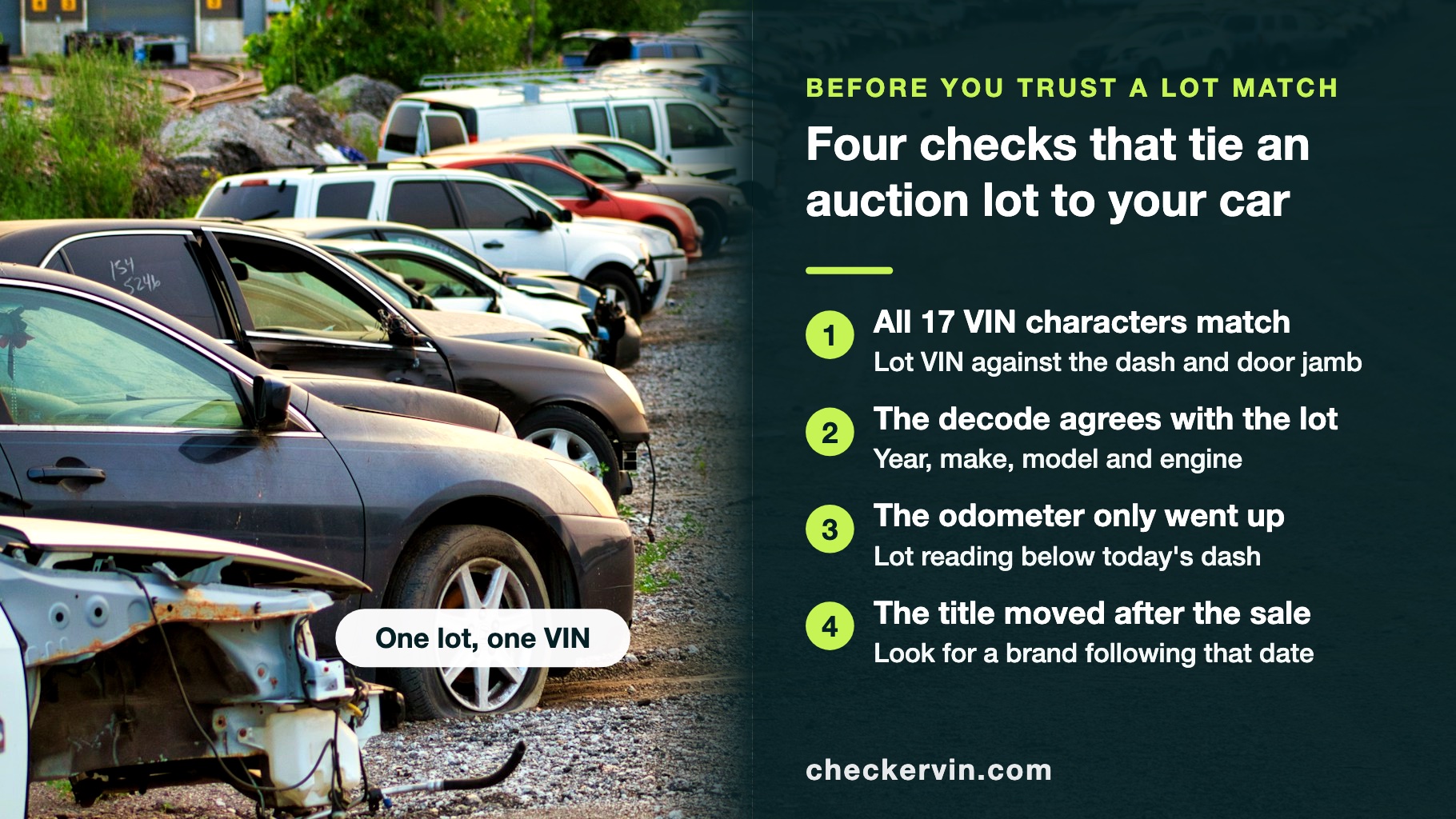
The most common way to misuse an auction archive is to accept a result without checking it belongs to the car in front of you. Listings are transcribed, VINs are mistyped, and a listing for a similar car can look convincing. Four checks settle it:
- 1All 17 VIN characters matchCompare the lot's VIN with the plate at the base of the windshield and the label on the driver's door jamb, character by character. One wrong character means a different car.
- 2The decode agrees with the lotRun the VIN through a free decoder and compare the model year, make, model and engine with what the listing says. A listing that disagrees with the factory build data is describing something else.
- 3The odometer only went upThe lot's intake reading should be lower than what the dash shows today. A current reading below the auction figure needs an explanation, and odometer readings in an NMVTIS report are the place to look next.
- 4The title moved after the saleNote the sale date, then look at what the title did afterwards. That comparison is the subject of the next section.
Reading the sale date against the title
The lot’s sale date is a timestamp you can hold the rest of the history against. If a car was sold through a salvage auction after an insurance total loss, you would expect the title record to reflect it: a salvage or similar brand, or a total loss entry, around that time. Federal rules require insurers and salvage yards to report the vehicles they handle to NMVTIS, so that is where to look.
Two patterns deserve a hard look. The first is a clean, unbranded title with no total loss history despite a salvage sale, which can have innocent explanations (some cars are sold through these auctions without ever being totaled) but can also be the trace of a title moved between states until the brand fell off. The second is a sale date followed closely by a resale at full retail with no mention of the auction. Neither proves anything on its own, and both are reasons to ask the seller directly and to put the car on a lift.
Free and paid: what we can and cannot tell you
The search interest around this site is heavy on price questions, so it is worth being precise about what we know. We know that the photographs and descriptions in auction listings were published openly while each lot was live, which is why archives of them exist at all. We do not know how Stat.vin divides free and paid features, or what it charges, because we could not read its pages.
The general rule holds anyway. Before paying any auction archive, read what the paid option actually adds over the free listing. If what you need is the title, brand and odometer history, the place to buy it is an approved NMVTIS provider, where reports cost a few dollars. Our Carfax alternatives page compares those providers on what they can actually supply.
Why “no auction record” does not mean “never damaged”
This is the misreading that costs buyers the most money. A blank Stat.vin search tells you that this archive holds no salvage auction listing for that VIN. It does not tell you the car was never damaged, for three separate reasons:
- The car never went to a salvage auction: repaired privately, claim never totaled, or kept by its owner
- It was sold somewhere this archive does not cover, outside Copart and IAAI
- The listing existed but the archive never captured it, or no longer shows it
The federal record has gaps of its own: the junk and salvage yard reporting rule, for instance, exempts operators handling fewer than five such vehicles a year. That is why no single source closes the question. The fuller treatment of what slips through is on our auction history page, and the same logic applied to listing photos is on VIN check with photos. If a seller has disclosed damage that no auction record supports, our damage reported guide explains where those report lines come from.
Is stat.vin legit?
It helps to split the question into three, because they have different answers. Is it a real service? Yes: it is operating and widely indexed. Is it a federal title report? No: it is not on the approved NMVTIS provider list, so it cannot sell you that record. Is the data it shows authentic? That depends on the listing, which is exactly why the four matching checks above exist. An archived photo set that matches the VIN, the decode and the odometer is strong evidence. One that does not match is evidence about a different car.
We are not in a position to judge its customer service, or its refund practice, and we would be guessing if we tried.
Where CheckerVIN fits, stated plainly
CheckerVIN does not sell a title or accident history report today, and it does not return auction lot records. What a free check here returns now is the factory build and specifications, factory warranty terms, open NHTSA safety recalls, photos filed against the VIN, and market and listing prices, with no account and no card. Title brands, damage records, odometer readings and ownership history are launching soon, and are not part of what we return yet. The decode is the first of the four matching checks above, and the quickest way to find out whether a listing, an auction lot or a seller’s description is about the car the VIN belongs to.
Decode a VIN before you trust a lot match
Decoded from official manufacturer and NHTSA records
Until our history report launches, the honest pairing is: our free check for identity and recalls, an auction archive for pre-repair photographs, and, for the title record itself, an NMVTIS report bought from one of the 12 providers on the Department of Justice list above, which covers title brands, total loss and odometer history.
The order to run it in
- 1Decode the VINConfirm the year, make, model and engine, and check for open recalls. Free, and it anchors everything after it.
- 2Search the auction archives by full VINStat.vin is one option. Try more than one archive before concluding there is no lot, and save what you find.
- 3Run the four matching checksVIN, decode, odometer and sale date against the car and the paperwork in front of you.
- 4Buy the NMVTIS record from an approved providerFor title state, brands, odometer, total loss and salvage history, the five things a lot record cannot give you.
- 5Inspect the car with the lot photos openAsk the mechanic to look specifically at the areas the auction photographed as damaged.
Where this information comes from
- NMVTIS — approved data providersRead November 24, 2026; Stat.vin is not listed in any tier
- NMVTIS — understanding a vehicle history reportThe five indicators an NMVTIS report covers, and what it is not meant to include
- 28 CFR 25.56 — junk yard, salvage yard and recycler reportingMonthly reporting duty and the under-five-vehicles exemption
- NHTSA vPIC — VIN decoder and manufacturer dataWhere factory build data for a VIN decode comes from
- stat.vinRequested November 24, 2026; access denied by the site's bot protection, so its own pages could not be read
- How we made this pageWritten by the CarCheckerVIN editorial team with AI assistance from NHTSA vPIC and other public records; facts checked November 2026.
Keep reading
Frequently asked questions
Is stat.vin legit?
It is a real, operating site: its pages appear widely in search results, describing Copart and IAAI auction history by VIN. What it is not is a company on the Department of Justice list of approved NMVTIS data providers, which we checked on November 24, 2026. So treat what it shows as an archived auction listing, not as a federal title record, and verify that the lot belongs to your car before relying on it.
Does stat.vin show Copart and IAAI auction history?
Its own pages, as they appear in Google's results, describe auction and sale history from Copart and IAAI. We could not open those pages to confirm exactly what each record includes, because the site refused our automated requests. Salvage auction listings in general carry pre-repair photographs, damage descriptors, an odometer reading taken at intake and a sale date, which is the kind of record to expect.
Is a stat.vin report the same as a vehicle history report?
No. A salvage auction record describes one sale: what the car looked like and how it was cataloged that day. A federal NMVTIS report covers five things across the car's life: title state and date, brands, odometer, total loss history and salvage history. A Stat.vin report may contain other material we could not inspect, but it cannot be an NMVTIS report, because Stat.vin is not on the approved-provider list.
Is stat.vin free?
We could not verify its pricing. The site blocked every page we tried to load on November 24, 2026, including the home page, FAQ, pricing and terms, so we are not printing any price or describing a free-versus-paid split. If you use it, read what a paid option promises before you pay, and compare that with the few dollars an approved NMVTIS provider charges for the federal title record.
If my car has no stat.vin record, was it never damaged?
No. No record only means no salvage auction listing for that VIN was found in that archive. Plenty of damaged cars never go through Copart or IAAI: privately repaired collisions, claims that were never totaled, owners who kept a totaled car, and sales outside those two auction houses. Run an NMVTIS report and get an inspection before treating a blank result as good news.
Is there a stat vin decoder for the build details?
Whatever site you use, the factory build data a VIN decoder returns ultimately comes from what manufacturers file with NHTSA, published through its vPIC database. Our free check returns the factory build and specifications, including year, make, model and engine, along with open safety recalls, which is also the quickest way to confirm that an auction lot describes the same car.
Check the VIN before you check the auction
Decode any VIN free for the factory build, specifications and open safety recalls. No account, no card. Full vehicle history reports are launching soon.
Run a free VIN check