The short answer
- Is there an official VIN check with photos?
- No. Every photograph you have ever seen attached to a VIN came from a commercial sales listing, not from a government record. The federal rule governing the national title system does not mention images at all.
- So where do the pictures on VIN sites come from?
- Archived listings. Services capture dealer inventory pages, marketplace ads and auction lots while they are live, then key those images to the VIN. What you are searching is an advertising archive with a VIN index on it.
- Is that still worth looking at?
- Yes, but for a narrower purpose than most buyers assume. A photo set is strong evidence of how a car was presented and described over time, and it is weak evidence about the car's condition today.
0
Photos in the federal record
28 CFR Part 25, whole part
5
Data elements states must send
All of them textual
Listings
The real source of VIN photos
Not any government file
Uneven
Coverage by vehicle
Never advertised, never captured
The short answer, before the detail
A vehicle identification number is a key into records. Which records depends entirely on who is holding them, and the distinction that matters here is between a record and an archive. A record is something a party is obliged to create and keep — a title, a recall notice, an odometer disclosure. An archive is something a private company chose to save because it was commercially useful.
Photographs of used cars live entirely in the second category. No law requires anyone to photograph a vehicle, file the photograph, or keep it. The pictures that exist exist because someone was selling something, and they persist because a third party decided that a copy was worth storing. Once you see the query that way, three things follow immediately: coverage will be uneven, the images will be flattering, and the absence of a photo will mean nothing at all.
There is no photograph in the federal vehicle record
The national title system is the National Motor Vehicle Title Information System, established by federal statute and governed by 28 CFR Part 25. It is the closest thing the United States has to an official history file behind a VIN: states feed it titling data, insurers and salvage yards feed it disposal data, and approved providers sell access to the result.
We read the regulation looking for what it says about images. It says nothing. The words photograph, image and picture do not appear anywhere in Part 25 — not in the definitions, not in the state reporting duties, not in the salvage yard duties, not in the provisions describing what a user of the system receives. This is not a gap someone forgot to fill. It is a record designed around identity and legal status, and a photograph establishes neither.
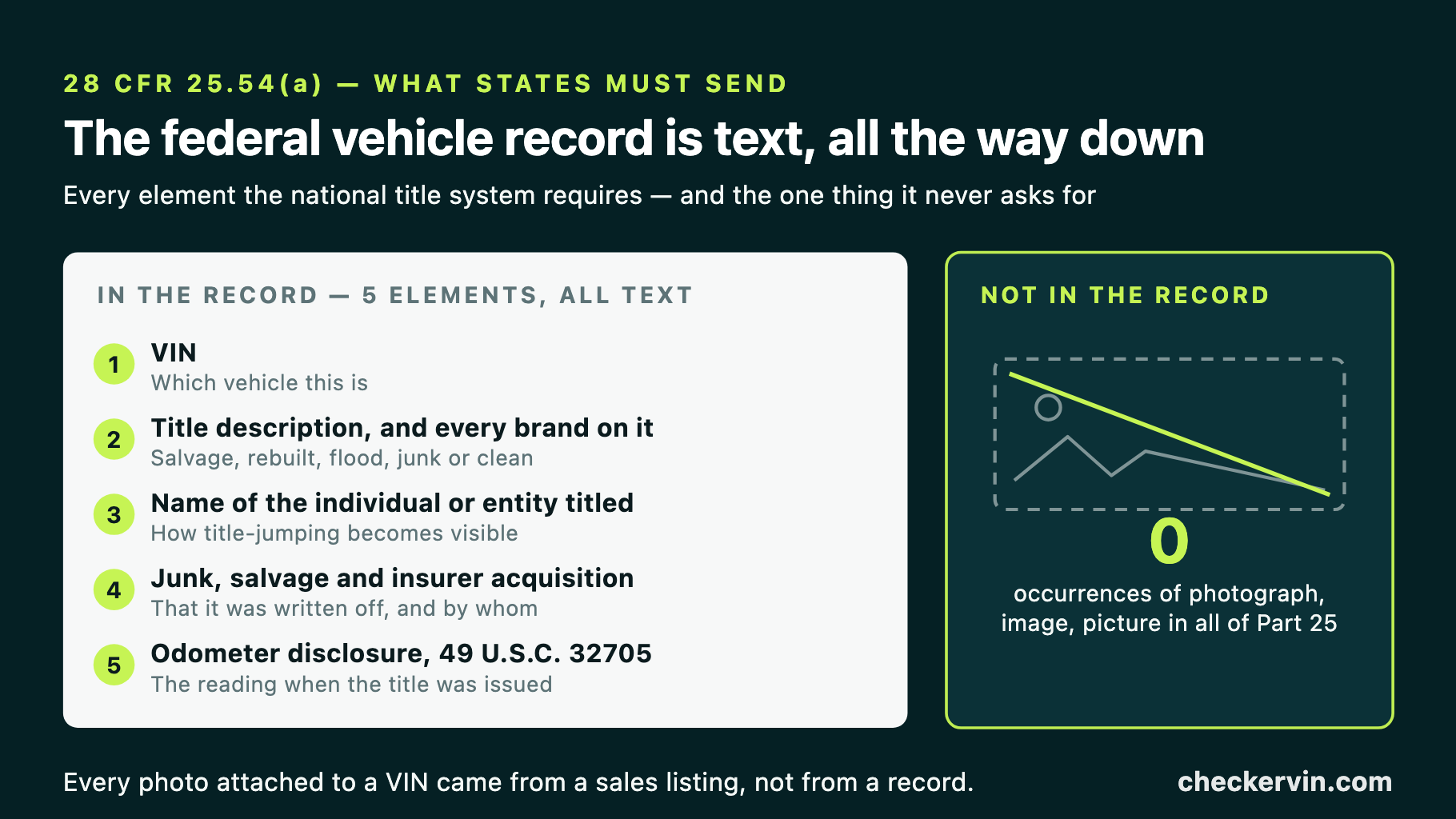
What the record does hold instead
It is more useful to know what is in there than what is not. Section 25.54 sets out what every state must transmit for each vehicle, at least once every twenty-four hours, in a format the system operator accepts.
| Required data element | What it establishes |
|---|---|
| The VIN | Which vehicle this record is about |
| Any description of the automobile on the certificate of title, including all brands | Whether the car is titled salvage, rebuilt, flood, junk or clean |
| The name of the individual or entity the certificate was issued to | Who held legal title, which is how title-jumping becomes visible |
| Information from junk yards, salvage yards and insurers on acquiring the vehicle | That the car was written off or dismantled, and by whom |
| The odometer mileage disclosure required by 49 U.S.C. 32705 | The reading recorded at the point the title was issued |
Five elements, all of them text, every one of them about legal status rather than appearance. Section 25.56 extends the same logic to junk yards, salvage yards and auto recyclers, which must report a monthly inventory of the vehicles they obtained: their own name and contact details, the VIN, the date obtained, and who they obtained it from. That is the one point in the entire system where a wrecked vehicle is physically in someone’s hands — and the rule still asks only for text.
Section 25.55 goes further, and it is the provision that explains why buyers reach for photographs in the first place. Insurance carriers must report five things about a car they have written off: their own contact details, the VIN, the date it was designated junk or salvage, who they got it from, and who owned it when the report was filed. The reasonis not on that list. It appears one paragraph later, at 25.55(c), where carriers are “strongly encouraged” to supply other information relevant to the title, including the reason the carrier took possession. Encouraged, not required.
Put the two findings side by side and the shape of the record is clear. It will tell you that a car was declared a total loss, by whom and when — and it need not tell you whether that was flood, fire, collision or theft, and it will never show you the car. That is not a failure of the system; it is a title record doing exactly its job. But it is precisely the gap a photograph would fill, which is why this search exists. Our auction history page works the same seam from the record side.
If you want the full picture of what that record can and cannot settle, our guide to the NMVTIS report covers it in detail. The point for this page is narrow and firm: no part of it was ever going to hand you a picture.
Where the pictures on VIN sites actually come from
Now the useful half. Photographs keyed to a VIN come from sales listings, captured while those listings were live and retained afterwards. There are four main reservoirs, and they behave differently.
| Source of the photos | How it behaves |
|---|---|
| Franchise and independent dealer inventory pages | Professionally shot, numerous, flattering; disappear when the car sells unless captured |
| Classified marketplaces and private-seller ads | Uneven quality, often the most honest, frequently deleted quickly |
| Salvage and insurance auction lots | Damage documented deliberately and from many angles, because bidders need it |
| Wholesale and dealer-only auction runs | Condition reports with photos, rarely visible to the public at all |
The commercial services that advertise pictures are, in substance, running a crawler and a database: capture listings at scale, extract the VIN where it is published, store the images, and let people search by VIN afterwards. Some of them say so plainly in their own marketing — one advertises tens of millions of listings with photos and historical asking prices, another describes what it holds as archive photos. That is an accurate description of the product, and it is worth reading carefully, because it tells you the coverage question is really a question about whether this specific car was ever advertised online in a form somebody captured.
Finding photos for one specific VIN
If you have a VIN and want to see the car's history of being sold, work outward from the most specific source to the least. Most of this costs nothing.
- 1Search the bare VIN as a quoted stringPut the full 17 characters in quotation marks in a search engine. Dealers routinely publish the VIN in the page body or in structured data, so live and cached listings surface directly. This single step finds more than every paid tool people try next.
- 2Search the VIN's last six characters with the modelThe final six are the production sequence and are often quoted alone in auction lot titles and forum posts where the full number was withheld. Pair them with the year and model to cut the noise.
- 3Check the cached and archived copiesA listing taken down last month may still exist in a search engine's cache or in a public web archive. This is where a sold car's photo set most often survives, and it costs nothing to look.
- 4Look at the salvage and insurance auction aggregatorsIf the car was ever a total loss, its lot page carried damage photos. Several aggregators index closed lots by VIN. Treat what you find there as the most informative photo set you will get.
- 5Ask the seller for photos with something in the frameThe photographs nobody has are the ones that matter most: current, dated and yours. Ask for shots taken today with the VIN plate visible, and with the door open showing the jamb sticker.
Why coverage is so uneven
Because the archive is built from advertising, a vehicle's photographic record is a record of how often it was sold publicly — not of how eventful its life was. The consequences are worth stating in order.
- A car sold privately, face to face, may never have been photographed for an ad at all
- A car that stayed with one owner for a decade will have a gap exactly that long
- A car sold repeatedly through dealers will look extensively documented, which reflects turnover and not quality
- A car repaired and resold without ever passing through an auction leaves no damage photos to find
- Listings deleted before anyone captured them are simply gone, and nothing indicates they existed
Read that list twice, because it inverts the intuition the search term carries. A thick photo history is not a sign of a well-documented car; it is a sign of a frequently traded one. A thin one is not a red flag at all.
What a photo set can actually prove
Used properly, an archive of old listings is genuinely powerful — not because of what each picture shows, but because of what several of them, taken at different times, show together.
- That the car was advertised on specific dates, establishing a rough timeline of sales
- What mileage was claimed at each of those points, when the odometer appears or is stated
- Whether the described condition changed between listings
- Whether a body panel, wheel set, badge or interior trim differs between one listing and the next
- Whether the color in an old listing matches the color in front of you
- Whether the same photographs have been reused across multiple sellers
The fourth and fifth of those are the ones that repay real attention. A car that is one color in a listing from three years ago and another color now has been resprayed, and a respray is either cosmetic taste or the visible end of a repair. Neither is disqualifying, and both are worth a direct question and a look at the panel gaps.
What a photo set cannot prove, however good it looks
This is where the search term quietly misleads, so it is worth being blunt. Photographs are evidence of appearance at a moment, chosen and framed by someone with an interest in the sale.
- They cannot establish that a car was never damaged — only that a given picture shows no damage
- They cannot show structural or frame repair, which is under the skin by definition
- They cannot show flood exposure, whose most reliable evidence is smell, silt and corrosion in places nobody photographs
- They cannot show mechanical condition, service history or how the car was driven
- They cannot establish current condition, because every photo you find is by definition old
- They cannot confirm the photographed car is the car attached to that VIN
How to read a set of listing photos
Sellers are not usually dishonest, but every listing is an argument. Read the set the way you would read any argument: notice what it emphasizes, and notice what it declines to mention.
| What you notice | What it is worth asking about |
|---|---|
| A panel or corner that never appears in any shot | Ask directly for that angle. Consistent omission across a set is a choice, not an accident |
| Every exterior photo taken wet, at dusk, or from a distance | Water and low light hide paint texture, orange peel and mismatched panels; ask for dry daylight shots |
| Reflections that break or bend across a panel join | A straight reflection line stepping sideways at a seam suggests filler or a replaced panel |
| Panel gaps that differ side to side | Uneven gaps at hood, doors or tailgate are the visible end of structural work |
| Tire and glass markings that differ across the car | Mixed brands or one newer pane of glass is normal wear, or the trace of an impact |
| An interior photographed only from the driver's door | Ask for the rear footwells and under the seats, which is where water and wear show first |
None of these is proof of anything. Each is a question worth asking before you spend money on an inspection, and the answers tell you whether the inspection is worth booking. Our guide to the red flags worth walking away from covers the non-photographic half of the same judgment.
The reused-photo tell, and the one thing image search is good for
Reverse image search cannot identify a car by VIN — two identical models in the same color are indistinguishable to an image matcher. It is excellent at one specific job: finding other places the same photograph has been published.
That matters because reused photography is a signature of two distinct problems. The first is an unlicensed dealer running many private-seller ads from one photo library, which is the practice known as curbstoning. The second is an advertisement for a car the seller does not have, where the images were lifted from a genuine listing elsewhere.
Run the seller's best photo through a reverse image search before you travel. If it appears under three names in three cities, you have saved yourself a trip, and you have learned it in about fifteen seconds.
Photo dates, metadata and why both mislead
A reasonable next thought is to check when a photograph was taken. In practice this is far less reliable than it sounds, and it is worth knowing why before you lean on it.
Cameras record capture data inside the image file, but almost every platform that hosts listing photos strips that data when it processes and resizes the upload. The image you can download from a listing has usually had its history removed as a matter of routine, not out of any intent to conceal. Where metadata does survive, it records the camera's own clock, which may be wrong, and it can be edited.
The more dependable dating signals are in the frame rather than the file. Foliage and weather place a shot in a season. A registration or inspection sticker, when legible, places it in a period. Most usefully, the date the listing was published is recorded by the platform independently of the photographs, and that is the timestamp worth trusting.
Damage and salvage photos: the most informative set you will find
If a vehicle was declared a total loss and sent to an insurance or salvage auction, its lot page almost certainly carried a thorough photo set. This is the one corner of the market where photography is deliberately unflattering — bidders are buying damage, so the damage is documented from every angle, along with the interior, the engine bay and often the odometer.
Those images are the closest thing to an honest photographic record a used car ever gets, and they occasionally survive in third-party archives after the lot closes. Finding them for a car now being sold as clean and repaired is the single most valuable outcome of this whole search — it shows you what was actually wrong before somebody put it right.
The title side of that story is covered on our salvage title check page, and the auction record itself — lots, sale outcomes and what the auction data can and cannot tell you — on our auction history page. What belongs here is the photographic consequence: a car with an auction past has a visual record; a car repaired privately does not.
What this site provides today, stated plainly
We think a page about finding pictures should be straightforward about its own limits, so here they are without hedging.
We do not provide photographs of vehicles, and we do not hold a listing archive. Our free decode is built on the manufacturer build data published through the federal vPIC database and on NHTSA's safety records. It returns what the vehicle was built as — model year, body class, engine, drivetrain, restraint system, plant and country — together with recall and complaint information for that model year. It does not return images, and nothing on this page should be read as a promise that it will.
We are also not affiliated with any of the commercial services named or alluded to above, and we do not reproduce their pricing here. What we can do is tell you where the pictures genuinely come from, which free routes actually work, and how to read what you find — which is most of the value people are looking for when they type this search, and the part nobody selling a report has any incentive to explain.
For the wider question of what is genuinely free and what is not, our page on free vehicle history reports sets out the economics without naming a price.
Where this information comes from
- 28 CFR Part 25 — National Motor Vehicle Title Information SystemThe federal rule for the national title record; contains no reference to images
- NHTSA vPIC — public VIN decoderManufacturer build data behind a free decode, published by the federal government
- NHTSA recall lookupFree open-recall check by VIN, repaired at no cost by the manufacturer
- NICB VINCheckFree theft and salvage lookup contributed by participating insurers
Keep reading
Frequently asked questions
Is there a free VIN check with pictures?
There are free services that display photos alongside a VIN, but the photos never come from a government record. They come from archived sales listings — dealer inventory pages, marketplace ads and auction lots that were captured while they were live. Coverage is therefore uneven: a car that was never advertised online may have no photo anywhere, no matter which service you use.
Does an NMVTIS report include photos of the car?
No. NMVTIS is a title and brand record. The federal regulation that governs it, 28 CFR Part 25, does not mention photographs, images or pictures anywhere in its text, and the data elements states must supply are all textual — VIN, title description and brands, the name of the certificate holder, salvage and junk acquisition records, and the odometer disclosure.
Can I see what a car looked like before it was repaired?
Sometimes, and only by luck rather than by right. If the vehicle passed through a salvage or insurance auction, its lot listing usually carried damage photos, and those images sometimes persist in third-party archives after the sale closes. If it was repaired privately and never auctioned, no such photo set exists to find.
Do photos prove a car has not been in an accident?
No. A photo shows one moment from one angle chosen by a seller. Clean photos are consistent with a clean car, with a well-repaired car and with a car photographed carefully to hide damage. Photos are useful for spotting problems, not for ruling them out, and an absence of damage photos is not evidence of an absence of damage.
Can I search for a car by VIN using an image?
Not reliably. Reverse image search matches pictures to other copies of the same picture, so it works well for catching a listing photo that has been reused across several ads — a known curbstoning signal — but it cannot identify a specific vehicle by its VIN, because two cars of the same model, year and color look identical to an image matcher.