The short answer
- What is a bill of sale for a car?
- A record that a sale happened — who sold what to whom, on what date, for how much. It is evidence of a transaction, not an instrument of ownership. The title is what transfers ownership.
- Does it handle the odometer disclosure?
- No. The federal rule places that on the title. An odometer box printed on a downloaded template is not the federal disclosure, however official the template looks.
- Do I need one?
- Sometimes legally and almost always practically. Some states require it to process a transfer; everywhere else it is the only proof you hold of the price and the date if a dispute follows.
0
Times "bill of sale" appears in 49 CFR 580
The federal odometer rule
5
Items the disclosure must carry
One of them is the VIN
Title
Where the disclosure belongs
Not on a reassignment document
State
Decides if a bill of sale is required
Check where it will be titled
The short answer
A bill of sale is a receipt with legal weight. It records that a specific vehicle changed hands between two named people on a date for a price. That is genuinely useful — it is what you produce when a tax authority asks what you paid, when a registration clerk asks when you bought it, or when a seller later claims the terms were different.
What it is not is the document that makes you the owner. Ownership moves with the title. A bill of sale alongside an unsigned title leaves you holding evidence of a transaction and no ownership, which is precisely the position title jumping relies on.

The odometer box that proves nothing
Most downloadable bill of sale templates include a line for the odometer reading, and many buyers reasonably conclude that filling it in discharges the federal odometer requirement. It does not, and the regulation is unusually direct about it.
The rule is 49 CFR Part 580. Section 580.5(c) provides that, in connection with a transfer of ownership, the transferor “shall disclose the mileage to the transferee on the physical or electronic title” — and then narrows it further: where the vehicle is titled in the transferor's own name, the disclosure shall be made “on the electronic title or the physical title, and not on a reassignment document.”
We then searched the whole of Part 580 for the phrase this page is about. It is not there.
| Phrase searched in 49 CFR Part 580 | Occurrences |
|---|---|
| "odometer" | 88 |
| "title" | 103 |
| "bill of sale" | none at all |
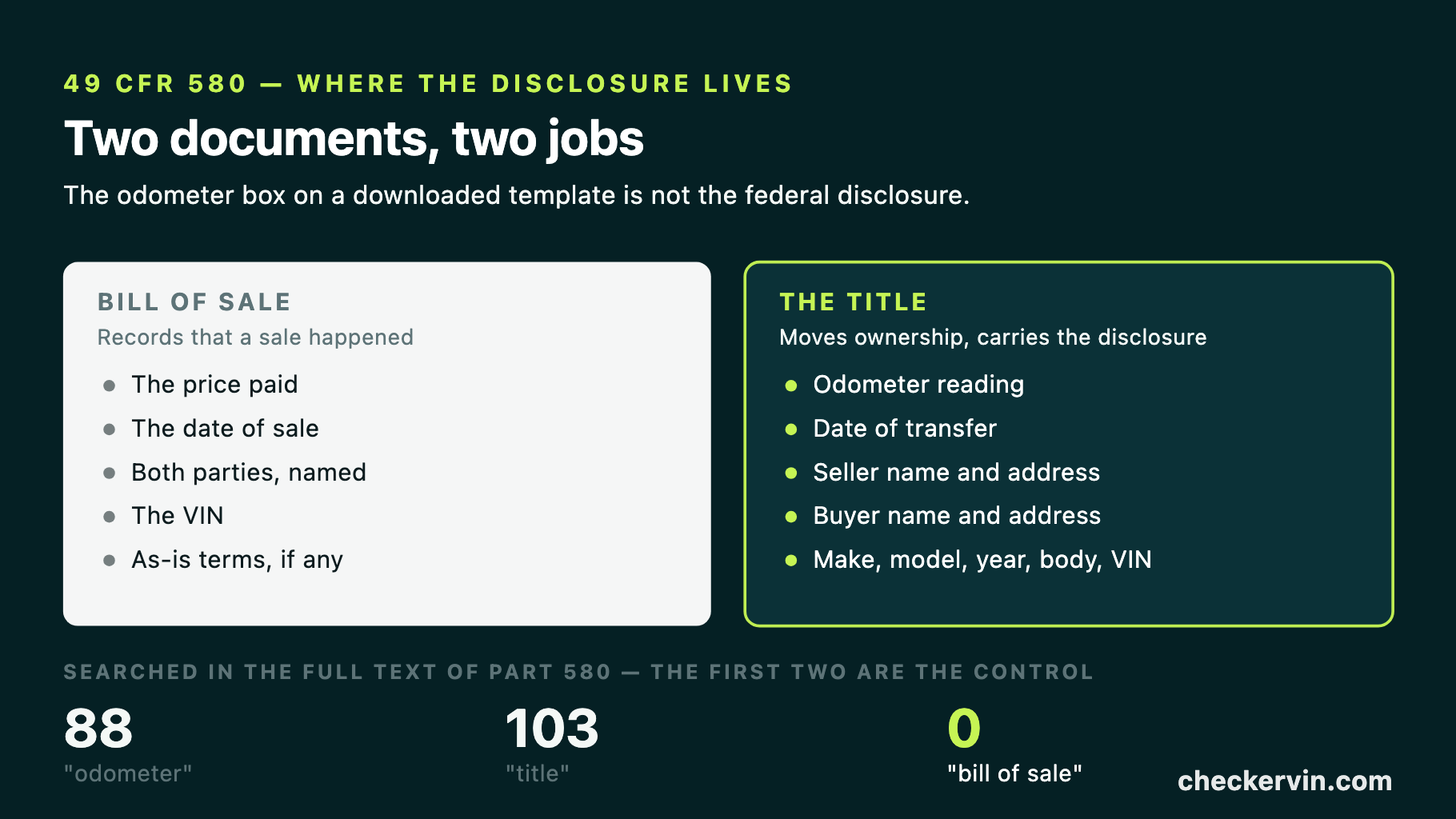
So the practical position is this. Fill in the odometer line on your bill of sale by all means — it is a useful second record and it costs nothing. Just do not treat it as the disclosure. If the mileage is not written and signed on the title, the federal disclosure has not been made, and the document that would prove the seller stated a mileage is the one that does not carry legal weight for that purpose.
What the federal disclosure actually requires
Since the disclosure is the part with statutory teeth, it is worth knowing what it has to contain. Section 580.5(c) lists five items, and the disclosure must be signed by the transferor and carry the transferor's printed name.
| # | Required in the odometer disclosure |
|---|---|
| 1 | The odometer reading at the time of transfer, not including tenths of miles |
| 2 | The date of transfer |
| 3 | The transferor's printed name and current address |
| 4 | The transferee's printed name and current address |
| 5 | The identity of the vehicle — make, model, year, body type and vehicle identification number |
Item five is the one worth pausing on, because it is where this subject meets the rest of this site: the disclosure has to identify the vehicle by make, model, year, body type and vehicle identification number. The VIN is not decoration on that form. It is the thing that ties a mileage statement to one specific car rather than to a description that could fit thousands.
Section 580.5(d) adds a requirement people rarely notice: the physical document must carry a statement referencing federal law and warning that failing to complete the disclosure, or providing false information, may result in fines or imprisonment. That sentence is not boilerplate padding — it is the disclosure telling you what kind of document it is.
The vehicles the federal rule exempts
Not every transfer carries the duty. Section 580.17 sets out exemptions, and two of them come up constantly in ordinary private sales.
- Vehicles with a gross vehicle weight rating above 16,000 pounds
- Vehicles that are not self-propelled — trailers and towed equipment
- Older vehicles under an age-based rule tied to the model year and the calendar year of transfer
The age-based exemption is the one that surprises buyers of older cars, who expect a mileage statement and find the title has no space for one. That is not a seller being evasive; it is the federal rule not applying. It also means the odometer on a vehicle old enough to be exempt has no federal statement standing behind it at all, which is worth knowing before you rely on the number. Our odometer rollback check covers what evidence is left when the disclosure is absent.
Electronic titles change what the paper can do
Part 580 was amended to contemplate titles that are not paper, and the wording matters for anyone buying in a state that has moved to electronic titling. Section 580.5(a) speaks of the point at which “a physical or electronic title is issued or made available to the transferee,” and 580.5(c) requires the mileage to be disclosed “on the physical or electronic title.”
In an electronic-title state there may be no paper title in the seller's hand at the moment of sale, because the record lives with the state and, frequently, with a lienholder until the loan is cleared. The transfer and the disclosure then happen through the state's system rather than across a kitchen table.
Two consequences follow, and they pull in opposite directions. The first is that a bill of sale becomes more valuable, not less: with no paper title changing hands, it may be the only contemporaneous document you hold showing the date, the price and the parties. The second is that it becomes more clearly insufficient on its own — you are relying on a state process to complete, and until it does, you have a receipt and a car rather than ownership.
The as-is clause, and what it does not cover
Nearly every private-sale bill of sale carries some version of “sold as-is, where is, with no warranty.” It is worth understanding what that phrase is doing, because it is neither as strong nor as weak as the two sides usually assume.
What it does: it records that the buyer accepted the vehicle in its present condition and that no promises about future performance were made. In a private transaction that is usually the reality anyway, and writing it down removes the later argument about whether it was understood.
What it does not do is convert a false statement into an honest one. An as-is clause describes the condition of the goods; it is not a license to have described the vehicle inaccurately. A seller who states a mileage that is not true, or represents a branded title as clean, has made a statement of fact — and the clause about condition does not reach backwards to cover it.
That is the practical reason to write down what you were told. A bill of sale that records the mileage, the VIN and any specific representation about the vehicle turns a conversation into a record. If everything is as described, you have lost nothing by writing it down. If it is not, that page is the difference between a disagreement and evidence.
One phrasing point that costs nothing and helps later: write representations as the seller's statements rather than as your own conclusions. “Seller states the vehicle has not been in an accident” is a record of what you were told. “No accident history” is you asserting something you cannot personally know, and it is weaker for exactly that reason. The same applies to mileage, to service history and to whether a title has ever been branded — attribute it, date it, and let the document say plainly who said what to whom.
What a bill of sale is actually for
Strip away what it does not do and a clear, narrow set of jobs remains — all of them about proving the transaction rather than effecting it.
| The job | Why it matters later |
|---|---|
| Establishing the price | Sales or use tax is usually assessed on the purchase price, and the bill of sale is the evidence of what that was |
| Establishing the date | Transfer deadlines and temporary tag windows both run from the date of sale, so the date is what starts your clocks |
| Naming both parties | It is the record that a specific person sold it, which matters if the title chain is later questioned |
| Recording the condition terms | A private sale is usually as-is, and a line saying so is the difference between an understanding and an argument |
| Identifying the vehicle | By VIN, not by description — the same reason the federal disclosure requires it |
The second row is easy to underrate. Both of the deadlines that follow a purchase — the temporary tag window and the title transfer deadline — are counted from the sale date, and the bill of sale is often the only independent record of when that was.
What belongs on one
If you are writing or checking one, this is the content that makes it useful rather than decorative.
- 1The VIN, copied off the vehicleTake the seventeen characters from the windshield plate and confirm them against the driver's door jamb label before writing them down. A VIN copied from the advert reproduces the advert's errors, and a VIN that differs between the two locations is a problem to resolve before signing anything.
- 2Full names and addresses of both partiesPrinted as well as signed. A signature nobody can read identifies nobody, which defeats the point of naming the parties at all.
- 3The date and the priceThe actual price. Understating it to reduce tax is fraud, and it also caps what you can claim if the vehicle turns out to be something other than what was described.
- 4The odometer reading, as a second recordUseful, and not the federal disclosure. Write it down anyway — it costs nothing and gives you a dated statement in the seller's hand.
- 5An as-is clause if that is the dealPrivate sales generally carry no warranty, but saying so removes the ambiguity rather than relying on it.
- 6Both signatures, and a copy eachA bill of sale that only the buyer holds is half a document. Both parties keep one.
Required, or merely sensible?
This is a state question and the honest answer is that the requirement varies in a way no single sentence covers. What can be said generally is the shape of the variation.
- Some states require a bill of sale before a transfer will be processed at all
- Some require one only where the title itself has no space to record the sale price
- Some require notarization, and most do not
- Some publish an official form and expect that form rather than a generic one
- Where none of the above applies, it is still the only proof you will hold of price and date
We are deliberately not publishing a fifty-state table of requirements. Those rules change quietly, and a table that is mostly right is worse than none, because a reader cannot tell which rows are the wrong ones. Read the requirement for the state where the vehicle will be titled — which, if you bought across a state line, is not the state you bought it in. Our guide to buying a car out of state covers that split.
Use your state's own form where one exists
Search results for this topic are dominated by downloadable templates, and several states publish their own form for exactly this purpose — Florida, New York and Washington among them. Where a state publishes one, use it.
The reason is not formality. A state form already contains the fields that state wants, in the order its clerks expect, including any notarization block and any state-specific declaration. A generic template contains the fields that whoever built the template thought were sensible, which is a different and less useful list.
Signing it properly
Sign it at the same time as the title changes hands, in each other's presence, and keep the two documents together afterwards. The bill of sale is evidence of a transaction and the title is evidence of ownership; separated, each is weaker than the pair.
Photograph both before you leave, including the VIN as written on each. Paper gets lost between a private sale and a registration appointment far more often than anyone expects, and a photograph taken at the point of sale is a dated record of what the documents said when they were signed.
If the sale happens somewhere other than the seller's home — a parking lot, a halfway point between two towns — write the location on the document as well. It is rarely required and it occasionally matters, because which state's rules govern a transaction can turn on where it took place, and a line of text written at the time is worth more than two people remembering differently a year later.
When the seller resists
A private seller declining to complete an ordinary bill of sale is unusual enough to treat as information. There are innocent explanations, and there are patterns worth recognizing.
- A seller who will not print their own name and address is refusing to be identifiable
- A seller whose name does not match the name on the title is not the owner, whatever they say about helping a friend
- A request to leave the price blank, or to write a lower one, is a request to make you party to something
- A refusal to write the VIN, or a VIN that does not match the car, ends the conversation
- Handing over a bill of sale but not a signed title leaves ownership exactly where it was
The second and fifth items are the signature of curbstoning — an unlicensed dealer moving cars without ever appearing in the title chain. The paperwork is where that becomes visible.
What happens next
The bill of sale is the beginning of the paperwork, not the end of it. Two clocks start on the date written on it, and neither is satisfied by the document itself.
- 1Get the vehicle legally on the roadA temporary tag covers the gap until permanent plates arrive, and its window is set by state law. It is a separate deadline from the title transfer and satisfying one does nothing for the other.
- 2Transfer the title into your nameThis is the clock that costs money if missed. Start it immediately rather than at the end of the window, because processing time is not yours to control.
- 3Check the VIN for open recallsFree, by VIN, and repaired at no cost by the manufacturer regardless of how many owners the vehicle has had. Doing it now is easier than doing it after the title is in your name.
- 4Keep everything togetherBill of sale, title copy, odometer statement and insurance confirmation in one place. The value of these documents is that they can be produced together.
Our free decode returns what the vehicle was built as, together with recall information for that model year, from federal data. It does not return accident history, title brands or odometer history, and nothing on this page should be read as a promise that it does.
Where this information comes from
- 49 CFR Part 580 — Odometer disclosure requirementsThe federal rule placing the disclosure on the title, and its exemptions
- NHTSA recall lookupFree open-recall check by VIN, repaired at no cost by the manufacturer
- NHTSA vPIC — public VIN decoderFederal build data behind a free decode, no account required
- NICB VINCheckFree theft and salvage lookup contributed by participating insurers
Keep reading
Frequently asked questions
Does a bill of sale transfer ownership of a car?
No. Ownership transfers with the title. A bill of sale records that a transaction happened, on what date and for how much, which is useful evidence and sometimes required by a state — but the document that moves ownership is the signed-over title.
Does the odometer reading on a bill of sale satisfy federal law?
No. The federal odometer disclosure rule, 49 CFR Part 580, requires the mileage to be disclosed on the title itself, and where the vehicle is titled in the seller's name it says the disclosure goes on the title and not on a reassignment document. The phrase bill of sale does not appear anywhere in Part 580.
Is a bill of sale required when buying a car privately?
It depends on the state. Some require one for the transfer to be processed, some require one only when the title has no space for the sale price, and others merely recommend it. Because it is state law, check the requirement where the vehicle will be titled rather than where it was bought.
Do I need a notarized bill of sale?
Only in the states that say so, and most do not. Where notarization is required it is usually specified on the state's own form, which is one practical reason to use the state form rather than a generic template downloaded from a search result.
What vehicles are exempt from odometer disclosure?
Part 580 exempts several categories, including vehicles with a gross vehicle weight rating above 16,000 pounds, vehicles that are not self-propelled, and older vehicles under an age-based rule. The exemption removes the federal disclosure duty; it does not remove any state paperwork requirement.