The short answer
- Can you check a car's smog history?
- In California, completely — the BAR's public lookup returns every test with dates and results from a VIN or plate. Illinois and other testing states publish results pages too; elsewhere the story shows up through registration status.
- What should worry you in the log?
- Repeated fails, a sale listed right after a fail, gross-polluter flags, and odometer readings that do not increase in order. Each is documentary, dated and hard to talk away.
- Why does it tie to registration?
- In testing states, renewal rides on a pass — so a car with lapsed tags in a smog state is presumptively a car avoiding a test until proven otherwise.
Public
California's entire test log
BAR lookup, by VIN or plate
Odometer
Recorded at every test
A fraud check nobody expects
GP
Gross polluter flag
Neglect with a paper trail
~⅓
States with no testing at all
History exists only where tests do
What smog history is — a dated, third-party service record
An emissions test is a snapshot taken by licensed equipment on a known date: the car’s identity, its odometer, its readings against the standard, pass or fail. Stack a decade of snapshots and you have something rarer than a service history — a third-party log the seller cannot edit. No listing mentions it, most sellers forget it exists, and in the states that publish it, it is free.
California — the public BAR lookup
California’s Bureau of Automotive Repair publishes Smog Check results for every vehicle in the program: enter a VIN or plate and the history returns with test dates, station numbers, results and the odometer captured at each visit. For any car with California in its past — which, given the size of the market, is a lot of cars everywhere — the lookup is a mandatory stop. Read it alongside our California VIN check guide, because the state’s seller-provides-the-smog rule turns test history directly into negotiation.
Other states with test records
| Program | What's available |
|---|---|
| California — BAR Smog Check | Full public history by VIN or plate: dates, stations, results, odometer |
| Illinois — Air Team | Test results and schedules for the Chicago-area program |
| Arizona — ADEQ | Phoenix and Tucson program records and test status |
| Ohio — E-Check | Seven-county program; results verifiable through the program |
| Oregon — DEQ | Portland and Medford zones; status tied to renewal |
| Non-testing states | No log exists — the inspection burden is entirely the buyer's |
Reading pass, fail and gross polluter
- Fail → quick pass — a repair happened; ask what was replaced and look for the receipt
- Repeated fails or long gaps after a fail — the car resisted fixing; assume deferred exhaust and sensor work
- Gross polluter flag — years of neglect with a state label on it; price catalytic converters into the offer
- Sale immediately after a fail — the previous owner chose selling over repairing; you are the repair plan
- Odometer readings out of sequence — documentary evidence of tampering; walk away or demand the explanation in writing
What a test record has to contain
State portals differ so much in what they show that it is easy to assume the underlying record differs too. It does not, or at least not in its essentials. Where a state runs an inspection and maintenance program under the federal rule, that rule sets a minimum list of what must be collected on every single test.
The stated goal is worth reading, because it explains the shape of everything that follows: the data must unambiguously link a specific test result to a specific vehicle, program registrant, test site and inspector, and establish whether the correct testing parameters were observed. It exists to catch bad testing as much as bad cars.
| What the record carries | Why a used-car buyer cares |
|---|---|
| VIN, plate, model year, make and type | Ties the result to the car in front of you rather than a similar one |
| Date of test, start time, and when final scores were determined | Puts every result on a timeline you can compare against ownership |
| Odometer reading | A mileage figure with a date and an official source behind it |
| Category of test — initial, first retest, subsequent retest | Reveals whether a pass followed a failure, and how many attempts it took |
| Station number, inspector number, test system number | Lets a pattern of results be traced to who produced them |
| Emission scores and the standards applied | The margin, not just the verdict |
| Visual inspection results on named components | A checklist someone physically looked at |
| OBD result and the trouble codes revealed | The actual fault codes stored at that moment |
That is a far richer artifact than a pass or fail sticker, and it is why an emissions history is one of the most underrated records attached to a used car. It is generated by a process designed to be audited.
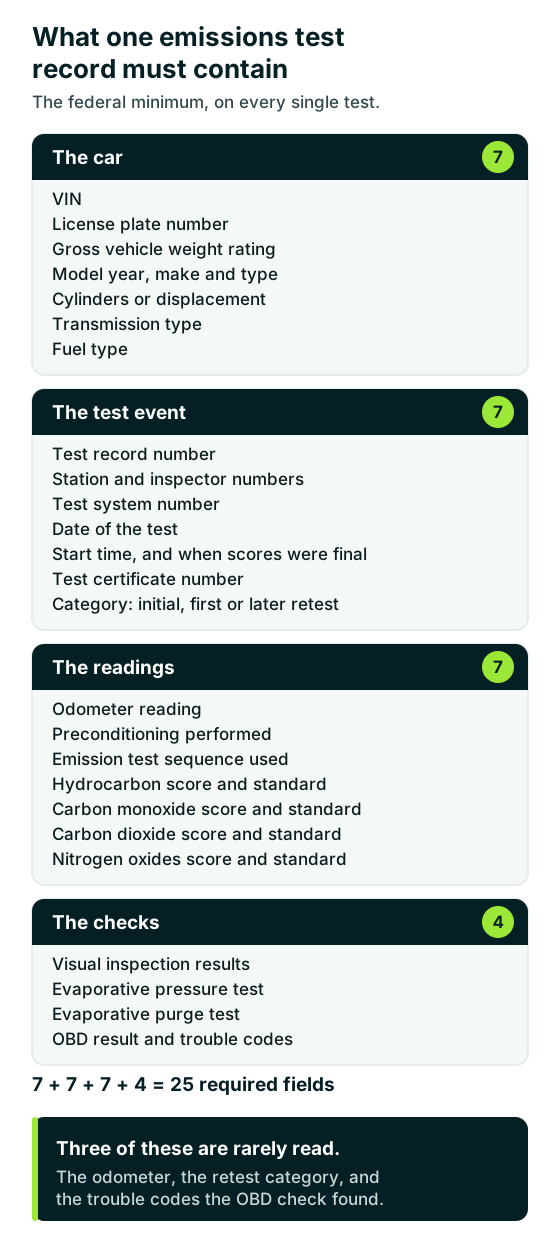
Every test writes down the mileage
One line in that list does work far outside emissions, and almost nobody thinks to use it. The odometer reading is a required field on every test record.
That means a vehicle tested regularly in a program state carries a series of official mileage readings, each with a date, each recorded by a party with no stake in the car’s resale value. It is an independent series, and independence is exactly what the usual mileage sources lack — a seller’s word, a dashboard that can be altered, a title document issued years apart.
Read down a smog history and the mileage should climb steadily. A reading that sits below an earlier one, or a gap where the annual increase collapses to almost nothing and then resumes, is the shape of a problem. Our odometer rollback guide covers what to do with that pattern and how it interacts with the federal disclosure rules; the point here is simply that the emissions record is a source of it, and a free one in the states that publish results.
The field that reveals a failure you would never see
Of all the required fields, the one that changes how you read a history is the smallest: each test is categorized as an initial test, a first retest, or a subsequent retest.
A vehicle that failed, was repaired and passed does not appear in a summary as a problem. It appears as a pass. The category field is what distinguishes that from a car that passed cleanly the first time, and the difference matters because a failure followed by a rapid pass tells you a repair happened — one that will not show up in any service history unless the shop reported it.
| The pattern in the record | The reasonable reading |
|---|---|
| Initial test, pass | Clean. The most common and least interesting case |
| Initial fail, then a first retest pass days later | Something was repaired. Ask what, and for the invoice |
| Initial fail, then several subsequent retests | The fault resisted the first fix, which is worth understanding |
| Repeated initial failures across separate years | A recurring condition rather than a one-off, and a real negotiating point |
| A pass with no prior initial test in a program state | Check whether the car was tested elsewhere, or was exempt |
None of these is proof of anything by itself. All of them are questions you can put to a seller with a date attached, which is a stronger position than asking whether the car has ever had trouble.
The trouble codes are in the record too
The last required field is the one people are most surprised by. Where the test includes an on-board diagnostic check, the record must carry the result as a pass or failalong with the diagnostic trouble codes revealed.
A trouble code is far more specific than a failure. It names a circuit, a sensor, a misfire on a particular cylinder, an evaporative leak of a particular size. Where a state publishes this detail, a smog history stops being a verdict and becomes something closer to a diagnostic log written at intervals across the car’s life.
The visual portion of the inspection is specified in the same way. Results have to be recorded for the catalytic converter, the air system, the gas cap, the evaporative system, the positive crankcase ventilation valve and the fuel inlet restrictor, plus any other visual check for which the program claims emission reduction credit. Six named components someone was required to look at, with the outcome written down.
Readiness monitors — the tell a cleared computer leaves
A modern emissions test does not only read the result. It reads whether the car’s own diagnostic system has finished checking itself, and that second answer is where preparation shows.
An OBD system runs a set of self-checks called readiness monitors. Disconnecting the battery or clearing codes with a scan tool resets them, and they only return to “complete” after the car has been driven enough for each check to run. If too many are still incomplete, the vehicle fails the inspection — not for emissions, but because the computer cannot yet vouch for itself.
The record is designed to catch bad testers, not only bad cars
One purpose of all this data has nothing to do with your vehicle, and knowing it changes how much weight a single clean pass deserves.
The rule states the aim plainly: the data is used to distinguish complying from non-complying vehicles, and to screen inspection stations and inspectors for investigation as to possible irregularities. That is why every record carries a station number, an inspector number and a test system number alongside the result. Programs are also required to gather quality control data on the test equipment itself, identified by station, system, date and start time.
The practical consequence for somebody buying a car is modest but real. A pass is a statement by a particular station on a particular day, and stations vary. Where a state publishes enough of the record to see which station performed a test, a history in which every test was performed at the same station, close to a registration deadline, is worth a second look — not because it proves anything, but because the program itself treats station patterns as the thing worth examining.
- Whether the tests are spread across stations or concentrated at one
- Whether a pass came immediately before a registration deadline
- Whether a failure at one station was followed by a rapid pass at another
- Whether the same test system number appears across suspiciously clean results
- Whether the emission scores sit comfortably inside the standards or scrape past them
That last one is the most useful and the most overlooked. The record carries the scores and the standards applied, not merely the verdict, so a car that passed by a hair is distinguishable from one that passed comfortably. On an older vehicle, a series of narrowing margins is a genuine forecast of a future failure, and it is visible in a document the seller has no control over.
The codes that will not clear
The obvious counter to an emissions test is to erase the fault codes beforehand. Modern systems anticipated that.
Permanent diagnostic trouble codes are stored the same way ordinary codes are, but they cannot be erased with a scan tool or by disconnecting the battery. Only the diagnostic system itself clears them, and only after it has verified that the defect causing them is genuinely gone.
They are set aside only once the vehicle has completed at least fifteen warm-up cycles and been driven at least two hundred miles since the system was last cleared. In other words, the shortcut requires either a real repair or several hundred miles of driving — which is precisely the point.
Why a car can have no history at all, and what that does not mean
The most common outcome of a smog history search is nothing, and it is worth understanding why before reading anything into it. The absence is usually about geography rather than the vehicle.
Testing programs are not imposed on vehicles; they are imposed on areas. The federal rule requires inspection and maintenance programs in ozone and carbon monoxide nonattainment areas, and which areas qualify turns on the nonattainment classification and on population. Enhanced programs reach metropolitan areas inside an ozone transport region above a population floor regardless of their attainment classification, and separately reach areas classified serious or worse for ozone, or moderate to serious for carbon monoxide above a design value, once an urbanized area population threshold is met.
States may go beyond the federal floor, and several run programs covering more territory than the rule strictly demands, which is why coverage maps do not line up neatly with nonattainment maps. But the direction of the logic is fixed: a car earns an emissions history by being registered somewhere that tests, for long enough to be tested.
| What you found | The most likely explanation |
|---|---|
| No records at all | The vehicle was registered outside a testing area for its whole life |
| Records that start abruptly a few years in | It moved into a program area, which also dates the move |
| Records that stop | It moved out, was exempted by age, or left the road |
| A gap in an otherwise regular series | Worth asking about — a period off the road, or registered elsewhere |
| Fewer records than years of ownership | Many programs test every two years rather than annually |
Read that way, an empty result is still information. It tells you the vehicle’s history is going to have to come from somewhere else, and it quietly narrows down where the car has spent its life — which is worth knowing before a seller tells you.
How emissions gate registration
Testing states wire the smog result into the renewal: no pass, no registration. That single linkage explains a pattern buyers see constantly — the smog-state car with expired tags, a “ran when parked” story, and a seller who suggests you handle the test after purchase. Sometimes it is innocent storage. Often it is a check-engine light that will not clear. The test history, where public, tells you which; where it is not public, the lapsed registration itself is the tell, and our registration lookup guide covers how to read it state by state.
The buyer's smog playbook
- 1Pull the history where it existsCalifornia's BAR lookup first — many cars pass through the state. Check the program page for any testing state in the title chain.
- 2Match odometer readings against the storyTest-day mileage should climb in order and line up with the title and service records.
- 3Treat lapsed tags in testing states as a failed testUntil the seller produces a fresh pass — their cost, not yours, in seller-obligation states like California.
- 4Run the rest of the recordDecode the VIN, check recalls and theft, pull the national title history — emissions is one chapter of the file.
Decode the VIN free
Decoded from official manufacturer and NHTSA records
Where this information comes from
- 40 CFR 51.350 — where I/M programs are requiredPrograms are imposed on ozone and carbon monoxide nonattainment areas by classification and population, with thresholds anchored to the 1980 and 1990 census figures
- 40 CFR 51.365 — I/M program data collectionThe 25 items every emissions test must record, including the odometer reading, the initial-or-retest category, and the OBD result with the trouble codes revealed
- California BAR — Smog Check history lookupThe public per-vehicle emissions test record
- Illinois EPA — Air Team vehicle testingThe Chicago-area program and its results
- Ohio EPA — E-CheckThe seven-county Cleveland-Akron program
- EPA — vehicle emissions inspection and maintenanceThe federal framework behind state testing programs
Keep reading
Frequently asked questions
Can I see a car's smog check history for free?
In California, yes — the Bureau of Automotive Repair publishes every vehicle's Smog Check results online, searchable by VIN or plate, with dates, stations and pass/fail outcomes. Illinois and several other testing states offer similar public results pages; elsewhere the history surfaces indirectly through registration records.
What does a failed smog test in the history mean?
It means that on that date the car could not meet the standard — and the interesting part is what follows. A fail followed quickly by a pass is a repair story; repeated fails, long gaps, or a sale right after a fail is a car that resisted fixing. The pattern matters more than any single result.
What is a gross polluter?
California's label for a vehicle that fails with emissions far beyond the limits. Gross polluters face repair requirements and directed testing at specific stations. In a used-car history the label is a flag for real mechanical neglect — catalytic converters, oxygen sensors and tune items left broken for years.
Do all states have smog checks?
No. Roughly a third of states run no emissions testing at all, and most of the rest test only in metro areas — Oregon's Portland and Medford zones, Arizona's Phoenix and Tucson, Ohio's Cleveland counties. Where testing exists, registration renewal usually depends on passing, which is why lapsed tags and emissions problems travel together.
Can smog history reveal odometer fraud?
Sometimes. Test records capture the odometer reading at each inspection, so a mileage sequence that goes backwards — or jumps implausibly — between tests is documentary evidence of tampering. It is one of the quiet reasons to pull test history even on a car that runs perfectly.
The test log doesn't forget — neither should you
Decode any VIN free for the factory build, specifications and open safety recalls. No account, no card.
Run a free VIN check