The short answer
- Why did nobody tell me about a tire recall?
- The record is kept against the first purchaser of the tires. A second owner is not in it, so there is nobody to notify.
- Does a VIN check cover the tires?
- Generally not. Tires are separate equipment with their own identification number and their own recalls, checked separately from the vehicle.
- What can I do about it?
- Read the tire identification number off each sidewall, check it, and register the tires in your own name. All of it is free.
5 years
How long the record is kept
49 CFR 574.10, from first sale
574.9
Makes a car dealer a tire dealer
Used vehicle, new tires
30 days
To forward your registration
With a six-month backstop
Free
Registering them yourself
At no charge to the purchaser
Why nobody calls you about a tire recall
Start with what the system is for, because the purpose clause explains the whole shape of it. Under 49 CFR 574.2, the purpose of the part is to facilitate notification to purchasers of defective or nonconforming tires, under 49 U.S.C. 30118 and 30119, so that they may take appropriate action in the interest of motor vehicle safety.
Notification to purchasers. Not to whoever currently owns the vehicle the tires happen to be fitted to. That single word is why the rest of this page exists.
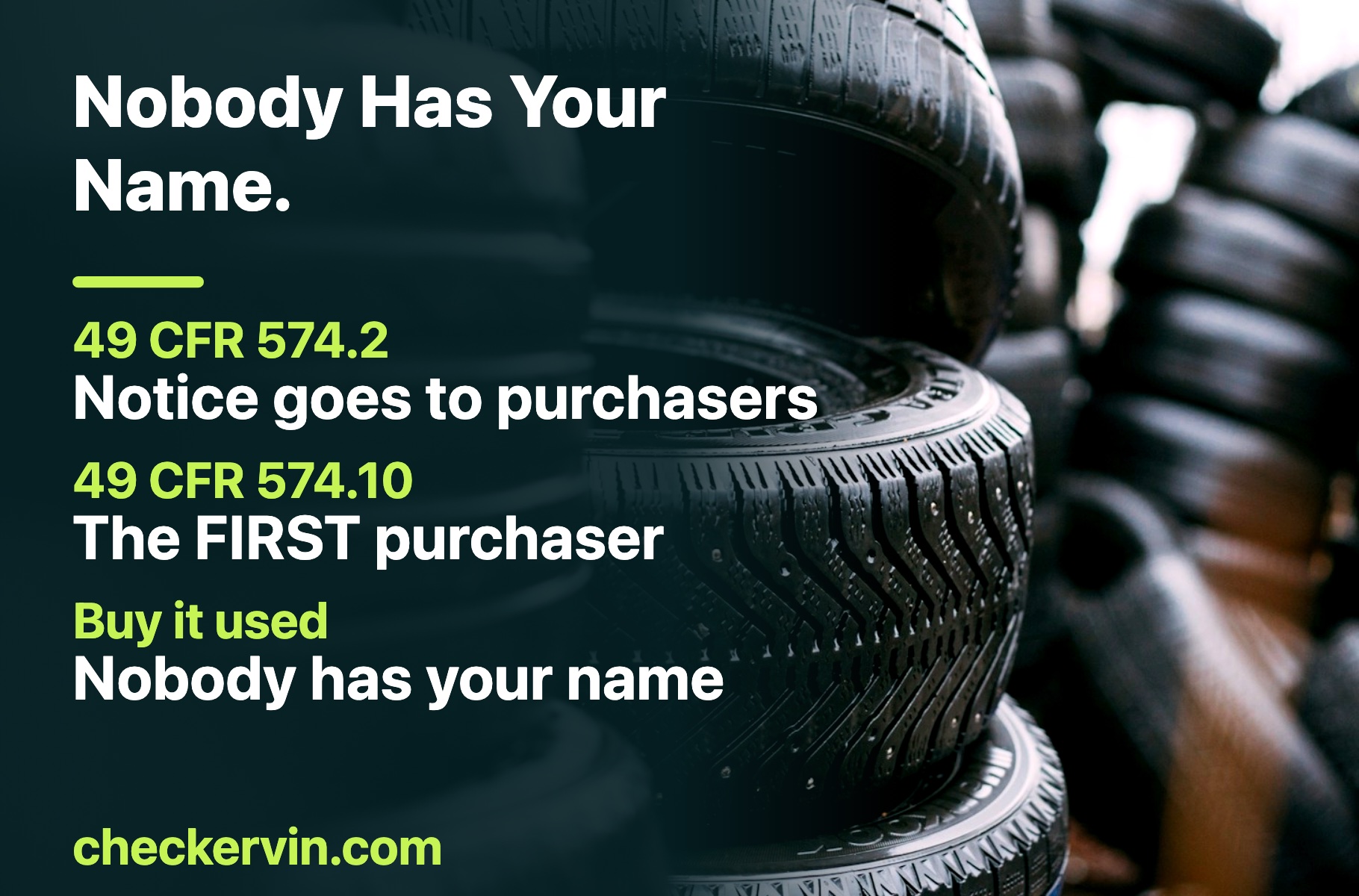
It also explains why a VIN recall check does not close this question. A VIN lookup returns recalls on the vehicle. Tires are separate items of motor vehicle equipment, with their own identification number molded into the sidewall and their own recall campaigns. The two systems run alongside each other and answer different questions.
The five-year record, and whose name is on it
49 CFR 574.10 places the obligation on the vehicle manufacturer, and it is worth reading closely because it names the person the system is designed around.
Each motor vehicle manufacturer, or its designee, must maintain a record of the new tires on or in each vehicle it ships, and must maintain a record of the name and address of the first purchaser for purposes other than resale of each vehicle so equipped. Those records must be kept for a period of not less than five years from the date of sale of the vehicle to that first purchaser.
A used-car dealer can be a tire dealer without knowing it
Here is the provision almost nobody in the transaction is aware of, and it applies squarely to the ordinary used-car purchase.
Under 49 CFR 574.9(a), each motor vehicle dealer who sells a used motor vehicle for purposes other than resale — or who leases a motor vehicle for more than 60 days — that is equipped with new tires is considered, for the purposes of this part, to be a tire dealer, and must meet the requirements in 574.8.
Paragraph (b) extends the same treatment to any person selling a vehicle to first purchasers, for purposes other than resale, that is equipped with new tires which were not on the vehicle when it was shipped by the vehicle manufacturer.
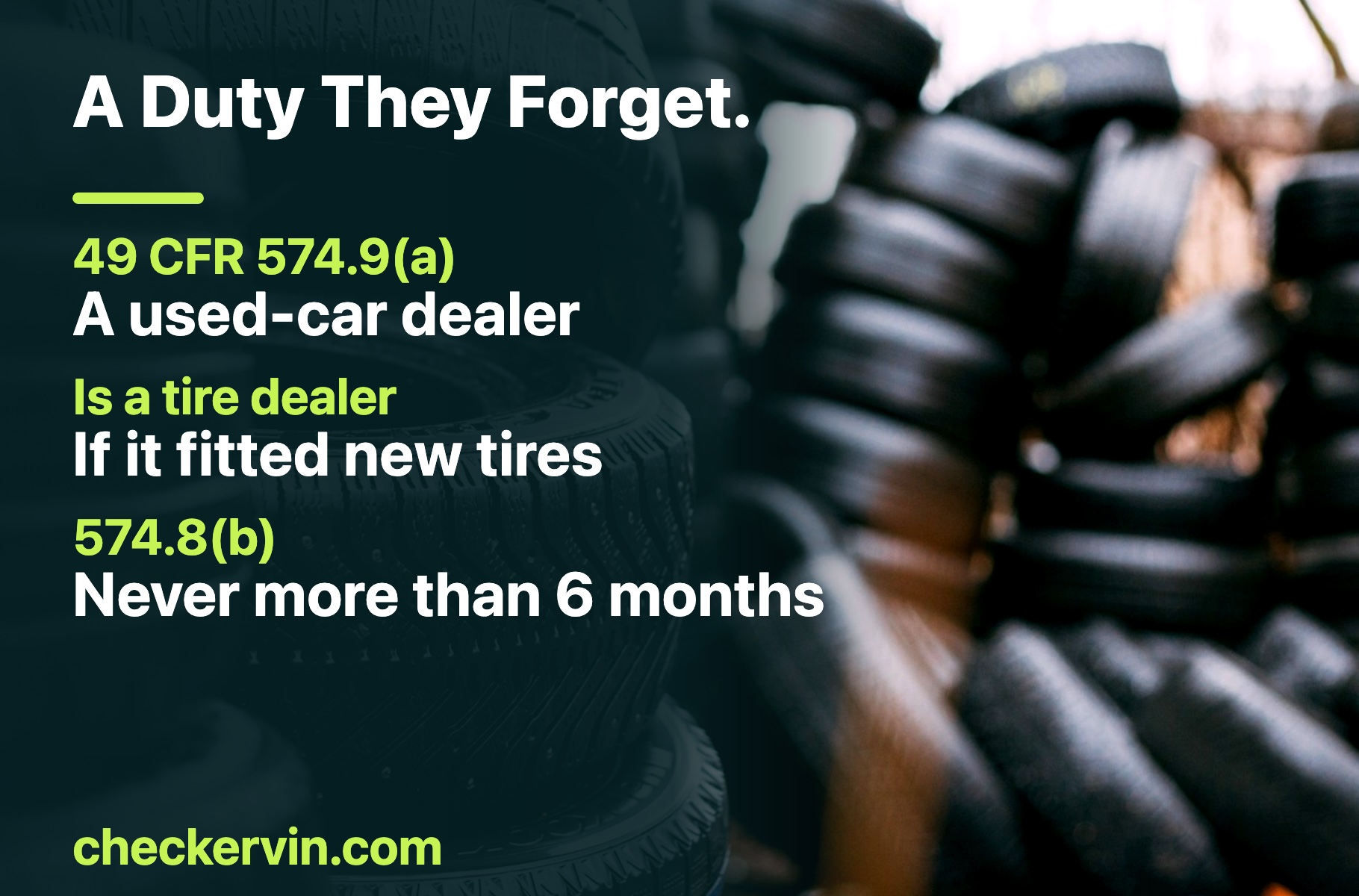
The practical reading is simple. If a dealer put new tires on the used car before selling it to you — a common piece of reconditioning, and often a selling point — the registration duties described below attached to that sale.
What a dealer in that position actually has to do
49 CFR 574.8(a) gives independent distributors and dealers a choice of routes. An independent dealer, per 574.3(c)(1), is one whose business is not owned or controlled by a tire manufacturer or brand name owner.
| Route under 574.8(a)(1) | What it involves |
|---|---|
| (i) Hand you the form | Provide the purchaser, at the time of sale or lease, with a paper tire registration form on which the dealer has recorded the entire tire identification number of each tire sold, and the dealer's name and street address — or, where available, an email address or website |
| (ii) Do it for you | Record the information on a paper form and return it to the tire manufacturer or its designee on the purchaser's behalf, at no charge to the purchaser, within 30 days of the sale or lease |
| (iii) Electronic means | The third alternative the paragraph provides, where the manufacturer has authorized it |
Two things are worth extracting from that. The dealer records the entire tire identification number, not a partial one — which tells you how specific the identification has to be. And where the dealer registers on your behalf, it must be at no charge to the purchaser. Registration is never something you should be billed for.
Thirty days, forty tires, or six months
Dealers that are not independent — those owned or controlled by a tire manufacturer or brand name owner — work to a different rhythm under 574.8(b), and the timing is the part a buyer should know.
They must submit the required information to the tire manufacturer or its designee not less often than every 30 days. A distributor or dealer selling fewer than 40 tires of all makes, types and sizes in a 30-day period may wait until a total of 40 new tires has been sold. But in no event may more than six months elapse before the information is forwarded.
The form is specified down to its dimensions
The manufacturer side of the chain sits in 49 CFR 574.7, and it starts by removing the excuse that forms were unavailable: each new tire manufacturer and each new tire brand name owner, or its designee, must provide tire registration forms to every distributor and dealer of its tires that offers new tires for sale or lease.
The rule then specifies the form itself. Those provided to independent distributors and dealers must be rectangular, not less than 3½ inches high, 5 inches long, and 0.007 inches thick, with space for the information the section lists.
A regulation that dictates the thickness of a card is telling you something about how the system fails when it fails: not through bad intentions, but through a small piece of paper not making a journey. Which is precisely the journey that does not happen when a car changes hands.
The sentence the government made them print
Of everything in Part 574, one requirement states the problem more plainly than any consumer guide has managed, and it is a mandated sentence on the registration card itself.
Section 574.7(a)(4)(iii)(B) requires the form to carry a statement explaining its purpose and how a consumer may register tires. That statement must include the heading IMPORTANT, must indicate that sending the card will add the person to the manufacturer's recall list, and must include this sentence:
That is the whole argument of this page, written into federal regulation and printed on a card most people throw away. The system is not secretive about its limitation. It says so on the form.
The rest of the specification is similarly exact. The form must be rectangular, not less than 3½ inches high, 5 inches long and 0.007 inches thick, and not more than 4¼ inches high, 6 inches long and 0.016 inch thick. The address side carries the manufacturer's name and address and, in the upper right hand corner, the words “Affix a postcard stamp.” A manufacturer may also voluntarily provide registration by internet, telephone or other electronic means, which is how most registration happens now.
What the part covers, including the tires people forget
The scope is broader than new tires on new cars, and two of its inclusions matter to used-car buyers in particular.
Under 49 CFR 574.4, the part applies to manufacturers, brand name owners, retreaders, distributors and dealers of new and retreaded tires, and to new non-pneumatic tires and non-pneumatic tire assemblies, for use on motor vehicles manufactured after 1948 — and to manufacturers and dealers of motor vehicles manufactured after 1948.
Retreads being inside the scope is the part worth noticing. A retreaded tire has its own identification and its own registration path, and on older or commercial vehicles a retread is a realistic possibility rather than an edge case.
There is one carve-out, and it is narrow: the part does not apply to persons who retread tires solely for their own use. Somebody retreading for their own vehicle is outside it. Anybody retreading to sell is not.
The number you need is on the sidewall
Everything above turns on the tire identification number, and it is molded into the sidewall of every tire. You do not need any special access to read it.
Reading it character by character — including the date code that tells you the week and year of manufacture — is covered properly on tire size by VIN, which handles the identification requirements and the quality grading rather than repeating them here. For this page you need only the full number, exactly as it appears.
- Check every tire, not one — they may have been replaced at different times
- Record the entire number, not the last four digits alone
- Include the spare if the vehicle carries a full-size one
- Note that the full number may be on the inboard sidewall, so you may need to look from underneath
- Photograph each sidewall so you are not relying on transcription
One more definition, for anyone leasing tire use
Part 574 carries a definition that looks obscure and quietly covers a real arrangement. A mileage contract purchaser, under 574.3(c)(2), means a person who purchases or leases tire use on a mileage basis.
That is the commercial fleet model, where tires are paid for by distance run rather than bought outright. If you are buying a former fleet or commercial vehicle, the tires on it may have moved through an arrangement of that kind rather than an ordinary retail sale, which is another route by which no registration in any private name was ever created.
The same section defines a new tire brand name owner as a person other than the manufacturer who owns or controls the brand name, or licenses another to buy tires bearing that name. It is worth knowing because the name on the sidewall and the company that actually made the tire are not always the same, and the registration chain follows both.
Checking the tires already on the car
The sequence is short, free, and worth doing before you buy rather than after.
- 1Read the number from every tirePhotograph each sidewall. Tires fitted at different times will carry different numbers and different dates.
- 2Check them against the federal recall lookupNHTSA's lookup covers tires as equipment, separately from the vehicle recall search you run on the VIN.
- 3Run the VIN recall check as wellThe two searches answer different questions and neither substitutes for the other. Do both while you have the car in front of you.
- 4Ask the seller whether the tires were replacedIf a dealer fitted new tires before sale, 574.9 treated that dealer as a tire dealer, and it is fair to ask what was done about registration.
- 5Register the tires in your own nameThis is the step that puts you in the chain for anything announced from now on. It costs nothing.
Registering tires you did not buy new
Registration is not restricted to the original purchase, and doing it late is better than not doing it. What you need is the full identification number from each tire and the manufacturer or brand name owner — both of which are on the sidewall.
The reason it matters is the one this page opened with. The system notifies purchasers it knows about. Registering converts you from somebody it has never heard of into somebody it can write to, for the remaining life of those tires. Given the tires on a used car are frequently the newest safety-critical components on it, that is a poor thing to leave undone.
What this page cannot do
Three limits, stated plainly.
We cannot tell you from a VIN whether the tires on a specific car are recalled. Tires are identified by their own number, not by the vehicle's, and the sidewall is the only place that number lives. Any tool claiming to check tire recalls from a VIN alone is inferring from what was fitted at the factory, which on a used car is frequently not what is on it now.
It is also worth being clear that none of this implies the tires on a used car are likely to be recalled. Most are not. The point is narrower: on this one class of safety-critical component, the absence of a notice tells you nothing at all, because there was never a route by which a notice could arrive.
Nor can we tell you whether a previous owner or dealer registered them. There is no public register to search; the records sit with tire manufacturers and their designees.
What our own free check does is the vehicle half: the factory build, the specifications and any open safety recall on the VIN. Run it alongside the sidewall check rather than instead of it.
Where this information comes from
- 49 CFR 574.7 — information requirements, tire manufacturersThe registration form's required wording, including the sentence about being reachable
- 49 CFR 574.9 — requirements for motor vehicle dealersWhy a dealer selling a used vehicle on new tires is treated as a tire dealer
- 49 CFR 574.10 — requirements for motor vehicle manufacturersThe record of the tires and of the first purchaser, kept not less than five years
- 49 CFR 574.8 — information requirements, distributors and dealersThe registration routes, the no-charge rule, and the 30-day and six-month timings
- NHTSA recall lookupFederal recall search covering vehicles and tires as equipment
Keep reading
Frequently asked questions
Why was I never told about a tire recall?
Because the notification chain is built around the first purchaser of the tires. Under 49 CFR 574.10 the vehicle manufacturer records the tires and the name and address of the first purchaser, and keeps that for at least five years. A later owner is outside that record unless they register the tires themselves.
Does a used-car dealer have any tire obligations?
Yes, and it surprises people. Under 49 CFR 574.9(a), a dealer selling a used vehicle equipped with new tires — or leasing one for more than 60 days — is treated as a tire dealer and must meet the registration requirements in 574.8.
How do I check whether my tires are recalled?
Read the tire identification number from the sidewall of each tire and check it against NHTSA's recall lookup. The tires are separate equipment from the vehicle, so a VIN recall check does not cover them.
Can I register tires myself after buying a used car?
Yes. Registration is what puts you in the manufacturer's notification chain, and doing it is free. You need the full tire identification number from each tire, which is molded into the sidewall.
Does a VIN recall check include the tires?
Generally no. A VIN-based lookup returns safety recalls on the vehicle. Tires are regulated as separate items of motor vehicle equipment with their own identification and their own recall notices, which is why they need checking separately.
Check the vehicle while you check the tires
Enter the VIN for the factory build, the specifications and any open safety recall on that exact vehicle. Free, and no account needed.
Run a free VIN check