The short answer
- What is Poctra?
- A site people use to look up past salvage-auction listings by VIN: photos and sale records kept after the auction closed. Its own pages blocked us in November 2026, so we could not read how it describes itself.
- Is it a title record?
- No. Poctra is not on the Department of Justice list of approved NMVTIS data providers. Title brands, total-loss and salvage history come from an NMVTIS report.
- Salvage sale but a clean title now?
- It happens innocently (a recovered theft) and dishonestly (title washing between states). An NMVTIS report shows the brand history from every state and tells you which one you are looking at.
Not listed
Poctra on the NMVTIS provider list
DOJ page, checked November 24, 2026
12
Providers that sell NMVTIS to the public
Same DOJ page
5
Indicators in an NMVTIS report
Brand history is one
Blocked
Poctra's own terms and prices
Captcha wall, November 2026
The short verdict
A Poctra search is worth running on any used car you are serious about, for one reason: if it finds the car, you learn that it passed through a salvage sale, and you learn it from pictures rather than from the seller. That alone changes the conversation.
What a hit does not do is tell you what the car is today. A salvage sale has more than one explanation, and the title the car carries now depends on which state handled it and how. The record that answers that is NMVTIS, which Poctra is not part of. Use Poctra to learn that there is a question, and the federal title report to answer it.
What Poctra is, from what we could verify
Poctra (poctra.com) is used as an archive of past salvage-auction listings. Buyers search it by VIN, the same way they use other auction-archive sites, to see how a car looked when it was offered for sale as salvage, together with the details the listing carried at the time.
The domain itself is not new. Verisign’s public registry record shows poctra.com was registered in 2017, and that it was last changed in October 2026. That tells you the name has been around for years. It tells you nothing about who runs it, which auctions it copies or how complete its archive is.
What we could not read, and why it matters to you
We set out to read Poctra’s own pages before writing a word about it: the home page, any about, terms, privacy, contact or FAQ page, and its robots file. On November 24, 2026, every one of those requests came back with an HTTP 403 and a “Checking your browser” page that asks the visitor to solve a captcha. We did not try to get around that, and we did not fill in the gaps from search snippets or forum posts.
So this review does not state any of the following, because we could not check them:
- Where Poctra says its listings come from, or which auctions it covers
- Whether searches are free, or what any paid tier costs
- Whether Poctra offers to remove a listing, and on what terms
- Who operates the site and where it is based
If you are about to pay for anything on a site using this name, read its terms yourself first, on the domain you meant to visit. Treat any claim it makes about title brands with care unless the seller appears on the federal provider list described below.
What “Poctra salvage history” tells a used-car buyer
When people search for a car’s Poctra salvage history, they are usually asking a simple question: was this car ever sold as a wreck? An archived listing answers yes. It places the car in the salvage channel on a particular date, and its photos show what was visible then.
That is real information, and it is narrow. A listing is one dated look at the car. It does not record what happened next: who bought it, whether it was repaired, by whom, to what standard, or which state titled it afterward. Our Bidfax review goes through the fields on a typical auction lot and what each one is worth; the stat.vin review covers checking that an archived lot really is the car in front of you. This page picks up the question those leave open: what the salvage sale means for the title.
A useful habit is to write down three things from any listing you find: the sale date, the state where the car was offered, and the title type the listing printed. Those are the three facts you will hold against the federal record later.
Four ways to read a salvage sale
The Justice Department’s own consumer guidance is blunt that salvage records do not all mean the same thing. Read together with the federal reporting rules, it supports at least four quite different stories behind the same archived listing.
| The story behind the sale | What you should expect on the title record |
|---|---|
| Insurer total loss after a crash, fire or flood | A total loss entry from the insurer, a salvage or junk report, and usually a state brand. A clean title with none of these deserves questions. |
| Stolen, paid out, then recovered | The DOJ notes that a stolen car not recovered within a 30-day period may be declared a total loss, and if it is later found in perfect condition the determination stays. A total loss entry with little real damage is possible. |
| Handled by a salvage yard, never branded | The DOJ says a car having been held by a junk or salvage yard does not mean a state must brand it. A salvage report can sit beside a clean title quite legitimately. |
| Branded in one state, retitled clean in another | Brand history from the earlier state should still show in NMVTIS. This is the pattern that matters most, and the one a paper title can hide. |
You cannot tell these apart from photos. A flood car can look clean in a listing; a theft recovery can look perfect because it is. The title record and an inspection are what separate them.
Why a car that sold at salvage can carry a clean-looking title
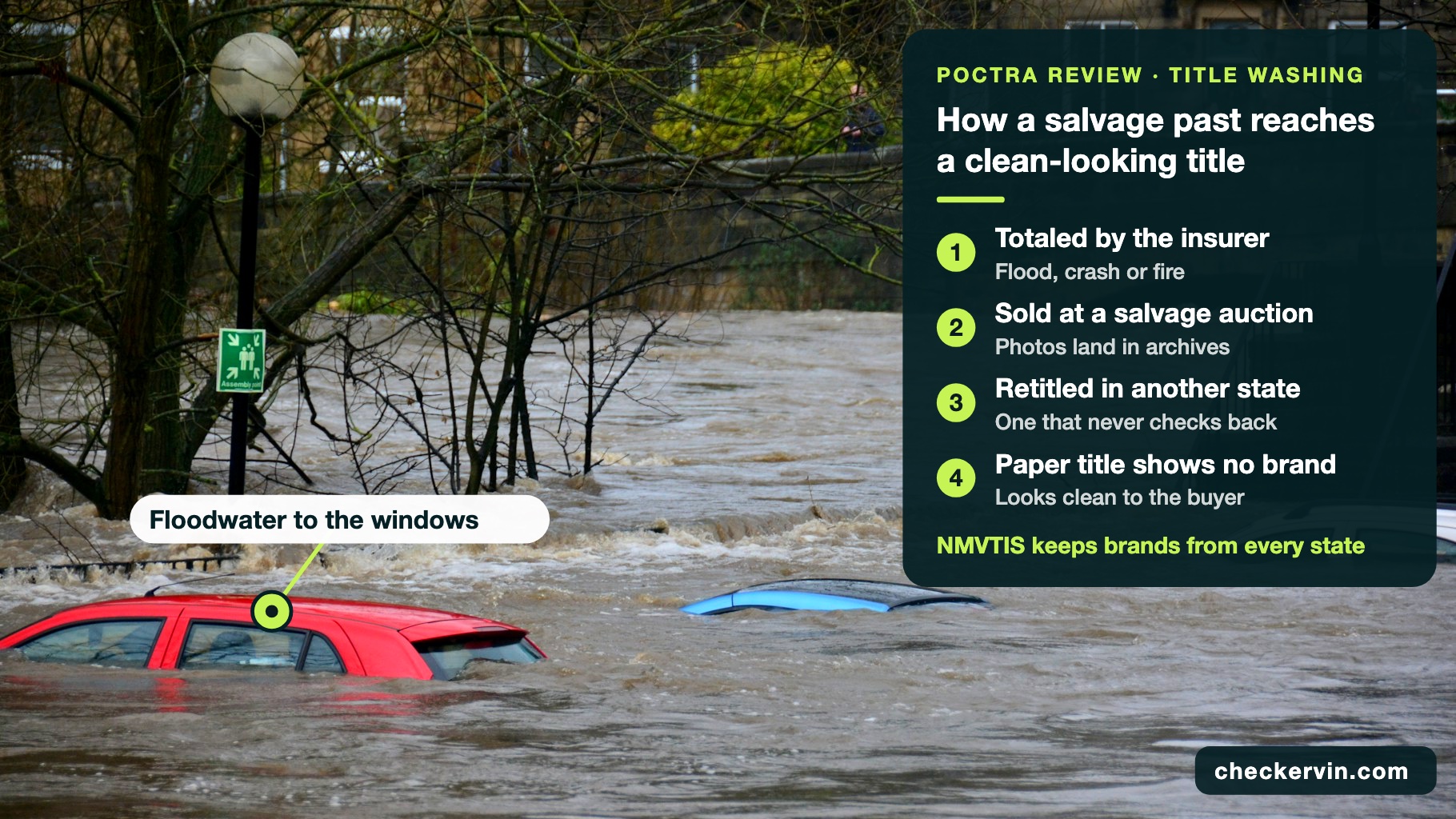
The DOJ’s consumer page describes the dishonest version directly. A branded car is retitled in another state that does not check with the state that branded it, or with every state that titled it before, and the new paper title comes out without the brand. The car is then sold to someone who never learns its history. That is title washing, and it is why a car you find in a salvage archive can be advertised with a title that looks spotless.
The department’s example is flood cars after Hurricane Katrina: truckloads of flooded vehicles taken out of Louisiana to states as far away as the upper Midwest, dried out, cleaned and offered for sale in states that do not brand flood vehicles. Buyers there may not have known the cars had sat in saltwater, which the page says makes electrical systems, airbag sensors included, more prone to failure.
Not every clean title on a salvaged car is fraud. States set their own branding thresholds and categories, and some have no flood brand at all, so a car can be damaged in one state and legitimately unbranded in another. Our full guide to title washingwalks through those structural causes and the date patterns that separate them from deliberate washing. For a salvage-archive hit, the practical point is simpler: the paper title in the seller’s hand is the least reliable document in the deal.
How NMVTIS is meant to stop it, and where it still leaks
NMVTIS exists largely to close that gap. Once a state brands a vehicle, the DOJ says, the brand becomes a permanent part of its NMVTIS record, and the system keeps every brand any state has applied, so moving the car across a state line does not wash it. When fully implemented, states are meant to query it before issuing a new title.
The same page is candid about the limits. It says 87 percent of the U.S. vehicle population is in NMVTIS and roughly 20million salvage or total-loss records are held, and that until every required entity reports, a search can return a false negative such as “no junk or salvage history.” It adds that private vehicle history databases can have the same gaps.
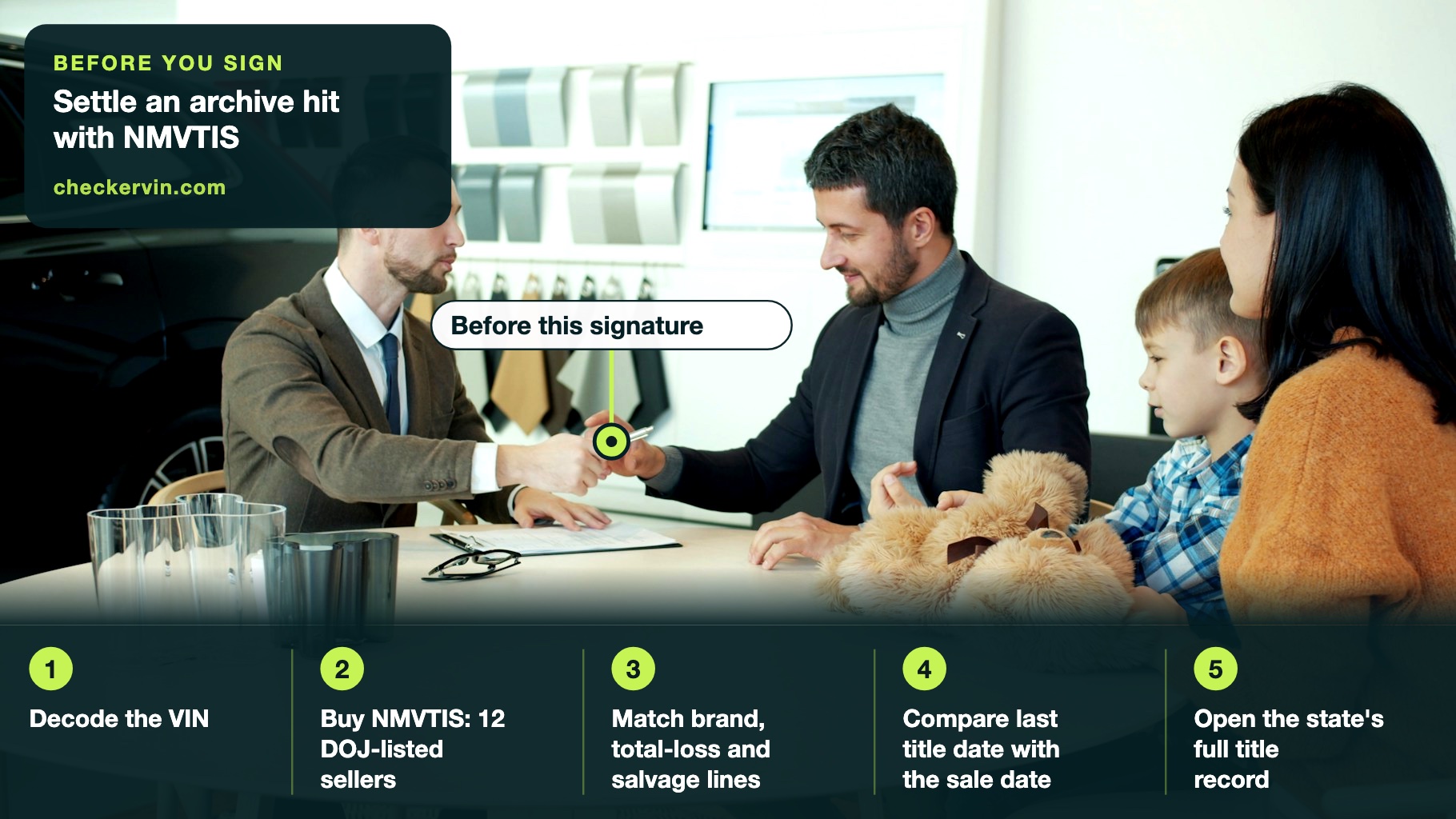
How to confirm salvage history with the NMVTIS title record
- 1Decode the VIN firstConfirm the year, make, model and engine, so you know the archived listing and the title report describe the same car.
- 2Buy the report from a provider on the DOJ listThe Department of Justice lists 12 approved providers that sell NMVTIS reports to the public. The DOJ adds that consumers cannot get NMVTIS reports from Carfax, DMVDesk or Experian, which serve dealers only.
- 3Read the brand and loss lines against your notesCheck brand history, total loss history and salvage history against the sale date and state you took from the listing. A salvage sale with no matching entry is the thing to ask about.
- 4Compare the current title date with the sale dateThe report gives the current state of title and the last title date. A new title in a different state shortly after a salvage sale is the sequence title washing produces.
- 5Open the state's full title recordThe DOJ says each consumer report links to the current state's full title record, which can hold information NMVTIS does not.
The report is short on purpose. The DOJ describes it as intentionally concise and limited to five indicators: current state of title and last title date; brand history from any state; odometer reading; total loss history; salvage history. It does not show repairs. Our NMVTIS report guide explains who reports what into it, and the salvage title VIN check covers how states apply brands in the first place.
Is Poctra legit?
Fairly answered, the question splits in two. Is it a real archive of auction listings? Very possibly, and the domain has existed since 2017, but we could not open it to confirm what it holds or where it gets it. Is it a vehicle history report? No, and that part we can verify.
The DOJ publishes every business approved to provide NMVTIS data. On November 24, 2026 it listed 12 providers for public customers, several of them with affiliated sites named beneath them, plus a separate commercial-only tier. Poctra appears nowhere on the page. You can check the official NMVTIS provider list yourself in under a minute.
| A salvage-archive result can suggest | Only a title record can establish |
|---|---|
| The car was offered as salvage on a date | Whether an insurer declared it a total loss |
| How it looked at that sale | Which brands any state has applied since |
| The title type printed on that listing | The current title state and last title date |
| Nothing at all, if the search is empty | Whether a salvage report exists anyway |
Removing a car from Poctra: what an owner can and can't change
“Remove car from Poctra” is a common search, mostly from owners. Someone who bought and repaired a salvage car, or whose stolen car was recovered unharmed, can find that old wreck photos follow the VIN and cut its resale price. We could not read whether Poctra offers removal, whether it charges for it, or what it asks for, so we cannot tell you how to request it.
What we can tell you is what removal would leave untouched, from the federal side:
- Any brand a state applied, which the DOJ says becomes a permanent part of the NMVTIS record
- An insurer's total-loss determination, which the DOJ says is not removed even if the car is later found in perfect condition
- Reports filed by the salvage yard or auction that handled the car
- Copies of the listing on other archive sites
For an owner, the stronger move is usually documentation rather than deletion: keep the repair invoices, the inspection that cleared the car for a rebuilt title where your state requires one, and for a recovered theft, the paperwork showing the recovery date and condition. A buyer who sees a total loss on the NMVTIS report will ask anyway, and a folder answers the question better than an empty search. The buyer’s side of removal, and why a missing listing proves nothing, is covered in our Bidfax review.
Poctra beside Bidfax, stat.vin and autoAstat
Poctra belongs to a family of auction-archive sites, and we have reviewed three of its neighbors. None of them is on the NMVTIS provider list either. Each review covers a different part of the job, so rather than repeat them here:
| If your question is | Read |
|---|---|
| What each field on an auction lot really tells you, and why removed photos prove nothing | Bidfax review |
| How to be sure an archived lot is the same car you are looking at | Stat.vin review |
| What a final bid means, and why one VIN can appear in several auctions | autoAstat review |
| How salvage auctions work and where their records end up | Auction history by VIN |
Start with the autoAstat review if the archive shows more than one sale for the same VIN, and with auction history by VIN if you want the whole picture of how a car reaches a salvage auction in the first place.
Where CheckerVIN fits, stated plainly
Before you search any archive, it helps to know exactly which car the VIN belongs to. That is the part we do today.
Decode the VIN free, then check the title record
Decoded from official manufacturer and NHTSA records
Where this information comes from
- NMVTIS — approved data providersThe Department of Justice list, read November 24, 2026; Poctra does not appear on it
- NMVTIS — For ConsumersBrand washing, the Katrina example, permanent brands, coverage figures, false negatives and the stolen-car total loss
- NMVTIS — Understanding an NMVTIS Vehicle History ReportThe five indicators and who is required to report
- Verisign RDAP — poctra.comPublic registry record: registration year and last-changed date
- poctra.comReturned HTTP 403 with a captcha browser check to every request on November 24, 2026
- How we made this pageWritten by the CarCheckerVIN editorial team with AI assistance from NHTSA vPIC and other public records, including the Department of Justice NMVTIS pages and the Verisign registry; facts checked November 2026. poctra.com blocked our requests, so none of its own claims are quoted.
Keep reading
Frequently asked questions
Is Poctra legit?
We could not test it. On November 24, 2026 poctra.com answered every request with a browser check that requires a captcha, so we cannot quote its terms, prices or description of its data. What we can verify: Poctra does not appear on the Department of Justice list of approved NMVTIS data providers, so whatever it shows is not the federal title record.
What does a Poctra salvage history result actually show?
Sites of this kind keep copies of past salvage-auction listings: photos, a damage description and sale details, filed by VIN. A hit tells you the car went through a salvage sale at some point. It does not tell you why, what the title says today, or what was repaired afterward.
Can I remove my car from Poctra?
We could not read whether Poctra offers removal, or whether it charges for it, because its site blocked us. Whatever happens to that listing, the federal record is not touched: NMVTIS says a brand applied by a state becomes a permanent part of the vehicle's record, and an insurer's total-loss determination is not removed even if the car turns out to be fine.
Why would a car with a salvage auction record have a clean title?
Sometimes for innocent reasons: a stolen car the insurer paid out on can be recovered undamaged, and a salvage yard handling a car does not oblige a state to brand it. Sometimes not: a brand can be lost when a car is retitled in a state that never checks earlier titles. That last pattern is title washing.
How do I confirm a car's salvage history officially?
Buy an NMVTIS vehicle history report from a provider on the Department of Justice list. It reports five indicators, including brand history from any state, total loss history and salvage history, and each report links to the current state's full title record.
If a VIN is not on Poctra, was the car never salvaged?
No. An archive only holds cars that went through the auctions it copies and whose listings are still up. The DOJ also warns that NMVTIS itself can return a false negative while some reporters are missing, so pair the title check with a pre-purchase inspection.
Know which car the VIN belongs to
Decode any VIN free for the factory build, specifications and open safety recalls. No account, no card. Full vehicle history reports are launching soon.
Run a free VIN check