The short answer
- What is Bidfax?
- An archive of past Copart and IAAI salvage-auction listings, searched by VIN: the auction's photos, damage notes and bid result, kept after the lot closes.
- Is it legit?
- As a photo archive, what it shows is copied from real auction listings. But Bidfax is not on the Department of Justice list of approved NMVTIS providers, so it is not a title record and cannot show title brands across states.
- Does a removed listing mean a clean car?
- No. Photo removal deletes one copy. The insurer and salvage-yard reports in NMVTIS, and any title brand, stay where they are.
10
Photos on every Copart lot page
Per Copart's help center
2
Damage codes per Copart lot
Primary and secondary
5
Indicators in an NMVTIS report
None of them a photo
Not listed
Bidfax on the NMVTIS provider list
DOJ page, November 2026
The short verdict
A Bidfax search is worth the minute it takes. If the car you are looking at went through Copart or IAA and the listing was archived, you get the auction’s own photographs of the damage, taken before repair, and the damage codes the auction assigned. For a car sold to you as “minor fender bender, never salvaged,” that can end the conversation.
The limit is that an archive of listings is not a history. It holds the cars that passed through those auctions and were captured, as they looked on one day. Title brands, the odometer trail, insurer total-loss reports and everything done to the car after the hammer fell live somewhere else. So use Bidfax for the pictures, and get the title facts from an NMVTIS report.
What Bidfax is, and what we could and could not check
Bidfax (bidfax.info) is used as an archive of past Copart and IAAI lot listings. While a lot is live, the auction publishes its photographs, damage descriptors and details so that bidders can price it. An archive keeps a copy after the sale closes, which is why the pictures are still findable months or years later.
We tried to read Bidfax’s own pages for this review: its home page, its about and contact pages, and anything stating terms or prices. On 24 November 2026 every request to bidfax.info and en.bidfax.info returned an HTTP 403 block. So this page does not tell you what Bidfax charges, how it describes its data or what its removal policy says, because we could not read those things first-hand. If you are about to pay for anything on a site using that name, read its terms yourself and confirm the domain is the one you meant to visit.
What we could check, we did: what Copart and IAA say their listings contain, what their own rules say those listings are worth, and whether Bidfax appears on the federal list of approved title-data providers.
Where the listings come from: Copart and IAA's own pages
The useful content in any auction archive was written by the auction. Copart’s help center says its lot details page carries 10 photos from multiple angles of every vehicle, plus the following where available:
- VIN
- Title type
- Odometer
- Primary damage
- Secondary damage
- Estimated retail value
- Body style, color, engine, cylinders, transmission, drive and fuel type
- Whether keys are available
- Seller
Lot pages also list the vehicle’s location, the date and time of its live auction and any extra notes. Copart sells a separate inspection report with more photos and at least two videos, and gives free condition reports on its wholesale and GO-app vehicles. Looking is open to anyone: Copart offers a free Guest membership for people who want to view auctions without bidding.
IAA’s auction rules put the weight of those photos in perspective. Every vehicle is sold “as is, where is,” the buyer alone is responsible for inspecting it, and the rules state that IAA’s images are not meant to show a vehicle’s condition exhaustively. Buyers agree not to base a bid on the information IAA provides. That is the auction describing its own listings, and it applies equally to an archived copy of them.
Searching Bidfax by VIN, for Copart and IAAI lots
The search that works is the full 17-character VIN. Auction listings are filed by VIN and lot number, so a year-make-model search turns up hundreds of strangers and a partial VIN turns up the wrong car. Before you search, decode the VIN so you know the year, body and engine of the car the seller is describing. That way you can tell at a glance whether an archived lot is the same vehicle.
“Bidfax IAAI” and “Bidfax Copart” searches are really the same question: did this car pass through either auction? IAA trades as IAA but lives at iaai.com, which is where the IAAI shorthand comes from. Expect to sometimes find the same VIN more than once. Copart relists a lot when the high bidder does not pay within 8calendar days of the sale, or when the seller does not approve the final bid. So a “final bid” in an archive is not proof that the car sold at that figure, or sold at all that day.
Decode the VIN free, then search the archive
Decoded from official manufacturer and NHTSA records
How to read an archived lot without over-reading it
| Field on the lot | What it really tells you |
|---|---|
| Photos | The car at intake, before repair. Real evidence of what was visible, but IAA says outright that its images are not an exhaustive record of condition. |
| Primary and secondary damage | Copart treats both codes as equally significant and expressly disclaims their accuracy. Codes include flood, frame damage reported, rollover, burn, and replaced or altered VIN. |
| Title type | What the title said when the auction listed the car. It is not the title today, and it is not the history of brands across states. |
| Odometer | One reading on one date. Useful for lining up against the seller's figure, but it is not an odometer history. |
| Run and drive | At IAA it means the engine started and the car engaged forward and reverse when it arrived. IAA's rules say it is no promise the car runs later. |
| Keys and seller | Whether keys came with the lot, and who consigned it. A seller that is an insurer usually means a claim was settled on the car. |
What an auction-photo archive tells a buyer
- That the car went through a salvage auction at all, which a seller may not have mentioned
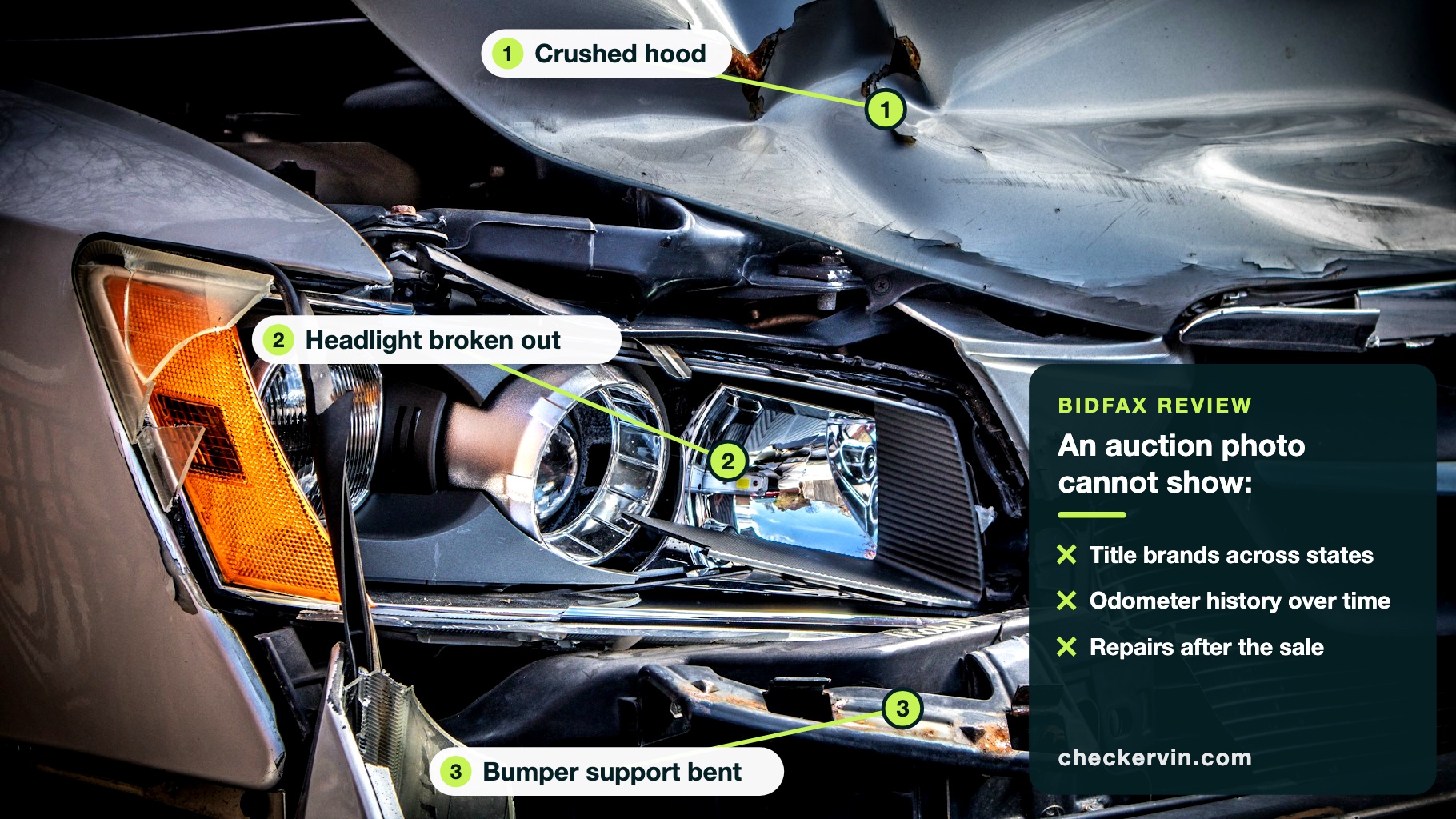
- What the damage looked like before repair: which panels, whether airbags deployed, whether the cabin was wet
- The damage codes the auction assigned, including flood, burn, frame damage reported or a replaced VIN
- The title type and odometer reading printed on the listing that day
- Whether the seller was an insurer, which points to a settled claim
- A dated point to line up against the title record and the seller's story
That last point is the most useful. If the seller says the car was hit in the rear last spring and the archived lot shows a front-end hit two years earlier, you have caught a story that does not fit, without needing anyone to admit anything. Our guide to VIN checks with photos covers how to read a photo set and spot reused listing pictures.
What it does not tell you
| Not in an auction archive | Where it actually lives |
|---|---|
| Title brands across states, such as salvage, rebuilt, junk or flood | NMVTIS, which keeps the brands applied by any state. Sold only through approved providers. |
| Odometer history over time | NMVTIS odometer readings and state title records. One auction reading cannot show a rollback. |
| Insurance total-loss records | Insurer reports to NMVTIS, filed monthly under federal rules, whether or not the car was ever photographed at a public auction. |
| Repairs made after the sale | Nowhere in any database. Only an inspection by a mechanic or body shop sees what was fixed and how well. |
| Damage that never reached an auction | Possibly nowhere. A privately repaired crash with no insurance claim leaves no auction trace. |
The repairs row is the one that matters most when you are buying a rebuilt car. The auction photo shows the wreck; it cannot show whether the frame was straightened properly or the airbags were replaced. Our guide to buying a car with a rebuilt title covers that inspection.
Is Bidfax legit?
It depends on what you are asking it to be. As a place to see auction photographs, the content is genuine: the pictures and codes were published by Copart and IAA while each lot was live, and an archive that keeps them is doing something real. As a vehicle history report, it is not one, and nothing on the federal record says otherwise.
The Department of Justice publishes the businesses approved to provide NMVTIS title data. Its list in November 2026 named 12providers for public customers, plus a commercial-only tier. Bidfax is on neither. Because we could not read Bidfax’s own pages, we do not know whether it claims to sell title records; we can only tell you that the federal list does not include it. You can check the list yourself on the official NMVTIS provider page.
| A Bidfax result can show | A Bidfax result cannot show |
|---|---|
| The auction's photos of the damage | Whether the repair was done properly |
| The damage codes the auction assigned | Whether those codes were accurate, which Copart disclaims |
| The title type on the listing | Brands added since, or applied in another state |
| One odometer reading | The odometer trail that reveals a rollback |
Bidfax photo removal, and why a missing listing proves nothing
Search “bidfax” and the suggestions include removal: people looking to take a VIN off the archive. The reason is obvious. A car with pre-repair photos online sells for less, and some sellers would rather the next buyer never saw them. Whether a listing comes down by request or through someone offering to arrange it, the effect is the same.
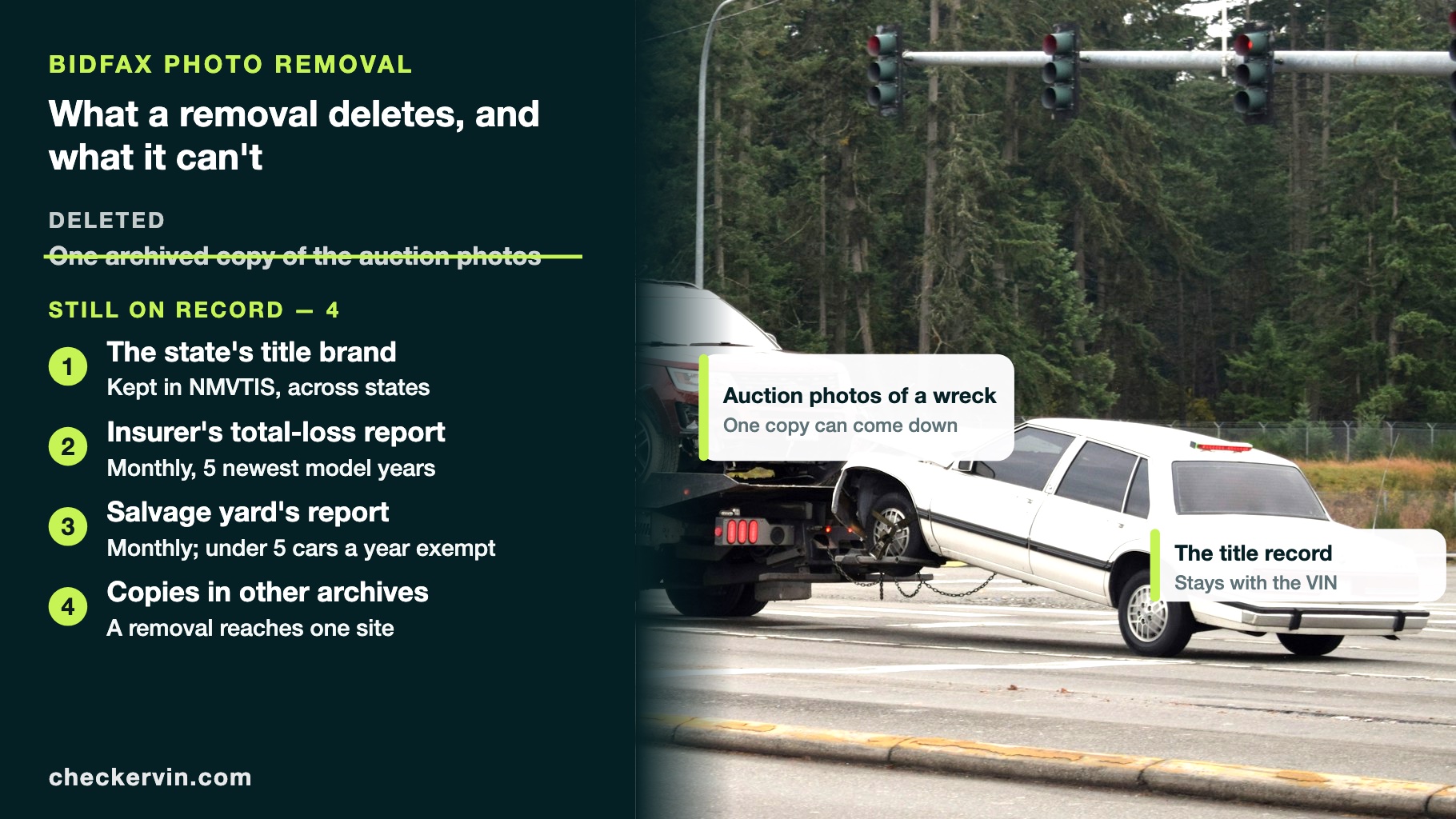
What disappears is one copy of the auction’s photos. What does not disappear:
- The title brand a state issued when the car was declared salvage
- The insurer's report to NMVTIS that it took the car as a total loss
- The salvage yard's or auction's own report of obtaining and disposing of it
- Copies of the same listing held by other archives
- The auction's own records of the sale
So a VIN that returns nothing on Bidfax tells you only that Bidfax has nothing on it today. That is consistent with a car never damaged, a car repaired privately, a car sold through a different channel, and a car whose listing was deliberately removed. You cannot tell those apart from a blank search, and only one of them is the clean car you hope it is.
The record a removal request can't touch
The federal title system collects reports from the businesses that handle wrecked cars, under rules in 28 CFR Part 25. None of them involve a photo, and none of them depend on an auction archive.
- 1Insurers report the cars they takeEvery month, an insurance carrier reports the junk or salvage vehicles it took possession of, covering the current model year and the 4 prior model years. The report carries the VIN, the date, who the car came from and the owner's name. Saying why (flood, collision, fire, theft recovery) is only encouraged.
- 2Salvage yards report what they obtainJunk yards, salvage yards and auto recyclers report monthly too: the VIN, the date obtained, who from, and whether the car was crushed, sold on or exported. Operators handling fewer than 5 such vehicles a year are exempt.
- 3States add the brandsState titling agencies apply brands such as junk, salvage and flood, and NMVTIS keeps the brands any state has applied, so moving a car across a state line does not wash them away.
The result is an NMVTIS report built on five indicators: current state of title and last title date; title brands applied by any state, such as junk, salvage or flood; odometer reading; total loss history; salvage history. The program says repair histories are not meant to be in it. That is the mirror image of an auction archive: no pictures, but a record that follows the car between states and does not come down on request.
Note the insurer window. The monthly report covers a 5-model-year span, so an older car totaled by an insurer is not caught by that particular rule. That is one more reason to read a clean result on a ten-year-old car more cautiously than on a new one. Our NMVTIS report guide explains who reports what.
Pairing a Bidfax search with a title check
- 1Decode the VIN, freeConfirm the year, make, model, body and engine, so you know which car you are researching and can match it against any archived lot.
- 2Check recalls, freeNHTSA's recall lookup lists open safety campaigns on that exact VIN, and the repair costs nothing.
- 3Search the auction archives by VINTry more than one archive. Save any photos you find, and note the sale date, damage codes, title type and odometer on the listing.
- 4Buy the NMVTIS title recordFrom a provider on the Department of Justice list. It shows the title brands, total-loss and salvage history and odometer readings an archive cannot.
- 5Inspect, with the photos openHave a mechanic or body shop look at exactly the panels the auction photographed. This is the only step that sees the repair.
Free decode and recall check, no card
Decoded from official manufacturer and NHTSA records
Which of our pages you actually need
This page is the Bidfax-specific review: what that one archive is good for and where it stops. If your question is wider, one of these will fit better.
| If you want to | Read |
|---|---|
| Understand salvage-auction records in general, and where to find them free | Auction history by VIN |
| Find any photos of a car, not just auction ones, and judge them | VIN check with photos |
| Know whether a car carries a salvage brand | Salvage title VIN check |
| Understand the federal title report itself | NMVTIS report explained |
| Compare paid history reports on what data they really hold | Carfax alternatives |
The general guide to auction history by VIN walks through how a car ends up at Copart or IAA, how to read the sale price, and the dealer auctions no public archive covers. For brands specifically, the salvage title VIN check covers state branding thresholds, and Carfax alternatives sets the paid reports side by side.
Where this information comes from
- Copart — Understanding the Lot Details PagePhoto count and fields on a lot page, read 24 November 2026
- Copart — Types of ConditionsDamage codes, and Copart's disclaimer of their accuracy
- Copart — Bidding & Buying FAQWhen a lot is relisted after an unpaid or rejected sale
- Copart — Learn More About A VehicleInspection reports and free condition reports
- IAA — Auction RulesAs-is sales, images not exhaustive, and what Run & Drive means
- NMVTIS — approved data providersThe Department of Justice list; Bidfax does not appear on it
- NMVTIS — Understanding a Vehicle History ReportThe five indicators, and what the report leaves out
- 28 CFR 25.55 — Responsibilities of insurance carriersMonthly total-loss reporting, five-model-year window
- 28 CFR 25.56 — Junk yards, salvage yards and auto recyclersMonthly inventory reporting and the small-operator exemption
- How we made this pageWritten by the CarCheckerVIN editorial team with AI assistance from NHTSA vPIC and other public records, including Copart's and IAA's published pages and the Department of Justice NMVTIS pages; facts checked November 2026. bidfax.info blocked our requests, so none of its own claims are quoted.
Keep reading
Frequently asked questions
Is Bidfax legit?
As an archive of salvage-auction listings, what it shows is copied from listings Copart and IAA published while each lot was live. What it is not is a source of title records: Bidfax does not appear on the Department of Justice list of approved NMVTIS data providers. We could not load bidfax.info in November 2026 (it returned an access block), so we cannot quote its own terms or prices.
Can I search Bidfax by VIN for Copart and IAAI cars?
Bidfax is searched by VIN or lot number for cars sold through Copart and IAA (whose site is iaai.com, hence the IAAI shorthand). Use the full 17-character VIN. The same car can show up more than once, because Copart relists a lot when the winning bidder does not pay or the seller rejects the final bid.
Can photos be removed from Bidfax?
Sellers do search for Bidfax photo removal, and listings on archive sites do disappear. A removal deletes one copy of the auction photos. It does not touch the insurer and salvage-yard reports filed with NMVTIS, the title brand a state issued, or copies held by other archives. A missing listing is not evidence of a clean history.
If a car is not on Bidfax, was it never salvaged?
No. A car only reaches an auction archive if it went through one of the auctions the archive copies, and the listing was captured and is still up. Cars repaired privately, cars sold through other channels and listings that were taken down all come back blank. Check the federal title record before reading anything into an empty search.
Does Bidfax show title brands or odometer history?
It can show the title type and odometer reading the auction printed on the day of the sale, which is one dated snapshot. The title brand history across states and the run of odometer readings over time sit in NMVTIS, which only approved providers can sell.
What should I run alongside a Bidfax search?
A free VIN decode to confirm which car you are looking at, NHTSA's free recall lookup, and an NMVTIS title check from a provider on the Department of Justice list. Then a pre-purchase inspection, which is the only thing that sees repairs done after the auction.
Know which car it is before you look at its past
Decode any VIN free for the factory build, specifications and open safety recalls. No account, no card. Full vehicle history reports are launching soon.
Run a free VIN check