The short answer
- What is autoAstat?
- A salvage-auction data service. Its own digest describes it as sales numbers, prices and trends for Copart, IAAI and Impact, searched by VIN, with deeper statistics behind a paid account.
- Is it a vehicle history report?
- No. autoAstat is not on the Department of Justice list of approved NMVTIS providers, so it cannot show the federal title record: brands across states, total-loss history and the odometer trail.
- What is the trap in its data?
- Reading a final bid as a sale price. Auction sales are subject to the seller's approval, so many lots bid high and do not sell, then run again.
58.7%
Copart lots sold in one week
Sold ÷ offered, autoAstat digest, June 2023
50.0%
IAAI lots sold that week
Same issue, same arithmetic
296
Bids on one lot that did not sell
autoAstat digest, November 24, 2026
Not listed
autoAstat on the NMVTIS provider list
DOJ page, November 2026
The short verdict
autoAstat is a market-data tool for people buying at salvage auctions, and on its own terms it looks useful: it tracks what lots bid to, whether they sold, who sold them and how often a car has been run. If you are bidding on a wrecked car at Copart or IAAI and want to know what similar lots really fetched, that is the job it was built for.
The risk is using it for a job it was not built for. A sale record tells you what happened on one auction day. It does not tell you what any state did to the title afterward, what the odometer read before or since, or whether the repair was any good. Its figures also need careful reading, because a final bid is not a sale and a VIN with three runs is not three cars. Read the numbers with the rules below, and get the title facts from an NMVTIS report.
What autoAstat is, and what we could and could not check
We tried to read autoastat.com itself: its home page, about, FAQ and terms. On November 24, 2026 every one of those returned an HTTP 403 block. Its newsletter subdomain, digest.autoastat.com, loaded normally, and that is where everything below comes from.
The digest calls the service “Salvage Auto Auctions Statistics” and says autoAstat reveals the number of cars sold at Copart, IAAI and Impact, analyzes the health of the market and picks out notable sales each week. Its front page lists weekly issues back to November 2022. The digest’s own pitch is to check actual sale prices, avoid scams and get a vehicle’s history before bidding. It also claims a lot archive going back to 2017, split across Copart, IAAI and Impact. Those are autoAstat’s figures; we had no way to test them.
| What we could verify | What we could not |
|---|---|
| It publishes a free weekly digest on Copart and IAAI sales | What a single VIN lookup costs, or whether one is free |
| Its Statistics tab needs a paid account, per the digest | Its pricing page, terms, refund policy or login flow |
| Vehicle pages are addressed by the full VIN plus a second ID | What a vehicle page shows beyond bids and sale status |
| Its domain was registered on November 27, 2017 | Who owns it: registry contact details are held by a privacy service |
| It is absent from the DOJ list of NMVTIS providers | Whether it claims to sell anything resembling title data |
The digest is signed by the autoAstat team, carries a copyright line running from 2017, and links to Contacts, FAQ, Pricing, Terms, Privacy and a Public Agreement page on the main site. We could not open those. If you plan to pay for an account, read the terms on the site itself first.
autoAstat for Copart and IAAI lots, searched by VIN
“autoAstat Copart” and “autoAstat IAAI” are really one question: did this car pass through either auction, and what happened when it did? The digest reports both auctions side by side each week, and its links to individual vehicles use the full VIN followed by a second number. Keep the distinction in mind: a VIN identifies the car, while each run through an auction is a separate listing. One car can have several.
The digest’s own search links show which fields autoAstat lets you filter on: lot status (sold or not), winning amount, estimated repair amount, a value figure, odometer, sale date, auction and location. That tells you what kind of record you are getting. It is a record of a sale, built from what the auction published, not a record of the car’s life.
Search with the full 17-character VIN, not year, make and model. Decode it first so you know the trim, body and engine of the car the seller is describing; that is how you spot a lot that belongs to a different vehicle with a similar description.
Decode the VIN free, then look up its auction runs
Decoded from official manufacturer and NHTSA records
A final bid is not a sale price
This is the single most common misreading of salvage auction data. IAA’s Auction Rules say its sales are “with reserve”: an award is subject to the consignor’s approval, and a reserve or minimum bid may have to be met. If the bidding stops short and the seller does not approve, IAA may make counteroffers to try to close a deal. So the number at the end of the bidding is an offer, not a price.
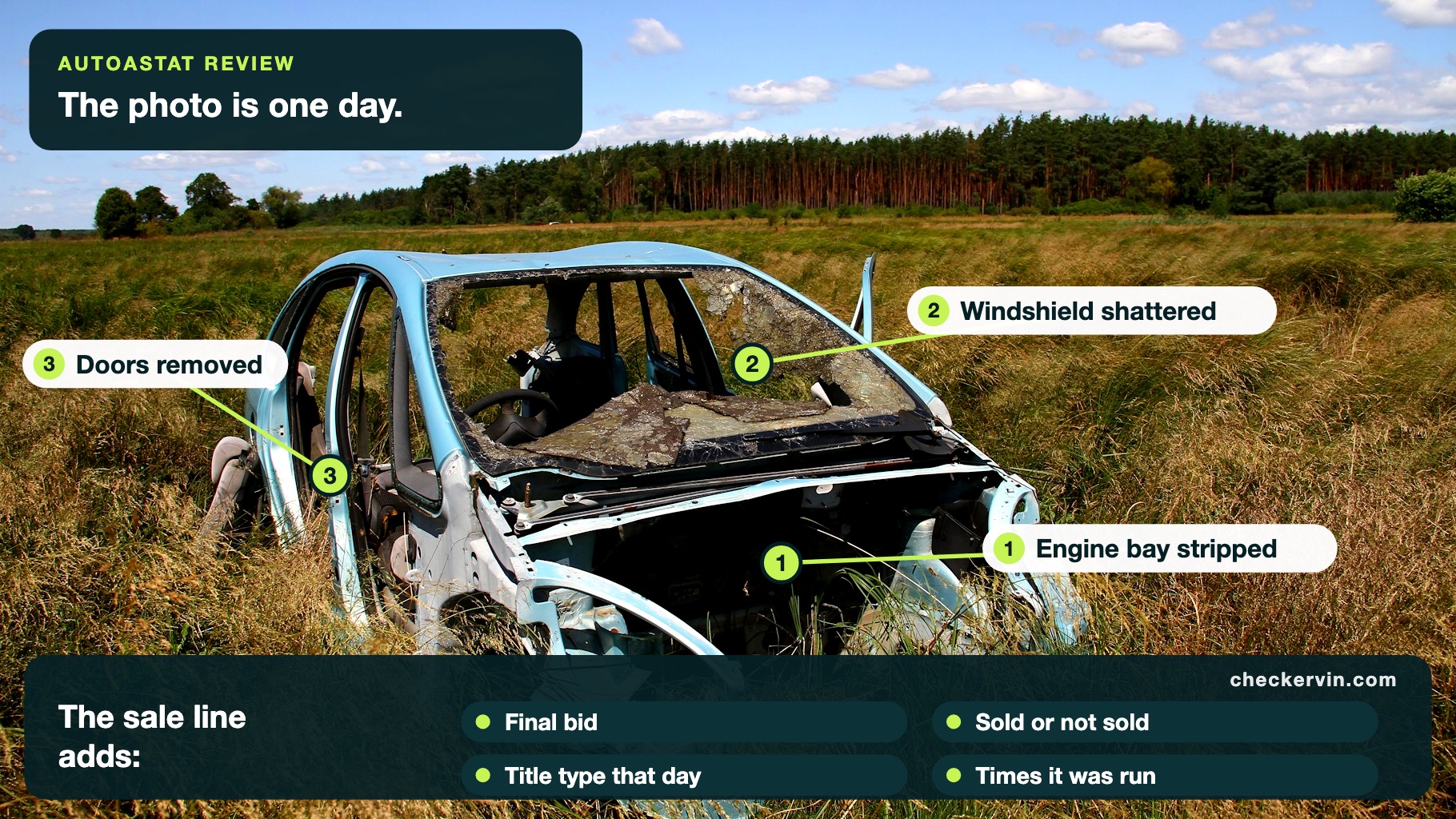
autoAstat’s own digest shows this plainly. Its issue of November 24, 2026 lists the lots with the most bids that week; the top one drew 296bids and is marked “Not sold” beside its final bid. The same issue lists other lots as “SOLD” with a figure. Those are two different kinds of record, and they belong in different columns when you work out what a car is worth.
| What the lot shows | What it means for you |
|---|---|
| Final bid, marked not sold | Bidders would pay this much, the seller wanted more. It is a ceiling on that day's demand, not a value. |
| Sold, with a figure | A buyer committed at that price. The closest thing to a market price the record holds. |
| Sold, very low figure | Usually a parts or scrap car. The digest runs a weekly feature on lots that sold for pocket change. |
| Many bids | Popularity, not quality. The digest itself warns that a crowded lot is not necessarily the best deal or in the best condition. |
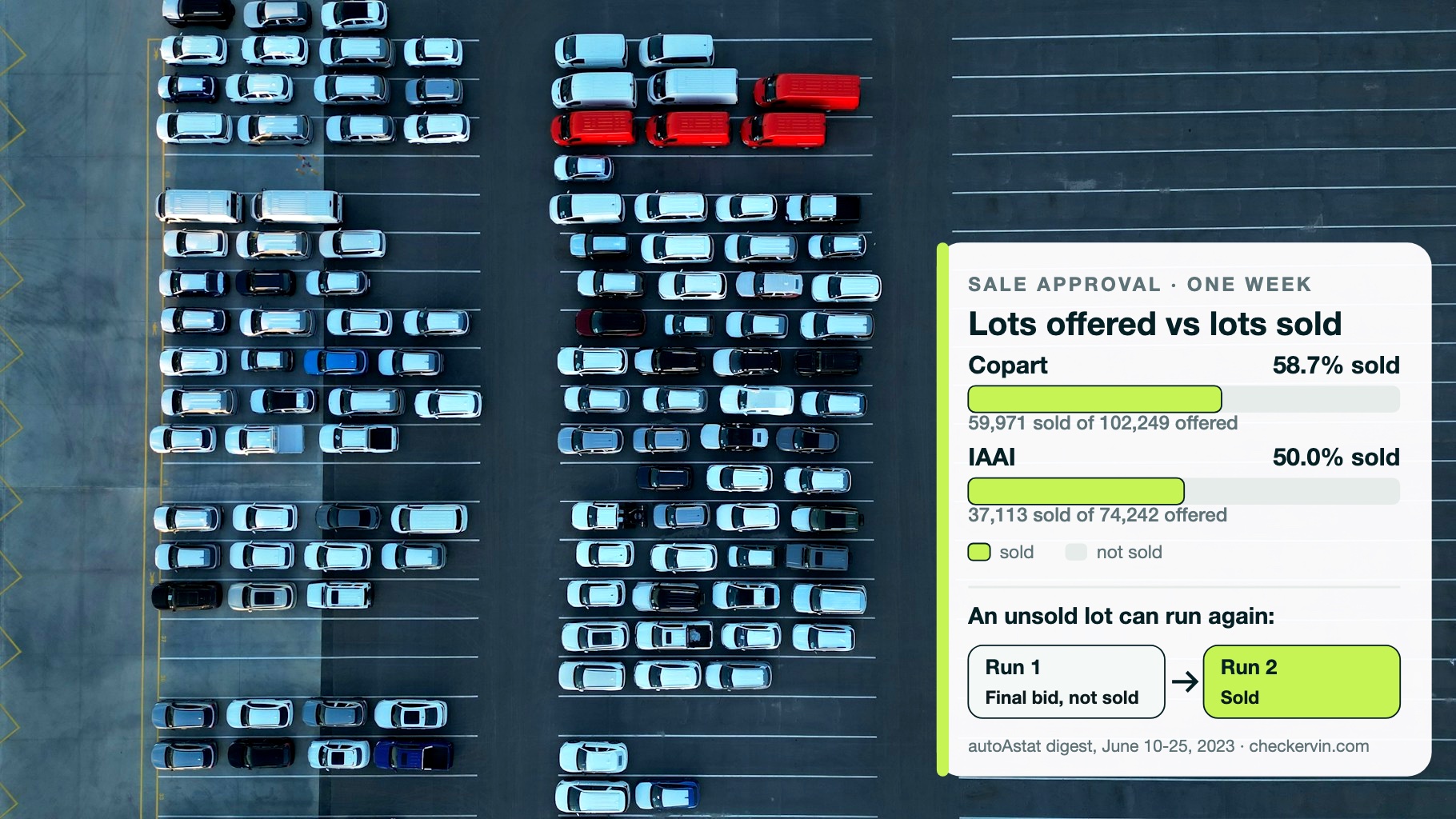
The digest also tracks what it calls sale approval. In its issue for June 10 to 25, 2023 it put Copart at 58.6% and IAAI at 50.0%. Within rounding, those figures match the number of cars sold divided by the number offered at live auctions in the same table: 58.7% for Copart and 50.0% for IAAI. Put another way, 42,278 Copart lots went through that week without selling. When nearly half of lots do not sell on the day, treating every final bid as a price will mislead you badly.
One VIN, several auctions
The digest’s “scam of the week” feature puts an auction count on lots, and one of the cars in the November 24, 2026 issue had been run 3times. A repeat run happens for ordinary reasons. The seller turned down the final bid. The winning bidder did not pay: IAA’s rules give a buyer 3 business days to pay and charge a renege fee once a car is 7 calendar days unpaid. Or a dealer bought the car, repaired it, and sent it back through.
That last case is the one to watch for. When a VIN shows more than one run:
- Sort the runs by date and read them in order, oldest first
- Compare the photos and damage notes between runs; new damage or fresh panels mean someone worked on it in between
- Compare the odometer readings; a later run with a lower reading is a red flag
- Compare the title type; a car that was salvage in one run and clear in a later one needs explaining
- Use the last run marked sold as the car's most recent auction price, not the highest bid across all runs
A car with several runs that ended unsold is often one the seller valued above what the market would pay. A car that sold, then reappeared looking repaired, has been flipped. Both are worth knowing before you agree a price with whoever is selling it now.
Title type at sale is a snapshot, not the title today
Auction listings show the title type the car carried when it was offered. IAA’s own guide to clear and salvage titles says most auction companies display that title type before a vehicle goes to auction, and that a salvage title follows when an insurer decides repairs would cost more than the car is worth. It also notes that states set their own rules for a rebuilt or restored title before a repaired salvage car can be driven or sold.
IAA’s Auction Rules are blunter about the limits. They tell buyers to verify the title type and brand before making any repairs; they say a state may change a vehicle’s title or brand classification after purchase; they warn that a clear-title vehicle may have a salvage history; and they say a clear-title vehicle may show up as junk or salvage in later NMVTIS reports. So the title line on an old lot record can be wrong about the car in front of you in either direction.
| Title on the lot | What to check now |
|---|---|
| Salvage | Whether it has since been inspected and retitled as rebuilt in the current state, and what that state requires |
| Clear | Whether an insurer reported it as a total loss anyway; NMVTIS records total-loss and salvage history separately from the brand |
| Any type, sold years ago | Every state the car has been titled in since; brands follow the car through NMVTIS, not through the auction listing |
Insurers report the cars they take as total losses to NMVTIS every month, covering the current model year and the 4 before it, under 28 CFR 25.55. Salvage yards report what they obtain under 25.56. Neither report depends on the car having been photographed at an auction, and neither disappears from the record if a listing is taken down. Our salvage title VIN check explains how brands are applied, and the NMVTIS report guide covers who reports what.
Damage and condition fields: what the auction itself says they are worth
The damage and condition fields on a lot record come from the auction, and IAA’s rules spell out how far to trust them. Vehicles are sold “as is, where is.” Its images are not intended to show a vehicle’s current condition exhaustively. A damage location statement is not meant to cover all damage. Buyers are told not to rely on the information IAA provides, including the images and the damage type.
| Field | IAA's own definition or caveat |
|---|---|
| Starts | The motor started and idled when the car arrived. No promise it will start, drive or move later. |
| Run & Drive | On arrival the engine started, forward and reverse engaged and the steering turned. No promise it will do so afterward. |
| Damage type and location | A general statement, not a complete list. Hidden damage is expressly not covered. |
| Images | Not intended to display the vehicle's condition exhaustively. |
Copart uses its own damage codes, primary and secondary, and disclaims their accuracy in its help center; our Bidfax reviewwalks through that glossary and what an auction photo can and cannot prove. For the wider question of what “damage reported” means on any history report, see our damage reported guide.
Reconciling a lot record with the car in front of you
Finding an auction record is the start, not the answer. The job is to prove the record belongs to this car and then work out what has happened since. Our stat.vin review covers matching a lot to a VIN in detail; the steps below focus on what the sale data adds.
- 1Confirm the identityDecode the VIN and check that year, make, model, body, engine and color match the lot. A lot that matches on year and model but not on trim or engine is a different car.
- 2Lay out every run in date orderNote for each run the date, the location, the odometer reading, the title type, the damage noted, the final bid and whether it sold.
- 3Find the last sale that actually happenedThat run tells you roughly what a professional buyer paid for the wreck. Anyone now asking far more for a car that has not been visibly repaired is charging for a story.
- 4Put the seller's account next to the recordIf the seller says the car had a minor rear hit last year and the lot shows front-end damage at a salvage auction two years ago, the story does not fit the record.
- 5Check the title as it stands todayBuy an NMVTIS report from a provider on the Department of Justice list. It shows brands, total-loss and salvage history and odometer readings across states, which no auction record carries.
- 6Inspect the panels the auction listedTake the lot's damage notes to a mechanic or body shop and have them look at exactly those areas. Only an inspection sees how the repair was done.
autoAstat free or paid, and what it costs
The digest is free to read. Beyond that, what we can say comes only from the digest’s own words: its Statistics tab, which does price analysis by state and over time, is “only available with a paid account,” and a PRO account lets you search all makes and models and run analysis by week, month, quarter or year. The digest also mentions filtering sales by buyer country for PRO users.
So the model is a free newsletter on top of a paid data product with at least one higher tier. We could not load autoAstat’s pricing page, so we cannot tell you what an account costs, whether a single VIN lookup is free, or how billing and cancellation work. If you are weighing the cost, compare what a paid tier promises with the job you need done. For pricing a salvage purchase, auction statistics are the point. For checking a car’s title, an NMVTIS report from an approved provider is the purpose-built product.
Is autoAstat legit?
On what we could verify, it is a real, long-running service doing what it says. The digest has been published weekly since November 2022, the domain dates from 2017, and the sale data it shows matches the way auctions actually run: final bids that did not sell, repeat runs, insurers as the biggest sellers. Nothing we read describes it as anything other than an auction data tool.
What it is not is a federal title source. The Department of Justice list of approved NMVTIS data providers named 12providers for public customers in November 2026, plus a commercial-only tier, and autoAstat is in neither. That is not an accusation; most auction-data sites are not on the list, because they do not sell title records. It just means the title line on an autoAstat result is the auction’s snapshot, not the state’s record. You can check the list yourself on the official NMVTIS provider page.
The two things we cannot vouch for are the operator and the terms. Registry contact details for autoastat.com are held by a privacy service, the digest names no company, and the main site blocked our requests. That does not make it untrustworthy. It does mean you should read the terms and billing details on the site yourself before you pay.
autoAstat alternatives, and what each one actually is
People looking for an autoAstat alternative usually want one of two things: other places to see auction records, or a check on the car’s title. These are different products.
| If you want | What does that job |
|---|---|
| Auction photos of a car before repair | Salvage archives such as Bidfax and stat.vin. See our Bidfax and stat.vin reviews for what each one shows. |
| What similar salvage lots really sold for | An auction statistics tool, which is autoAstat's own category |
| Title brands, total loss and odometer history | An NMVTIS report from a provider on the DOJ list |
| The factory build, specifications and open recalls | A VIN decode and NHTSA's recall lookup, both free |
| How well the car was repaired | A pre-purchase inspection; no database holds it |
Our Bidfax review looks at the photo side, including why a removed listing proves nothing, and the stat.vin review covers matching a lot to a VIN and reading a sale date against a title. For the bigger picture of where salvage auction records come from, start with auction history by VIN.
Where CheckerVIN fits, stated plainly
CheckerVIN does not return auction sale records, and it does not sell a title or accident history report today. The free check here returns the factory build and specifications, factory warranty terms, open NHTSA safety recalls, photos filed against the VIN, and market and listing prices, with no account and no card. Title brands, damage records, odometer readings and ownership history are launching soon and are not part of what we return yet.
Free decode and recall check, no card
Decoded from official manufacturer and NHTSA records
Where this information comes from
- autoAstat digest — index pageHow autoAstat describes itself; issue list back to November 2022. Read November 24, 2026
- autoAstat digest — Vol. 211 (November 24, 2026)Final bids marked not sold, auction counts, paid Statistics tab and PRO account
- autoAstat digest — Vol. 34 (July 4, 2023)Cars offered, cars sold and sale approval for Copart and IAAI, June 10-25, 2023
- Verisign RDAP — autoastat.comRegistration date; registrant details held by a privacy service
- IAA — Auction RulesSales with reserve, payment and renege timing, Starts and Run & Drive, title verification
- IAA — U.S. Vehicle Titles: Clear and SalvageTitle type shown before auction; state rules for rebuilt titles
- NMVTIS — approved data providersThe Department of Justice list; autoAstat does not appear on it
- NMVTIS — Understanding a Vehicle History ReportThe five indicators an NMVTIS report covers
- 28 CFR Part 25 (eCFR)Sections 25.55 and 25.56: insurer and salvage-yard reporting to NMVTIS
- How we made this pageWritten by the CarCheckerVIN editorial team with AI assistance from NHTSA vPIC and other public records, including autoAstat's own digest pages, IAA's published rules and the Department of Justice NMVTIS pages; facts checked November 2026. autoastat.com and Copart's help center blocked our requests, so neither is quoted.
Keep reading
Frequently asked questions
Is autoAstat legit?
It is a real, operating service: its weekly digest has been published since November 2022 and its domain was registered in 2017. It describes itself as salvage-auction statistics for Copart, IAAI and Impact. It is not on the Department of Justice list of approved NMVTIS data providers, so it is not a source of federal title records. We could not open autoastat.com itself in November 2026, so we cannot review its terms, prices or refund policy.
Does autoAstat cover Copart and IAAI?
Yes, by its own description. The autoAstat digest says it counts cars sold at Copart, IAAI and Impact, and its weekly issues report figures for Copart and IAAI side by side. Its links to individual vehicles start with the full VIN.
Is autoAstat free?
Partly, as far as we could verify. The weekly digest is free to read. The digest itself says its Statistics tab needs a paid account and that a PRO account unlocks searching all makes and models. We could not load its pricing page, so we cannot say what a lookup or an account costs, or whether a single VIN search is free.
What does a final bid with no sale mean?
The bidding closed at that figure but the car was not sold. IAA's rules say its sales are subject to the consignor's approval and may carry a reserve, so a high bid below what the seller will accept leaves the car unsold. The digest for November 24, 2026 lists a lot that drew 296 bids and still did not sell.
Why does the same VIN show several auctions?
A car that did not sell, or whose buyer never paid, can be offered again, so one VIN can carry several runs with different bids. autoAstat's digest shows an auction count on some lots. Read the runs in date order and use the last one that shows the car sold.
I can't log in to autoAstat or reach its contact page. What can I do?
We could not reach autoastat.com's login, contact or FAQ pages either; all of them returned an access block to us in November 2026. The digest at digest.autoastat.com loads normally and links to a Contacts page and an email address, so that is the route to try for account questions.
What is a good autoAstat alternative for a title check?
For auction photos and bids, other salvage archives such as Bidfax and stat.vin do the same kind of job. For title brands, total-loss records and odometer history you need an NMVTIS report from a provider on the Department of Justice list, which no auction archive is.
Know which car the lot describes
Decode any VIN free for the factory build, specifications and open safety recalls. No account, no card. Full vehicle history reports are launching soon.
Run a free VIN check