The short answer
- Can I look it up myself?
- No. The VIN is visible through every windshield, so a retrievable key code would be a working key for any car you can see.
- Who can get it?
- A dealer for that make, or a locksmith registered for vehicle security work — after verifying your ownership and identity.
- Can I check my locksmith?
- Yes. The vehicle security professional registry is public and searchable by business name or ID before you hand over anything.
Gated
Key codes, deliberately
The VIN is visible to anyone
Public
The professional registry
Searchable before you hire
Up to 3
Jobs to make one key work
Cut, program, immobilizer
Ownership
What you must prove
Title or registration, plus ID
Why you cannot look it up
It is worth sitting with the reasoning, because it explains every friction you are about to meet and turns them from obstacles into features.
Federal rules require the VIN to be readable from outside the vehicle. That is why there is a plate at the base of the windshield on the driver’s side of essentially every car you have ever seen. Anyone standing next to a parked vehicle can read it, photograph it, and walk away with it in thirty seconds.
Now suppose a key code could be derived from that number by anybody who asked. The consequence is immediate: the identifier the law requires to be publicly visible would become the credential for taking the car. Any lookup service offering that would be, in effect, a key-cutting service for vehicles the requester does not own.
What a key code actually is
The term gets used loosely, and the looseness is why quotes for “a new key” differ so wildly between two people describing what sounds like the same job.
A key code is a manufacturer’s reference describing the mechanical cuts for that specific vehicle’s locks — the pattern of depths and spacings that lets a blade turn in the cylinder. With the code, a blade can be cut correctly without having an existing key to copy. That is genuinely valuable when every key is gone and there is nothing to duplicate.
What the code is not is a key. On a vehicle with a transponder or a proximity system, a correctly cut blade will open the door and turn in the ignition and the car will not start, because the electronic side has not been addressed at all.
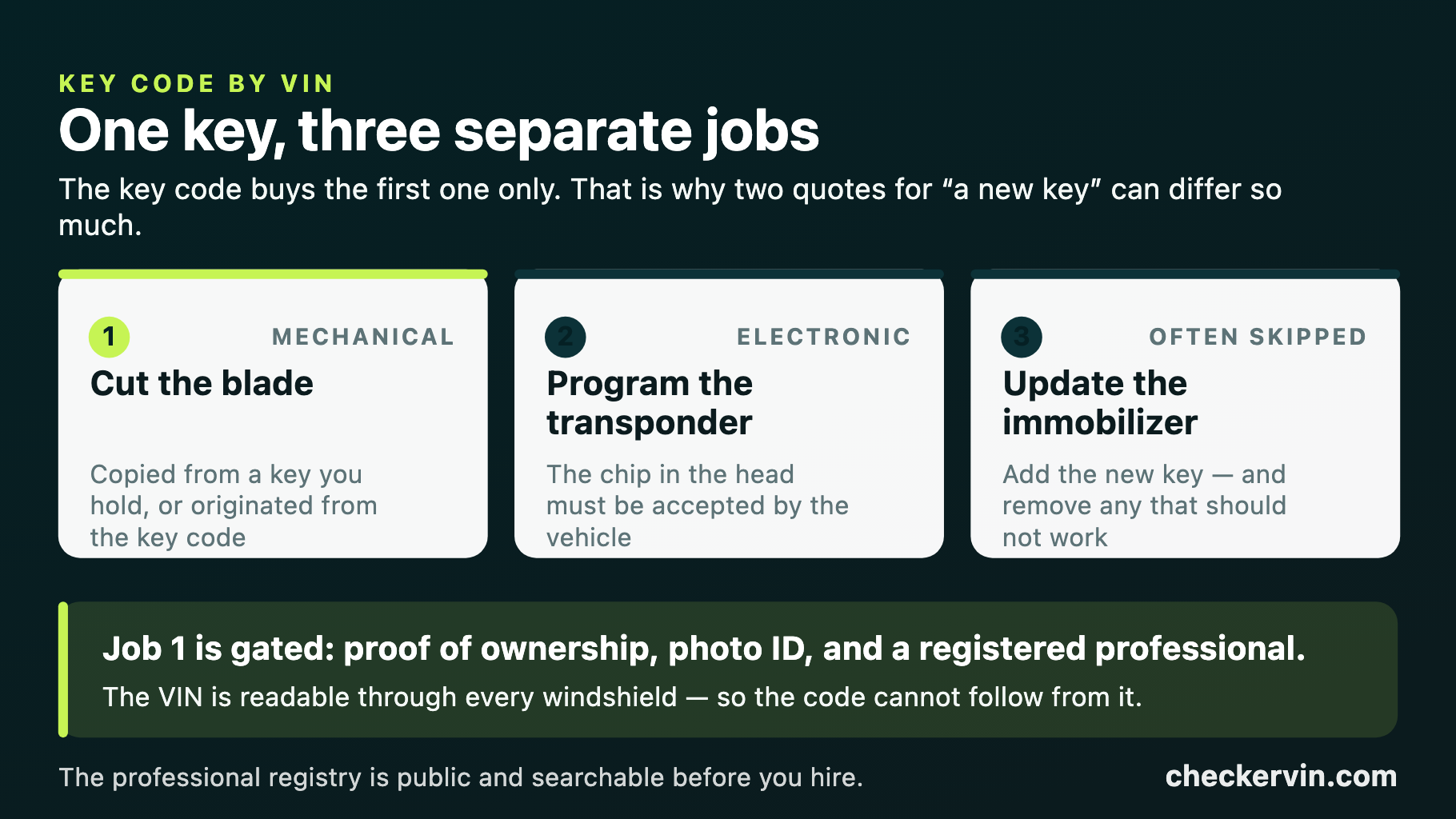
Three separate jobs, not one
Separating these is the single most useful thing on this page, because it lets you read a quote and know what you are being charged for.
| The job | What it involves |
|---|---|
| Cutting the blade | Mechanical. Either copied from an existing key, or originated from the key code when there is nothing to copy. This is the part the code exists for. |
| Programming the transponder | Electronic. The chip in the key head has to be introduced to the vehicle so the immobilizer accepts it. Requires equipment and, on many makes, access to manufacturer security data. |
| Updating the immobilizer | Also electronic, and the step people forget. Adding a new key is one operation; removing keys that should no longer work is another, and it is the one that matters if a key went missing rather than broke. |
A duplicate made from a key you are holding may need only the first two. An all-keys-lost job needs the code for the first, and the security access for the rest. Our theft recovery guide covers why the third job matters so much on a car that was taken.
Who is allowed to get it
Two routes exist for a consumer, and they work the same way underneath.
- A franchised dealer for that make, which has manufacturer access as a matter of course
- A locksmith or technician registered for vehicle security work, who obtains codes and security data through the same manufacturer channels
- In both cases, only after your ownership and identity have been verified
The registered-professional route exists because dealers are not always the practical answer — a vehicle with no working key may not be drivable to a dealership, and a locksmith comes to the car. The registration system is what lets that happen without opening manufacturer security data to anyone who asks.
The registry you can check
This is the part with a practical payoff, and it is the reason to read this page before you are standing next to a car you cannot start.
The National Automotive Service Task Force maintains the Vehicle Security Professional registry — the United States authorization through which registered professionals reach manufacturer key codes, security data and immobilizer programming. Registration involves verified business documentation and compliance with the licensing requirements that apply where the professional operates.
The useful detail is that the registry is public. It can be searched by business name or by the professional’s registry ID. So before you give somebody your VIN, your title and your address, you can confirm they hold the credential the work requires.
What you have to prove
Expect to establish two things — that the vehicle is yours, and that you are you — and to do it with documents rather than assurances.
- Proof of ownership: the title in your name, or the current registration
- Photo identification matching the name on that document
- The vehicle present, or its location verified — this work is generally done at the car
- Where the registered owner is not the person present, written authorization and the owner's documents
- Patience with being asked again by the dealer or the manufacturer channel, which is the system working
If you have recently bought the car and the title has not caught up, say so early. The paperwork gap is common and there are established ways around it, but it is better raised at the start than discovered when somebody is already parked beside you.
Why all-keys-lost is the expensive one
The gap between “I have one key and want a spare” and “I have no keys” is much wider than most people expect, and knowing why makes the quote legible.
- 1There is nothing to copyWith a key in hand, a blade can be duplicated mechanically. With none, the cuts have to come from the key code, which is the gated step this page is about.
- 2The car may not be movableA vehicle that cannot be started usually cannot be driven to a dealership, so the work happens where the car is or the car gets towed.
- 3The security side is harder without a working keyMany programming procedures assume an existing accepted key. Where none exists, the procedure is longer and on some makes involves manufacturer authorization.
- 4You should remove the old keys, not just add oneIf a key was lost rather than destroyed, somebody may have it. Adding a new key without invalidating the old ones leaves that door open.
Dealer or locksmith
Both are legitimate routes and the choice usually turns on circumstances rather than on one being better.
| Consideration | How it usually falls |
|---|---|
| The car cannot be driven | Favors a locksmith, who comes to the vehicle. A dealer route may add towing to the total. |
| An unusual or very recent model | Favors the dealer, which has the manufacturer's own procedures and parts for that make as a matter of routine. |
| Out of hours or urgent | Favors a locksmith, subject to checking the registry rather than the first result you find. |
| You want the old keys invalidated | Ask both. It is a specific request rather than an assumed part of the job, and the answer should be yes. |
How the cost is built
We do not print prices on this site, because a figure would be stale and every market differs. What is durable is the structure of the bill, and reading it is what protects you.
- The key itself — a plain blade, a transponder key and a proximity fob are three different parts at three different levels
- Originating the cuts from the key code, where there is no key to copy
- Programming labor, which is where equipment and manufacturer access are paid for
- A call-out or towing charge, depending on which route you took
- Any immobilizer work beyond adding a single key, including removing old ones
Ask for the quote broken into those parts. A single number is hard to compare and easy to pad; the same job itemized is straightforward to price against a second opinion.
Buying a car with one key
This is where the subject stops being an emergency and becomes a negotiation, and it is worth raising before you agree a price rather than after.
A used car offered with a single key carries a known future cost. It is not a defect and it should not end a purchase, but it is a real number that the seller has and you are about to inherit. On a modern vehicle with a proximity system that number is not small.
There is also a security dimension that has nothing to do with money. You do not know how many keys were ever programmed to that car, or where they are now. A previous owner, a previous household, a valet, a garage — any of them could hold a key that still works.
What a bad actor asks for
Because the legitimate process involves handing over genuinely sensitive documents, it is worth knowing which requests are normal and which are not.
| Normal | Not normal |
|---|---|
| Asking for your title or registration and photo ID before work begins | Offering a key code from the VIN alone, with no ownership check at all |
| Asking for the VIN, which is visible on the car anyway | Asking you to email a photograph of your title and ID before any verified contact, to an address you cannot check |
| Declining the job because your paperwork does not establish ownership | Offering to proceed anyway if you pay more |
| Being findable in the public registry under the name they gave you | Refusing to give a business name or a registry ID |
The general shape is that a legitimate professional wants more verification than you expect and an illegitimate one wants less. Our VIN cloning guide covers why vehicle identity is defended this carefully.
What to do before you need this
All of this is cheaper and calmer if handled while you still have a working key, and it takes very little.
- Have a spare made now, while duplication rather than origination is possible
- Keep the spare somewhere that is not the same bag, car or building as the first
- Photograph your title and registration and store them where you can reach them remotely
- If you bought the car used with one key, decide early whether to add a spare or re-key
- Note the make's approach — some vehicles are far more involved than others, and finding out in advance costs nothing
The check sequence
If you are researching a car rather than solving a lockout, keys are one line on a longer list. Decode the VIN free for the factory build and specifications. Check open recalls through NHTSA at no cost. Screen for theft and total-loss records through the NICB. Buy the federal NMVTIS record for title brands. Then inspect the vehicle — and count the keys while you are there.
Where this information comes from
- NASTF — Vehicle Security Professional registryThe US authorization through which registered professionals reach manufacturer key codes, security data and immobilizer programming, and the public registry that can be searched before you hire
- NASTF — what a Vehicle Security Professional isWhat the credential covers and the verification involved in holding it
- 49 CFR Part 541 — Federal Motor Vehicle Theft Prevention StandardThe parts-marking standard, for context on how vehicle identity is defended generally
- NICB — VINCheckFree screen for theft and total-loss records reported by participating insurers
- NHTSA recall lookupOpen safety recalls by VIN, free of charge
Keep reading
Frequently asked questions
Can I get a key code from a VIN?
Not as a member of the public, and the restriction is deliberate rather than bureaucratic. A VIN is visible through the windshield of every parked car; if the key code were retrievable from it, anyone could have a working key cut for any vehicle they could see. Codes are released to registered professionals who have verified your ownership and identity first.
How do I get a replacement key if I lost all of them?
Contact a dealer for that make or a locksmith registered for vehicle security work, and expect to prove ownership and identity before anything happens. With no working key the job usually means originating a key from the code and then programming it to the vehicle, which is why all-keys-lost costs more than duplicating a key you still have.
How can I tell if a locksmith is legitimate for this work?
The industry registry for vehicle security professionals is public and searchable. NASTF maintains it, and you can look up a business name or a VSP ID before you hand anybody your VIN and your title. A professional doing this work properly will not mind being checked.
Is a key code the same as the key itself?
No. The code describes the mechanical cuts, so it lets a blade be made to fit the lock. On a modern car that is only the first of up to three jobs — the transponder in the key head still has to be programmed to the vehicle, and the immobilizer may need the new key added and old ones removed.
Does CheckerVIN return a key code?
No, and no consumer lookup does or should. Our free lookup returns the factory build, specifications and open safety recalls. If a site offers you a key code from a VIN with no proof of ownership, that is a reason to leave rather than a service.
Start with the VIN
Decode any VIN free for the factory build, specifications and open safety recalls. No account, no card.
Run a free VIN check