The short answer
- What is genuinely different?
- Accident history. The federal standard for electric vehicles is written around what happens to the battery during and after an impact.
- What is the free check?
- Open safety recalls. Several of the largest electric vehicle campaigns have been battery related, and the lookup costs nothing.
- Can a VIN show battery health?
- No. State of health comes from a diagnostic read of the car itself. No decode reports it, and no federal record holds it.
5.0 L
Electrolyte allowed to spill outside
None visible inside — FMVSS 305 S5.1
30 min
How long spillage is measured after impact
Plus any static rollover
500/100
Ohms per volt of isolation, AC / DC
One of three alternative routes
10 yr
EPA useful life for GHG standards
Or 120,000 miles — not a warranty
What is actually different about buying a used EV
Strip out the things that are the same — tires, brakes, suspension, bodywork, title brands, odometer questions, and every record check on the rest of this site — and a short list remains. There is a large, expensive, structural component that the car is partly built around, it stores a great deal of energy, and it is the one part of the vehicle whose condition you cannot see, cannot hear on a test drive, and cannot infer from mileage with any confidence.
That is the real difference, and it explains why the useful checks on a used EV are weighted differently rather than being different in kind. It also explains why the federal government wrote a standard that exists solely because the car is electric.
The standard the battery installation had to meet
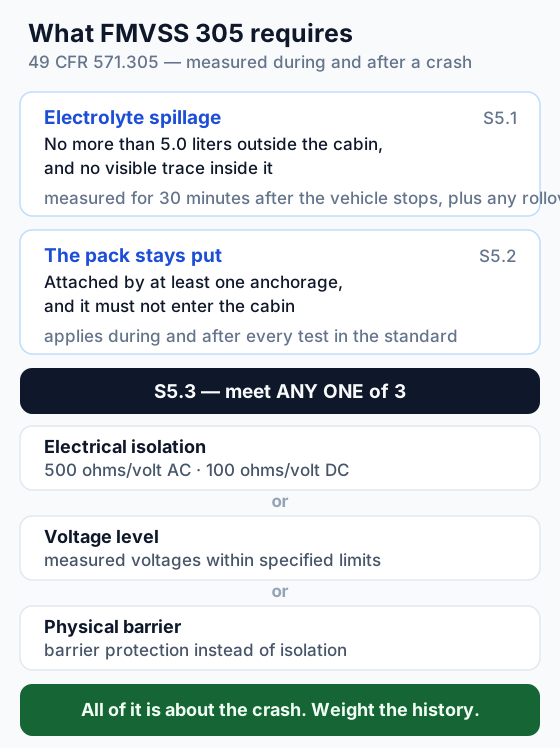
49 CFR 571.305, Federal Motor Vehicle Safety Standard 305, applies to electric-powered vehicles. Its scope is worth reading in the regulation’s own words, because the emphasis is not where most buyers assume:
Nearly every requirement in it is about a crash. The standard is not primarily concerned with how long the battery lasts or how far the car goes — those are handled elsewhere, or not at all. It is concerned with what the pack does when the vehicle is hit. For somebody buying used, that focus is the most useful thing in the document, because it identifies precisely which part of a used EV’s history deserves extra weight.
Five liters, and thirty minutes
S5.1 sets the electrolyte limit, and it is specific in a way that tells you something about the failure it is guarding against. Not more than 5.0 liters of electrolyte from propulsion batteries may spill outside the passenger compartment, and no visible trace may spill into the passenger compartment.
The measurement window is the informative part. Spillage is measured from the time the vehicle ceases motion after a barrier impact test until 30 minutes thereafter, and throughout any static rollover after the impact. The standard is not asking whether the pack survived the moment of impact. It is asking what the pack does in the half hour afterward, while occupants are getting out and responders are arriving.
Carry that into a used purchase and the question sharpens: a repaired EV is a vehicle whose enclosure, mountings and seals have been disturbed after being certified as a system. That is not a reason to reject every repaired electric car. It is a reason to want the repair documented and inspected by somebody who works on that model, rather than accepting that it drives fine.
Staying attached, and staying out of the cabin
S5.2 covers retention, and it has two parts. During and after each test in the standard, electric energy storage or conversion devices must remain attached to the vehicle by at least one component anchorage, bracket or structure that transfers load from the device into the vehicle structure. And devices located outside the occupant compartment must not enter the occupant compartment.
“At least one” is a revealing threshold. The requirement is not that the mounting system is undamaged — it is that the pack does not come free. On a used car, that maps directly to something checkable: the condition and completeness of the mounting hardware, and whether underbody protection has been removed, damaged or replaced with something improvised.
- Look underneath, in daylight, at the pack enclosure and its mounting points
- Ask whether any underbody shield or skid protection has been removed or replaced
- Treat scraping damage on the enclosure as a question for a specialist, not a cosmetic issue
- Missing, mismatched or corroded mounting fasteners deserve an explanation
Electrical isolation after the crash
S5.3 is the electrical safety requirement, and unlike the first two it offers a choice. After each test in the standard, each high voltage source in the vehicle must meet one of three alternatives:
| The route | What it requires |
|---|---|
| Electrical isolation — S5.3(a) | At least 500 ohms/volt for an AC high voltage source, or 100 ohms/volt for a DC high voltage source |
| Voltage level — S5.3(b) | The measured voltages of the high voltage source fall within specified limits |
| Physical barrier protection — S5.3(c) | The source is protected by barriers meeting the standard's requirements instead |
Isolation is a measure of how well the high voltage system is kept separate from the body of the car, expressed in ohms per volt. It is also, usefully, something a technician can measure on a used vehicle rather than merely infer. If you are buying an EV with any accident history, an isolation check is the single most model-specific thing to ask a specialist for, and it is not part of an ordinary pre-purchase inspection unless you request it.
Why accident history carries more weight on an EV
Everything above points the same direction. The federal standard that exists because the car is electric is, almost in its entirety, about crash behavior. So the single record that matters more on a used EV than on an equivalent gasoline car is what has happened to it structurally.
Our accident check guide covers what records exist and the large gap between an event and a record, and that analysis is unchanged here — a clean report is weak evidence about moderate damage. What changes is the consequence. On a conventional car, an undocumented repair is a question about structural integrity and resale value. On an electric car it is also a question about an enclosure that was certified as a system and has since been opened, moved or replaced.
Two adjacent checks are worth running for the same reason: flood exposure, because water and high voltage systems are a poor combination and flood damage frequently produces no title brand at all, and a title brand check, since a structural brand tells you an insurer once concluded the repair economics did not work.
What the federal decoder actually returns for an electric car
NHTSA’s free decoder has a set of fields that exist only for electrified vehicles — electrification level, battery type, battery kWh, battery packs, charger level and charger power. It is worth knowing what comes back in practice, so we ran two ordinary used EVs through it.
| 2018 Tesla Model 3 | 2018 Nissan Leaf |
|---|---|
| Electrification level: BEV (Battery Electric Vehicle) | Electrification level: BEV (Battery Electric Vehicle) |
| EV drive unit: Single Motor | EV drive unit: empty |
| Battery kWh: empty | Battery kWh: 24 |
| Battery type, packs, charger level, charger power: all empty | Battery type, packs, charger level, charger power: all empty |
| 66 of 154 fields populated | 57 of 154 fields populated |
Two things follow, and they point in opposite directions. The useful one: the decoder reliably confirms what kind of electrified vehicle you are looking at, which settles hybrid-versus-plug-in-versus-battery-electric questions on a listing that is vague about it. The limiting one: the battery fields are populated inconsistently by manufacturer. The Leaf returned its pack size and the Tesla did not, from the same database on the same day.
The ten-year figure, and what it is not
There is one number in federal regulation that gets quoted as though it were a battery lifespan, and it is worth stating precisely so you can recognize when it is being misused.
40 CFR 86.1805-17 is titled Useful life. It sets the period the emission standards apply for, and for the greenhouse gas standards it specifies a useful life of 10 years or 120,000 miles for light-duty vehicles and light light-duty trucks, whichever comes first.
The widely repeated eight-year battery warranty is a different thing again: it comes from manufacturers and from California’s requirements rather than from a federal rule of general application, so the only reliable version is the warranty statement for the specific make, model year and state. Check it for the car in front of you rather than trusting a number from an article.
Battery recalls are the check that costs nothing
Some of the largest and most disruptive campaigns in recent years have involved high-voltage batteries, with remedies ranging from a software limit on charge level to a complete pack replacement. For a buyer, an open campaign is the rare defect that is both serious and free to resolve, because a recall remedy is performed at no charge.
- 1Run the VIN for open recalls before you travelIt costs nothing and takes seconds. An open battery campaign changes what the car is worth and what you should agree to.
- 2Ask whether a completed recall was a software or hardware remedyOn battery campaigns the two are very different outcomes. A replaced pack on an older car can be a genuine advantage.
- 3Get any interim guidance in writingSome battery campaigns carry parking or charging advice while owners wait for parts. If one applies, it applies to you after purchase.
- 4Have state of health read from the carThis is a diagnostic read, not a record lookup. No VIN service holds it, and a seller's screenshot is not a substitute for a live read taken in front of you on the day.
Check this VIN for open recalls
Decoded from official manufacturer and NHTSA records
The question this page does not answer
The most common search on this subject is what a replacement battery costs, and we are not going to print a figure. Replacement pricing varies by make, model year, pack size, whether the remedy is a module or the whole pack, whether a remanufactured unit is available, and by labor market — and none of it comes from a federal source we can cite and re-check. A confident number would be a guess wearing a citation.
What is honest to say is how to get the answer for a specific car: ask a franchised dealer for that model year’s pack part number and price, ask whether module-level repair is supported, and ask what the remanufactured option costs if one exists. Those three answers price the risk for the car you are actually looking at, which is the number that matters rather than an average.
The viewing checklist
Nothing here is exotic, and most of it is the ordinary used-car process with two items promoted. Accident history moves up because the standard that exists for electric cars is written around crashes. A live battery reading moves up because it is the one number that matters and the one number no record anywhere holds. Everything else stays where it would be on any other car.
- Open recalls run on the VIN before you travel, and any interim guidance read in full
- Accident history weighted more heavily than you would on a gasoline car, per FMVSS 305's focus
- Underbody and pack enclosure inspected in daylight, including mounting hardware and shielding
- State of health read live from the car by a technician, not taken from a seller's screenshot
- An electrical isolation check requested explicitly if there is any accident history
- Charging behavior observed at least once, on a charger you did not bring
- Every ordinary used-car check as well — brands, liens, odometer, tires, brakes
- The 12-volt battery, which is separate from the traction pack and strands an EV just as completely when it fails
Where this information comes from
- 49 CFR 571.305 — FMVSS 305, electric-powered vehiclesElectrolyte spillage limits, storage device retention, and the electrical isolation alternatives after crash testing
- 40 CFR 86.1805-17 — useful lifeThe 10-year or 120,000-mile period the greenhouse gas standards apply for — a durability period, not a warranty
- NHTSA recall lookupOpen campaigns by VIN, free, including battery-related campaigns
- NHTSA vPIC decoderThe federal build and specification record behind a free decode
Keep reading
Frequently asked questions
What should I check on a used electric car?
Open safety recalls first, because battery recalls are the most consequential and the check is free. Then accident history, because the federal crash standard for electric vehicles is written entirely around what happens to the battery during and after an impact. Then the ordinary used-car checks, which do not change because the car is electric.
Is a used EV that has been in a crash safe?
It has to be assessed rather than assumed. FMVSS 305 requires that the energy storage device stay attached to the vehicle by at least one anchorage, that a device outside the occupant compartment does not enter it, and that electrical isolation is maintained after the test. Those are requirements for a new vehicle in a controlled test, not a guarantee about a specific repaired car.
How long does an EV battery last?
There is no federal answer to that, and anyone quoting one precisely is guessing. What does exist is a regulatory durability figure: EPA sets the useful life for the greenhouse gas standards at 10 years or 120,000 miles for light-duty vehicles. That is the period the emission standards apply for, not a warranty and not a prediction about a specific battery.
Does a VIN check tell me the battery health?
No. No VIN decode reports state of health, and any service claiming to is not reading it from a federal source. A decode tells you the factory build and specifications and whether there are open safety recalls, several of which on electric vehicles have been battery related. Battery state of health comes from the car, through a diagnostic read.
What does electrical isolation mean on an electric car?
It is a measure of how well the high voltage system is separated from the vehicle body, expressed in ohms per volt. After the crash tests in FMVSS 305, a high voltage source must meet one of three alternatives: isolation of at least 500 ohms/volt for AC or 100 ohms/volt for DC, a voltage level requirement, or physical barrier protection.
Run the recall check before you drive out
Decode any VIN free for the factory build, specifications and open safety recalls. No account, no card. Full vehicle history reports are launching soon.
Run a free VIN check