The short answer
- What is Credit Acceptance?
- A Michigan-based indirect auto lender. Dealers write the loan and assign it to Credit Acceptance, which funds the dealer, services the loan and holds the lien.
- Is there a settlement?
- Yes. On September 17, 2026 it settled with New York and 40 states plus D.C.: $60.0 million in restitution, $15.5 million to the states and an estimated $634.0 million in debt relief, with no admission of wrongdoing.
- What should I do at the dealer?
- Ask for the written itemization of the amount financed, compare the total of payments with an outside offer, question every add-on, and check the car's VIN yourself.
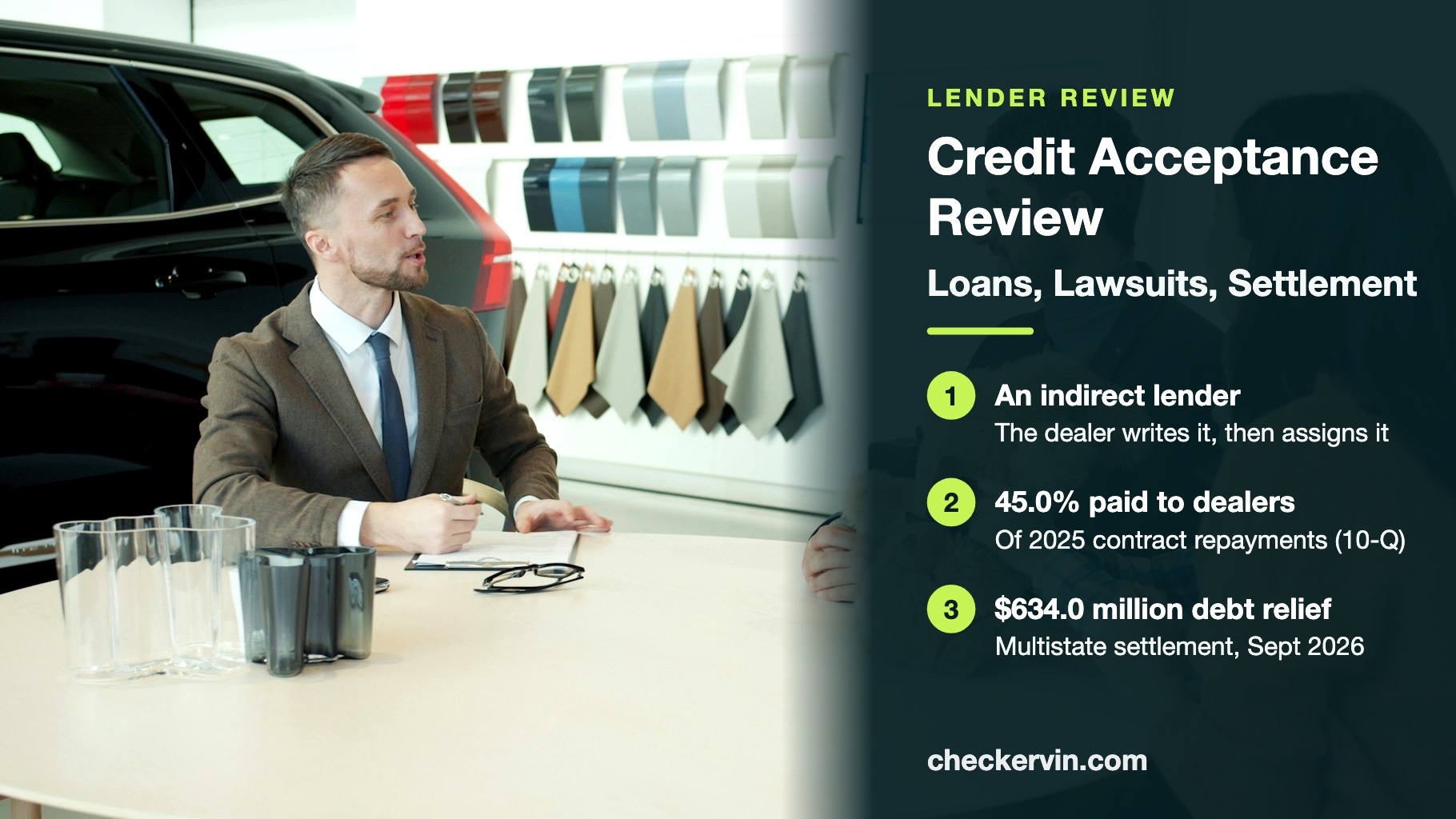
Indirect
How it lends
Dealer writes the loan, then assigns it
79.5%
2025 loans: FICO under 650 or none
Form 10-K for 2025
45.0%
Paid to dealers, 2025 loans
As a share of contract repayments (10-Q)
$634.0 million
Estimated debt relief, 2026
Settlement of September 17, 2026
Credit Acceptance review: the short version
Credit Acceptance is a large, long-established lender that does one thing: it finances cars for people other lenders turn down, through dealers. Its own annual report says 79.5% of the loans assigned to it in 2025 went to consumers with a FICO score below 650 or no score at all. If that describes you, it may be one of the few approvals a dealer can get you, and that is the reason it exists.
The other half of the picture is on the public record. New York and the CFPB sued it in 2023 over loans they alleged were built to fail, and in September 2026 it resolved that case and a separate investigation by dozens of states with a settlement worth hundreds of millions of dollars, mostly as debt forgiveness, without admitting wrongdoing. The settlement also imposed new rules on how its loans are sold. None of that tells you whether one specific offer is good. The contract does, and so does the car, and both can be checked before you sign.
What Credit Acceptance is, and why the dealer's name is on your contract
The company describes itself in its 10-K, filed February 13, 2026, as an indirect lender “from a legal perspective, meaning the Consumer Loan is originated by the Dealer and assigned to us.” It was founded in 1972 to collect installment contracts written by dealerships owned by its founder, Donald Foss, and began offering the service to unaffiliated dealers in the 1980s. It is headquartered in Southfield, Michigan, and its stock trades on Nasdaq as CACC.
For you, the practical point is who is on which piece of paper. The filing says the dealer is named on the contract but “generally does not have legal ownership of the Consumer Loan for more than a moment,” that Credit Acceptance, not the dealer, is listed as lienholder on the title, and that you make your payments directly to Credit Acceptance. The contract is written on a form Credit Acceptance provides or approves. Its homepage carries the same disclaimer in plainer words: all financing agreements are originated between the customer and the dealer.
| Role | Who, per the 10-K |
|---|---|
| Sells you the car and signs the contract with you | The dealer |
| Supplies or approves the contract form | Credit Acceptance |
| Decides whether to fund, and how much | Credit Acceptance, "solely" |
| Collects your payments and handles delinquency | Credit Acceptance |
| Lienholder on the title | Credit Acceptance |
Portfolio Program vs Purchase Program: how your dealer gets paid
Credit Acceptance runs two programs, and which one your dealer uses changes the dealer’s stake in how your loan turns out. In 2025, by its 10-K, 74.2% of loans by unit came through the Portfolio Program and 25.8% through the Purchase Program.
Under the Portfolio Program, the dealer receives your down payment and a cash advance from Credit Acceptance at the sale. Your loan joins a pool of 50 or 100 loans from that dealer. As you pay, the money runs through a fixed order, and the dealer gets a further share, called Dealer Holdback, only after the advance on the whole pool has been recovered. The filing notes that the advance plus your down payment typically already gives the dealer a cash profit at the time of sale, so “the Dealer’s risk in the Consumer Loan is limited.”
| Order your payments are applied in | What the 10-K says |
|---|---|
| 1. Collection costs | Reimburses Credit Acceptance for certain costs of collecting |
| 2. Servicing fee | Paid to Credit Acceptance; the 10-K says it generally equals 20% of collections |
| 3. The dealer's advance balance | Repays the cash advance plus related fees and other amounts the dealer owes |
| 4. Dealer Holdback | What is left goes to the dealer, pool by pool, once the advance is recovered |

Under the Purchase Program, the dealer is paid once, at assignment, and Credit Acceptance keeps everything it collects. Access is narrower: typically a dealer that has already assigned at least 50 loans under the Portfolio Program, a franchise dealership, or an independent that meets certain criteria at enrollment.
Two dealer-side details are worth knowing. A dealer may take an individual loan back from Credit Acceptance within 180 days of assignment by repaying the advance or purchase payment, and a dealer that ends its agreement must pay a termination fee of 15% of outstanding loans. Those are rights between the dealer and the lender. Neither gives you, the buyer, a way to cancel your contract.
How Credit Acceptance decides what to fund
The dealer submits your application through Credit Acceptance’s system, called CAPS, or through the aggregator software dealers use to reach several finance companies. The 10-K says the response comes back with the amount Credit Acceptance will pay the dealer and any conditions, and that the dealer can “interact with our proprietary credit scoring system to optimize the structure of each transaction prior to delivery.” In practice that means the down payment, term, car and add-ons can be adjusted on the dealer’s screen until the deal fits.
The amount paid to the dealer comes from a formula built on the cash Credit Acceptance expects to collect from you and its target profit. Its scoring system combines your credit report, your application, the deal structure and the vehicle into a composite score that “corresponds to an expected collection rate.” Each dealer also carries a rating based on how its past loans performed, which is one factor in what it is paid.
The averages in the filing show the scale of a typical deal. For loans assigned in 2025 the 10-K reports:
| 2025 loans, per the 10-K | Average |
|---|---|
| Repayments owed under the contract (principal plus interest) | $25,423 |
| Paid to the dealer at assignment (advance or purchase price) | $11,428 |
| Initial term | 60 months |
| Loans assigned in the year | 337,411 |
Read those two dollar figures with care. The first is everything a borrower agrees to pay over the full term, interest included. The second is the cash the dealer got from Credit Acceptance at the start, before your down payment and before any later holdback. Neither is the price of a car. The point is the shape: the contract total runs far above what changed hands on day one, and the difference is interest, fees and any add-ons.
What the filings say about collection rates
Credit Acceptance publishes how much of each year’s contracts it expects to collect, as a share of what borrowers contractually owed. That figure is unusually useful to a buyer, because it shows how often these loans are not paid as written. The 10-Q for the quarter ended September 30, 2026, filed October 29, 2026, gives these numbers:
| Loans assigned in | Forecast collected, as of Sep 30, 2026 |
|---|---|
| 2025 | 64.9% of contract repayments (initial forecast 67.0%); dealers were paid 45.0% |
| 2022, the weakest year shown | 59.2% (initial forecast 67.5%) |
Put plainly, on its 2025 loans Credit Acceptance expected, as of that date, to collect a little under two-thirds of what borrowers signed up to pay, after paying dealers less than half of it up front. The gap between those two percentages is what the company calls its spread. The remaining third is not money borrowers kept: the forecast reflects defaults, repossessions, early payoffs and settlements across the whole group. It is a portfolio average, so it says nothing about your own odds. It does say that a large share of these contracts do not run their full course as written, which is why the affordability of the payment matters more than the approval.
How big Credit Acceptance is
The 10-K counts 15,745 active dealers in 2025, meaning dealers funded on at least one loan that year, out of a target market of about 60,000 independent and franchised dealers in the United States, with 5,752 new enrollments in the year. In the third quarter of 2026 the 10-Q reports 12,093 active dealers and 110,010loans assigned in the quarter alone. The company’s homepage says its dealer network is over 15,000 nationwide.
Finance charges made up 92.4%of its 2025 revenue. The rest came mainly from reinsuring vehicle service contracts and from profit sharing on add-on products, which matters for the add-on section below. The size is a reason the dealer may suggest Credit Acceptance first: many dealers are already set up with it, and its homepage tells dealers they can approve “up to 100% of your customers.”
Is Credit Acceptance legit?
It is a real, regulated, publicly traded lender, not a scam in the sense people usually mean when they search that question. A loan assigned to it is an enforceable contract, and if you stop paying, the company will collect, repossess and, where the law allows, pursue a deficiency balance, all of which its 10-K describes.
“Legit” is still a low bar. The more useful question is what officials have said about how its loans were made and sold, and that record is long. The filing’s own legal proceedings note lists a federal civil investigative demand, subpoenas from New York, Maryland, New Jersey and California, a multistate investigation and a pending class action under the Telephone Consumer Protection Act over calls to cell phones. The sections below set out the matters that reached a lawsuit or a settlement, in the officials’ words.
The 2023 CFPB and New York lawsuit, as filed
On January 4, 2023, the New York Attorney General and the CFPB jointly sued Credit Acceptance in the U.S. District Court for the Southern District of New York (docket 1:23-cv-00038). Everything in the table below is what the plaintiffs alleged, as described in the New York Attorney General’s announcement. None of it was proved in court.
| Allegation (NY AG release, January 2023) | What was claimed |
|---|---|
| Ability to repay | Loans pushed on low-income borrowers without considering whether they could repay |
| Hidden credit costs | Contracts listed an APR of 22.99% or 23.99%; the AG alleged the true average was over 38%, and over 100% in numerous cases |
| Outcomes | Nearly 90% of New York borrowers delinquent at some point; 44% had vehicles repossessed |
| Dealer payments | Projected collections split with dealers so both profited even when borrowers defaulted |
| Add-ons | Dealers allowed to mislead buyers about add-on products, with e-signing that made adding them easier |
| Securities | Loans packaged into securities with statements of legal compliance the AG called false |
The CFPB’s part ended without a ruling. Its enforcement page records that the Bureau moved to withdraw as a plaintiff on April 24, 2025, and the court granted that on April 29, 2025; the page now lists the action as expired, terminated or dismissed. New York kept litigating, and the case ended in the settlement below. Credit Acceptance’s 10-K had said it intended to defend itself vigorously.
The September 2026 multistate settlement
On September 17, 2026, Credit Acceptance entered a consent judgment with New York and separate consent judgments with the attorneys general of 40 states and the District of Columbia, 41 agreements in all, according to its 10-Q. Each needs court approval in its own jurisdiction. As of October 22, 2026, 35 of the 41 had it, and they were scheduled to take effect on November 2, 2026. The company made no admission of wrongdoing or liability.
| Term | Per the 10-Q and the AG releases |
|---|---|
| Payment to the states | $15.5 million to the participating attorneys general |
| Restitution trust | $60.0 million, for consumers who lost their cars within months of taking the loan, per the NY AG |
| Debt relief | An estimated $634.0 million: waivers of outstanding balances for certain customers with open accounts as of December 1, 2025 |
| How the relief splits | $388 million where the car was repossessed, $246 million where it was not (California AG) |
| Affordability off-ramp | For certain risky loans from December 2025, qualifying borrowers get 95% debt relief and no collection lawsuit, for five years (California AG) |
| Disclosures before the loan | Default risk and the vehicle's value; extra disclosures on financing, pricing and add-ons for seven years |
| Price cap | For seven years, a cap of 109% of retail book value on vehicle prices for certain consumers (California AG) |
| Dealer pricing | Dealers may not raise prices because of a buyer's creditworthiness or above the advertised price (California AG) |
| Starter interrupt devices | Policies on their non-use, per the 10-Q |
What this means at a dealership: once the agreements are in force, a Credit Acceptance loan should come with disclosures about the car’s value and the loan’s risk before you sign, and you should get a separate alert after the sale about any service contract or GAP you bought, with an easier way to cancel. California’s release names those as an “anti-packing” process. If you do not see them, ask the dealer why, and keep copies of whatever you are given.
Earlier state actions: Massachusetts, California and others
The 2026 settlement was not the first. Massachusetts sued Credit Acceptance in Suffolk County Superior Court on August 28, 2020. The company’s Form 8-K of September 1, 2021 reports a settlement in which it paid $27.2 millioninto an independent trust to provide relief for eligible Massachusetts consumers and cover the attorney general’s costs, again without admitting liability. We could not read the Massachusetts Attorney General’s own release, because mass.gov refused our request, so we report only what the company filed.
- California: a 2021 subpoena from the state attorney general about GAP products, administration and refunds. The 10-K says the office confirmed on May 8, 2025 that the matter was closed
- Maryland and New Jersey: subpoenas from 2016 and 2020 about repossession, origination and collection, which grew into the multistate investigation resolved in 2026. The 10-K says Kansas, Texas and Iowa withdrew from that investigation
- Telephone Consumer Protection Act: a putative class action filed in April 2025 in the Eastern District of Michigan over calls to cell phones. In February 2026 the court granted in part and denied in part the company's motion to dismiss; it was pending at the 10-Q
You may also see reports of a Mississippi settlement. We found no page on the Mississippi Attorney General’s site to confirm its date, amount or terms, so we leave it out.
How to read a Credit Acceptance contract at the dealer
Truth in Lending disclosures are the same on any car loan, and our DriveTime review sets out what each of the standard boxes means. With an indirect lender like this one, three parts of the paperwork deserve more attention than usual.
- 1Ask for the itemization of the amount financedRegulation Z, 12 CFR 1026.18(c), requires a written breakdown of the amount financed, including amounts paid to other people on your behalf, who must be named. A lender may skip it only if the form tells you of your right to it and you do not ask. Ask. It is where a service contract, GAP or other add-on shows up as a line with a payee.
- 2Set the total of payments beside the cash priceThe total of payments is what you will have paid by the end of the term. On these loans the filings show it can run far above the cash that changed hands at the sale, so compare it with the car's price and with any outside offer, not just the monthly figure.
- 3Check the lienholder and where payments goThe contract should name the dealer as seller, show assignment to Credit Acceptance, and list Credit Acceptance as lienholder. Write down how to reach the servicer before you leave.
- 4Watch for changes after the screen workThe 10-K says dealers can restructure a deal on Credit Acceptance's system before delivery. If the down payment, term or add-ons change between what you discussed and what you sign, stop and ask why.
If the dealer pulled your credit before you agreed to anything, our guide on what to do when a dealer ran your credit covers what that inquiry is and the notices you are owed.
Service contracts and GAP on a Credit Acceptance loan
The 10-K spells out how add-ons work on its loans. For both vehicle service contracts and GAP, the retail price is added to the principal of your loan, so you pay interest on it for the whole term. The third-party provider receives a wholesale cost, Credit Acceptance keeps an administrative fee, and “the difference between the wholesale cost and the retail price to the consumer is paid to the Dealer as a commission.” A Credit Acceptance subsidiary, VSC Re, reinsures service contracts sold through one provider, and the company receives profit sharing on some products.
That is ordinary in auto finance and is not an accusation. It does mean every party on the dealer’s side of the desk earns something from an add-on you accept, which is exactly the area the 2023 complaint and the 2026 settlement targeted. Treat each add-on as a separate purchase: ask its price on its own, whether it is optional, and how to cancel it. Refund rules when a loan ends early, and the CFPB’s findings on them, are covered in our buy here pay here guide.
Get a second offer before you sign
A Credit Acceptance approval at the dealer is one offer, arranged by the dealer. You can look for another one first. The CFPB’s guidance on dealer-arranged versus bank financing says you can apply directly to a bank or credit union, that a preapproval gives you a rate, a term and a maximum amount to compare with the dealer’s offer, and that rate shopping inside a short window, 14 to 45 days, counts as a single inquiry.
The CFPB’s description of dealer-arranged loans centers on a dealer adding interest above a lender’s buy rate. Credit Acceptance’s filings describe a different payment: an advance, holdback, or a one-time purchase price set by its own formula. Either way the dealer is paid for placing the loan, so an outside quote is the only neutral benchmark you will have.
Credit Acceptance also offers pre-qualification on its own website, which shows a monthly payment and matches you with up to three dealers in its network. The homepage does not say whether that step uses a soft or a hard credit inquiry, so ask before you enter your details. If a credit union says no, you have lost little; if it says yes, you have a number to put on the desk.
If you already have a Credit Acceptance loan
Payments, text alerts and account access run through the company’s Customer Portal, according to its homepage. Its 10-K says it reports to the three national credit reporting agencies, so on-time payments are recorded, and so are missed ones. Our AutoNation review covers how a franchised dealer group handles financing differently, if you are weighing where to buy next time.
If you are falling behind, the 10-K describes what follows: contact by phone, email, text and mail, then repossession under policy-based criteria. After repossession you can redeem the car by paying off the balance or, where appropriate or required by law, reinstate the loan by paying the past-due amount. Otherwise the car is sold at a wholesale auction, and if the sale does not cover the balance the company may offer to settle the shortfall for less or pursue it, including through collection attorneys where the law permits.
- Ask early about options; the 2026 settlement adds affordability protections for certain newer loans
- Keep every add-on contract: a canceled service contract or GAP can mean a refund that reduces what you owe
- Use the CFPB complaint system or your state attorney general's consumer office if a dispute goes nowhere
- If you hear about the settlement, check eligibility only through official attorney general channels
The loan is for one car: check its VIN before you sign
Everything above concerns the money. The loan, though, is secured by one specific vehicle, and Credit Acceptance’s funding decision is a judgment about the loan, not an inspection of the car on your behalf. If the car turns out to have a branded title, open recalls or a mechanical problem, you still owe the full contract. The checks below are yours to run.
- 1Decode the VIN against the paperworkThe year, model, engine and trim on the contract should match the car. A mismatch on a financed car is a reason to stop before anything is signed.
- 2Look up open safety recallsNHTSA's lookup shows open recalls by VIN. If one is open, ask for proof the repair was done before you sign.
- 3Pull the federal title recordThe Department of Justice lists twelve businesses approved to sell NMVTIS reports to consumers, read November 26, 2026. Salvage, junk, flood and odometer brands reported by states appear there.
- 4Have a mechanic look at itA pre-purchase inspection by a shop you choose. On a high-interest loan, a repair bill in the first months is the fastest route to falling behind.
Decode the VIN and check recalls free
Decoded from official manufacturer and NHTSA records
For the warning signs that should end a deal before financing is even discussed, see used car red flags, and our vehicle lien check guide explains how to make sure no earlier lien survives the sale.
Where CheckerVIN fits, and where it stops
We do not lend money or sell cars. We cover the first checks on the car, free:
- Factory build and specifications decoded from the VIN
- Factory warranty terms
- Open NHTSA safety recalls
- Photos filed against the VIN
- Market and listing prices
Run the free decode and recall check on the car before the finance office, and spend money on a title report and an inspection only for the car you intend to finance.
Where this information comes from
- Credit Acceptance Corp. — Form 10-K for 2025 (SEC EDGAR)Filed February 13, 2026: programs, holdback, funding formula, averages, add-ons, servicing, legal proceedings
- Credit Acceptance Corp. — Form 10-Q, quarter ended September 30, 2026 (SEC EDGAR)Filed October 29, 2026: collection and advance rates, active dealers, settlement terms and court approvals
- Credit Acceptance Corp. — Form 8-K, September 1, 2021 (SEC EDGAR)The Massachusetts settlement agreement
- New York Attorney General — Attorney General James and CFPB sue auto lender (January 4, 2023)The allegations quoted on this page
- New York Attorney General — settlement with Credit Acceptance Corporation (September 17, 2026)Restitution, debt relief and the CFPB's 2025 withdrawal
- California Attorney General — nationwide settlement with subprime auto lender (September 17, 2026)Off-ramp, disclosures, price cap, anti-packing process, notification of eligible consumers
- CFPB — enforcement action: Credit Acceptance CorporationDocket 1:23-cv-00038; Bureau withdrawn as plaintiff April 2025
- Ask CFPB — dealer-arranged financing versus bank or credit union financingPreapproval and the 14 to 45 day rate-shopping window
- 12 CFR 1026.18 — Truth in Lending content of disclosures (eCFR)Itemization of the amount financed, § 1026.18(c); total of payments, § 1026.18(h)
- Credit Acceptance homepageRead November 26, 2026: pre-qualification, dealer network, Customer Portal
- NMVTIS — approved data providers (DOJ / BJA)The consumer-tier list, read November 26, 2026
- NHTSA recall lookupOpen safety recalls by VIN
- How we made this pageWritten by the CarCheckerVIN editorial team with AI assistance from Credit Acceptance's SEC filings, New York and California attorney general releases, CFPB records and eCFR; facts checked November 2026.
Keep reading
Frequently asked questions
Is Credit Acceptance a legit company?
Yes. Credit Acceptance Corporation is a Nasdaq-listed auto finance company (ticker CACC) headquartered in Southfield, Michigan, founded in 1972, that files annual reports with the SEC. It also has a long regulatory record, including a $27.2 million Massachusetts settlement in 2021 and a September 17, 2026 settlement with 40 states and the District of Columbia, both without any admission of wrongdoing. Being a real lender and being the right lender for you are separate questions.
Why does my contract say the dealer, not Credit Acceptance?
Because Credit Acceptance is an indirect lender. Its 10-K says the dealer originates the retail installment contract and assigns it to Credit Acceptance, which then services it, collects the payments and is listed as lienholder on the title. Your payments go to Credit Acceptance, not to the dealer.
What happened in the Credit Acceptance lawsuit?
The New York Attorney General and the CFPB sued on January 4, 2023, alleging unaffordable loans, hidden credit costs and add-on abuses. The CFPB withdrew as a plaintiff in April 2025. On September 17, 2026 Credit Acceptance settled with New York and a multistate group of attorneys general, paying $15.5 million to the states and $60.0 million into a restitution trust and providing an estimated $634.0 million in debt relief, with no admission of wrongdoing.
Am I eligible for the Credit Acceptance settlement?
Only certain borrowers are. California's release says the debt relief covers certain risky loans made from November 1, 2015 to November 30, 2025, and that eligible consumers have already been identified and will be notified without having to apply. If you think you qualify and hear nothing, contact your state attorney general's consumer office rather than any third party offering to file for you.
What interest rate does Credit Acceptance charge?
We could not verify a current rate from any filing or government source, so we do not print one. The New York Attorney General's 2023 complaint alleged that contracts stating an APR of 22.99% or 23.99% carried an effective rate over 38% on average once hidden charges were counted. That is an allegation, not a finding. The APR on your own disclosure is the number to compare.
Can I refinance a Credit Acceptance loan?
Refinancing means a new lender pays this loan off. The filings we read do not describe prepayment terms, so check your own contract for them. Credit Acceptance's 10-K says it reports to the three national credit bureaus, which is how a record of on-time payments can help you qualify elsewhere later. Ask a bank or credit union for a quote, compare the payoff figure with the new APR and term, and check whether any add-on you bought refunds on early payoff.
Whoever funds the loan, check the car's VIN yourself
Decode any VIN free for the factory build, specifications and open safety recalls. Full vehicle history reports are launching soon.
Run a free VIN check