The short answer
- What is a buy here pay here dealer?
- A used-car dealer that finances the cars it sells and services the loan itself, usually for buyers with thin or damaged credit.
- What did the CFPB find?
- In loans from 2014 through 2016, average subprime rates were approximately 10 percent at banks and 15 percent to 20 percent at finance companies and buy-here-pay-here dealers (CFPB, September 2021).
- What should I check first?
- The VIN, the Buyers Guide box (As Is or warranty), whether a GPS or starter interrupt device is fitted, and whether on-time payments will be reported.
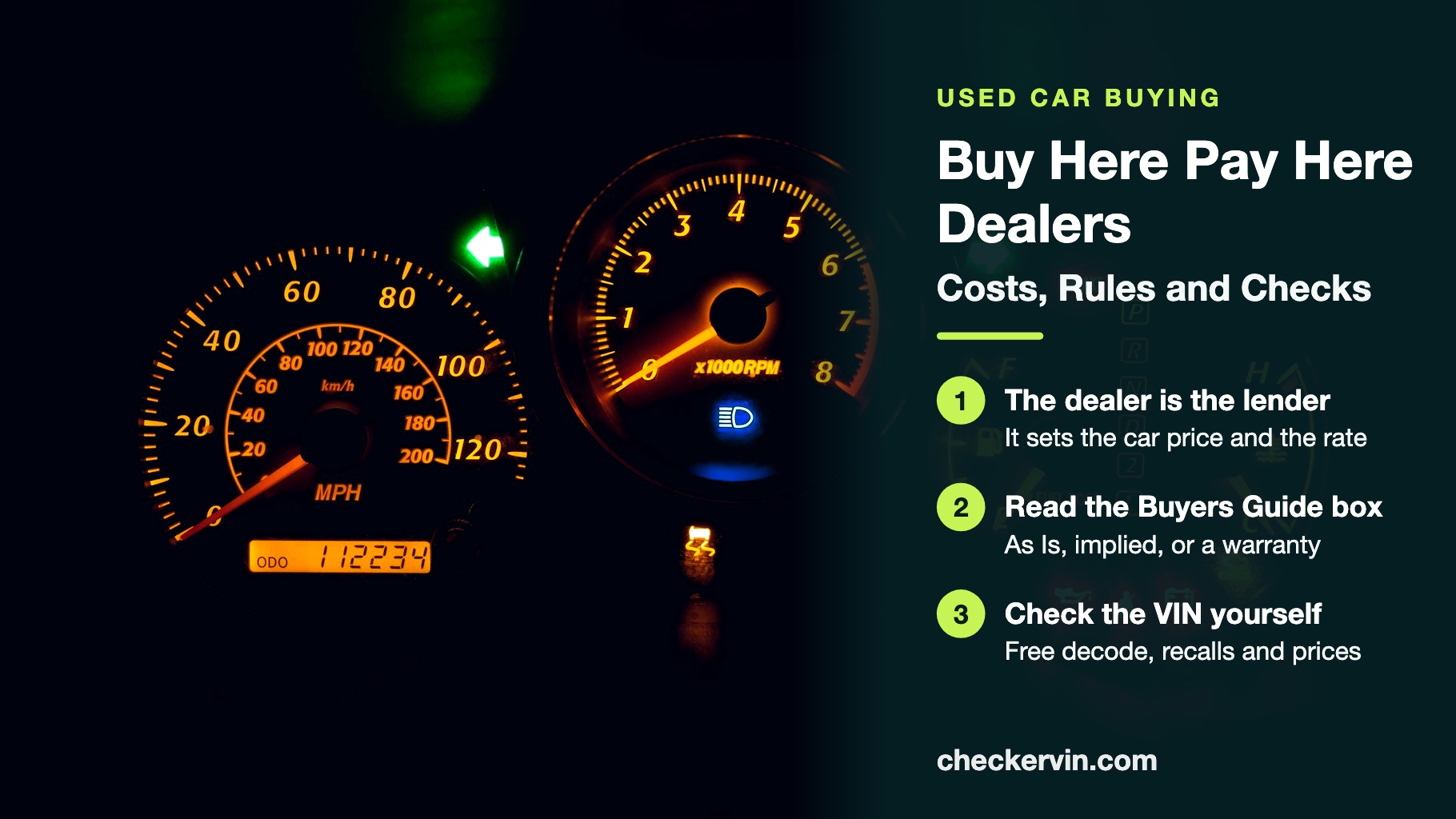
Seller = lender
The model
The dealer writes and services the loan
15 percent to 20 percent
Average subprime rate, finance cos. and BHPH
CFPB, loans from 2014 through 2016
As Is?
Read the Buyers Guide box
16 CFR 455.2(b)
48 hours
Shutdown warning in California
Civil Code 2983.37 (2012)
The short answer
Buy here pay here is a way to get a car when banks and credit unions say no. The trade-off is that one business sets the price of the car, the interest rate, the payment schedule and the add-ons, and that same business repossesses the car if payments stop. Federal research has found higher average rates and much higher default rates at these lenders than at banks, and regulators have acted against dealers and servicers in this market over collections, credit reporting and remote-disabling devices.
None of that means every buy here pay here dealer is a bad deal. It means the contract and the car both need more checking than they would at a franchise dealer with a bank preapproval in your pocket. The checks are cheap, and most of them are free.
How buy here pay here financing works
Most car loans are arranged by the dealer and funded by someone else: a bank, a credit union, a carmaker’s finance arm or a finance company. The CFPB’s 2021 research on subprime auto loans describes buy-here-pay-here dealerships as the one lender type that provides loans themselves for the vehicles they sell. They typically originate direct loans for their own cars and typically do not arrange loans from other lenders. In other words, there is no second lender being shopped on your behalf.
California wrote the distinction into law in 2012. Its Vehicle Code §241 defines a buy-here-pay-here dealer as one that assigns less than 90 percent of its conditional sale and lease contracts to unaffiliated finance or leasing companies within 45 days. That is a useful way to think about any dealer, in any state: if the dealer keeps your contract, it is your lender for the life of the loan.
| At a buy here pay here dealer | What it means for you |
|---|---|
| The dealer sets the car price and the loan terms | A low rate can be offset by a high price, so compare the total of payments, not the rate alone |
| The dealer services the loan | Payment methods, late fees and collection calls are the dealer's or its affiliate's policies |
| The dealer holds the lien | The dealer, or its finance affiliate, is the lienholder on your title until payoff |
| The dealer repossesses after default | A repossessed car can go back on the same lot and be sold again |
The first row comes straight from the CFPB. Its researchers noted that buy-here-pay-here dealerships, unlike other lender types, control both the price of the vehicle and the interest rate, and may in many cases charge a below-market rate in exchange for an above-market vehicle price. That is why the market price of the specific car is worth knowing before you sit down. The Truth in Lending disclosures a dealer-lender must give you are set out on our DriveTime review, which covers one of the largest businesses in this market.
How to tell you are at a buy here pay here dealer
Not every lot uses the name on its sign. The CFPB notes that dealers advertising “no credit check,” “buy here, pay here,” or “military E-1 and up” tend to market to people with no credit history or poor credit. Other signs show up in the paperwork rather than the advertising:
- The seller named on the purchase contract is also the creditor named on the retail installment contract, or a company with a closely related name
- Payments go to the dealer or its affiliate, not to a bank or finance company you have heard of
- The dealer, or its affiliate, will be listed as lienholder on the title
- A GPS tracker or starter interrupt device is mentioned in the paperwork or already fitted to the car
None of these is a problem on its own. They tell you which rules and risks on this page apply, and that the business across the desk will be your lender for the whole loan.
What CFPB research found on rates and defaults
The most detailed federal look at this market is the CFPB’s Data Point No. 2021-10, “Subprime Auto Loan Outcomes by Lender Type,” published in September 2021. It studied subprime loans originated from 2014 through 2016 and compared banks, credit unions, captive lenders, finance companies and buy-here-pay-here dealerships. These are the figures it reported. They describe loans from those years, not the rate you will be offered today.
| Finding (CFPB, September 2021) | What the report says |
|---|---|
| Average subprime interest rate | Banks approximately 10 percent; finance companies and buy-here-pay-here dealerships 15 percent to 20 percent |
| At least 60 days delinquent within three years | Bank borrowers approximately 15 percent; finance company and buy-here-pay-here borrowers between 25 percent and 40 percent |
| Same estimated default risk, different rate | A shallow-subprime borrower: 13 percent at a small buy-here-pay-here lender vs nine percent at a bank |
| What that gap costs | Roughly $894 over the life of a loan with the median term and amount for small buy-here-pay-here borrowers |
| New cars in the mix | Roughly 0.1 percent of the subprime loans studied from small buy-here-pay-here lenders were for new cars |
The CFPB was careful about what this proves. It said the report examines empirical correlations only and that none of its conclusions should be read as causal. It also found that differences in default risk alone are unlikely to fully explain the differences in rates, and listed other possible reasons, from down payments and vehicle values to lender practices and incentives. The useful takeaway for a buyer is narrower: two people with the same risk can pay different rates depending on where they borrow, so an outside offer is worth getting even if you expect to be turned down.
Will a buy here pay here loan build your credit?
Many lots advertise that they help you rebuild credit. The CFPB’s consumer guidance answers that directly: buy-here-pay-here dealers often report only negative information, like late payments, and not positive payment information. So months of on-time payments may do nothing for your score, while one late payment can hurt it. The same page suggests asking the dealer to put in writing that it will report your on-time payments.
The 2021 Data Point is consistent with that. Banks, credit unions and captive lenders furnished data at very high rates, while small finance companies and small buy-here-pay-here lenders furnished at far lower rates. If rebuilding credit is part of why you are considering a lot, make reporting a written condition of the deal, and check your credit reports a few months in. If the dealer pulled your credit before you agreed to anything, our guide to what happens when a dealer runs your credit explains what notices you are owed.
Why the car matters more than usual on a buy here pay here lot
A buy here pay here loan is secured by the car, and you keep paying whether the car runs or not. That makes the car’s condition a credit question as well as a mechanical one. Two official sources point the same way about what tends to be on these lots.
- The CFPB found that bank and credit union subprime loans are for more valuable vehicles than finance-company and buy-here-pay-here loans, that small buy-here-pay-here borrowers buy less valuable cars still, and that roughly 0.1 percent of the subprime loans it studied from small buy-here-pay-here lenders were for new cars
- California's Legislature, in its 2012 findings, said these dealers stock older, high-mileage vehicles, put the typical inventory at 90,000 to 130,000 miles, and said consumers had complained of mechanical problems emerging within days or weeks of purchase
- The FTC reminds buyers that federal law does not give you three days to cancel a dealer sale and return the car, so a problem found after signing is usually yours to deal with
The Legislature’s figures are its own findings, made to justify a law, and describe California in 2012. They are not a national statistic. Still, the logic holds anywhere: an older car with an unknown past, financed at a high rate with no return window, is exactly the purchase where a title brand, an open recall or a mismatched engine costs the most to discover late. Our guide to whether you can return a used car explains why the three-day idea rarely applies to a dealer sale.
Decode the VIN and check recalls free
Decoded from official manufacturer and NHTSA records
As Is, implied warranties only, or a dealer warranty
The FTC’s Used Car Rule, 16 CFR Part 455, applies to any business that has sold or offered five or more used vehicles in the previous twelve months, so it covers buy here pay here lots like any other dealer. Before a car is offered for sale, the dealer must fill in and display a Buyers Guide on it. The warranty section of that form is the part to read first, because it tells you who pays when something breaks.
| Box marked on the Buyers Guide | What it means under 16 CFR 455.2(b) |
|---|---|
| As Is — No Dealer Warranty | The car is offered without any implied warranty. Repairs after the sale are yours |
| Implied Warranties Only | No dealer promise to fix things, but implied warranties under your state's law may give you some rights over serious problems that were not apparent at the sale |
| Full or Limited Warranty | The dealer must list the systems covered by name, the duration, and the share of repair costs it pays |
Three details in the rule matter at a buy here pay here lot. First, if state law limits or prohibits As Is sales, state law overrides the federal rule, and the dealer must use the Implied Warranties Only wording instead. Second, a dealer that names covered systems cannot use shorthand like “drive train” or “power train”. Third, under §455.3 you can negotiate warranty coverage, but the final terms must be written into the contract of sale and summarized on the copy of the Buyers Guide you take home. If the salesperson promises a repair that the form does not show, get it added before you sign.
The FTC does not publish a list of which states restrict As Is sales. Its consumer guidance tells buyers to contact their state attorney general to find out what disclosures are required for As Is sales in their state.
California: a state law written for buy here pay here dealers
California is the clearest example of a state regulating this model directly. Assembly Bill 1447 was approved on September 29, 2012 as Chapter 740, Statutes of 2012. It added Civil Code §1795.51, which bars a buy-here-pay-here dealer from selling or leasing a used car at retail without a written warranty lasting at least 30 days from delivery or 1,000 miles, whichever comes first. The dealer must pay 100 percent of parts and labor for covered repairs, and any agreement that waives these rights is void. If the dealer fails to give the warranty, the law treats it as given anyway.
The warranty must cover at least these fourteengroups of parts, and the Buyers Guide on a buy-here-pay-here dealer’s car must list them:
- Engine, including all internally lubricated parts
- Transmission and transaxle
- Front and rear wheel drive components
- Engine cooling system
- Alternator, generator, starter and ignition system (not the battery)
- Braking system
- Front and rear suspension systems
- Steering system and components
- Seatbelts
- Inflatable restraint systems as originally manufactured
- Catalytic converter and emissions parts needed to pass a California emissions test
- Heater
- Seals and gaskets on the parts above
- Electrical, electronic and computer components, where they substantially affect the parts above
The dealer can choose to cancel the sale and refund you instead of repairing the car, minus a reasonable amount for damage after the sale, and it may not treat that return as a repossession. A failure reported inside the warranty period must be fixed or refunded even if the period has since run out.
GPS trackers and starter interrupt devices
Some buy here pay here contracts come with a device fitted to the car: a GPS tracker that reports the car’s location, a starter interrupt device that can stop it from starting, or both. The CFPB’s 2021 Data Point noted that finance and buy-here-pay-here lenders often adopt these technologies because they lower costs when borrowers default. Its supervisors describe the devices as ones that, when activated by a servicer, either beep or prevent the vehicle from starting.
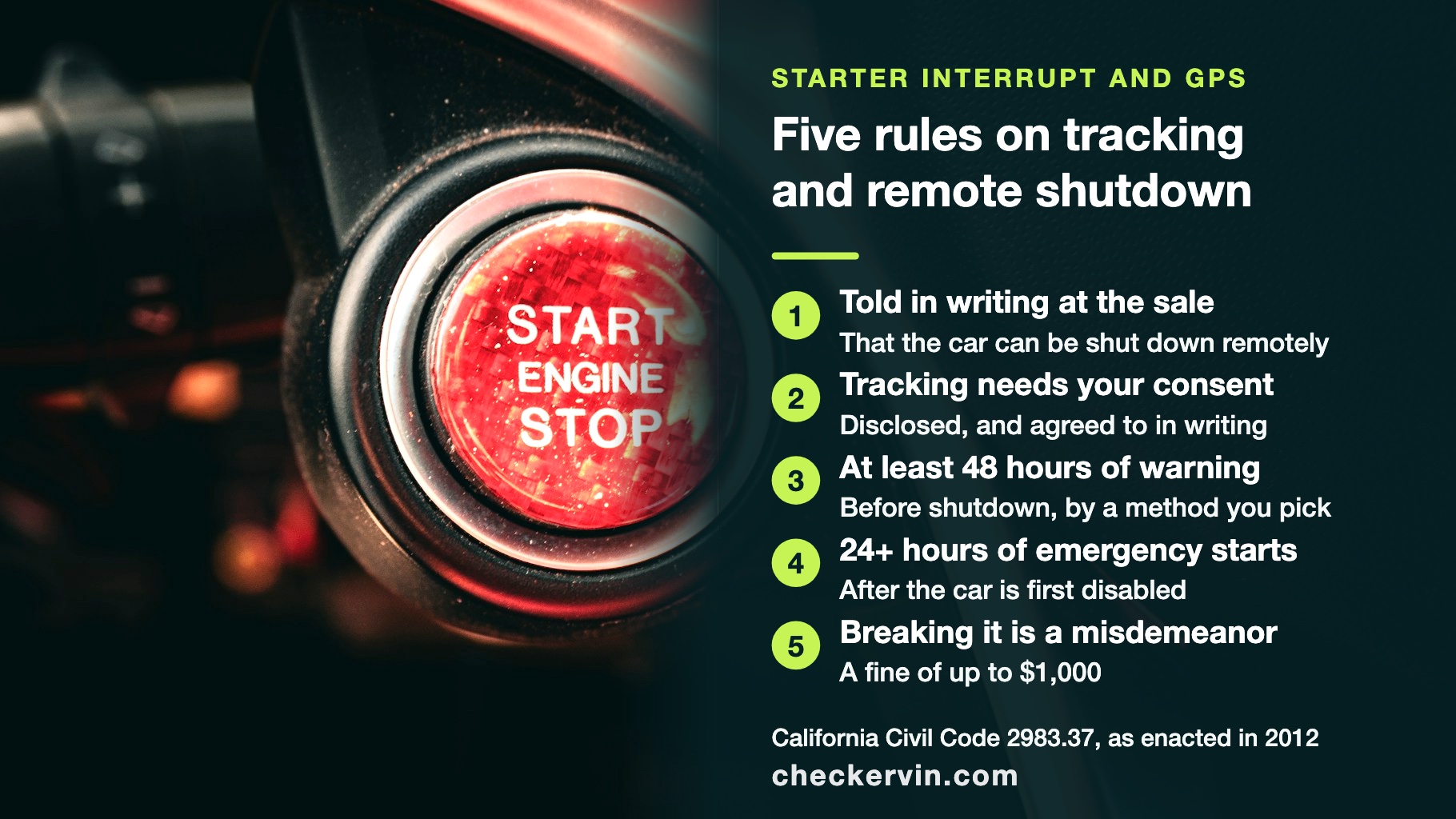
California’s 2012 law, Civil Code §2983.37, sets conditions on both. A buy-here-pay-here dealer may track the car only if you are told about the technology and give written consent, and only to keep it working, repossess the car, locate it to service the loan, or for an optional service you can cancel. It may disable the car only if it told you in writing at the sale, the disclosure promises a warning at least 48 hours before a remote shutdown and lets you choose how that warning reaches you, and you can start a disabled car in an emergency for at least 24 hours. The same section bars requiring in-person payments, other than the down payment. A violation is a misdemeanor with a fine of up to $1,000.
Regulators have found these devices misused. In its Fall 2022 Supervisory Highlights, the CFPB reported that servicers had activated them in cars of borrowers who were not past due, because of errors in their own systems. Some cars would not start; in others the device sounded late-payment beeps every time the car was started, sometimes for days. The CFPB treated both as unfair practices.
The CFPB’s lawsuit against USASF Servicing, filed August 2, 2023, shows the scale this can reach. USASF serviced loans made by an affiliate the CFPB described as a buy-here-pay-here dealer and lender with 31 dealerships in the Southeast. The CFPB alleged it incorrectly disabled vehicles at least 7,500 times, caused warning tones in vehicles over 71,000 times, and remotely disabled vehicles at least 1,500 times after promising consumers it would not. USASF filed for bankruptcy and did not respond; on November 26, 2024 the court entered a final judgment awarding a $10,000,000 civil money penalty and $32,627,689 in consumer relief.
Add-ons, GAP and refunds when the loan ends early
Service contracts and GAP coverage are often sold at the same desk and folded into the loan. The CFPB’s October 2024 Supervisory Highlights special edition on auto finance explains how that works: the price is usually charged as a lump sum at the start and included in the amount financed, so you pay interest on it for the life of the loan. GAP is a credit product meant to help pay off the loan if the car is totaled or stolen; a service contract is a vehicle product that pays for certain repairs.
When a loan ends early, through payoff or default, the account is generally eligible for a pro rata refund of the unused portion. On an early payoff the full refund should go to the borrower; after a default it should first reduce any deficiency balance. The CFPB found subprime auto-finance companies collecting for add-ons consumers did not agree to buy, and servicers failing to make sure refunds were paid. If you buy an add-on, keep its contract and note its cancellation terms. If your loan ends early, ask for the refund in writing.
Which federal rules apply, and the one that no longer does
Searches for buy here pay here often surface the FTC’s CARS Rule, which would have set new federal limits on dealer add-ons and advertising. It is not in force. On January 27, 2025, the Fifth Circuit (No. 24-60013) vacated it, holding that the FTC failed to issue an advance notice of proposed rulemaking and that the error was not harmless. The FTC then withdrew the rule in a final rule published on February 12, 2026 (Federal Register document 2026-02866).
| Rule | Status for a buy here pay here sale, November 2026 |
|---|---|
| FTC Used Car Rule (16 CFR Part 455) | In force: the Buyers Guide and its warranty disclosure |
| Truth in Lending Act (Regulation Z) | In force: the dealer-lender must disclose the APR, finance charge and total of payments |
| FTC CARS Rule | Vacated January 27, 2025; withdrawn February 12, 2026 |
| State law | Varies: As Is limits, warranty rules, device rules and licensing differ by state |
The CFPB’s first action against a buy-here-pay-here dealer came in 2014, against DriveTime, over collection calls and credit reporting. Our DriveTime review quotes that order in full detail rather than repeating it here.
What to check on the VIN before you talk payments
A buy here pay here salesperson will often start with the payment you can afford. Start with the car instead. Ask for the VIN before any credit application, and run these checks while you still have nothing signed. Each one is tied to a risk this page has already described.
- Decode the VIN and compare the year, model, engine and trim with the listing, the Buyers Guide and the contract. A mismatch is a reason to stop before any credit is discussed
- Check open safety recalls by VIN. An open recall is worth knowing about, and worth asking the dealer about, before you take on a loan secured by the car
- Compare the asking price with market and listing prices for the same car. The CFPB notes these dealers can trade a lower rate for a higher price, so the price is half of the cost
- Look at photos filed against the VIN. Earlier listing or auction photos can show damage, a different color or a different trim
- Get the federal title record from a provider on the Department of Justice NMVTIS list (twelve consumer-tier names, read November 26, 2026) for salvage, junk, flood and odometer brands
- Have a mechanic you choose inspect the car before you sign. The FTC says a history report is not a substitute for an independent inspection
If any of these turns something up, you have learned it at the cheapest possible moment. For the signs worth walking away over, see used car red flags; for cars that came back to a lot after a repossession, see buying a repossessed car.
What CheckerVIN shows free today
We do not sell cars or loans and have no relationship with any dealer. What we do is the free part of the checklist above. Enter a VIN and you get:
- Factory build and specifications decoded from the VIN
- Factory warranty terms
- Open NHTSA safety recalls
- Photos filed against the VIN
- Market and listing prices
On a buy here pay here lot, two items on that list do extra work. Market and listing prices let you test the sticker price the dealer controls, and the factory warranty terms tell you whether any of the carmaker’s coverage could still apply, which matters when the Buyers Guide says As Is.
Questions to ask a buy here pay here dealer before you sign
Bring these in writing. A dealer that answers them clearly is easier to deal with for the next few years; one that will not answer them has told you something too.
- Which box is marked on the Buyers Guide, and will any promised repair be written into the contract?
- Do you report on-time payments to all three credit bureaus? Will you put that in writing?
- Is a GPS tracker or starter interrupt device fitted? How and when will I be warned before it is used?
- What is the total of payments over the full term, not just the monthly figure?
- Which add-ons are in the price, what does each cost, and how do I cancel for a refund?
- Who services the loan, how can I pay, and what are the late fees?
- Can my mechanic inspect the car before I sign, on or off the lot?
The CFPB’s guidance lists three ways to finance a car: directly with a bank or credit union, through dealer-arranged financing, or through a buy here pay here dealer that lends in-house. If you can get even one outside quote, bring it. Our guide to buying a used car sets out the full order of steps. If something goes wrong with a lender, you can file a complaint with the CFPB.
Where this information comes from
- CFPB — Data Point No. 2021-10: Subprime Auto Loan Outcomes by Lender Type (PDF)September 2021; rates, delinquency, furnishing, price-vs-rate and device findings for loans from 2014 through 2016
- Ask CFPB — What is a "no credit check" or "buy here, pay here" auto loan or dealership?Definition, higher rates, negative-only credit reporting; last reviewed January 30, 2024
- CFPB — Supervisory Highlights, Issue 28 (Fall 2022) (PDF)Section 2.1.4: starter interrupt devices activated on borrowers who were not past due
- CFPB — Supervisory Highlights, Special Edition Auto Finance, Issue 35 (PDF)October 2024; add-on products, GAP and refunds on early termination
- CFPB — enforcement action: USASF Servicing, LLCN.D. Ga. 1:23-cv-03433; final judgment November 26, 2024
- CFPB — CFPB sues USASF Servicing for illegally disabling vehiclesPress release, August 2, 2023; the buy-here-pay-here affiliate and the device allegations
- 16 CFR Part 455 — Used Motor Vehicle Trade Regulation Rule (eCFR)Dealer definition, the Buyers Guide warranty boxes, the state-law override and final terms in the contract
- 12 CFR 1026.18 — Truth in Lending content of disclosures (eCFR)Finance charge, annual percentage rate and total of payments on a closed-end car loan
- FTC — Buying a Used Car From a DealerNo federal three-day cancellation right; As Is rules by state; inspection advice
- U.S. Court of Appeals, Fifth Circuit — NADA v. FTC, No. 24-60013 (PDF)Filed January 27, 2025; vacates the CARS Rule
- Federal Register — Withdrawal of the CARS Rule (doc. 2026-02866)Published February 12, 2026
- California AB 1447 (2012), chaptered textChapter 740, Statutes of 2012: Civil Code 1795.51 and 2983.37, Vehicle Code 241, and the Legislature's findings
- NMVTIS — approved data providers (DOJ / BJA)The consumer-tier list, read November 26, 2026
- NHTSA recall lookupOpen safety recalls by VIN
- How we made this pageWritten by the CarCheckerVIN editorial team with AI assistance from CFPB research and supervisory reports, FTC and eCFR rules, court and Federal Register records, California statutes and the DOJ NMVTIS list; facts checked November 2026.
Keep reading
Frequently asked questions
What does buy here pay here mean?
It means the dealer that sells you the car also lends you the money and collects the payments, instead of arranging a loan with a bank or finance company. The CFPB describes these dealers as typically financing in-house for borrowers with no credit or poor credit.
Do buy here pay here dealers report to the credit bureaus?
Some do and many do not. The CFPB says these dealers often furnish only negative information, such as late payments, so on-time payments may not help your credit while a late one can hurt it. Its 2021 research also found that small buy-here-pay-here lenders furnish loan data at far lower rates than banks. Ask the dealer to put in writing that it will report your on-time payments.
Are buy here pay here cars sold as is?
Check the Buyers Guide on the window. Under the FTC's Used Car Rule it must show whether the car is sold As Is, with implied warranties only, or with a dealer warranty, and the final terms must match your contract. State law can limit or ban As Is sales, and California requires buy-here-pay-here dealers to give a 30-day or 1,000-mile warranty.
Can a buy here pay here dealer shut off my car?
Some contracts allow a starter interrupt device that can stop the car from starting after a missed payment. Rules depend on your state. California's 2012 law requires written notice at the sale, a warning at least 48 hours before a remote shutdown, and an emergency start for at least 24 hours. The CFPB has found servicers activating these devices on borrowers who were not behind.
Is the FTC CARS Rule in effect?
No. The Fifth Circuit vacated the CARS Rule on January 27, 2025, on procedural grounds, and the FTC formally withdrew it in a final rule published February 12, 2026. The Used Car Rule, the Truth in Lending Act and state law still apply to a buy-here-pay-here sale.
How do I check a car at a buy here pay here lot?
Get the VIN before any credit discussion. Decode it to confirm the year, model and engine, check open recalls, compare the asking price with market prices, get the title record from a provider on the Department of Justice NMVTIS list, and have a mechanic inspect the car before you sign.
Check the car before you sign for the loan
Decode any VIN free for the factory build, factory warranty, open safety recalls, photos and market prices. Full vehicle history reports are launching soon.
Run a free VIN check