The short answer
- Is DriveTime legit?
- It is a real dealer that sells and finances its own cars. It also has a 2014 CFPB consent order and a 2017 North Carolina settlement on the public record.
- Can I return a DriveTime car?
- Its 2013 annual report described a 5 day return policy. Current terms could not be verified, so get them in writing before you sign.
- What should I check myself?
- Decode the VIN, check open recalls, get the title record from a DOJ-listed NMVTIS provider, run a lien check and pay for an independent inspection.

Seller + lender
What DriveTime is
Sells and finances its own cars
5 days
Return policy in its 2013 10-K
Current terms not verifiable
$8,000,000
CFPB civil money penalty, 2014
2014-CFPB-0017
Buyers Guide
Part of your contract
16 CFR 455.3(b)
The short verdict
DriveTime is a legitimate, established business whose model is unusual for one reason: it is both the seller and, through an affiliate, the lender. That is useful if banks have turned you down, because the dealer that wants to sell you the car is also prepared to finance it. It also means the price of the car, the loan terms and the add-on products are negotiated with one counterparty that controls all three.
Its public record cuts both ways. Its filings describe a short return window and a short included warranty, which are real protections many used-car dealers do not offer. The CFPB and the North Carolina Attorney General have both taken action against it, over collections, credit reporting, and how it described its inspections and warranty. Read the contract, compare the loan with an outside offer, and verify the car yourself. None of that is specific to DriveTime, but all of it matters more when one company holds every side of the deal.
What DriveTime is, and who your lender would be
The CFPB’s 2014 consent order describes DriveTime as a “buy-here, pay-here” used car dealer headquartered in Phoenix, Arizona, that sells cars and, through its finance affiliate, provides subprime vehicle financing. The CFPB’s announcement defines the term plainly: the dealer sells the car as well as originates and services the auto loan.
DriveTime’s own 2013 annual report, the last it filed with the SEC, is more specific about the structure. DriveTime Automotive Group and DT Acceptance Corporation were sister companies under common control, the first directing retail sales and operations and the second directing financing and loan servicing. The same report described an integrated model covering vehicle buying, reconditioning, sales, pricing, financing terms and loan servicing, all controlled by the company.
| Role | Who, per the source |
|---|---|
| Sells the car | DriveTime Automotive Group (2013 10-K; CFPB order) |
| Finances and services the loan | DT Acceptance Corporation (2013 10-K; CFPB order) |
| Where payments go today | Bridgecrest — the Make a Payment links on drivetime.com, read November 2026 |
| Who controls it | The Garcia Parties, per Carvana's 2025 10-K, which lists DriveTime as a related party |
Carvana’s annual report for 2025 adds the current picture: DriveTime is a related party of Carvana because Ernest Garcia II, Ernest Garcia III and entities they control own substantially all of DriveTime, and DriveTime administers vehicle service contracts and services finance receivables for Carvana. That is relevant to a buyer in one way. The company that services the loan may be an affiliate rather than a bank you would recognize, so note who it is on the contract and how to reach them.
Is DriveTime legit?
Yes, in the sense people usually mean: it is a real company that sells real cars from its own dealerships and has filed paperwork with federal regulators for years. Its 2013 annual report put its experience at 21 years and its footprint at 20 states. It is not a listing site or a broker standing between you and an unknown seller.
“Legit” is a low bar, though, and the more useful question is what its record shows. Two official actions are on file, set out in the regulatory record below. Neither found that DriveTime was not a real dealer. Both concerned how it treated customers: one over collection calls and credit reporting, the other over how it described its inspection process and warranty coverage. We quote those findings rather than summarize them into a verdict, because the agencies that made them chose their words carefully and you should read theirs, not ours.
What in-house financing means for you as the buyer
With in-house financing, the dealer is not shopping your application to a bank on your behalf. It is deciding whether to lend to you itself. That changes three things.
- There is one lender in the room, so there is no competing offer unless you bring one. A preapproval from a credit union or bank gives you a number to compare against
- The price of the car and the loan are set by the same business, so a low payment can come from a long term rather than a low price. Compare the total, not the monthly figure
- Add-ons such as a service contract, GAP or a GPS device are offered at the same desk. DriveTime's 2013 10-K listed all three as optional, a la carte products
The law that protects you here is the Truth in Lending Act. Regulation Z, at 12 CFR 1026.18, requires a closed-end credit contract like a car loan to state a fixed set of figures using specific terms. A dealer-lender has to give you these just as a bank would:
| Term on the contract | How Regulation Z describes it |
|---|---|
| Amount financed | The amount of credit provided to you or on your behalf — § 1026.18(b) |
| Finance charge | The dollar amount the credit will cost you — § 1026.18(d) |
| Annual percentage rate | The cost of your credit as a yearly rate — § 1026.18(e) |
| Total of payments | The amount you will have paid when you have made all scheduled payments — § 1026.18(h) |
| Total sale price | The total price of your purchase on credit, including your downpayment — § 1026.18(j) |
We do not quote rates on this page, and you should not rely on anyone’s advertised figure either. The APR on your own disclosure is the only rate that matters, and it is the number to set beside an outside offer. If the dealer pulled your credit before you agreed to anything, our guide on what to do when a dealer ran your credit explains what a hard inquiry is and what permission it needs.
How DriveTime approval works
The current homepage is built around getting terms before choosing a car: its main prompts are “Get Your Terms” and “Shop with Your Terms,” with a separate Down Payment Comparison page. We could not open the approval pages themselves, so we cannot tell you what information the application asks for today or whether the first step uses a soft or hard credit inquiry. Ask before you submit anything.
The 2013 annual report described the logic behind it. DriveTime used proprietary credit scoring models built for its customer segment, and its systems offered customers vehicle and financing options based on their income, down payment, the desirability of the vehicle and overall affordability. In plain terms, the approval and the car were linked: the terms you qualified for shaped which cars were offered.
The DriveTime return policy, and what it is not
DriveTime’s 2013 annual report said it gave all customers a 5 day, no questions asked, vehicle return policy with the purchase of any vehicle. That is the most recent version of the policy we could read in DriveTime’s own words. Its live site blocked our requests, so we cannot confirm how many days apply now, how they are counted, or whether mileage limits, fees or financing conditions attach.
- 1Ask for the return policy in writing before you signThe number of days, how they are counted, any mileage cap, and what happens to your down payment and the loan if you return the car.
- 2Use the window for an inspectionA return window is only worth something if you find a problem inside it. Book an independent mechanic for the first days, not the last.
- 3Do not confuse it with a legal rightA dealer's return policy is a contractual promise. The federal three-day cooling-off rule does not cover a purchase made at a dealership.
That last point catches a lot of buyers. Our guide can I return a used car?explains why the federal cooling-off rule turns on where you signed, and why a dealership visit is excluded from it. With DriveTime, any right to hand the car back comes from DriveTime’s own policy, so the wording of that policy is the whole of your protection.
The DriveTime warranty and service contract
The same 2013 annual report described two layers of coverage. Every car came with a 30 day, 1,500 mile DriveCare Limited Warranty, which it said covered labor and parts for major mechanical items and A/C, plus reimbursement of specified rental car and towing costs. Separately, starting in 2013, DriveTime sold a DriveCare Extended Vehicle Service Contract as an optional, separately priced product. Before 2013, a 3 year/36,000 mile DriveCare limited warranty had been included in the vehicle price; the company described moving to unbundled pricing over the course of that year.
| Coverage | What the 2013 10-K said |
|---|---|
| Included limited warranty | 30 days or 1,500 miles; major mechanical items and A/C, labor and parts |
| Optional service contract | Sold separately from 2013 as the DriveCare Extended Vehicle Service Contract |
| Other optional products | GAP and a GPS monitoring subscription, offered a la carte |
A service contract is not a warranty in the legal sense: it is a separate product you pay for, with its own terms, exclusions and administrator. Carvana’s 2025 annual report says DriveTime administers the service contracts Carvana sells, which tells you DriveTime is still in that business; it does not tell you DriveTime’s own current terms.
The regulatory record, in the regulators' words
Two official actions are public. We report what each agency said and what was agreed, and nothing more.
| Action | What the official source says |
|---|---|
| CFPB consent order 2014-CFPB-0017, filed November 19, 2014 | Found unfair collection practices — calls to workplaces, to references and to wrong numbers after people asked them to stop — and inaccurate repossession and delinquency information furnished to credit reporting agencies, with disputes not corrected |
| CFPB remedy | A $8,000,000 civil money penalty; stop the calling practices; correct or delete inaccurate credit information; tell affected consumers how to get free credit reports. DriveTime consented without admitting or denying the findings |
| North Carolina Department of Justice, August 16, 2017 | Settlement over allegations that DriveTime misrepresented its pre-sale inspection process and warranty coverage and engaged in aggressive debt collection; refunds of $79,933.70 to eligible customers |
| North Carolina terms | Barred from overstating its warranty coverage and pre-sale inspection process; DriveTime and DT Acceptance may not call consumers at work after being asked not to |
The CFPB order set its own end date: it terminates fiveyears from its effective date unless the Bureau brings a further action, and the CFPB’s enforcement page now lists its status as expired, terminated or dismissed. The findings describe conduct from 2010 through 2014. They are history, not a description of how DriveTime collects today, and we found no other federal enforcement action naming DriveTime on the CFPB or FTC sites in November 2026. The North Carolina terms are worth remembering for a reason that applies to any dealer: the allegation was about how inspections and warranty were described, which is exactly the kind of claim a buyer can test with an independent inspection and a written warranty.
Does DriveTime give you a vehicle history report?
We could not answer this from DriveTime’s own pages. Its help center and approval pages were among the paths that blocked us, and its 2013 annual report does not mention a history report. It does describe a process: a post-auction inspection before a car was transported, then a multi-point inspection and reconditioning at a regional facility. That is a dealer’s inspection of its own stock, which is useful, and is not the same thing as an independent one.
The same report says DriveTime sells repossessed vehicles at auction to recover their value, so a former DriveTime car can turn up at a wholesale sale later. If you are on the other side of that, buying a car that came back from a finance company, our guide to buying a repossessed car covers what that route involves. Either way, ask the salesperson which report comes with the car, read it before signing, and run your own checks below.
The checks to run yourself, whoever sells you the car
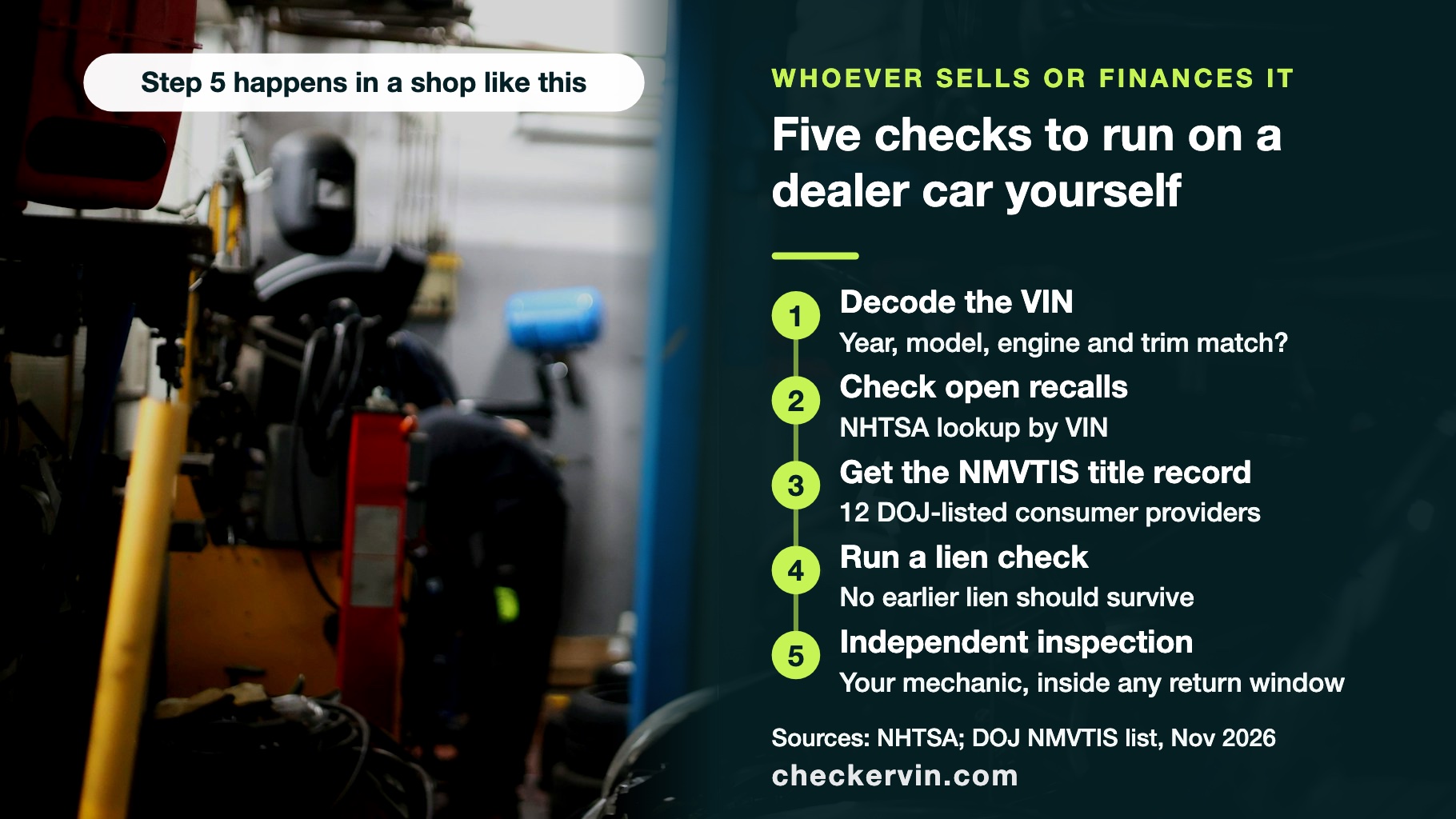
None of these depends on the dealer’s cooperation beyond letting you see the VIN and letting a mechanic look at the car. A dealer that refuses either has told you something.
- 1Decode the VINConfirm the year, make, model, engine and trim match the listing and the paperwork. A mismatch is a reason to stop before credit is discussed.
- 2Check open safety recallsNHTSA's lookup shows open recalls by VIN. If one is open, ask for proof the repair was done before you sign, or get it done yourself.
- 3Get the title record from a DOJ-listed NMVTIS providerThe Department of Justice lists twelve businesses approved to sell NMVTIS reports to consumers, read November 25, 2026. That is where salvage, junk, flood and odometer brands reported by states show up.
- 4Run a lien checkA car with an unreleased lien cannot be cleanly titled to you. Ask for the title status and check it independently.
- 5Pay for an independent inspectionA mechanic you choose, ideally inside any return window. Ask before you sign whether the car can go to your mechanic or be inspected on the lot.
The lien step deserves a word of its own at a buy-here, pay-here dealer, because the dealer’s own finance affiliate will normally be the lienholder on your new loan. That is expected. What you are checking is that no earlier lien survives. Our vehicle lien check guide explains how to confirm it with the state and what a clean title should show.
Decode the VIN and check recalls free
Decoded from official manufacturer and NHTSA records
Where CheckerVIN fits, and where it stops
We do not sell cars or loans, so there is nothing to compare head to head. What we do is the first two checks above, free:
- Factory build and specifications decoded from the VIN
- Factory warranty terms
- Open NHTSA safety recalls
- Photos filed against the VIN
- Market and listing prices
Run in that order, the free decode and recall check sort out mismatched or unrepaired cars before you spend anything, and the paid title report and the mechanic are spent on the one car you are serious about.
How to read DriveTime reviews
Search for DriveTime reviews and you get star ratings from several sites, including the one DriveTime displays on its own homepage. We do not reprint ratings: they come from programs with different invitation methods, and an average says little about the one car and one contract in front of you. Reviews are more useful read for patterns than scores.
- Return-window complaints: did the buyer miss the deadline, or did the dealer refuse a return inside it? The difference tells you whether the policy is the problem or the reading of it
- Warranty claims: what was denied, and was it outside the included coverage or under a separately sold service contract?
- Collection and payment experiences: these concern the finance and servicing side, not the dealership
- Dates: a complaint from before the 2014 consent order describes practices the order required to change
For complaints filed with a regulator rather than a review site, the CFPB publishes its consumer complaint database, which you can filter and view in a browser. It is not a rating, but it shows what people raised with a regulator about a company.
Who DriveTime suits
It suits a buyer who has been turned down elsewhere and needs the seller to provide the loan, who values a return window and a short included warranty, and who will read the contract line by line. It suits less well a buyer with good credit who can get an outside loan, because that buyer gives up the ability to compare lenders by financing at the dealer. In either case, bring an outside offer if you can, take the Buyers Guide seriously, and verify the car yourself. Our guide to buying a used car sets out the full sequence, and used car red flags covers what to walk away from.
Where this information comes from
- CFPB — enforcement action: DriveTime Automotive Group, Inc. and DT Acceptance CorpDocket 2014-CFPB-0017, filed November 19, 2014; status expired/terminated/dismissed
- CFPB — consent order, 2014-CFPB-0017Findings, the buy-here, pay-here description, the without-admitting-or-denying stipulation and the five-year term
- CFPB — announcement of its first action against a buy-here, pay-here dealerDefinition of buy-here, pay-here; references, workplace and wrong-number calls; required remedies
- North Carolina DOJ — Attorney General returns nearly $80,000 to consumers (8/16/2017)The DriveTime settlement over inspection and warranty claims and debt collection
- DriveTime Automotive Group — Form 10-K for 2013 (SEC EDGAR)Filed March 25, 2014: return policy, limited warranty, service contract, structure and credit model
- Carvana Co. — Form 10-K for 2025 (SEC EDGAR)DriveTime as a related party; service-contract administration and loan servicing
- DriveTime homepageRead November 25, 2026; the only DriveTime page that did not block our requests
- 12 CFR 1026.18 — Truth in Lending content of disclosures (eCFR)Amount financed, finance charge, APR, total of payments, total sale price
- 16 CFR 455.2 and 455.3 — the Used Car Rule (eCFR)The Buyers Guide, and why it is part of the contract
- NMVTIS — approved data providers (DOJ / BJA)The consumer-tier list, read November 25, 2026
- NHTSA recall lookupOpen safety recalls by VIN
- CFPB consumer complaint databaseComplaints filed with the regulator, viewable and filterable online
- How we made this pageWritten by the CarCheckerVIN editorial team with AI assistance from NHTSA vPIC and other public records, including CFPB and North Carolina DOJ records, SEC filings and eCFR; facts checked November 2026.
Keep reading
Frequently asked questions
Is DriveTime legit?
DriveTime is a real, long-running used-car dealer that finances its own sales. Its annual report for 2013 described it as the nation's largest integrated used car retailer and subprime finance company. It also has a public enforcement record: a 2014 CFPB consent order over debt collection and credit reporting, and a 2017 North Carolina settlement over how it described its inspections and warranty. Legitimate and spotless are different questions.
What is the DriveTime return policy?
DriveTime's 2013 annual report described a 5 day, no questions asked, vehicle return policy. We could not read its current policy page, because drivetime.com blocked our requests beyond the homepage in November 2026. Ask for the current return terms in writing before you sign. No federal rule gives you a return window on a dealership purchase.
What warranty does DriveTime give?
Per its 2013 annual report, every car came with a 30 day, 1,500 mile DriveCare Limited Warranty covering major mechanical items and A/C, and a longer DriveCare service contract was sold separately as an optional product. Whatever the terms are today, the Buyers Guide on the car's window is part of your contract under federal rule, so read it.
Who is DriveTime's finance company?
DriveTime's 2013 annual report named DT Acceptance Corporation as the sister company that directs its financing and loan servicing. The CFPB's 2014 order named the same company as DriveTime's finance affiliate. Today the Make a Payment links on drivetime.com point to Bridgecrest, an account-servicing site.
What did the CFPB find against DriveTime?
In consent order 2014-CFPB-0017, filed November 19, 2014, the CFPB found unfair collection calls to workplaces, references and wrong numbers after people asked them to stop, and inaccurate repossession and delinquency information furnished to credit bureaus. DriveTime paid a $8,000,000 civil money penalty and consented without admitting or denying the findings. The CFPB lists the action as expired.
Does DriveTime give you a vehicle history report?
We could not confirm it from DriveTime's own pages, which blocked our requests. Ask the salesperson which report, if any, comes with the car, and read it before signing. Either way, run the free VIN checks yourself and get the federal title record from a provider on the Department of Justice NMVTIS list.
Whoever finances the car, check the VIN yourself
Decode any VIN free for the factory build, specifications and open safety recalls. Full vehicle history reports are launching soon.
Run a free VIN check