The short answer
- Am I owed a notice?
- Yes, in one of two forms. Either a risk-based pricing notice, or the credit score disclosure most auto creditors give to every applicant instead.
- Does it include my score?
- The credit score disclosure must, along with the score range and how your score compares with other consumers.
- When should it arrive?
- For a car loan, before the deal is consummated and no earlier than when the approval decision is communicated to you.
3
Notices the rules describe
Two if approved, a third if you are declined
6 bars
Minimum on the required graph
12 CFR 1022.74(e), or equivalent clarity
1 / 12 months
Free report you can claim
15 U.S.C. 1681j, separate from anything here
Free
Our VIN check
Run it on the car while they run you

What actually happens when they take your details
A dealership arranging financing does not usually lend you the money. It takes your application and submits it, typically to several lenders, each of which pulls your consumer report and answers with terms it is prepared to offer. What comes back to the desk is a set of answers; what is presented to you is a number.
Two things follow from that structure. Your report has been used by more than one party, and the terms you are shown are the product of a commercial decision as well as an underwriting one. Federal law does not regulate the second of those on this page. It does have quite a lot to say about the first.
Why they are allowed to pull it at all
A consumer report is not public. It may be handed out only for reasons the statute lists, and the statute is emphatic about that: under 15 U.S.C. 1681b(a), a consumer reporting agency may furnish a consumer report under the following circumstances and no other.
What follows in the statute is an enumerated list — a court order or a grand jury subpoena is the first of them — and a credit application by the consumer is what supplies the purpose in an ordinary dealership transaction. That is the legal basis on which your report is obtained: you applied.
The corollary is the useful part. If a report was obtained when you had not applied for credit, the question of which listed circumstance authorized it is a real question with a real answer, and it is a fair one to put in writing. The same “and no other” construction appears in the cosigner rule, and in both places it means the list is the whole of it.
What the report actually shows
People imagine a credit report as a score. It is not; the score is a number computed from the report. The rule’s own required wording describes the underlying document, and the description is worth having.
A consumer report, the disclosure must tell you, is a record of your credit history that includes information about whether you pay your obligations on time and how much you owe to creditors. A credit score, it must then say, is a number that takes into account information in that report, and it can change over time as your credit history changes.
| The report | The score |
|---|---|
| A record of your credit history | A number computed from that record |
| Whether you pay obligations on time | One model's summary of that behavior |
| How much you owe to creditors | Changes as the underlying record changes |
| What you can dispute | Not itself a thing you dispute |
That distinction matters when something looks wrong. You do not dispute a score. You dispute an entry in the report the score was computed from, and the score moves afterward if the entry does — which is the whole reason the rule requires the disclosure to tell you a score can change over time.
Two different notices, and which one you get
People conflate these constantly, so it is worth separating them before anything else. They are triggered by different events and they contain different things.
| Notice | When it applies |
|---|---|
| Risk-based pricing notice | You get credit, but on terms materially less favorable than most of that person's customers get |
| Credit score disclosure | The alternative a creditor may give to every applicant instead of the above |
| Adverse action notice | You are declined, or action is taken against you, based on your report |
The first two are the ones a buyer who drives away in a car is likely to encounter. The third belongs to the buyer who does not, and it is covered further down.
The risk-based pricing notice, in the rule's own words
Under 12 CFR 1022.72(a), a person must provide a risk-based pricing notice if that person both uses a consumer report in connection with an application for, or a grant, extension or other provision of, credit that is primarily for personal, family or household purposes; and, based in whole or in part on the consumer report, provides that credit on material terms that are materially less favorable than the most favorable material terms available to a substantial proportion of consumers from or through that person.
Read the second limb slowly, because it is doing something specific. The comparison is not against the market, and not against some national average. It is against the best terms a substantial proportion of that particular person’s customers receive. The question the rule asks is whether you are being priced worse than their good customers, because of your report.
Why most people get a credit score instead
Work out who is materially worse off than a substantial proportion of your customers, for every applicant, and you have a compliance problem. The rule anticipates this and offers a way out that is easier and, for the consumer, generally better.
Under 12 CFR 1022.74(e), a person is not required to provide a risk-based pricing notice for an extension of credit other than one secured by one to four units of residential real property — which covers a car loan — if that person instead provides to each such consumer a notice containing the credit score information the section then lists.
That is why the sheet you were handed has a score on it rather than a warning about your terms. The creditor has taken the exception, and the practical consequence is that everyone gets a disclosure rather than only the people being priced worse.
| Route | Who receives something |
|---|---|
| Risk-based pricing notice under 1022.72 | Only consumers priced materially worse than most |
| Credit score disclosure under 1022.74(e) | Every applicant for that kind of credit |
What that notice must contain, down to the graph
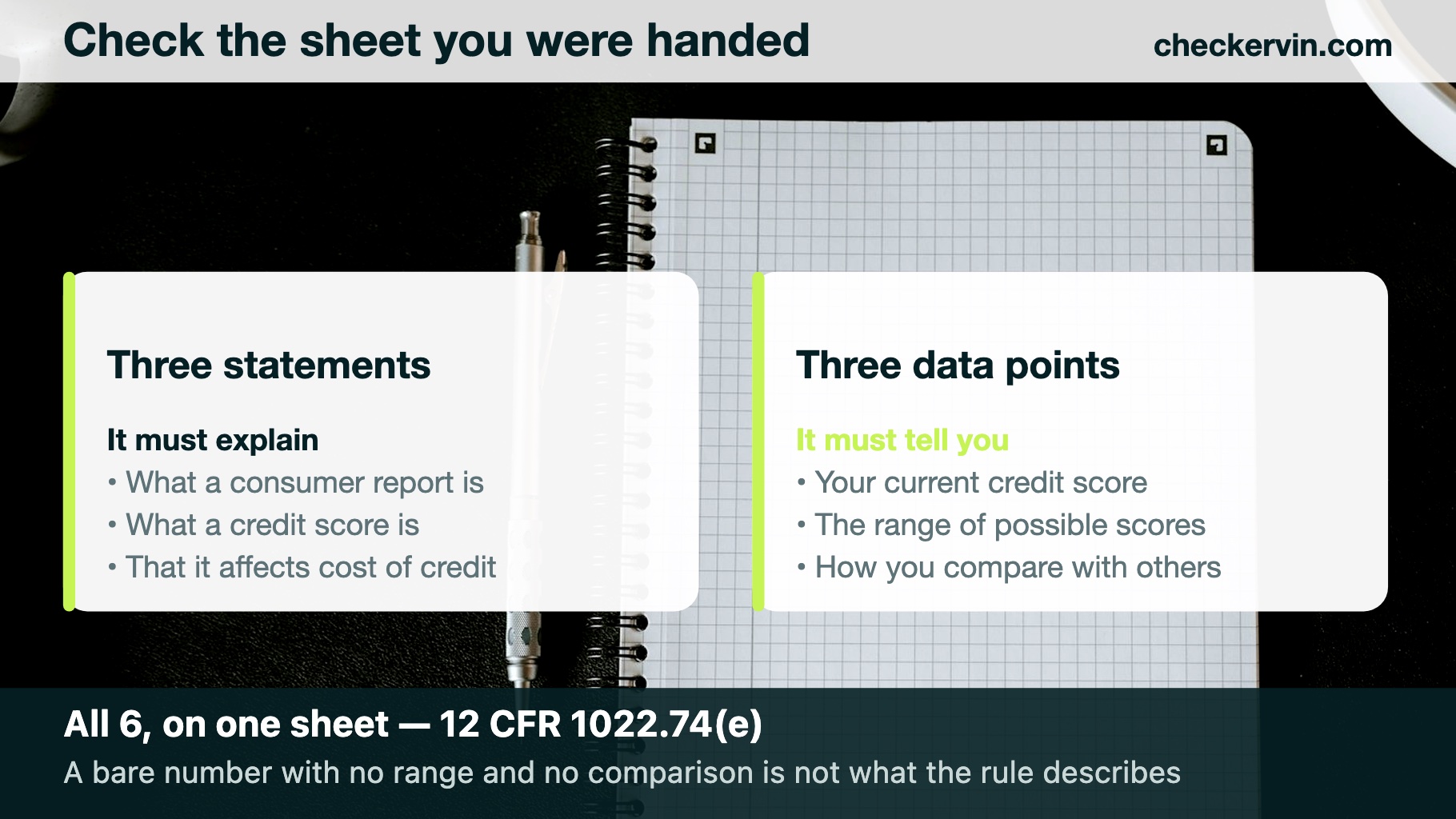
Section 1022.74(e)(1)(ii) enumerates the contents, and the specificity is the interesting part. The notice must contain all of the following.
- A statement that a consumer report is a record of your credit history, including whether you pay obligations on time and how much you owe
- A statement that a credit score is a number based on information in a consumer report, and that it can change over time as your history changes
- A statement that your credit score can affect whether you can obtain credit and what that credit will cost
- Your current credit score, or the most recent one calculated by the consumer reporting agency for a credit-related purpose
- The range of possible scores under the model used to generate it
- The distribution of scores among consumers scored under the same model
The last item is the one worth knowing about. The rule says that distribution must be presented as a bar graph containing a minimum of six bars, showing the percentage of consumers whose scores fall in each range — or by other clear and readily understandable graphical means, or as a clear and readily understandable statement telling you how your score compares with other consumers.
There is also a variant for the case where the creditor regularly obtains scores but one is not available for you. The rule addresses that at 1022.74(f) rather than leaving it to be improvised.
The window the notice has to arrive in
Timing is specified rather than left open, and the specification is narrower than people assume. For closed-end credit — which a car loan is — 12 CFR 1022.73(c)(1)(i) requires the risk-based pricing notice to be provided before consummation of the transaction, but not earlier than the time the decision to approve is communicated to the consumer.
So there is a defined window: it opens when you are told you are approved, and it closes when the deal is consummated. The notice is meant to reach you inside it, which is to say while you can still act on what it tells you.
| Moment | Where the notice sits |
|---|---|
| You submit the application | Too early — the rule says not before the decision is communicated |
| You are told you are approved | The window opens |
| You are reviewing the numbers | Where the notice belongs |
| The transaction is consummated | The window has closed |
If you are declined, or the terms get worse
That is adverse action, and a different statute applies. Under 15 U.S.C. 1681m, if any person takes any adverse action with respect to a consumer that is based in whole or in part on any information contained in a consumer report, that person must provide notice of the adverse action to the consumer, orally, in writing or electronically.
The section also requires written or electronic disclosure of the numerical credit score used by that personin taking the adverse action, along with further information the statute specifies — including how to reach the consumer reporting agency involved, and that the agency did not make the decision.
The free report you can claim, and when to claim it
Separately from anything a dealership hands you, 15 U.S.C. 1681j entitles you to a file disclosure from a nationwide consumer reporting agency once during any twelve-month period, on request and without charge.
The timing advice is the whole of the value here. A report obtained after you have signed tells you what happened. The same report obtained before you shop tells you what to expect, gives you time to dispute anything wrong on it, and means the number the finance office quotes you is not the first information you have about your own position.
- Claim it before you shop, not after you sign
- Read it for errors rather than only for the score
- Disputes take time, which is a reason to start early
- It is your file, and the entitlement does not depend on any dealer
Multiple inquiries, described honestly
The most common worry about a dealership credit pull is that submitting one application to several lenders will damage a score several times over. Here is the honest position, which involves telling you what we are not going to tell you.
Credit scoring models are commercial products, not regulations. They generally treat a cluster of auto-loan inquiries made while shopping as a single event rather than as many, on the reasoning that a person shopping for one car loan is not a person opening several debts. But the length of that window differs between models and between versions of the same model.
So we are not going to quote you a number of days, because the correct answer depends on which model a particular lender is using and we cannot know that. What is safe to say is the shape: applications compressed into a short shopping period are treated differently from applications spread over months, and nothing in federal law caps how many inquiries a report may carry.
Who actually owes you the notice
The rules attach to the person who uses the report and provides the credit, which in a dealership transaction is not always the party in front of you. Where a dealer arranges financing that is assigned to a lender, working out who owed what can be less obvious than it looks from the customer chair.
The practical approach is not to adjudicate that yourself. Ask the dealership which notices you should have received and from whom, and keep everything you were handed. If a notice is missing, the useful first step is a specific question rather than an accusation.
Before you go in
Every entitlement on this page arrives after your report has been pulled. The notices tell you what happened; none of them changes what happens. The only part of this sequence you control is what you know beforehand, and that part is free.
- 1Claim your free file disclosure first15 U.S.C. 1681j entitles you to one from a nationwide agency in any twelve-month period, on request and without charge. Doing it before you shop turns the finance office's number into a confirmation rather than a surprise.
- 2Read it for errors, not just for the numberAn entry that does not belong to you affects the score computed from it. Disputes take time, which is an argument for starting before you need the outcome rather than after.
- 3Know what a comparison would look likeA rate quoted in isolation cannot be evaluated. Whether you obtain a comparison from your own bank, a credit union or anywhere else is your decision, but arriving with nothing to compare against means accepting the first number you are shown.
- 4Decide in advance what you are authorizingYour application is what makes the credit pull permissible. Being clear about whether you are authorizing one submission or an open-ended set of them is easier before you are sitting at the desk.
What to ask at the desk
- 1Ask how many lenders your application is going toBefore it is submitted, not after. It is a reasonable question and the answer tells you what to expect on your report.
- 2Ask for the credit score disclosureIf a creditor is using the 1022.74(e) route, every applicant for that credit is supposed to receive one. It should carry your score, the range, and a comparison.
- 3Check the document against the listScore, range, distribution or comparison, and the three explanatory statements. A sheet with a bare number is not what the exception describes.
- 4Ask what changed, if anything changedIf the terms you were told about move after the report is pulled, ask which notice covers that. Adverse action is not limited to a flat refusal.
- 5Keep every piece of paperIncluding the ones that look like boilerplate. The notices described here are exactly the documents people discard and later need.
What none of this does
It does not get you a better rate. These are disclosure rules: they govern what you must be told, not what you may be charged. A creditor that prices you on your report and tells you so has complied.
It is not legal or financial advice, and it cannot account for your state, your lender or your particular paperwork. And it says nothing about whether the loan is a good idea, which is a question about your budget rather than about a regulation.
One deliberate omission worth naming: there is a separate Federal Trade Commission rule aimed at motor vehicle dealer practices, including add-ons and fee disclosure. Its current legal effect is not something we could establish confidently from the Code of Federal Regulations alone, so this page does not rely on it. Citing a rule whose status you have not verified is worse than omitting it.
What we can do is the vehicle half, and it is worth doing while they are checking you. Our free check returns the factory build, the specifications and open safety recalls from the VIN, at no cost and without an account. It does not return accident, title, odometer or theft history, and it has nothing to do with anyone’s credit file.
Where this information comes from
- eCFR — 12 CFR Part 1022, Regulation V (Fair Credit Reporting)1022.72 sets the risk-based pricing trigger; 1022.73 the content, form and timing; 1022.74(e) the credit score disclosure exception and its required contents, including the minimum six-bar graph
- 15 U.S.C. 1681m — duties of users taking adverse actionsNotice of adverse action based in whole or in part on a consumer report, and disclosure of the numerical credit score used
- 15 U.S.C. 1681j — charges for certain disclosuresThe free file disclosure available once during any twelve-month period on request
- NHTSA — check for open recalls by VINFree, and worth running on the vehicle while the finance office runs you
Keep reading
Frequently asked questions
Does a dealer have to tell me my credit score?
In practice, usually yes, though by a slightly indirect route. Federal rules require a risk-based pricing notice when a creditor uses your report and gives you terms materially less favorable than those a substantial proportion of its customers get. Most auto creditors use an alternative the rule allows: give every applicant a credit score disclosure instead. That disclosure must include your score.
What is a risk-based pricing notice?
The notice required by 12 CFR 1022.72 when a person uses a consumer report in connection with consumer credit and, based in whole or in part on that report, provides credit on material terms that are materially less favorable than the most favorable terms available to a substantial proportion of consumers from that person. In plain terms: you are being charged more because of your report, and you must be told.
Why did I get a page with a bar graph on it?
Because the rule requires one. The credit score disclosure under 12 CFR 1022.74(e) must show the distribution of scores among consumers scored under the same model, as a bar graph with a minimum of six bars, or by other clear graphical means, or as a clear statement of how your score compares with others.
When am I supposed to get the notice?
For a car loan, 12 CFR 1022.73(c) requires the risk-based pricing notice before consummation of the transaction, but not earlier than the time the approval decision is communicated to you. There is a defined window between being told you are approved and signing, and the notice belongs in it.
What if I am turned down for financing?
That is adverse action, and 15 U.S.C. 1681m applies. Anyone who takes adverse action based in whole or in part on information in a consumer report must give you notice of it, and must disclose the numerical credit score they used, along with further information the section specifies.
Does the dealer running my credit hurt my score?
An inquiry for credit is recorded and can affect a score. Scoring models generally treat several auto-loan inquiries made while shopping as a single event, but the length of that window depends on the model in use, so we are not going to quote you a number. What is certain is that submitting one application to many lenders on the same day is treated differently from applying repeatedly over months.
Can I get a free copy of my credit report?
Yes. Under 15 U.S.C. 1681j you are entitled to a file disclosure from a nationwide consumer reporting agency once during any 12-month period on request and without charge. That is separate from anything the dealer gives you, and it is worth doing before you shop rather than after.
Is a dealer allowed to pull my credit at all?
Only for a reason the statute lists. 15 U.S.C. 1681b(a) says a consumer reporting agency may furnish a report under the circumstances the section enumerates and no other, and a credit application by you is what supplies the purpose in an ordinary dealership transaction. If a report was obtained when you had not applied, which listed circumstance authorized it is a fair question to put in writing.
Does the dealer decide my rate?
Not alone. A dealership arranging financing typically submits your application to lenders, who respond with terms. What happens between the lender's answer and the number you are offered is a commercial question, and it is a reasonable thing to ask about directly rather than to assume.
Check the car while they check you
Decode any 17-character VIN free for the factory build, specifications and open safety recalls. No account required.
Run a free VIN check