The short answer
- Is the pattern the whole check?
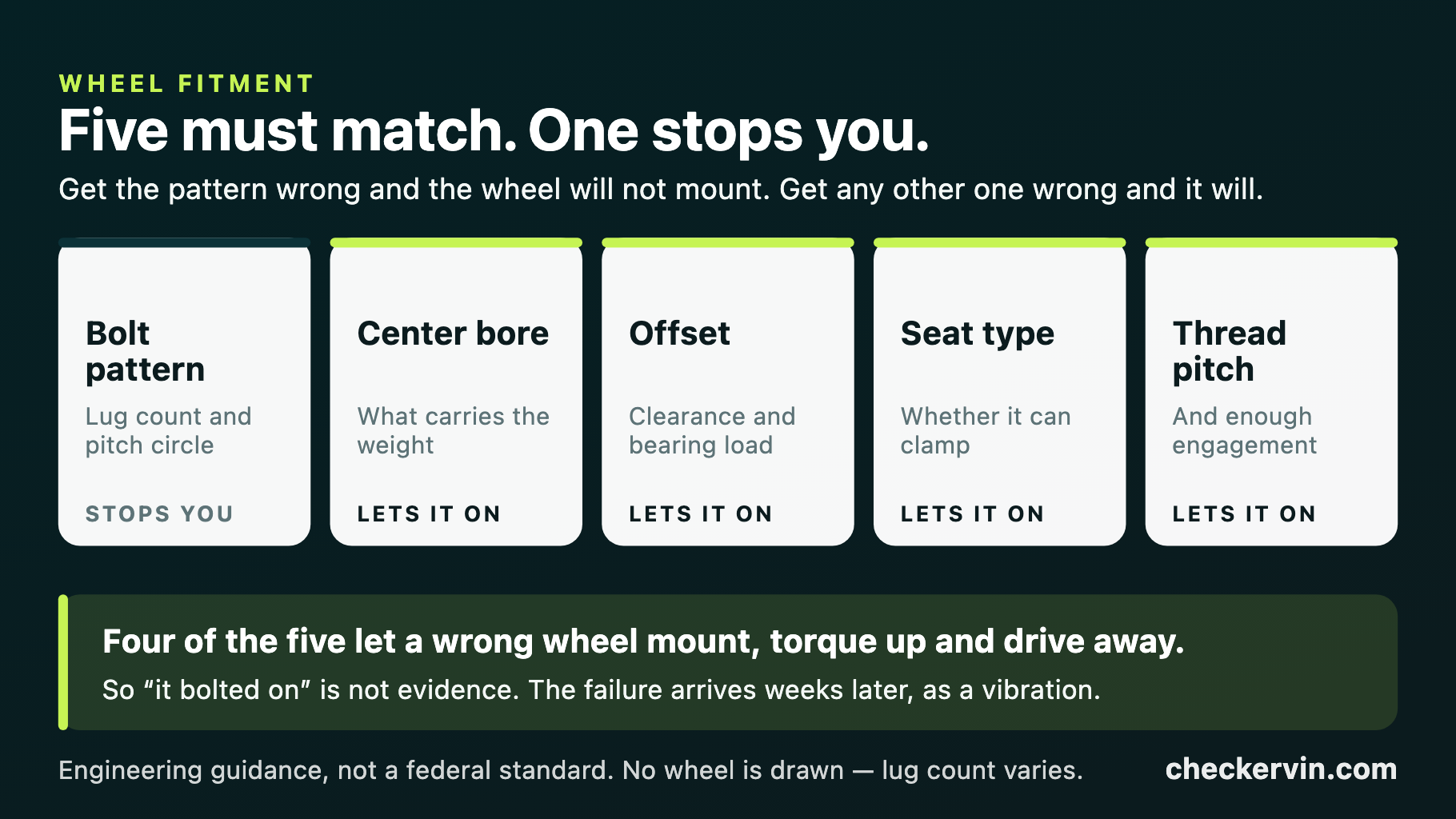
- No. Pattern, center bore, offset, seat type and thread pitch all have to match. The pattern is just the one with a catchy number.
- What holds the wheel up?
- The hub, on a hub-centric vehicle. The studs clamp it; they are not meant to locate it or carry it.
- What gets overlooked most?
- Seat type. Conical, ball and flat are different geometries, and a mismatched nut cannot clamp properly however tight it feels.
Five
Things that must match
Pattern is only the first
The hub
What carries the weight
Not the studs
60°
Typical seat included angle
But geometry types differ
Delayed
When the failure shows
Not on the drive home
Bolting on is not fitting
The central point deserves stating before any detail, because it is the thing that makes this a safety subject rather than a shopping one.
A wheel that shares your vehicle’s bolt pattern will physically mount. The holes line up with the studs, the nuts thread on, a torque wrench will click. Nothing at that moment distinguishes a correct fitment from an incorrect one, and the car will drive.
What separates them is whether the wheel is located and clamped the way it was designed to be. If it is centered on the hub and clamped by fasteners whose seats match its holes, the assembly does what the engineers intended. If either of those is wrong, the load goes somewhere it was not meant to go — and that shows up later, as vibration, as loosening, or as damage to the studs and the wheel itself.
Reading the pattern itself
Worth getting out of the way, since it is the part people came for and it is genuinely simple.
A designation like 5x114.3 gives two facts: five lug holes, arranged on a circle 114.3 millimeters in diameter. The second number is the pitch circle diameter — the diameter of the imaginary circle passing through the center of every hole. Some patterns are expressed in inches instead, which is why the same pattern can appear as 5x4.5.
On an even number of lugs you can measure center to center across opposite holes. On an odd number — five, most commonly — you cannot, because no two holes sit directly opposite, and that is why measuring a five-lug pattern by eye goes wrong. Use the published figure for your vehicle rather than a tape measure.
Five things, not one
Here is the full list, and the point of the page is that four of these are invisible if you are only checking the pattern.
| What has to match | What it governs |
|---|---|
| Bolt pattern | Whether the wheel physically mounts on the studs at all. The only one that stops you if it is wrong. |
| Center bore | Whether the wheel sits on the hub. This is what carries the vehicle's weight on a hub-centric design. |
| Offset | Where the wheel sits across the width of the arch, which affects clearance, steering feel and loading on the bearing. |
| Seat type | Whether the fasteners can actually clamp. Conical, ball and flat-with-washer are different geometries. |
| Thread pitch and length | Whether the nut threads correctly and engages enough of the stud to develop its clamping force. |
Only the first prevents installation. The other four permit a wheel to go on, come up to torque, and be wrong.
What actually carries the car
This is the piece most often misunderstood, and understanding it changes how you read every wheel listing.
On a hub-centric vehicle — which is most modern passenger cars — the machined hub protrudes into a matching bore in the back of the wheel. The wheel sits on that hub, concentric with the axle, and the hub carries the vehicle’s weight in shear. The lug nuts or bolts then clamp the wheel against the hub face. Their job is clamping force, not location and not load-bearing.
Aftermarket wheels are frequently made with a larger center bore so one casting can serve many vehicles, and they are then centered with hub-centric rings that fill the gap. That is a normal and acceptable arrangement — provided the rings are correct and actually fitted. Where they are missing, the wheel is located by the fasteners rather than the hub.
The seat type nobody checks
If one item on this page saves somebody, it is likely this one, because it is invisible, cheap to get wrong, and feels fine when it is.
The lug hole in a wheel is machined to a particular geometry, and the fastener has to match it. The common types are conical — a tapered seat, generally with a 60-degree included angle — ball or radius, which is a rounded seat, and flat, which uses a washer against a flat face.
Put a conical nut into a ball-seat wheel and the contact is a narrow ring rather than a mated surface. The nut will still turn, still resist, and still reach a torque reading — but the clamping load is concentrated where it was not designed to be, and the joint can relax as that contact patch deforms. The result is fasteners that were tight and are not any more.
- New wheels frequently require their own fasteners — the ones in the trunk may be wrong for them
- Match seat type first, then thread pitch, then length
- A nut that spins on easily but seats oddly, or sits noticeably proud, is worth stopping for
- Re-torque after a short distance following any wheel change, which is standard practice for a reason
Offset, and what it moves
Offset is usually discussed as an appearance question and it is a mechanical one.
It describes how far the wheel’s mounting face sits from its centerline, expressed in millimeters and often marked ET. A higher number tucks the wheel further inboard; a lower or negative number pushes it outward. Changing it moves the wheel relative to the suspension, the brake components and the arch.
Two consequences follow. The obvious one is clearance — against the strut, the caliper, the inner arch liner at full lock, or the arch lip over bumps. The less obvious one is that offset changes the leverage the wheel exerts on the hub and bearing, and a large departure from standard loads those parts differently than they were designed for.
Thread pitch and engagement
Two separate requirements that are easy to conflate.
Pitch is the thread specification — the diameter and spacing, such as M12x1.5 or M14x1.25. A nut of the wrong pitch may start onto a stud and feel like it is threading. It is damaging the threads as it goes, and neither part is trustworthy afterwards.
Engagement is how much thread is actually in contact once the nut is home. Fitting a thicker wheel, or a spacer, without longer studs or nuts reduces engagement, and the clamping force a fastener can develop depends on it. A nut that reaches torque with only a few threads engaged is not doing the job the number implies.
The sensor in the wheel
A practical item rather than a structural one, and it catches people buying a second set of wheels.
Vehicles fitted with tire pressure monitoring carry a sensor inside each wheel. A new set of wheels needs sensors fitted, and on many vehicles they need to be matched to the car so the system recognizes them. Without that, expect a warning light that no amount of inflating will clear.
Our tire size guide covers the placard and the tire designation in full, including what the law requires to be shown and where. This page deliberately does not repeat that ground.
Why the failure is delayed
There is a pattern here worth naming, because it recurs across several of the things a modern car quietly requires.
A wrong-seat lug nut, an uncentered wheel, a battery of the wrong construction, a key that was cut but never programmed — all of them work on the day. The car drives, starts, moves. The consequence arrives weeks or months later, in a form that looks like a different problem: a vibration blamed on balancing, a battery blamed on the brand, a car that will not start blamed on the key.
That delay is precisely why these get skipped. Nothing punishes the shortcut at the moment it is taken. It is also why the check has to happen before the work rather than after the symptom — by then the evidence points somewhere else.
What the VIN is doing here
The VIN’s role is real and indirect, the same as elsewhere in this family.
The federal decoder holds a build record — make, model, model year, body class, displacement, cylinders, fuel type. There are no wheel fields in it. What it does is establish exactly which model, engine and trim your car is, and wheel specifications follow from those with much less ambiguity than from the badge on the tailgate.
That matters because wheel fitment frequently varies by trim within one model year — a larger brake package or a sport trim can change offset and sometimes bore. Establishing the trim is what makes a retailer lookup trustworthy. Our trim level guide covers reading that field.
Where the answer actually is
Four sources, in descending order of authority.
- 1The owner's manual and the vehicle itselfThe manual gives the factory specification. The wheel currently on the car often carries the pattern, offset and bore cast or stamped on its back face.
- 2A wheel retailer's fitment lookup, given the exact trimThese are generally reliable when the trim is right, which is what the VIN is for. Give them the VIN rather than the model name.
- 3A tire or wheel shop, physicallyThe only route that confirms clearance and seat type against your actual car rather than against a database entry.
- 4The wheel manufacturer's own specificationFor the wheel you are considering — particularly its bore and whether rings are supplied — rather than a marketplace listing's summary.
- 5Then re-torque after a short distanceStandard practice after any wheel change, and the cheapest insurance available on this entire page.
Buying a car on aftermarket wheels
This is where the subject meets the rest of the site, and it is a real inspection point rather than a tacked-on paragraph.
Aftermarket wheels on a used car are not a problem in themselves — plenty are correctly specified and properly fitted. What they do is add a question that a factory-wheeled car does not raise, and it costs nothing to ask it.
- Are the original wheels included? Their absence is a negotiating point and sometimes a story
- Do the fasteners look like a matched set, or a mixture?
- Are hub-centric rings present where the bore is oversized?
- Any vibration at speed that the seller attributes to balancing?
- Do the wheels clear the arches at full lock and over bumps on the test drive?
A vibration the seller has already explained away is the one to take seriously. Our used car red flags and pre-purchase inspection guides cover where this fits in the wider check.
The check sequence
Decode the VIN free to establish the exact model, engine and trim. Take that — not the model name — to the manual or a wheel retailer for the factory specification. Match all five items rather than the pattern alone. Confirm seat type against the fasteners you intend to use. Fit, torque, and re-torque after a short distance. And check open recalls through NHTSA at no cost while you have the number in front of you.
Where this information comes from
- Discount Tire — hub-centric vs lug-centric wheelsHow the two locating arrangements differ, and what centers the wheel in each
- US Patent 5,711,581 — wheel opening inserts and lug nut assembliesTechnical background describing the consequence of a lug nut out of concentric location: stressing or bending of the stud, inaccurate wheel location, imbalance and stress cracks in the wheel
- US Patent 5,056,870 — wheel nut assemblyThe tapered seating geometry, including the 60-degree included angle typical of conical seats
- NHTSA recall lookupOpen safety recalls by VIN, free — worth running while you have the number to hand
Keep reading
Frequently asked questions
Can I find my bolt pattern from the VIN?
Indirectly and reliably. The VIN establishes the exact model, engine and trim, and wheel specifications follow from those — a tire shop or wheel retailer resolves the pattern from that information routinely. What no lookup does is confirm that a particular wheel is safe on your car, because the pattern is only the first of several things that have to match.
What does 5x114.3 mean?
Five lug holes arranged on a circle 114.3 millimeters in diameter. The first number is how many studs or bolts, the second is the diameter of the imaginary circle their centers sit on. Two wheels sharing that designation can still be wrong for your vehicle on center bore, offset or seat type.
Are hub-centric rings necessary?
If the wheel's center bore is larger than your vehicle's hub, then something has to locate the wheel concentrically, and that is what the rings do. Without correct centering the fasteners end up positioning the wheel, which is not what they are designed for and shows up as vibration and stress on the studs.
Can I use my old lug nuts on new wheels?
Only if the seat type matches. Conical, ball or radius, and flat with a washer are different geometries, and a nut whose seat does not match the wheel will not clamp correctly however tight it feels. It is the single most overlooked item in an aftermarket wheel fitting.
Does CheckerVIN return wheel specifications?
No. Our free lookup returns the factory build, specifications and open safety recalls from the federal decoder, which has no wheel fields. Decode the VIN to confirm the exact model, engine and trim, then take that to a wheel retailer or your manual.
Start with the VIN
Decode any VIN free for the factory build, specifications and open safety recalls. No account, no card.
Run a free VIN check