The short answer
- Is there a free VIN check for all of Canada?
- Not one that covers everything. The RCMP's CPIC search is national but only answers the stolen question. Brands and claims sit with each province, and IBC's free VIN Verify covers non-repairable reports from Alberta, Ontario and the Atlantic provinces.
- Will a US report show a Canadian car's history?
- Only the years it spent titled in a US state. NMVTIS takes reports from US titling agencies, insurers and salvage yards. Canadian provincial records are not in it.
- When does US history matter most?
- When a car was imported from the US. The Registrar of Imported Vehicles passes any US brand to every province, and flood or junk brands mean the car can never be licensed in Canada.
17
Characters in a Canadian VIN
Motor Vehicle Safety Regulations s. 115(3)
3 regions
In IBC's free VIN Verify
Alberta, Ontario, Atlantic provinces
< 15 yrs
Age of US vehicles RIV regulates
Registrar of Imported Vehicles
Worst brand
What the IRE shows for a US car
When there is more than one
Why there is no single Canadian VIN database
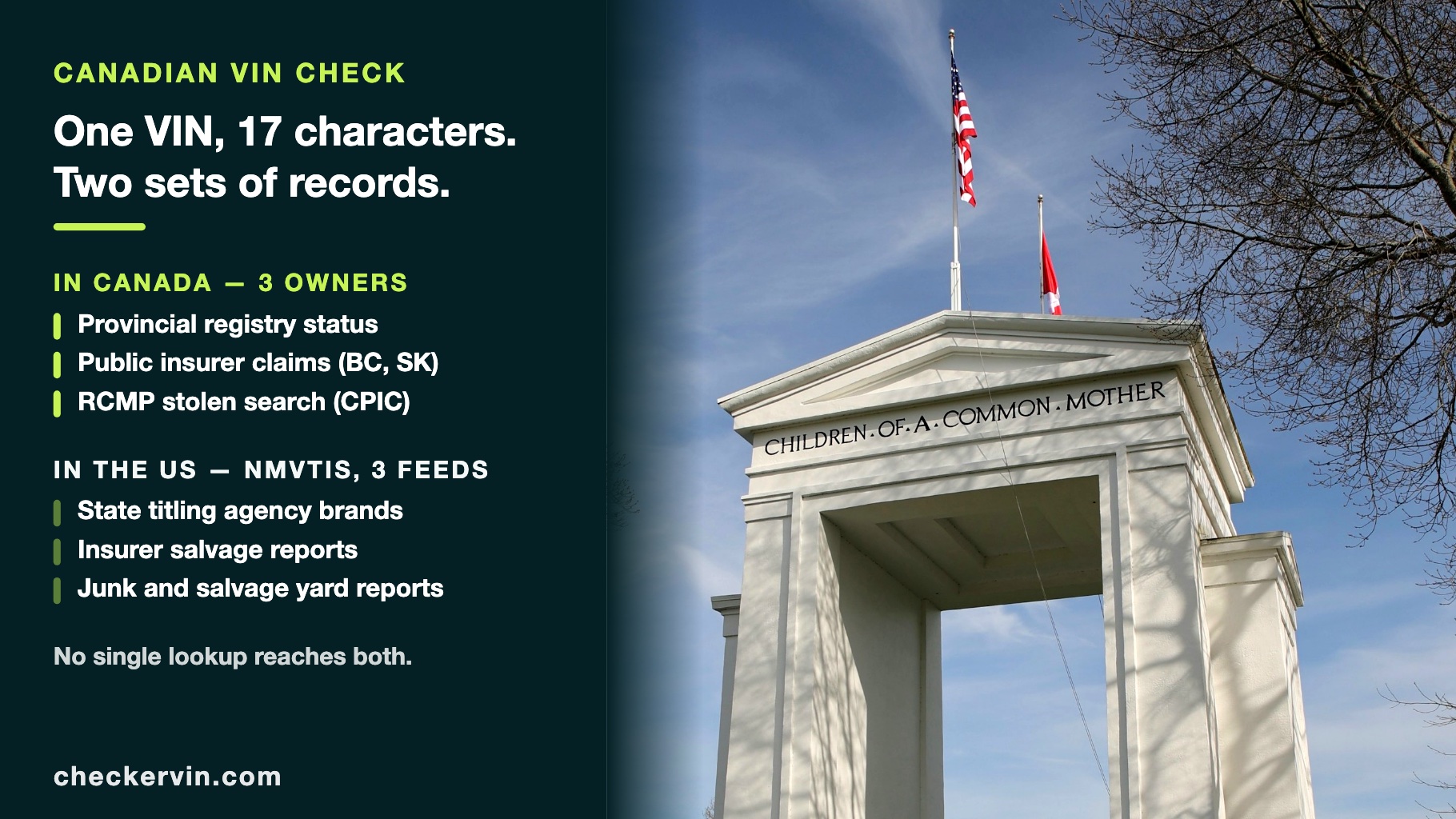
In the United States, a buyer can lean on one federal system. NMVTIS collects title brands from state agencies, insurers and salvage yards, and approved providers resell it. Canada has nothing built that way. Vehicle registration is provincial, so each province keeps its own status records. In British Columbia and Saskatchewan, the public insurers (ICBC and SGI) also hold the damage claims they paid, and they sell or give away searches of them. Stolen vehicles are a police matter, searchable nationally through the RCMP.
So “vin check canada” covers several questions with different owners. Is it stolen? Ask the police database. Is it branded? Ask the province it was registered in. Has it been in a crash? Ask the insurer who paid. Was it ever titled in the US? Ask the US title system. The sections below go through those owners in turn, using what each one says on its own site.
The same 17 characters on both sides of the border
A Canadian VIN is not a different format. Section 115(3) of the federal Motor Vehicle Safety Regulations requires every VIN to be alphanumeric and seventeen characters long. The first three identify the manufacturer, the ninth is a check digit, the tenth codes the model year and the eleventh identifies the plant. That is the same layout US rules use, so any decoder that reads a US VIN reads a Canadian one.
We checked that against the US federal decoder. Two VINs built on real patterns, a 2019 Civic from Honda’s plant (prefix 2HG) and a 2019 Corolla from Toyota’s (prefix 2T1), both decoded clean in NHTSA’s vPIC. The check digits came back correct and the plant country came back as Canada, with the cities Alliston and Cambridge. We are not printing the full numbers, because a made-up serial can belong to someone’s car.
The official Canadian VIN checks, province by province
These are the government and insurer tools a buyer can use directly. Fees are in Canadian dollars, as each body published them when we checked in November 2026.
| Check, and who runs it | What it covers, and the cost |
|---|---|
| CPIC vehicle search (RCMP) | Canada-wide police records. VIN only; covers autos, trucks, motorcycles, snowmobiles, trailers, ATVs and more. Online. |
| VIN Verify (Insurance Bureau of Canada) | Vehicles reported non-repairable in Alberta, Ontario and the Atlantic provinces. Free, online. |
| Saskatchewan VIN search (SGI) | Saskatchewan status, latest registration expiry, SGI-appraised damage claims since Nov. 1, 2002, PST owing. Free, online. |
| Cross-Canada VIN search (SGI) | Whether a vehicle status exists in any Canadian jurisdiction, plus the CPIC stolen check. $20, by request. |
| Vehicle status search (ICBC) | The status on BC's registry — normal, rebuilt, salvage and so on. Free, online. |
| Vehicle claims history report (ICBC) | Damage claimed through ICBC, import to BC, possible stolen report, licensing restrictions. $20 + GST, by phone. |
| Used Vehicle Information Package (ServiceOntario) | Ontario registration history with owners' cities and odometer readings, liens, wrecked or unfit status. $20. |
Two of these are free and need nothing but the VIN, so they are worth running on any car in Canada. IBC’s VIN Verify catches the non-repairable brand in the provinces that report to it. The CPIC search answers the stolen question nationally. If the car has a Saskatchewan or BC past, add that province’s free search. If you are buying privately in Ontario, the seller is legally required under the Highway Traffic Act to hand you a UVIP, so ask for it before you pay.
SGI’s Cross-Canada search is the nearest thing to a national status check. SGI says it searches all Canadian jurisdictions to see whether a vehicle status exists, and runs the CPIC stolen check too. It is not an online form. You request it through a Saskatchewan motor license issuer office or by phone, and the results come by email, fax or mail.
What each provincial result leaves out
Each agency is careful to say what its search does not cover, and those notes matter more than the results.
- IBC warns that some flooded or fire-damaged vehicles are not in VIN Verify, and that recently damaged vehicles may not appear right away
- SGI's free search only shows damage appraised by SGI since November 1, 2002. In November 2026 its page also noted a technical problem with loss amounts on some claims after April 1, 2025
- ICBC's report covers claims made through ICBC in BC. It does not include private insurers' claims, complete US history, odometer records or RIV records
- SGI's Cross-Canada result is valid only on the day it is run, and SGI takes no responsibility for liens or mechanical fitness
- Ontario's UVIP is the Ontario record only. It is not required when a vehicle was previously bought or sold outside Ontario
How US title history follows a car into Canada
This is where a Canadian check and a US one overlap, and it is the main reason to look at US records for a car sold in Canada. Many used cars in Canada came from the US, and the import process is built to carry their history across.
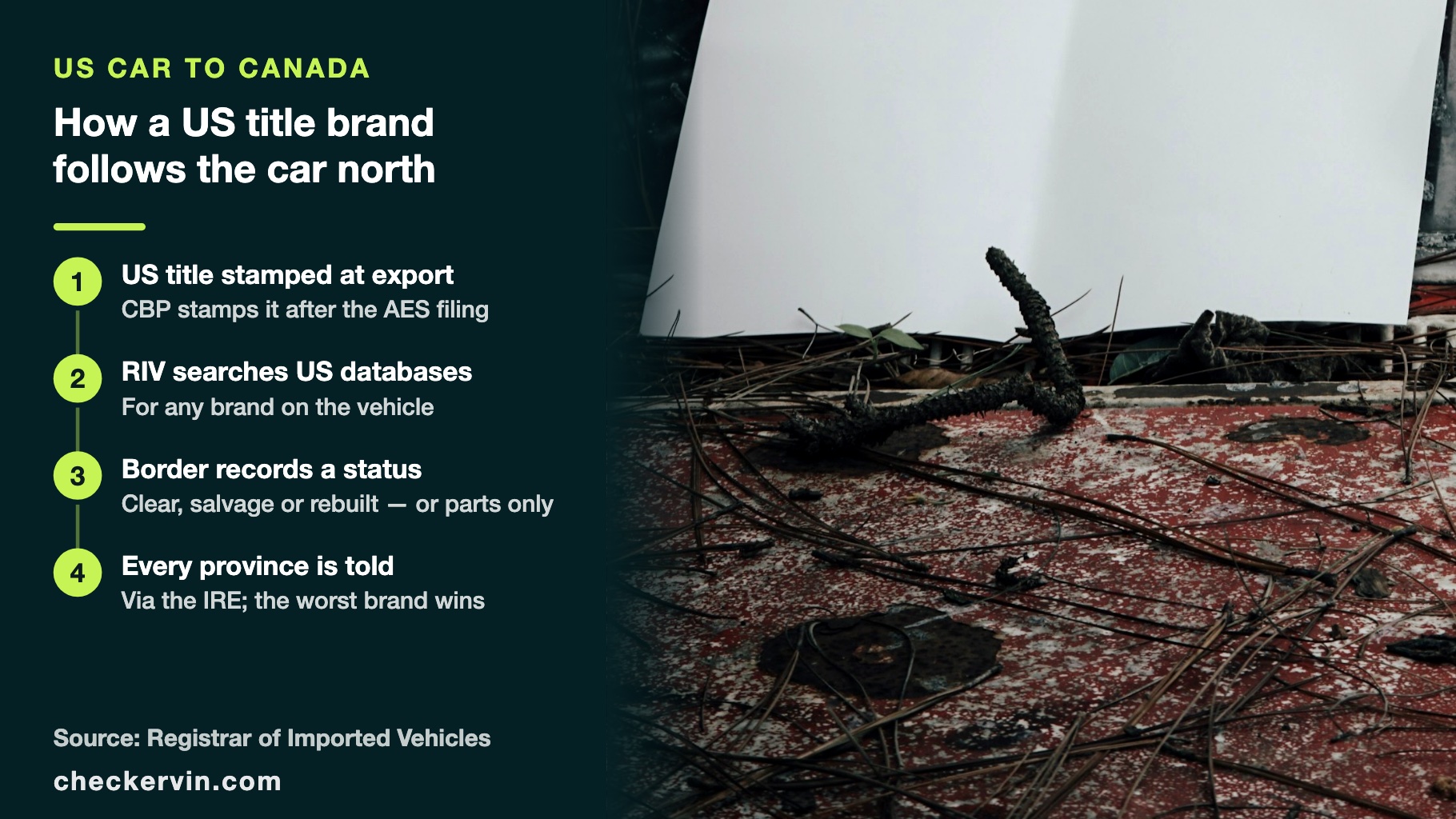
- 1The US title is stamped at exportRIV's export guidance says the exporter files through the US Automated Export System, sends the title and supporting documents to US Customs and Border Protection at least 72 hours ahead, and the officer stamps the title as exported. Any lien has to be released, or the lender has to give written permission, before the car can leave.
- 2RIV checks US databases for brandsThe Registrar of Imported Vehicles regulates most vehicles under 15 years old that were built for the US or Mexican market. At import it searches available US electronic databases for any brand on the vehicle.
- 3The border records a Canadian statusCanada Border Services Agency officers record clear, salvage or rebuilt on the Vehicle Import Form, based on the US title. A non-repairable brand can only be entered on the parts-only form.
- 4Every province is told, and the worst brand winsRIV shares US brands with all provinces and territories through the Interprovincial Record Exchange. If a car was branded junk in one state and rebuilt in another, the junk brand is the one displayed.
So for a car imported from the US, the US record isn’t background. It decides whether the car can be licensed. RIV’s own advice is to get a complete title history for any vehicle you are thinking of importing. Its branding page names CARFAX and VinAudit as companies that sell US title histories, and adds that it is not responsible for their results.
US title brands and the Canadian status they become
US states use many more brand words than Canadian provinces. RIV publishes how they map, and the bottom row is the one that ends a purchase:
| Words on the US title | Canadian status recorded |
|---|---|
| Clear, clean, normal, none, standard, original | Normal (clear) |
| Rebuilt, repaired, reconstructed, prior salvage, restored, reconditioned, damage/repair | Rebuilt |
| Salvage, salvageable, total loss, total insurance loss, write off, salvage/re-buildable | Salvage |
| Junk, scrap, parts, parts-only, dismantled, non-repairable, destroyed, irreparable, any flood or water-damage brand | Non-repairable — parts form only, never licensed |
RIV says flood or water-damaged vehicles from the US are treated as junk or non-repairable by every licensing jurisdiction in Canada. Notes such as hail, fire, stolen and recovered, or lemon law buyback are not treated as a new brand. The brand they sit alongside is what gets recorded, and a copy of the title goes to RIV. A car declared parts-only at the border gets non-repairable status, and RIV calls that status final. Our guide to title washing explains why moving between jurisdictions is where brands get lost, and why this rule exists.
Recall clearance: where an open recall stops an import
One part of a US-side check is a hard requirement for a car going north. RIV will not release the Vehicle Inspection Form until it has confirmed there are no outstanding recalls. If the manufacturer has a VIN recall lookup, RIV checks it for you. If not, the importer has to supply a letter from the manufacturer or a printout from an authorized dealer. An open recall needs a work order showing the repair was done.
RIV also points importers to NHTSA’s recall lookup, and that is the data our free check returns. Running the VIN before you buy a US car for import tells you early whether a dealer visit stands between you and the inspection. On the Canadian side, Transport Canada keeps a recalls database covering recalls issued in Canada since 1970. Since January 1, 2025, designated manufacturers have also had to offer a VIN recall lookup on their own websites.
Check a US car's open recalls before you import it
Decoded from official manufacturer and NHTSA records
Going the other way: Canadian cars coming into the US
Our imported car VIN checkcovers the general US import rules: the 25-year declaration, EPA’s fixed dates and the Customs bond. A Canadian car has one extra route of its own, and VIN history decides whether it can use it.
Under 49 CFR 591.5(g), for personal use only, an importer can declare a vehicle that its manufacturer certified to Canadian safety standards and has told NHTSA meets the US federal standards. There are narrow exceptions for some labeling rules and daytime running lamp specifications. The same paragraph excludes any salvage motor vehicle, repaired salvage motor vehicle or reconstructed motor vehicle. Under 49 CFR 591.4, salvage includes a vehicle whose repair cost exceeded 75 percent of its retail value, or one an insurer took ownership of in a damage settlement.
EPA’s test is separate. A Canadian vehicle counts as identical to a US-certified one if it has an emission label stating it is certified to US EPA standards, or if the manufacturer’s US or Canadian representative confirms it in a letter. EPA notes that Customs may ask for that letter even when EPA has already found the vehicle identical.
What a US VIN report can and cannot see on a Canadian car
The NMVTIS consumer site describes a system fed by US state titling agencies, auto recyclers, junk and salvage yards, and insurers. It says more than half of the states report to it and that 87 percent of the US vehicle population is in it. It doesn’t mention Canada, and no Canadian province appears as a source.
| The record | In a US title report? |
|---|---|
| Brands from the US states where the car was titled | Yes, from reporting states |
| A US insurer's salvage determination, or a sale to a US salvage yard | Yes, as reported to NMVTIS |
| The last US odometer reading on the title | Yes |
| A provincial brand applied after the car came to Canada | No |
| ICBC, SGI or other Canadian insurer claims | No |
| A CPIC stolen report | No — run the RCMP search |
| A lien registered in a Canadian province | No — that is a provincial registry search |
That is why the use case is specific. A US report is the right tool for a car in Canada that was titled in the US, or a car you are about to bring north. For a car that has only ever been registered in Canada, it will come back nearly empty, and that tells you nothing about the car.
Where our check fits, and where it doesn't
Here is what CheckerVIN gives you today, so you can judge it against this page. Free, with no account and no card: the factory build and specifications, factory warranty terms, open NHTSA safety recalls, photos filed against the VIN, and market and listing prices. That covers the decode and the US recall check above, which is the recall check RIV needs before inspection. It works on Canadian-built VINs, since they decode in the federal database like the two examples above.
Title brands, damage records, odometer readings and ownership history are launching soon on this site. We don’t offer them today. Until then, for the US title record, use a provider on the Department of Justice’s approved NMVTIS list; our NMVTIS report page explains what it contains. For the Canadian side, use the provincial tools above. CARFAX Canada is the best-known commercial report there, and ICBC sends online buyers of claims reports to it. We have no connection to it and do not resell it.
Liens are a separate search in every province
None of the stolen or brand checks above tells you whether a lender still has a claim on the car. In Ontario, the UVIP includes lien information, and the Personal Property Security Branch handles questions about it. In Saskatchewan, SGI sends buyers to the Information Services Corporation. A car coming from the US needs its US lien released before export, as noted above. Our vehicle lien check guide covers the US side.
Red flags on a car with a cross-border past
- A US-built, US-market car sold in Canada with no Vehicle Import Form or recall clearance paperwork
- A US title with a flood, junk or parts-only brand anywhere in its history, however it reads now
- A seller who offers a US title report but refuses the provincial checks, or the other way round
- An Ontario private sale where the seller cannot produce a UVIP
- A Canadian car offered to a US buyer as 'clean' with no provincial status check behind the claim
- A VIN on the dash that does not match the registration, UVIP or US title
The last one matters most and costs nothing to check. Every document on this page is keyed to the VIN, so a mismatch makes all of them meaningless. For the US salvage side, our salvage title VIN check explains how branded titles are recorded.
The order to run the checks
- 1Decode the VIN and match it to the paperworkFree. Confirms the year, make and model, and the plant, and catches a mismatched number before anything else.
- 2Run the RCMP's CPIC search and IBC VIN VerifyBoth free, both VIN only. One answers the stolen question nationally; the other catches non-repairable reports from Alberta, Ontario and the Atlantic provinces.
- 3Add the province the car lived inSGI for Saskatchewan, ICBC for BC, a UVIP for an Ontario private sale, or SGI's paid Cross-Canada search for a national status check.
- 4If it was ever US-titled, get the US title recordFrom a provider on the DOJ's approved NMVTIS list. For a car you are importing, also check NHTSA recalls, since RIV will not release the inspection form with a recall open.
- 5Then have it inspectedEvery record here can be clean on a car with unreported damage. A mechanic is the only check that looks at the metal.
Where this information comes from
- RCMP — Canadian Police Information Centre vehicle searchVIN-only search; vehicle types covered; contact police on a positive result
- Insurance Bureau of Canada — VIN VerifyFree non-repairable check for Alberta, Ontario and the Atlantic provinces, and its stated limits
- SGI — Saskatchewan VIN searchFree Saskatchewan status and SGI-appraised claims since Nov. 1, 2002
- SGI — Cross-Canada VIN searchAll-jurisdiction status and CPIC check, $20, requested in person or by phone
- ICBC — Vehicle history reportsFree BC status search; claims history report at $20 plus GST and what it excludes
- ServiceOntario — Used Vehicle Information PackageUVIP contents, $20 fee, and when a seller must provide one
- Registrar of Imported Vehicles — Vehicle branding historyUS-to-Canadian brand equivalencies, the IRE, and the worst-brand rule
- Registrar of Imported Vehicles — Admissibility, recall clearance and US exportThe under-15-years scope, parts-only status, and the CBP export steps on linked pages
- Motor Vehicle Safety Regulations, C.R.C., c. 1038, s. 115The 17-character VIN requirement in Canada
- Transport Canada — Recall information and VIN lookup requirement (Feb. 2025)Manufacturer VIN recall lookups required from January 1, 2025
- 49 CFR Part 591 — importation of vehicles (eCFR)The Canadian-certified declaration at 591.5(g) and the salvage definition at 591.4
- EPA — Importing Canadian vehiclesThe emission label or manufacturer letter test
- U.S. Department of Justice — approved NMVTIS data providersWhere to buy the US title record today
- NMVTIS — consumer informationWho reports to the US title system and how much of the fleet it covers
- NHTSA vPIC decoderThe federal decoder behind the Canadian-built VIN test above. Written by the CarCheckerVIN editorial team with AI assistance from NHTSA vPIC and other public records; facts checked November 2026.
Keep reading
Frequently asked questions
How do I run a free VIN check in Canada?
Use the free official tools for the provinces the car has lived in. The RCMP's Canadian Police Information Centre runs a vehicle search by VIN. The Insurance Bureau of Canada's VIN Verify shows vehicles reported non-repairable in Alberta, Ontario and the Atlantic provinces. SGI's Saskatchewan VIN search and ICBC's status search cover their own provinces. None of them covers the whole country on its own, and none covers US history.
Is there a VIN lookup in Canada that shows accident history?
Only province by province from the public insurers. SGI's free Saskatchewan search lists damage claims appraised by SGI since November 1, 2002. ICBC sells a claims history report for $20 plus GST, by phone, covering claims made through ICBC in British Columbia. Damage paid by private insurers, or in another province, is outside both. Commercial reports such as CARFAX Canada compile claims from more sources; ICBC itself points online buyers there.
Does a US VIN report work on a Canadian car?
It works on the US part of the car's life. NMVTIS, the federal title system behind US title checks, takes reports from US state titling agencies, insurers and salvage yards. If the car was titled in a US state before it came to Canada, those records are there. Anything that happened under a Canadian registration — a provincial brand, an ICBC claim, a CPIC theft report — is not.
How do I check if a car is stolen in Canada?
Run the VIN through the RCMP's Canadian Police Information Centre vehicle search at cpic-cipc.ca. It accepts autos, trucks, vans, SUVs, motorcycles, snowmobiles, farm vehicles, heavy equipment, trailers and ATVs. If it returns a positive result, the RCMP asks you to contact your local police to confirm it. SGI's paid Cross-Canada search includes the same national stolen check.
What happens to a US salvage title when the car is imported to Canada?
The Registrar of Imported Vehicles searches US electronic databases at import and shares any US brand with every province and territory through the Interprovincial Record Exchange. Where a car carries more than one brand, the worst one is displayed. Junk, parts-only and any flood or water-damage brand become the Canadian non-repairable status, and the car can never be licensed in Canada.
Can I bring a Canadian car into the United States?
Often, for personal use. Under 49 CFR 591.5(g) a vehicle certified to Canadian safety standards can be declared if its manufacturer has told NHTSA it meets the US standards (with narrow labeling and daytime running lamp exceptions). It must not be a salvage, repaired salvage or reconstructed vehicle. EPA separately requires a US emission label or a manufacturer letter. Our imported car page covers the 25-year route and Customs.
Start with the free part, on either side of the border
Decode any VIN free for the factory build, specifications and open NHTSA safety recalls, the recall check RIV needs before a US car can be inspected in Canada. No account, no card. Full vehicle history reports are launching soon.
Run a free VIN check