The short answer
- Can you get a build sheet from a VIN?
- Not by decoding it. Federal rules require the VIN to identify the make, line, series, body type, engine type and restraint devices, and nothing about paint or options. The VIN is the key you hand to whoever holds the record: the manufacturer, a dealer, or a licensed archive.
- Which makers still issue one?
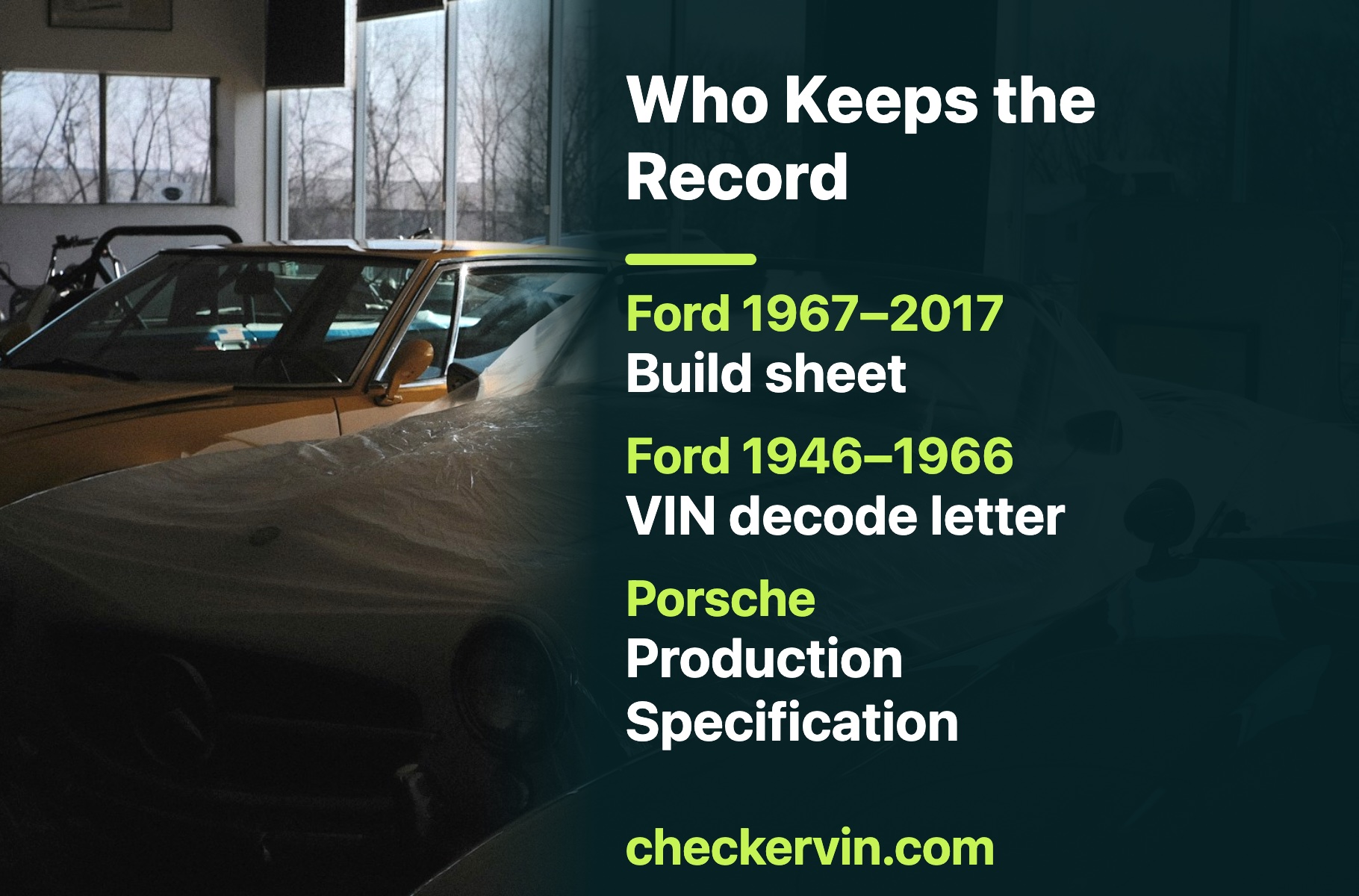
- Ford points owners to a build sheet for 1967 to 2017 models and a VIN decode letter for 1946 to 1966. Porsche issues a Production Specification. GM prints the option codes on a label in the car. Stellantis returns window stickers by VIN on its brand sites.
- What if there is no record?
- That is common on older cars and proves nothing on its own. The configuration then has to be read off the car: the labels, the tags, the casting numbers and, where one survived, a paper sheet left inside during assembly.
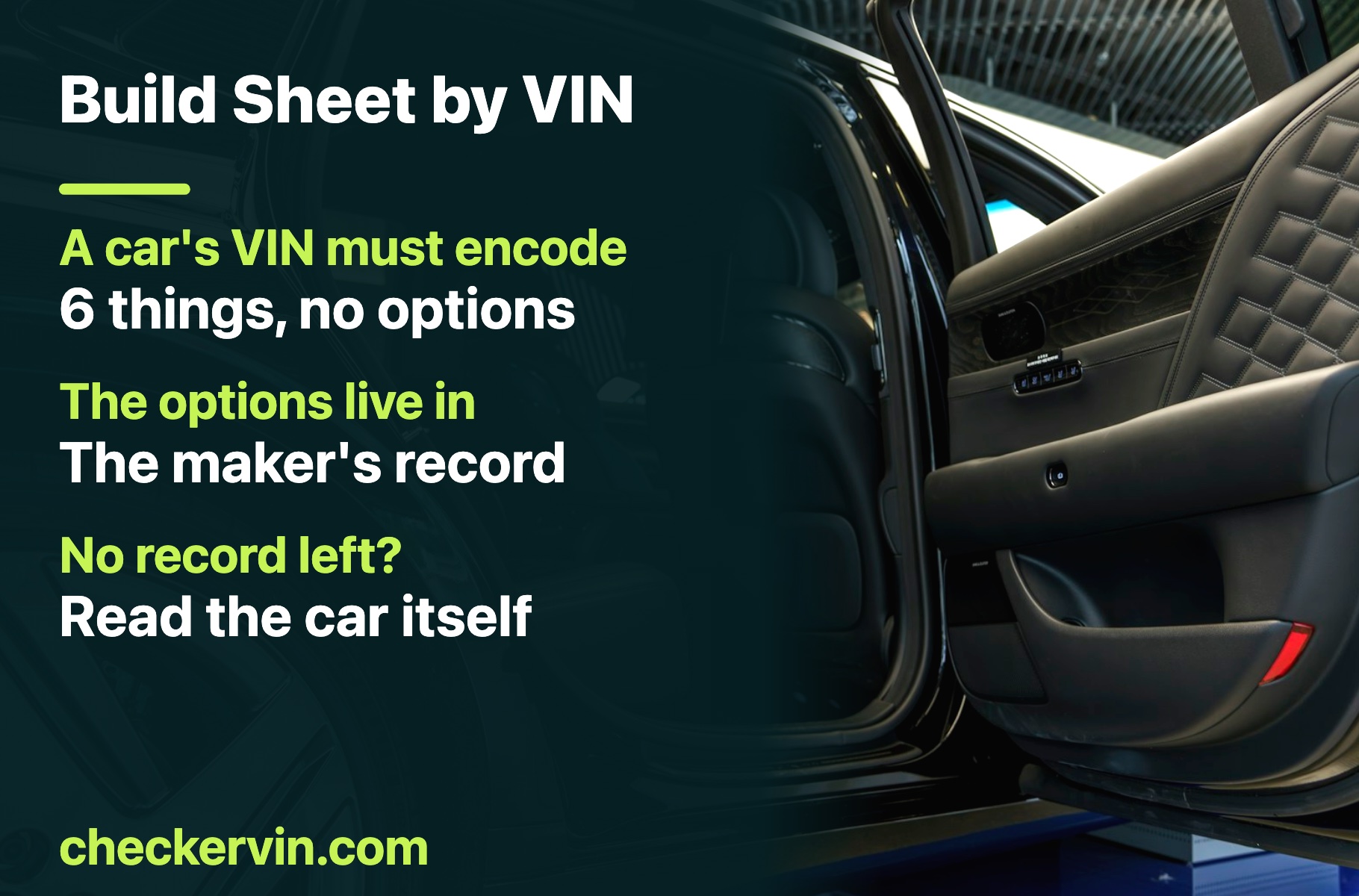
6
Things a car's VIN must encode
49 CFR 565.15, Table I
145
Variables in NHTSA's decoder
None for paint or option codes
1967–2017
Ford build sheet model years
Per Ford owner support
10 years
Porsche Technical Certificate floor
Out of standard production
What a build sheet for a car actually is
The phrase covers several different pieces of paper, and most of the confusion around build sheets comes from treating them as one. A build sheet in the strict sense is a production document: it traveled with the car down the line, or it was generated from the order that told the line what to fit. A window sticker is a sales document, printed for the customer and required by law. A door-jamb label is a safety-compliance document. All three carry the VIN. Only the first was written for the factory.
| Document | Written for, and whether it carries options |
|---|---|
| Build sheet or broadcast sheet | The assembly line. Yes, in the maker's codes, sometimes with axle and production data |
| Window sticker (Monroney label) | The first buyer. Yes, as sold, with prices |
| Option-code label on the car | Parts and service. Yes, as codes, on makers that fit one |
| Door-jamb certification label | Federal compliance. No, though some makers add paint and trim codes |
| Free VIN decode | Identification. No, it returns what the VIN encodes |
The sticker has a page of its own: window sticker by VIN covers what the law forces onto it and where to get a copy. This page is about the production side, and about which manufacturers still let you see it.
Why the VIN can't hold a build sheet
Seventeen characters is not much room, and the regulation that governs them spends that room on identity. Under 49 CFR 565.15, positions four through eight must make certain attributes decipherable, and Table I lists them by vehicle type. For a passenger car the list is 6 items long: make, line, series, body type, engine type and all restraint devices and their location. Trucks add chassis, cab type, brake system and gross vehicle weight rating. Paint, interior, axle ratio and option packages appear nowhere in the table.
The same part tells you where the decoding information goes. Section 565.16(c) requires manufacturers to submit to NHTSA the information needed to decipher their VINs, and 565.16(d) sets the deadline at least 60 days before the first vehicle carrying that coding is offered for sale. That filing is why a free decoder works at all. It is also why a free decoder stops where it does: NHTSA receives the key to the VIN, not the order record behind each car.
What a free decode returned on four sample patterns
To show where the line falls, we ran four VIN patterns through NHTSA's vPIC decoder. Each had its check digit and serial number replaced with wildcards, so none belongs to a real car, and each still decoded down to the trim. The decoder answered every request with 154 fields. Most came back empty.
| Pattern decoded | What came back, and what came back empty |
|---|---|
| 2015 Dodge Charger (2C3) | Trim SE, 3.6-liter V6, rear-wheel drive, built at Brampton, Ontario, manufacturer FCA Canada Inc., and the line “Sales Code: ERB”. Empty: series, transmission style and speeds, base price. |
| 2015 Chrysler 300 (2C3) | Trim Limited, 3.6-liter V6, rear-wheel drive, Brampton, and the same engine sales code, ERB. Empty: series, transmission, base price. |
| 2018 Chrysler Pacifica (2C4) | Trim Touring L, 3.6-liter V6, automatic, front-wheel drive, built at Windsor, Ontario, and a base price of $35,945. Empty: series, engine sales code. |
| 2015 Lexus ES (JTH) | Trim 350, 3.5-liter V6, built at Miyawaka, Fukuoka, Japan, and the series field GSV40L/AVV60L. Empty: transmission style, base price. |
The single most useful line in that table is the one that looks like a typo. Chrysler files its engine sales code with NHTSA, so a Dodge or Chrysler decode can return one Mopar sales code, for the engine, in a field labeled other engine info. That is the only part of a Mopar build sheet a federal database will give you. Paint, interior and package codes are not in it, because the decoder has nowhere to put them: NHTSA's published list of 145 decoder variables has a field for base price, filled on only one of our four patterns, and none for paint color, option codes or packages.
For what each field means and how often it comes back blank, the specs by VIN page works through a full decode.
Dodge and Chrysler build sheet by VIN
Start with a detail that trips people up. Ask vPIC for the manufacturer identifiers filed under the name Dodge and it returns 3 rows, all of them trailer builders that happen to have Dodge in their company name. Ask for Chrysler and it returns 51. A Dodge is filed by its corporate manufacturer, which is why the Charger above decodes with FCA Canada Inc. as the maker. The same goes for the build record: a Dodge VIN build sheet and a Chrysler VIN build sheet come out of the same corporate system and use the same sales-code scheme.
The quickest route to the options is the window sticker. Stellantis serves one from its own brand domains, at a path ending in /hostd/windowsticker/getWindowStickerPdf.dothat takes the VIN as a parameter and answers with a PDF. We requested it with no VIN at all, to see what a miss looks like, and the PDF that came back read: “Sorry, a Window Sticker is unavailable for this VIN.” That is the answer to expect for a car the system no longer holds, and we could not establish how far back its coverage reaches.
- Decode first to confirm the model, trim, engine and plant match the listing
- Try the brand-domain sticker lookup for the option list as ordered
- Ask a Dodge, Chrysler, Jeep or Ram dealer to look up the order record
- On an older car, look for the paper broadcast sheet inside the body
- Check the fender tag on a classic, which carries its own codes
The classic side, with fender tags, broadcast sheets and the car-line codes Chrysler put into older VINs, is covered on the Mopar VIN decoder page. The Jeep build sheet page explains how sales codes read and what the door label must say.
GM: the label in the car is the build sheet
GM took a different approach from the rest: it printed the option list on the car. The 2010 Chevrolet Camaro owner's manual describes the Service Parts Identification Label as “in the trunk” on that model and lists what it carries: the VIN, the model designation, paint information, and production options and special equipment. It ends with an instruction not to remove the label.
The location is set per model, which is why the manual for the specific car matters: on that Camaro it is the trunk, and the manual for another GM vehicle may name somewhere else. Once found, it does most of what a build sheet does, without anyone having to look anything up. Decoding the three-character codes, the classic cowl tag and the federal Incomplete Vehicle Document are all on the GM build sheet page.
Ford: three documents, split by model year
Ford is the one maker that sets out, on its own support site, which build document exists for which years. Its answer depends entirely on the model year.
| Model years | What Ford points you to, and how |
|---|---|
| 1945 and older | Ford's historical information article, rather than a vehicle document |
| 1946–1966 | VIN decode letter: Ford's Customer Relationship Center, with the VIN and door tag codes if available |
| 1967–2017 | Build sheet: purchased from Marti Auto Works, which Ford names as the source |
| 2007–current | Duplicate window sticker: purchased through Ford |
Ford's own description of the build sheet is worth having, because it explains why people want one over the sticker. It calls them Marti Reports, says they provide the complete factory options list and door data plate information, and lists engine size and transmission, paint codes, production date, and axle code and ratio among the details. Axle ratio is a good example of something a window sticker may not spell out and a VIN decode never returns.
Ford also notes that its door-jamb label carries more than the federal minimum: paint code, interior trim, transmission type and axle code sit alongside the VIN and weight ratings. On a Ford that has lost every other document, the door is the first place to look. The sticker route for recent Fords is on the Ford window sticker page.
Porsche: a factory record and an inspected one
Porsche issues two documents and is careful to say they do different jobs. The Porsche Production Specification, which replaces the earlier Certificate of Authenticity, includes vehicle data at the time of delivery only: the VIN, model year and type, production date, exterior and interior color and material, and the optional equipment. It is ordered online through Porsche's vehicle documentation form, and it describes how the car left the factory, not how it is today.
The Porsche Classic Technical Certificate adds the present. A Porsche Classic technician inspects the car, records the engine and transmission numbers actually fitted, photographs it and gives an expert opinion. It can only be ordered through a Porsche Classic Partner or a qualified authorized dealer, and it covers historic models that have been out of standard production for at least 10 years. On a car sold on its originality, the gap between the two documents is the whole question.
The option codes themselves, and why they drive a used Porsche's price, are on the Porsche VIN decoder page.
Lexus: no public build sheet, but a useful decode
People looking for a Lexus build sheet tend to come away empty-handed, and we did too: we found no Lexus-published lookup that returns a build record or a window sticker from the VIN. The free decode does better than on most makes, though. On the 2015 ES pattern above, the series field came back as GSV40L/AVV60L, the manufacturer's own model codes as filed with NHTSA. A second pattern, for a 2019 RX built at Cambridge, Ontario, returned six such codes, because a partial VIN fits several variants until the full number narrows it down.
So for a Lexus the practical sequence is: decode for the model code and plant, then ask a Lexus dealer whether it can pull the factory equipment for the full VIN. We could not confirm from any Lexus source what a dealer is able to retrieve. The Lexus VIN decoder page covers the trim distinctions that make the equipment worth checking.
Third-party build sheet sites: reproduced or rebuilt?
A large share of build sheet searches are for commercial lookup sites rather than for the manufacturers, which is reasonable: they are often quicker. But they are not all doing the same thing, and the difference decides whether the result proves anything.
| What the site does | What you get, and whether it proves an option |
|---|---|
| Retrieves the maker's own document | A copy of a sticker or record the manufacturer still issues. Yes, as far as that document goes |
| Rebuilds from public data | A lookalike assembled from the VIN decode, EPA fuel economy and NHTSA ratings. No, it can only repeat what the decode already says |
| Estimates from the model and trim | Standard equipment for the trim, presented as this car's. No, and it can be wrong about the exact car |
How to request a build sheet by VIN
- 1Read the VIN off the car, not the listingWindshield plate and door-jamb label. They must match each other and the title before any lookup means anything.
- 2Decode it for freeConfirm make, model, trim, engine and plant. On a Dodge or Chrysler, note the engine sales code if the decode returns one.
- 3Go to the maker's own route for that model yearThe Stellantis sticker lookup, Ford's build sheet or decode letter, Porsche's Production Specification, the GM label in the car.
- 4Ask a franchised dealerA parts or service department can look up the record against the VIN. On a car they are selling you, the request costs nothing.
- 5Walk the car against whatever you getThe record says what left the factory. Wheels, seats and engines get changed, so check that what was coded is still fitted.
When the build record cannot be recovered
Sometimes there is nothing to retrieve. The Stellantis lookup answers with its “unavailable for this VIN” PDF. Ford's own table has no build sheet entry for a 2018 or later model, leaving the duplicate window sticker as the option list for those years. Dealer systems do not reach back indefinitely, and a classic built before any of this was digitized may only ever have had the paper copy that rode down the line with it.
None of that is a warning sign by itself. It means the configuration has to be read off the car, which is slower and describes the vehicle as it stands rather than as it was ordered.
- The door-jamb label, for build month and year, weight ratings and, on some makers, paint and axle codes
- Any option-code label in the glove box, trunk, console or cargo area
- The fender, cowl or body tag on an older car
- Engine and transmission casting and stamping numbers
- The axle tag or differential cover for the ratio
- Original dealer paperwork, if the seller kept it
- A marque registry or owners' club, which often holds production data for rare models
Where this information comes from
- 49 CFR 565.15 — VIN content requirementsTable I: what positions four to eight must make decipherable for each vehicle type
- 49 CFR 565.16 — reporting requirementsWhy manufacturers file VIN decoding data with NHTSA, and the 60-day deadline
- NHTSA vPIC — VIN decoding APIThe decodes, the variable list and the manufacturer identifier counts on this page
- Ford — requesting a VIN decode letterWhich Ford document exists for which model years
- Ford — where to find vehicle specificationsFord's description of the build sheet and the door-jamb label
- Porsche Classic — Technical CertificateThe Technical Certificate compared with the Production Specification
- 2010 Chevrolet Camaro owner's manualService Parts Identification Label, section 11
- How we made this pageWritten by the CarCheckerVIN editorial team with AI assistance from NHTSA vPIC and other public records; facts checked November 2026.
Keep reading
Frequently asked questions
How do I get a Dodge build sheet by VIN?
Start with the free decode to confirm the car, then try the window sticker endpoint Stellantis runs on its own brand domains, which takes a VIN and returns a PDF where a label is on file. The sticker lists the options as ordered, with their sales codes. If it returns nothing, a Dodge dealer can look up the order record, and on an older car the paper broadcast sheet may still be inside the body.
Can I get a Chrysler build sheet by VIN for free?
The identity half is free: NHTSA's decoder returns make, model, trim, engine and assembly plant for a Chrysler VIN. The option half lives in the manufacturer's records. The brand-domain window sticker lookup costs nothing when it has the vehicle, and asking a dealer costs nothing either. Neither is guaranteed to hold an older car.
What is a build sheet for a car?
The factory's record of how one specific vehicle was built: its paint, trim, engine, transmission, axle and every option, usually in the manufacturer's own codes. Some makers left a paper copy in the car, some print the codes on a label, and some keep the record internally and sell copies. None of it is encoded in the VIN.
Is a build sheet the same as a window sticker?
No, though they overlap. The window sticker is the federally required sales label, listing price, standard equipment and options as sold. A build sheet is a production document and can carry things the sticker never shows, such as axle codes and production dates. Where a maker no longer issues a build sheet, the sticker is the nearest substitute.
Is there a Lexus build sheet?
We could not find a public Lexus lookup that returns one. A free decode of a Lexus VIN does return the manufacturer's model codes in its series field, along with engine and plant. For the factory equipment, ask a Lexus dealer what it can pull from the full VIN.
Are third-party build sheet sites official?
Some reproduce a document the manufacturer still issues; others rebuild a lookalike from public decode, fuel economy and safety data. Only the first is the factory record. Read the site's own description of where its data comes from before treating the result as proof of an option.
Start with the free decode
Enter any VIN for the factory model, trim, engine, assembly plant and open safety recalls. Free, no account.
Run a free VIN check