The short answer
- Why does my Mopar VIN not decode?
- It predates the 17-character standard, which arrived for the 1981 model year. Before that Chrysler used its own shorter scheme, and there is no common format for a general decoder to read.
- What should I read instead?
- The fender tag under the hood, alongside the VIN plate. On a classic Mopar the tag carries the build detail — paint, trim, options, build date — that the VIN does not.
- Does it prove the car is genuine?
- The VIN is the strongest single piece of evidence because the car line and engine are encoded in it. It is not proof alone: tags come off and numbers get restamped.
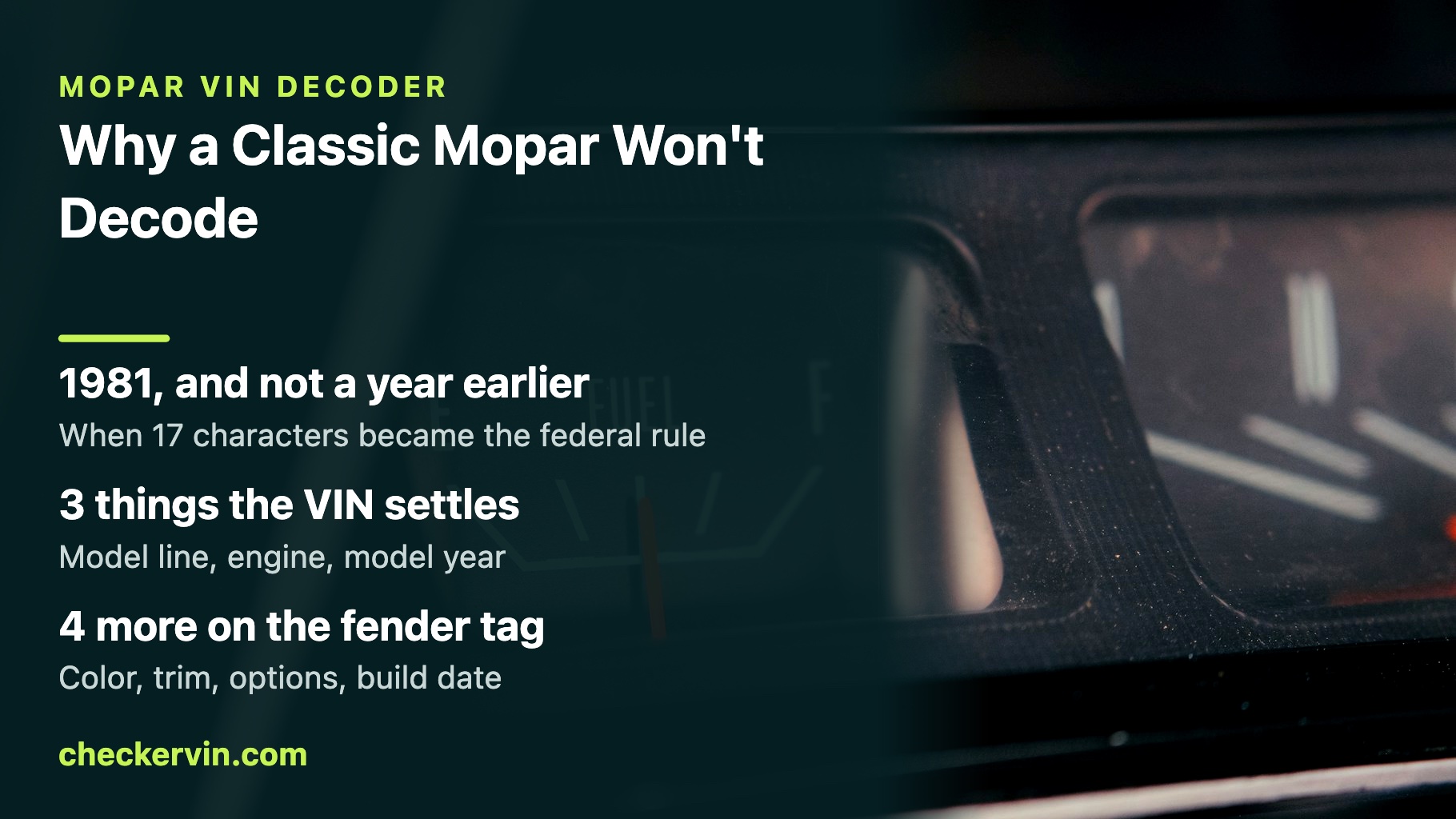
1981
When 17 characters arrived
Everything before is Chrysler's own scheme
Fender tag
Where the build detail lives
Under the hood, not in the VIN
Engine
The character that matters most
It is what separates a clone from a real one
Free
Decoding a 1981-or-later VIN
No account needed
What “Mopar” actually means
Worth settling first, because it explains why this search behaves oddly. Mopar is not a marque. It is Chrysler’s parts and service brand — the name on the boxes and the dealership service counter — and enthusiasts long ago adopted it as shorthand for the corporation’s vehicles collectively.
So a Mopar is a Chrysler, a Dodge, a Plymouth, an Imperial, and in the modern era a Jeep or a Ram. One word covering several marques is why a single search term pulls in cars that have nothing else in common, and why a Mopar decoder has to be a family decoder rather than a marque one.
| Marque | Status |
|---|---|
| Chrysler | Still building cars |
| Dodge | Still building cars |
| Plymouth | Ended — the classic era is all there is |
| Imperial | Ended — a separate marque for much of its life |
| Jeep and Ram | Modern additions to the same corporate family |
Two different questions wear the same words
The phrase “Mopar VIN decoder” is asked by two people who want entirely different things, and most pages answer only one of them without saying which.
| Who is asking | What they actually need |
|---|---|
| Someone at a parts counter | Identify a current vehicle so the right part is ordered — the manufacturer's own tool does this |
| Someone looking at a classic | Establish what a pre-1981 car left the factory as, and whether the seller's description survives it |
If your vehicle is from 1981 or later, the seventeen characters follow the federal standard and an ordinary decode returns the build. The rest of this page is for the other question, because that is the one no general tool answers.
Why a decoder returns nothing on a classic Mopar
The answer is a date. The seventeen-character VIN became mandatory for the 1981 model year, and 49 CFR Part 565 — the rule that fixes what each position means, which characters may appear and how the check digit is computed — governs vehicles from that point on. Before it, no federal rule set the format at all.
What existed instead was each manufacturer’s own scheme. Chrysler ran one, Ford ran another, General Motors ran a third, and they shared neither length nor logic. A modern decoder is built to read a standard; handed a number that predates the standard, it has nothing to apply and returns nothing. The tool is not broken and neither is the number.
| Era | What the number is |
|---|---|
| 1981 model year onward | Seventeen characters under 49 CFR 565, with a check digit |
| Before 1981 | Chrysler's own scheme — shorter, no check digit, no federal format |
What the 1981 rule actually fixed
It is worth being concrete about what changed, because the difference explains why a decoder can read one number and not the other. 49 CFR Part 565 did not merely require a number. It fixed what each position of that number means, for every manufacturer selling into the United States, in the same order.
| Characters | What the rule assigns them to |
|---|---|
| 1–3 | World Manufacturer Identifier — country, manufacturer and vehicle type |
| 4–8 | Vehicle Descriptor Section — the maker's own description of model, body, engine and restraints |
| 9 | The check digit, standing alone |
| 10 | Model year |
| 11 | Assembly plant |
| 12–17 | Sequential production number |
Three further constraints come with it. The letters I, O and Q never appear anywhere in a VIN, because each is too easily confused with a numeral. The number must be unique for a long enough span that two vehicles in service cannot share one. And the descriptor section is the manufacturer’s own vocabulary, published to the agency rather than invented at the point of decoding.
That last point is the one that matters here. A decoder does not know what any particular character means by inspection. It knows that position ten is the model year because the rule says so, and it knows what the maker’s descriptor characters mean because the maker filed them. Neither of those exists for a car built in 1970. There is no filed vocabulary and no fixed position map, so a general tool has nothing to apply.
The check digit a classic does not have
One position of a modern VIN does no describing at all. Position nine is arithmetic: each of the other sixteen characters is converted to a value, multiplied by a fixed weight for its position, and the total divided by eleven. The remainder is the check digit, with a remainder of ten written as the letter X.
The practical effect is that a modern VIN validates itself. Mistype one character and the arithmetic stops agreeing, and the error surfaces immediately rather than three conversations later. It is a small piece of engineering that quietly prevents an enormous amount of confusion.
A pre-1981 number has no such position. Nothing in it cross-checks anything else, so a digit read wrong off a corroded plate is simply a different number that looks equally plausible — and it will be repeated faithfully by everyone who receives it, into a registry query, into a classified advertisement, onto a bill of sale.
Where the numbers are on a classic Mopar
- 1The dash plate, driver's sideOn most of these cars the VIN sits on a plate at the top of the dash panel on the left side, readable through the windshield from outside the car. That placement is why it can be checked without opening anything.
- 2The fender tag, under the hoodA separate metal plate carrying the coded build information. This is the one the Mopar community reads, and it is covered in its own section below.
- 3Body and structural stampingsDepending on year and plant, numbers appear stamped on body components and structure. These are the ones that are difficult to change, which is exactly why they are checked.
- 4The broadcast sheet, if it survivedThe paper sheet that traveled the assembly line with the car. Copies turn up under seats, above the glovebox, inside the springs. Finding one is luck rather than method.
The fender tag, and why it matters more here
On most makes the identification plate is the end of the story. On a classic Chrysler product it is the beginning, because the corporation attached a second plate carrying the build detail in code — commonly called the fender tag.
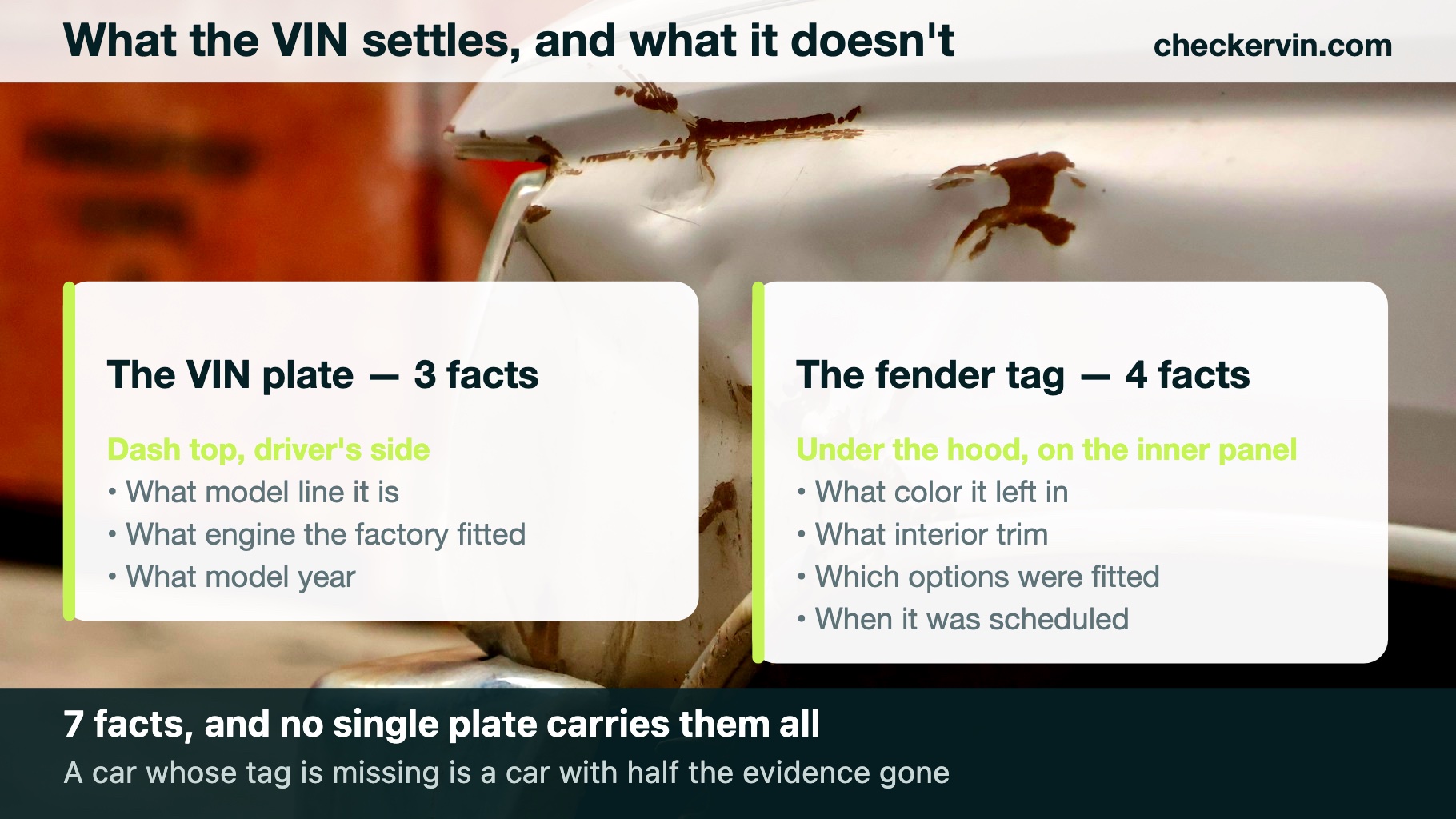
What it records is the specification as ordered and built: paint, interior trim, the option codes fitted, and scheduling information including a build date. That is the detail that decides value on a collector car, and almost none of it lives in the VIN.
| Question about the car | Which plate answers it |
|---|---|
| What model line is it | The VIN |
| What engine did it leave with | The VIN |
| What model year | The VIN |
| What color was it originally | The fender tag |
| What interior trim | The fender tag |
| Which options were fitted | The fender tag |
| When exactly it was scheduled | The fender tag |
Read that split and the buying discipline follows from it. A car whose VIN supports the seller’s claim but whose fender tag is missing is a car where half the evidence is gone — and on these vehicles the missing half is the half that carries the color, the trim and the options that the price is being justified with.
The clone problem, and why it is worse on Mopars
Every collector market has cars pretending to be better cars. The Mopar market has it acutely, for a reason that is structural rather than cultural: the corporation sold the same body shell as an ordinary family car and as a high-performance model, and the visible difference between them is largely badges, stripes and trim.
A plain sedan and a car worth many times as much can share a silhouette. Badges unbolt. Stripes are a decal. Paint is a weekend. What does not change that easily is the number the factory stamped into the car, which is precisely why the number carries the weight it does in this market.
Restamps, replaced tags, and why the number is not self-proving
There is an uncomfortable corollary to everything above. If the number carries the value, then the number is worth falsifying, and on cars of this age the physical barriers to doing so are lower than people assume.
A fender tag is a metal plate attached to a panel. Plates come off, and reproduction tags are openly manufactured and sold for restoration work, which is a legitimate trade with an obvious secondary use. Stamped numbers can be ground and re-struck. Panels containing stamped numbers can be replaced entirely, sometimes for honest reasons after collision or rust repair.
None of that means the evidence is worthless. It means the evidence is corroborative rather than conclusive, and that a claim is settled by several independent records agreeing rather than by any single one. Where the money is large enough, the recognized route is a marque authenticator or judge who has seen enough genuine examples to know what a factory strike looks like — a service that exists precisely because the plates alone do not close the question.
The character that settles the argument
Here is why the VIN matters so much on these cars despite carrying less information than a modern one. Chrysler encoded the car line and the engine into the number itself. Not the trim, not the color — but what model it was and what engine the factory fitted.
That is the exact pair of facts a clone has to misrepresent. Someone selling an ordinary car as a performance model is claiming a car line the VIN does not support, an engine the VIN does not support, or both. The number is where the story either holds or stops holding, which is why every serious classified for one of these cars quotes it and every serious buyer decodes it before traveling.
- Get the full VIN from the seller before you travel, not when you arrive
- Decode it against a specialist source written for that era and marque
- Check the car line the number gives against the model being advertised
- Check the engine the number gives against the engine in the car
- Read the fender tag for the color, trim and options the price assumes
- Ask the marque registry, which is where documented cars are already recorded
A-body, B-body, E-body: the vocabulary sellers use
Mopar listings are written in platform letters rather than model names, and a buyer who does not have the vocabulary is at a disadvantage in the conversation. The letters denote the body platform a car was built on, and several marques shared each one.
That sharing is the point. A platform carried both plain and performance models across Dodge and Plymouth simultaneously, which is exactly the structure that makes the clone question live. When a seller says a car is a B-body, they have told you the platform and nothing whatever about which version of it you are looking at.
Plymouth, Imperial and the marques that stopped
Two names in this family produce no modern vehicles at all, and that changes how you research them. Plymouth ended, and Imperial ran for long stretches as a marque in its own right rather than a Chrysler model. Every Plymouth is therefore a classic by definition, and every Plymouth VIN predates or straddles the federal standard.
The practical consequence is that there is no manufacturer lookup to fall back on for these cars the way there is for a current Dodge. The registries, the club archives and the specialist decoders are not a second-best option here — for a Plymouth they are the only option, and they are generally very good, because the people who built them care about exactly this question.
What the marque registries actually hold
For pre-1981 cars the useful records are not held by any agency. They are held by enthusiasts, and it is worth understanding what that means before you rely on them.
A marque registry is a catalog of documented cars, maintained by people who care about a particular model. Owners submit their vehicles with whatever evidence they have; the registry records the numbers and often the history. Over decades that accumulates into something no commercial database matches for these vehicles, because nobody else was keeping the records at all.
The limits follow from the same fact. A registry only contains cars somebody bothered to register, so absence from one is not evidence of anything — plenty of genuine cars have never been submitted. Standards of proof vary between registries. And a registry records what was submitted, which is not always the same as what was verified.
Used with that in mind they are the strongest tool available. A car that appears in a registry with a history attached is in a different evidential position from one that does not, and a car that appears in a registry as a different specification from the one being advertised is a conversation you want to have before money moves.
Verifying a car someone is asking real money for
- 1Collect every number before you goThe VIN from the dash plate, the fender tag, and any stampings the seller can photograph. A seller unwilling to photograph them has told you something.
- 2Decode the VIN against an era-specific sourceGeneral decoders return nothing. Specialist decoders written for the marque and the years do work, and the marque registries hold documented cars.
- 3Read the fender tag independentlyEstablish the color, trim and options the factory recorded, then compare that against the car in front of you and against the asking price.
- 4Look for the documentsA broadcast sheet, a window sticker, dealer paperwork or a registry entry. Any one of them corroborates. None of them is required, and their absence is common rather than damning.
- 5Have the structure inspectedRust on these cars is structural and expensive, and no number tells you about it. The documentation question and the condition question are separate, and both cost money to get wrong.
If yours is a modern Mopar
Everything above applies to the pre-1981 cars. If your vehicle is from 1981 or later, it carries a standard seventeen-character VIN and the ordinary route works: decode it for the factory build and specifications, and check it for open safety recalls, both free.
For the current marques the individual pages go further into each one’s own coding, and the Jeep build documentation — Mopar sales codes and the sheet built into the car — is covered on its own page rather than repeated here.
What a decode returns on a modern Chrysler product is the factory specification as the manufacturer filed it: the model line and body, the engine, the model year, the assembly plant, and the restraint and equipment details recorded in the descriptor characters. The recall check is separate and runs against the manufacturer’s own campaign records, which is why it can name an open repair rather than merely a model that had one.
The overlap with the classic problem is smaller than it looks. On a modern car the number is the record and the build sheet is a convenience. On a pre-1981 car the number is a fragment and the tag is where the build lives, which is why the two halves of this audience end up on different pages despite typing the same search.
What none of this proves
A number establishes what a car was when it left the factory. It says nothing about the fifty years since, and on a vehicle of this age those years are most of the story.
A VIN that supports the seller’s claim is necessary and not sufficient. It does not establish that the car is rust-free, that the engine in it is the engine the number describes, that the work was done well, or that the price is reasonable. Documentation and condition are two separate investigations, and passing one says nothing about the other.
Our own free check covers 1981-and-later vehicles: the factory build, the specifications and open safety recalls, with no account. On a pre-1981 Mopar it will return nothing, and this page exists to explain why that is the expected answer rather than a problem with the car.
Where this information comes from
- eCFR — 49 CFR Part 565, vehicle identification number requirementsThe federal rule that fixes the seventeen-character format, the permitted characters and the check digit — and which governs vehicles from the 1981 model year, not before
- NHTSA — check for recalls by VINFree safety recall lookup for 1981-and-later vehicles
- NHTSA vPIC VIN decoderThe public federal decoder, which reads seventeen-character VINs and returns nothing for a pre-1981 number
Keep reading
Frequently asked questions
Why will my Mopar VIN not decode?
Because it almost certainly predates the federal standard. The 17-character VIN became mandatory for the 1981 model year. Chrysler Corporation cars built before that carry the company's own shorter scheme, which no general decoder reads because there is no common format to read. That is not a broken number or a broken tool.
What is a fender tag on a Mopar?
A metal plate the factory attached under the hood carrying coded build information — the paint, trim, options and scheduled build date for that specific car. On a classic Chrysler product it usually tells you more about how the car was built than the VIN does, which is why the Mopar community reads it so closely.
Does the VIN prove my car is a real Road Runner or Hemi car?
It is the single best piece of evidence, because Chrysler encoded the car line and the engine into the number itself. It is not proof on its own. Tags can be replaced and numbers can be restamped, so a serious claim is settled by the VIN, the fender tag, the broadcast sheet if one survives and the marque registry agreeing with each other.
Is Mopar a car brand?
Not in the way Dodge or Plymouth are. Mopar is Chrysler's parts and service brand, and enthusiasts use it as a collective term for the corporation's vehicles — Chrysler, Dodge, Plymouth, Imperial and later Jeep and Ram. That is why a Mopar search covers several marques at once.
Why is there no check digit on my old Chrysler VIN?
Because the check digit is part of the seventeen-character federal format, which arrived for the 1981 model year. A pre-1981 number has no position that validates the others, so a character read wrong off a corroded plate produces a plausible but different number that nothing will catch. Photograph the plates rather than transcribing them.
What is a broadcast sheet, and do I need one?
It is the paper sheet that traveled the assembly line with the car, carrying the build instructions. Copies turn up decades later under seats or above the glovebox. It corroborates a car strongly when it survives, but most did not, and its absence is normal rather than suspicious.
Can a fender tag be faked?
Reproduction tags are manufactured and sold openly for restoration work, and stamped numbers can be re-struck. That is why a serious claim rests on the VIN, the tag, surviving paperwork and a registry entry agreeing with each other, and why marque authenticators exist for cars where the sums are large.
Where is the VIN on a classic Mopar?
On most of these cars it is a plate on the top of the dash panel on the driver's side, readable through the windshield from outside. Depending on year there are also stampings on body and structural components, which is what investigators and serious buyers check against the visible plate.
For 1981 and later, the VIN still works
Decode any 17-character VIN free for the factory build, specifications and open safety recalls. No account required.
Run a free VIN check