The short answer
- How do you read a Porsche VIN?
- Characters one to three identify Porsche and German assembly. Four to eight cover model, body style, engine and restraint system. Nine is the check digit, ten the model year, eleven the plant, and twelve to seventeen the production sequence.
- How do I identify the generation?
- Decode the model year, then map it to Porsche's type code. A 911 from one generation and the next share a name and almost nothing else — different engines, different known issues and very different values.
- What else should I get?
- The original option list from Porsche, using the VIN. Options were a substantial share of the original price and remain a substantial share of the used value.
WP0
German-built Porsche car
SUVs use a related code
993→992
911 generation codes
Not printed in the VIN
Options
A major share of value
Get the original list
150%
Bond on a gray-market import
49 CFR 591.5(f)(1)
What a Porsche VIN tells you
- Model year, model and body class as filed with NHTSA
- Engine displacement and configuration
- Drivetrain — rear-wheel or all-wheel drive
- Restraint system fitted at the factory
- Country of manufacture and the assembly plant
- Open safety recalls against that exact vehicle
Porsche WMI codes
| Starts with | What it identifies |
|---|---|
| WP0 | Porsche passenger car built in Germany — the sports car range |
| WP1 | Porsche multipurpose vehicle built in Germany — the SUV models |
911 generation codes: the framework that matters
Porsche identifies 911 generations by internal type number, and the entire enthusiast, parts and specialist ecosystem is organized around them. Two 911s a few years apart can be different generations with different engines, different known issues and values that differ by a multiple.
| Code | Roughly which years |
|---|---|
| 993 | Mid to late 1990s — the last air-cooled 911 |
| 996 | Late 1990s to mid 2000s — the first water-cooled generation |
| 997 | Mid 2000s to early 2010s |
| 991 | Early 2010s to late 2010s |
| 992 | Late 2010s onward — the current generation |
The air-cooled and water-cooled divide
The move from air-cooled to water-cooled engines is the defining split in 911 history, and it shapes both the market and what ownership involves.
Air-cooled cars are now firmly in collector territory, valued accordingly, and serviced by specialists who work on them specifically. Water-cooled cars are more usable as everyday propositions and more affordable to buy, with their own generation-specific considerations.
Neither is objectively the better purchase. What matters is knowing which side of the line a car sits on before you form a view about its price, because the two markets behave completely differently.
The IMS bearing era, and how to think about it
Any research into water-cooled 911s and Boxsters from the earlier generations surfaces the intermediate shaft bearing. The concern is real, it is well documented, and it has shaped the market for those cars for years.
Two things are worth being precise about. It affects specific engine types from specific periods rather than every water-cooled Porsche. And by now a large share of affected cars have either had preventive work done or have already failed and been rebuilt — which means the question on any individual car is documentary rather than theoretical.
- 1Decode the VIN and establish the generation and engineThat tells you whether the car belongs to an affected period at all.
- 2Ask directly whether preventive work has been doneAnd ask for the invoice. On an affected car this document materially changes what it is worth.
- 3Ask whether the engine has ever been rebuilt or replacedA rebuilt engine is not automatically a negative, but it must be disclosed and documented.
- 4Have a marque specialist inspect itNot a general workshop. A Porsche specialist knows what to look for on that specific engine and will check oil filter contents and other indicators.
- 5Price the work in if there is no documentationAn undocumented car of that era is not necessarily a bad buy, but it is a car with a known job outstanding.
Option codes and the build sheet
Porsche has always sold heavily optioned cars, and the options were expensive. Two otherwise identical examples can differ by a very large sum in original specification, and much of that difference persists into the used market.
The build record for a VIN lists the option codes the car was actually delivered with. Porsche can supply it, and a dealer can retrieve it. On any Porsche worth real money this is not optional homework.
- Seat type and upholstery specification, which carry substantial value differences
- Wheel specification, and whether the wheels on the car are the ones it was built with
- Suspension and chassis options, which affect how the car drives and what it is worth
- Brake specification, which on some cars is a very large original-cost item
- Transmission choice, which on certain models drives value more than anything else
- Paint, including any special or custom finish
- Delete options, which some buyers specifically seek
Why original specification drives value here more than elsewhere
On an ordinary used car, condition and mileage dominate and specification is a minor adjustment. On a Porsche, specification can be the largest single variable — a well-optioned car in the right colors with the right transmission can be worth substantially more than a base example of the same year and mileage.
That cuts both ways for a buyer. It means the option list is essential homework before you agree a price, and it means a seller who cannot produce one may not know what they have — occasionally in your favor.
How a Porsche legally got into the country
There is a question about a Porsche that almost never gets asked and occasionally matters more than every option code combined: how did this specific car enter the United States? On a Camry the answer is uninteresting. On a marque with decades of European models that were never sold here, it is a real fork in the road, and the federal rule that governs it is public.
49 CFR 591.5 states the principle plainly: no person may import a motor vehicle into the United States unless, at the time it is offered for importation, the importer files a declaration selecting one of a defined list of categories. Every Porsche on American roads came in through one of those boxes, and which box it was still shapes what the car is allowed to do.
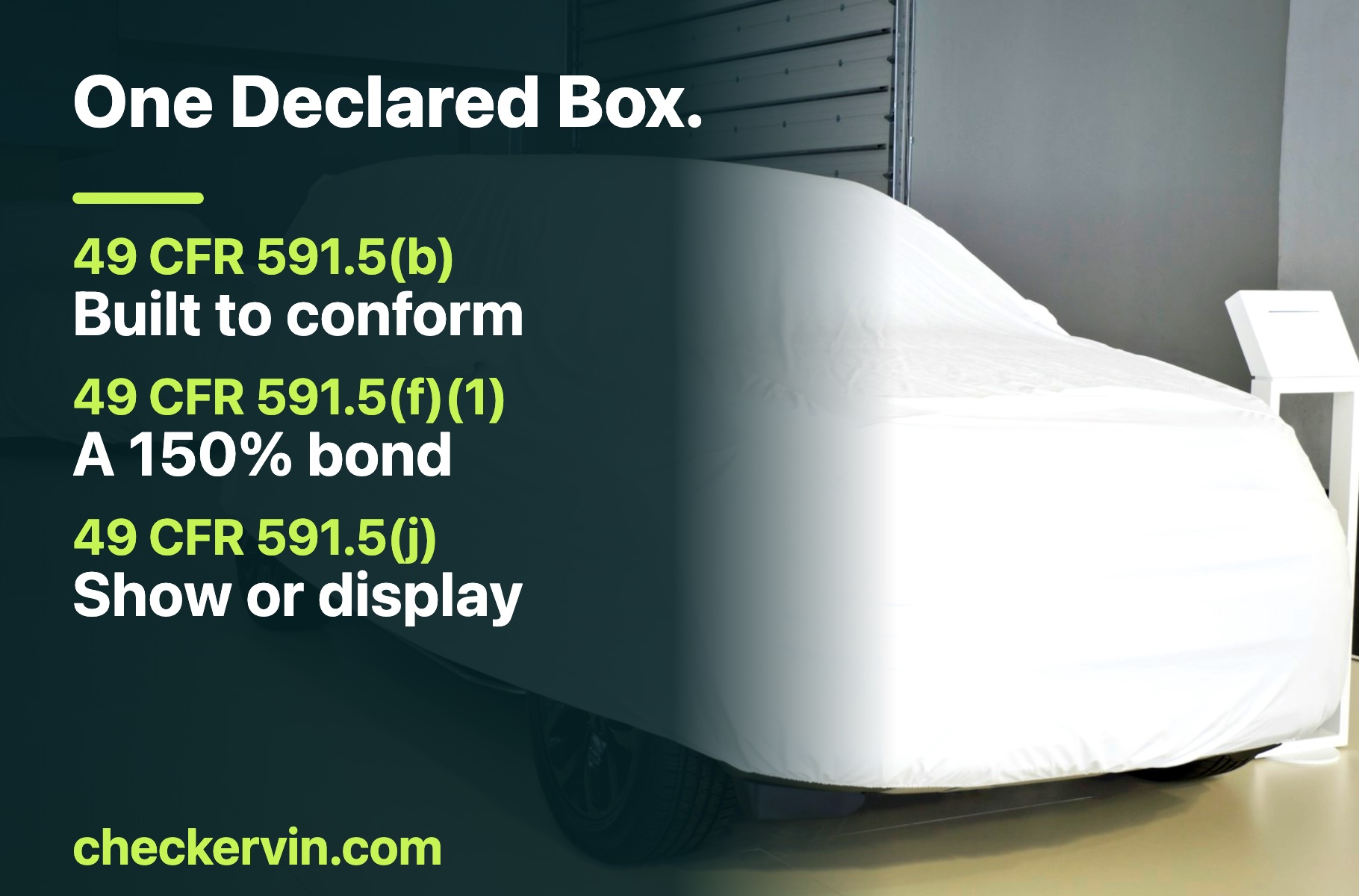
The ordinary route is 591.5(b): the vehicle conforms to all applicable safety, bumper and theft-prevention standards and bears a certification label permanently affixed by the original manufacturer. That is the federally-delivered car, and it is what the overwhelming majority of Porsches sold through American dealers are.
Two other categories are worth a buyer's attention because they place lasting conditions on the vehicle. Under 591.5(d), a nonresident may bring a foreign-registered car in temporarily for personal use for a period not exceeding one year, may not sell it during that time, must export it by the end of that year, and must put a passport number and country of issue on the declaration. Under 591.5(c), a nonconforming vehicle may enter solely for export, labeled to that effect. Neither is a car that should be for sale to you.
The gray-market route, the 150% bond, and who counts as the manufacturer
The interesting category is 591.5(f), which is how a vehicle that does notconform to the federal safety and bumper standards can nevertheless be imported and stay. The conditions are specific.
| 49 CFR 591.5(f) | What it requires |
|---|---|
| (f)(1) | A bond in an amount equal to 150 percent of the dutiable value of the vehicle, on the terms set out in 49 CFR 591.8 |
| (f)(2)(i) | An importer registered with NHTSA under 49 CFR Part 592, whose registration is neither revoked nor suspended |
| (f)(2)(ii) | Or a contract with such a Registered Importer, where the importer is not one |
| (f)(2) | And a determination by the Administrator under 49 CFR Part 593 that this model and model year is eligible for importation at all |
| (f)(3) | And that the vehicle is not a salvage motor vehicle or a reconstructed motor vehicle |
Read (f)(2) carefully, because it is the part people get wrong. Eligibility is determined by model and model year, not by the individual car. A particular European Porsche being desirable, or already sitting in a container, has no bearing on it. If NHTSA has not determined that model and year eligible under Part 593, the 150 percent bond and a Registered Importer's signature do not help.
Then there is a definition in 591.4 that quietly settles a common argument. Original manufacturer means the entity responsible for the original manufacture or assembly of the vehicle, and expressly does not includeany other person who converts the vehicle after its manufacture to conformance with the federal safety standards. In other words, the Registered Importer who federalizes a European car is not the manufacturer of it, however thorough the work. The conversion is somebody else's workmanship added to a Porsche, and it should be inspected and documented as exactly that.
Show or display, and the 2,500-mile leash
The last route is the one that brought some of the most desirable Porsches in America here, and it comes with the tightest strings. A vehicle can be imported under 591.5(j) on the basis that it is of historical or technological interest — the provision usually called show or display.
The documentation requirements sit in 49 CFR 591.6, and they are not a formality. The would-be importer must write to the Administrator in advance with a full and complete statement identifying the vehicle by make, model, model year or date of manufacture, VIN and mileage at the time of the request, and must explain why the vehicle is of historical or technological interest. The request states the intended use, the means of final disposition and a disposition date, and importation proceeds on a permission letter whose unique identifying number is filed with Customs.
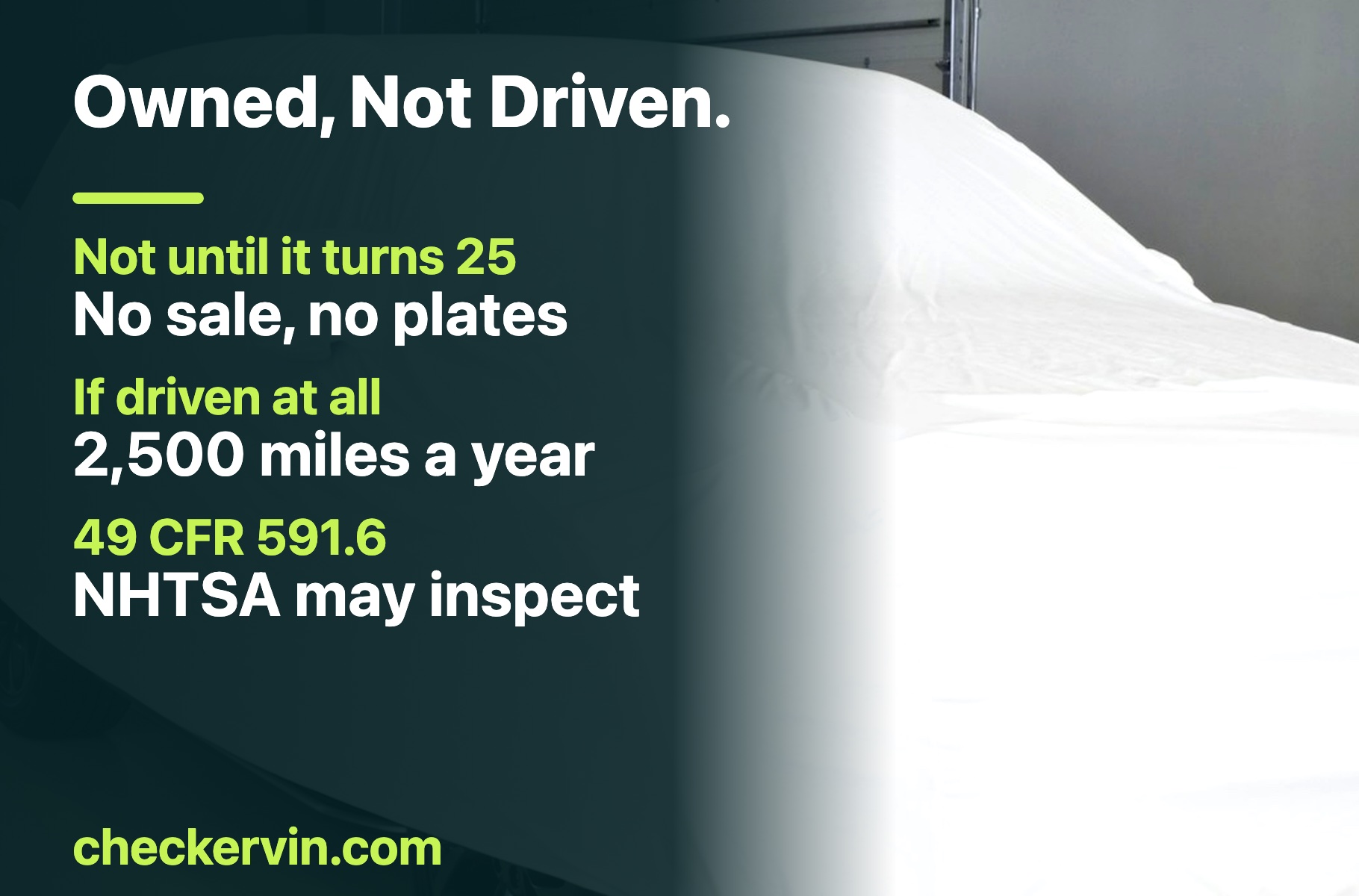
Then the conditions attach, and they attach to the car rather than to the paperwork. Until the vehicle is not less than 25 years old, the importer must not sell it, transfer possession of it or title to it, license it for use, or operate it on the public roads, except on such terms as the Administrator may authorize.
If the importer wants to drive it at all, the request must describe why road use is necessary and include an insurance policy — or a contract to acquire one — carrying as a condition that the vehicle will not accumulate more than 2,500 miles in any 12-month period. That policy has to be maintained until the car is 25 years old, and the importer must state that NHTSA may inspect the vehicle at any time after importation to verify the mileage has stayed within the cap.
- Ask which declaration category the car entered under, and ask to see the paperwork
- On a show-or-display car, confirm whether it has passed its 25th year yet
- Treat an unusually low odometer on such a car as a condition of entry, not a bragging point
- On a federalized car, ask who did the conversion and what documents came with it
- Check the certification label, and whose name is on it
- Remember eligibility under Part 593 attaches to the model and year, not to this car
Track use: ask, and look
Porsches are used on track more than almost any other road car, and track use is not disclosed by any VIN decode or history report. It is also excluded by most warranties.
- Look for harness bar or roll bar mounting holes, and for cage tabs
- Check brake discs and pads for heat damage and unusual wear patterns
- Look at tire wear across the tread — track use leaves distinctive shoulder wear
- Check for a fire extinguisher mount, a battery cut-off, or timing transponder wiring
- Ask directly, and ask whether the car has ever been on a circuit
- Track-day stickers in the service file are a disclosure, not a warning — but price accordingly
A track car that has been maintained properly can be an excellent purchase. One that has been tracked and serviced as though it had not is a different matter, and the service file is where you tell them apart.
Checking Porsche recalls by VIN
Recalls attach to VIN ranges rather than models. NHTSA's free lookup answers it at VIN level, and the manufacturer must perform the remedy at no cost to the owner however many times the car has changed hands.
Buying a used Porsche: the checklist
- 1Decode the VIN and establish the generationModel year to type code. Everything else follows from knowing which car this actually is.
- 2Obtain the original option listBefore you agree a price. It is the largest single input into what the car is worth.
- 3Ask the generation-specific questionsFor an affected era, the bearing documentation. For every era, the engine and gearbox history.
- 4Verify the options are still fittedWheels, seats and brakes in particular.
- 5Pay a marque specialist for a pre-purchase inspectionThis is the least optional item on the list. A general workshop will miss what a Porsche specialist checks as routine.
- 6Read the full service historyContinuity matters. Gaps in the file on a car of this value are a question, not a detail.
- 7Run the free recall checkInstant, free, and the remedy costs nothing.
Where this information comes from
- 49 CFR 591.5 — declarations required for importationThe categories every imported vehicle enters under, including the 150% bond route at (f)
- 49 CFR 591.6 — documents accompanying declarationsShow or display: the historical-or-technological-interest request and the 2,500-mile condition
- NHTSA vPIC — public VIN decoderThe federal database manufacturers file their VIN structure with
- NHTSA recall lookupFree open-recall check by VIN, repaired at no cost by the manufacturer
- EPA fuel economy dataOfficial economy figures by engine and drivetrain configuration
Keep reading
Frequently asked questions
How do I decode a Porsche VIN for free?
Enter the 17-character VIN into a decoder. Porsche files its VIN structure with NHTSA's public vPIC database, so a free decode returns model, model year, body class, engine and plant with no charge and no account. The full option list comes separately, from Porsche.
What does WP0 mean on a Porsche VIN?
WP0 identifies a Porsche passenger car built in Germany — W is the country code for Germany and P0 identifies Porsche. Porsche's SUV models carry a related but distinct identifier.
Is the 911 generation code in the VIN?
Not directly. Codes such as 993, 996, 997, 991 and 992 are Porsche's internal type designations. A decode gives you the model year, which maps to a generation — and on a 911 the generation determines almost everything about what you are buying.
Which 911 generations had the IMS bearing issue?
The concern relates to certain water-cooled engines from the first two water-cooled generations. It is well documented, many affected cars have had preventive work done, and the availability of that documentation is a major factor in what a specific car is worth.
How do I get a Porsche's original option list?
Porsche can supply the build record for a VIN, and a dealer can retrieve the option codes the car was built with. On a Porsche this matters more than on most makes, because options were expensive when new and still drive the used value.
Decode your Porsche in seconds
Enter any Porsche VIN for the factory build, engine, plant and open safety recalls. Free, no account.
Run a free VIN check