The short answer
- What does it cost?
- RepairPal: $1,040–$1,302 across years, $1,117–$1,454 for a 2014. KBB: $1,023–$1,187 for a 2018 in ZIP 94102.
- Why so much?
- On the turbo engines the pump shares a module with the thermostat valve and has its own toothed belt. Parts alone run about $570–$610.
- Is it covered?
- No recall. VW warranty extensions covered certain 2008–2014 and 2014–2021 Jettas; the second can still apply to a 2019–2021 under 80,000 miles.
858
Jetta engine complaints counted
2008–2022, top-five data
10% → 24%
Engine share of each year’s record
2008–2012 vs 2019–2022
2
VW pump warranty extensions
VWP-19-08 and VWP-22-06
$1,040–$1,302
RepairPal, all Jetta years
Parts and labor, retrieved Oct. 2026
The numbers, and whose numbers they are
We do not sell repairs and we publish no price of our own, so every dollar figure here belongs to the site that published it, as served to us in October 2026. RepairPal’s Jetta water pump estimator puts the job at $1,040 to $1,302 across model years, with labor at $472 to $692 and parts at $568 to $609. Its per-year table runs from $950 to $1,242 for a 2012 or 2013, to $1,117 to $1,454 for a 2014, and $1,278 to $1,635 for a 2015. Its 2018 Jetta page shows $1,112 to $1,415.
Kelley Blue Book’s ZIP-specific pages agree. Its 2018 Jetta page, served for ZIP 94102 in San Francisco, shows $1,023 to $1,187. Its 2021 Jetta GLI page, for ZIP 27833 in Greenville, North Carolina, shows $1,040 to $1,160, of which $465 to $525 is parts and $575 to $635 labor. KBB also prints a generic $375 to $787 line in the FAQ on these pages; the same sentence appears on unrelated models, so we do not treat it as a Jetta estimate. We could not open RepairPal or KBB directly from our tools, so the figures above are the ones those pages served in search results on October 26, 2026.
Two things stand out. The range sits above $1,000 for nearly every year, and close to half of it is parts. That is unusual for a compact sedan, and it points to what Volkswagen bolted to the side of the engine.
Why a Jetta pump costs more than a Focus pump
On a 2008–2018 Focus, Ford’s catalog lists a gasoline water pump at $55 to $62 on its own pulley; our Focus water pump post walks through it. On the turbocharged Jetta engines the part is different in kind. Audi’s 2013 training document for the third-generation 1.8L and 2.0L EA888 engines, a copy of which sits on NHTSA’s servers, describes an Engine Temperature Control Actuator, a pair of electrically driven rotary valves that replace a simple thermostat. It is “installed as a module on the cooling side of the engine, together with the coolant pump.” The document’s cutaway labels a “toothed drive belt for coolant pump” and a pump drive gear: the pump has a small belt of its own, separate from the accessory belt.
The 1.8-liter turbo that arrived in the 2014 Jetta, which VW’s own service notes list as engine codes CPKA and CPRA, is commonly identified as a member of that third-generation family. So is the 2.0-liter turbo in later GLIs. On those cars a pump failure usually means replacing a pump-and-valve assembly with a small belt, which is why RepairPal’s parts line is close to ten times a Focus pump.
The earlier 2.0-liter turbo, engine codes CCTA and CBFA, used a different design with the same reputation. NGP Racing, which sells an aluminum replacement for it, says the TSI pump “has only been available as a plastic unit” from the factory, and its kit includes a dedicated water pump belt. The smaller 1.4-liter turbo also turns its pump with a toothed belt of its own: Volkswagen’s 2018 maintenance schedule lists “coolant pump toothed belt” as a check at 150,000 miles “1.4L Jetta only.”
Which engine you have, by model year
Federal fuel economy records at fueleconomy.gov list every engine Volkswagen certified for each Jetta sedan year. The engine decides which pump, which bulletins and which warranty extension apply:
| Model years | Engines EPA lists for the Jetta |
|---|---|
| 2008 | 2.5L five-cylinder; 2.0L turbo |
| 2009–2010 | 2.5L; 2.0L turbo; 2.0L turbo diesel (TDI) |
| 2011 | 2.5L; 2.0L four-cylinder (non-turbo); TDI |
| 2012–2013 | 2.5L; 2.0L; 2.0L turbo (GLI); TDI. Jetta Hybrid 1.4L turbo from 2013 |
| 2014–2015 | 2.0L; 1.8L turbo; 2.0L turbo; TDI; Jetta Hybrid |
| 2016–2018 | 1.4L turbo; 1.8L turbo; 2.0L turbo. No diesel |
| 2019–2021 | 1.4L turbo; 2.0L turbo in the GLI |
| 2022 | 1.5L turbo; 2.0L turbo in the GLI |
The diesel matters less here than its history suggests. The 2009 through 2015 TDI cars went through Volkswagen’s emissions buyback and fix programs, which are a separate story; for a pump quote the point is simply that a TDI is not a turbo gasoline engine and the gasoline figures do not transfer. The engine size lookup by VIN settles which one a given car has before anyone orders a part.
Volkswagen extended pump coverage twice
This is the part of the Jetta story most cost pages leave out. Volkswagen settled two class actions over engine water pumps, and each produced a warranty bulletin that Volkswagen filed with NHTSA.
Bulletin VWP-19-08, dated December 2, 2019, covers certain 2008–2014 Jettas, along with the GTI, Eos, CC, Tiguan, some Passats and Beetles. It extends coverage on a failed “Primary Engine Water Pump” to 10 years or 100,000 miles from the original in-service date, parts and labor, and pays a sliding share of engine damage the pump caused. In years eight through ten, that share falls to between 25% and 5% depending on mileage.
Bulletin VWP-22-06, dated June 21, 2022, covers certain 2014–2021 Volkswagens, the Jetta among them. It is broader in what it covers, naming the water pump, the thermostat and the thermostat housing, and shorter in time: 8 years or 80,000 miles. OpenClassActions, which tracks the case, describes the class as certain 2014–2021 Volkswagen and Audi vehicles with 1.8-liter or 2.0-liter engines, which on a Jetta means the 1.8T and the GLI.
Our Volkswagen warranty check by VIN page explains how VW’s coverage extensions attach to a VIN and what a dealer sees. For a pump quote, the practical step is to ask a VW service desk to read the VIN before an independent shop starts work, because the extension only pays at an authorized dealer.
What the complaint record says
NHTSA has no water pump category. Owners file pump failures under ENGINE, alongside oil leaks, misfires, carbon buildup and everything else that goes wrong under the hood, so ENGINE is context and an upper bound, never a pump count. Across 2008–2022, our corpus counts 858 ENGINE complaints in the years where ENGINE reached the top five, at least 16% of the 5,457 complaints on file for the nameplate.
The shape is more useful than the total. ENGINE made up at least 10% of complaints for the 2008–2012 cars, 23% for 2013–2017, and 24% for 2019–2022. Total complaints fell sharply over that stretch, but the engine’s slice of each year grew. The 2019 model year, the first of the current generation, has the most ENGINE complaints of any Jetta year at 147, and 2022 has the highest share, though on only 42 complaints.
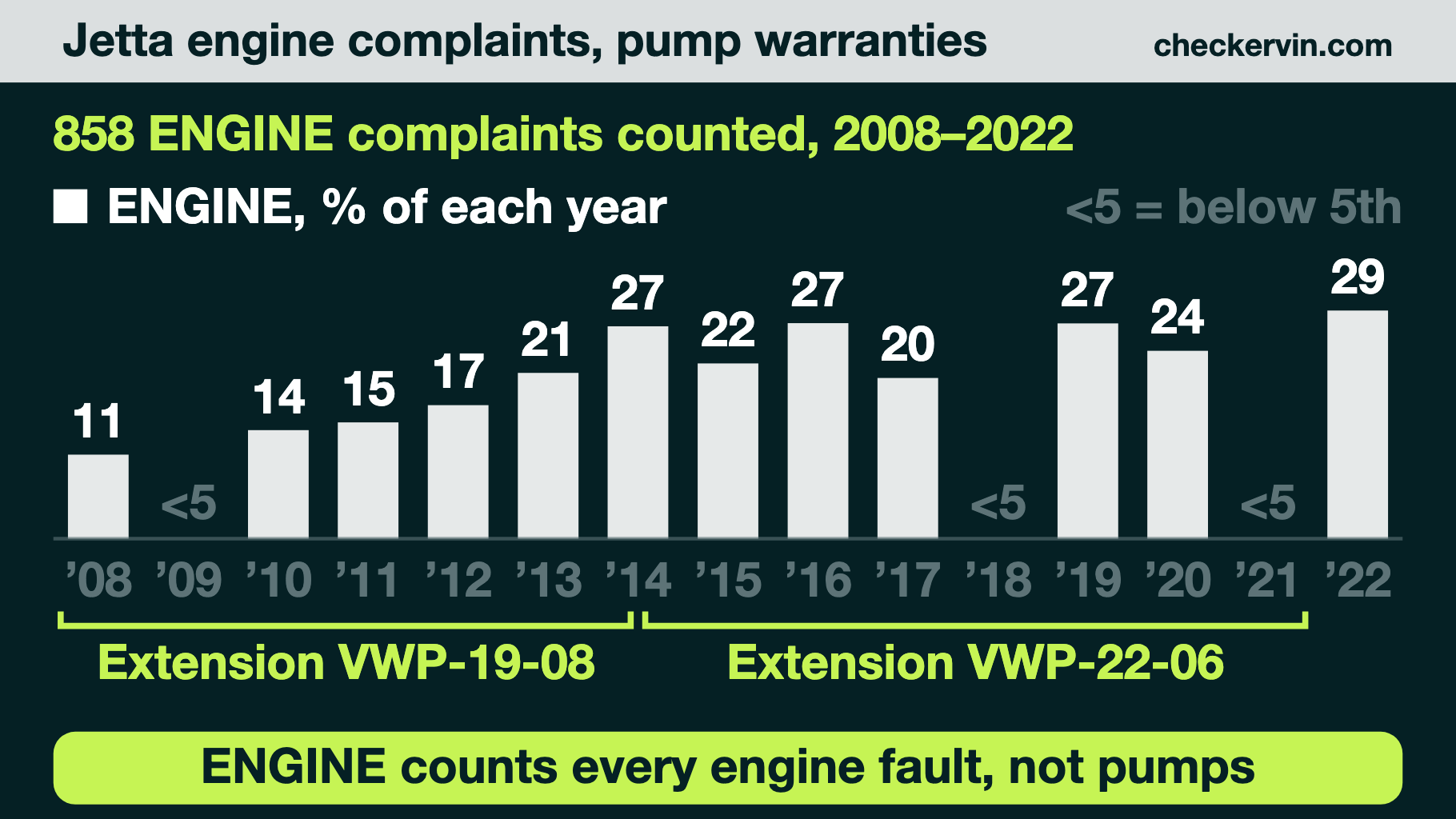
The years under the first extension hold at least 568 of the counted engine complaints; the years under the second hold at least 395, with 2014 in both. The full year-by-year picture, beyond the engine, is on the Volkswagen Jetta years-to-avoid page.
What the record does not prove
Three limits apply. First, our data stores only each year’s five largest complaint categories. In 2009, 2018 and 2021, ENGINE ranked below fifth, which means it was smaller than the fifth category, not zero, so every total above is a minimum. The 2018 model year is a special case: only 31 complaints are on file for it, too few to read anything into.
Second, when we read the owner narratives behind the live NHTSA record, only a handful mention a water pump, coolant pump or thermostat housing by name, and none on cars newer than 2016. The strongest evidence that Jetta pumps fail is not in the complaint database at all. It is in Volkswagen’s own settlement bulletins, which is why we lean on them.
Third, our file runs slightly ahead of NHTSA’s live count for two years. When we checked in October 2026, the live database showed fewer complaints for the 2013 and 2014 Jetta than our corpus holds, while the other years matched within a few reports. That shifts those two years’ bars a little, not the pattern.
Coolant loss that is not the pump
Volkswagen’s service messages on the Jetta name several leaks and overheating causes that a quick look can blame on the pump. Each is cheaper to fix than a module, and each has a VW document behind it.
| Car and engine | What Volkswagen told technicians |
|---|---|
| 2.0L turbo (CCTA/CBFA) | Tech Tip 19-13-02: engine oil on the pump can swell its gasket and cause the leak. Fix the oil leak, clean the area, then vacuum-bleed the system |
| 2011–2014 2.5L | Tech Tip 19-18-01: overheating with little coolant flow can be a restricted oil cooler trapping air in the thermostat housing |
| 2013–2016 1.4L turbo (incl. Hybrid) | Bulletin 2045451: a coolant pipe can rub on the air filter housing and leak; replace the pipe |
| 2019 Jetta | Circular 19O3: the coolant bottle may leak into the coolant level sensor connector |
The first row matters for anyone quoted on an older GLI or 2.0T. If the leak started with engine oil on the pump, a new pump alone will leak again. It also matters for the old extension, whose dealer guidance says a pump damaged by another component’s failure, such as an oil leak from the valve cover, is not covered.
Is there a recall on the Jetta water pump?
No Volkswagen safety recall names the water pump. We checked NHTSA’s recall database for every Jetta model year from 2008 through 2022. The one recall that does mention a pump is not Volkswagen’s: in 2014 the Gates Corporation recalled aftermarket Tru-Flow pumps, part TFW 41127, sold through certain NAPA stores for cars including 1999–2008 and 2011–2013 Jettas. On those pumps, Gates said, the pulley or sprocket that turns the timing belt could crack. If a 2011–2013 Jetta had its pump replaced around 2013–2014 with an aftermarket part, that recall is worth a look.
Two Volkswagen recalls sit near the cooling system without being pump problems: 14V182 covered leaking transmission oil cooler seals on 2014 Jettas with the 1.8T, and 17V070 covered 2017 Jettas whose 1.4L block could be cast improperly and seize. Check a specific car through the Volkswagen recall check; our TSB versus recall page explains why a tech tip like 19-13-02 pays for nothing on its own while a recall is free.
Can you keep driving it?
- Low coolant or temperature warning in the cluster
- Coolant level dropping between top-ups
- Wetness or dried coolant crust around the pump housing
- A sweet smell or steam after a drive
- Temperature gauge climbing above its usual position
A slow seep with a steady gauge gives you a few days to book the work, if you check the level every morning. A climbing gauge ends that. An aluminum head that overheats can warp, and on a turbo engine that is a far larger bill than any pump. Pull over and let it cool rather than limping to the shop.
Before you authorize the repair
- Confirm the engine by VIN: 2.5L, 2.0L, 1.4T, 1.8T, 2.0T or TDI each use different parts
- On a 2019–2021 under 80,000 miles, have a VW dealer check the VIN for extension VWP-22-06
- Ask whether the leak was seen at the pump, or only the level is dropping
- On a 2.0T, ask whether there is engine oil on the pump
- Get the pump, thermostat, belt and coolant as separate lines
- Refill with the coolant Volkswagen specified, and keep the receipt
The last point matters more on a VW than on most cars. Both extensions excluded damage from improper coolant and asked owners to prove the right fluid was used. The coolant type lookup by VIN shows what the factory specified.
If you are buying the Jetta, not repairing it
For a shopper, the water pump is a known cost, not a deal-breaker. The published estimates above put it a little over $1,000 on most years, so treat it as a line in the budget on any turbo gasoline Jetta that has not had one, and ask the seller for receipts. A documented pump and thermostat replacement with the correct coolant is worth something on these cars.
On a 2019–2021 GLI, check whether the car might still be inside VWP-22-06; on any year, look for crust around the pump and a low reservoir during the inspection. A Volkswagen VIN decode confirms the engine and build, and the recall check on the same VIN shows whether anything is open. If you are weighing the Jetta against a Toyota, our note on Corolla transmission fluid changes covers a maintenance cost on the other side of that comparison.
Where this information comes from
- NHTSA — Jetta complaints, recalls and manufacturer communicationsThe federal complaint record behind every figure here, the recall list with no VW pump campaign, and the bulletins below.
- Volkswagen bulletin VWP-19-08, Water Pump Limited Warranty Extension (NHTSA-hosted)10-year/100,000-mile pump coverage on certain 2008–2014 Jettas, with prorated engine damage.
- Volkswagen bulletin VWP-22-06, Water Pump Limited Warranty Extension (NHTSA-hosted)8-year/80,000-mile coverage of pump, thermostat and housing on certain 2014–2021 Jettas.
- Audi eSelf-Study Program 920243, third-generation EA888 (NHTSA-hosted)Describes the coolant pump installed as a module with the thermostat actuator and its toothed drive belt.
- Volkswagen Tech Tip 19-13-02 (NHTSA-hosted)2.0L CCTA/CBFA leaks from the water pump area: engine oil swelling the pump gasket, and the bleed procedure.
- NHTSA — recall lookup by VINWhere to confirm the Gates aftermarket pump recall 14E007 and other open campaigns on a specific car.
- EPA and DOE — fueleconomy.gov vehicle recordsThe per-year Jetta engine listings behind the engine table.
- RepairPal — Volkswagen Jetta water pump replacement estimateThe $1,040–$1,302 range and per-year figures quoted above, as served October 26, 2026.
Keep reading
Frequently asked questions
How much does it cost to replace the water pump on a Volkswagen Jetta?
Most published estimates land between about $950 and $1,650. RepairPal's Jetta estimator shows $1,040 to $1,302 across model years, with $568 to $609 in parts, and lists $1,117 to $1,454 for a 2014 and $1,278 to $1,635 for a 2015. Kelley Blue Book's 2018 Jetta page, for ZIP 94102 in San Francisco, shows $1,023 to $1,187. Those are their figures as served in October 2026; your ZIP code and engine move them.
Why is a Jetta water pump more expensive than on other compact cars?
On the turbocharged gasoline engines the pump is not a simple part on a pulley. Audi's training document for the third-generation 1.8L and 2.0L EA888 engines describes the coolant pump installed as one module with the electronically controlled thermostat valve, turned by its own small toothed belt. RepairPal's parts figure for the Jetta, $568 to $609, is close to ten times the $55 to $62 that a Ford dealer's parts catalog listed for a Focus pump in October 2026.
Is there a recall or extended warranty on the Jetta water pump?
There is no Volkswagen safety recall for the pump. There were two warranty extensions from class-action settlements. Bulletin VWP-19-08 covers certain 2008–2014 Jettas for 10 years or 100,000 miles from the in-service date, and VWP-22-06 covers the pump, thermostat and thermostat housing on certain 2014–2021 Jettas for 8 years or 80,000 miles. The first has run out on practically every car; the second can still apply to a 2019–2021 car under 80,000 miles. A VW dealer can check the VIN.
What are the signs of a failing water pump on a Jetta?
Wetness or dried coolant crust around the pump housing, a coolant level that keeps dropping, a low-coolant or temperature warning, and a sweet smell after driving are the usual signs. On the 2.0L turbo, Volkswagen tells technicians to look for engine oil on the pump first, because oil can swell the pump gasket and cause the leak.
Is it worth fixing the water pump on an older Jetta?
Usually, yes, if the engine has not overheated. A pump repair around $1,000 to $1,300 is a moderate bill even on an older car. Ask for a cooling-system pressure test and a check for combustion gases in the coolant before you approve it if the gauge climbed, because a warped head turns a pump job into an engine job. If the car is a 2019–2021 under 80,000 miles, ask a VW dealer about extension VWP-22-06 first.
Confirm the engine before you price the pump
A free CheckerVIN report shows the factory build, engine, specifications and open recalls for any VIN, so you know which Jetta pump design applies before you call a shop or a VW dealer.
Run a free VIN check