The short answer
- How do you read a VW VIN?
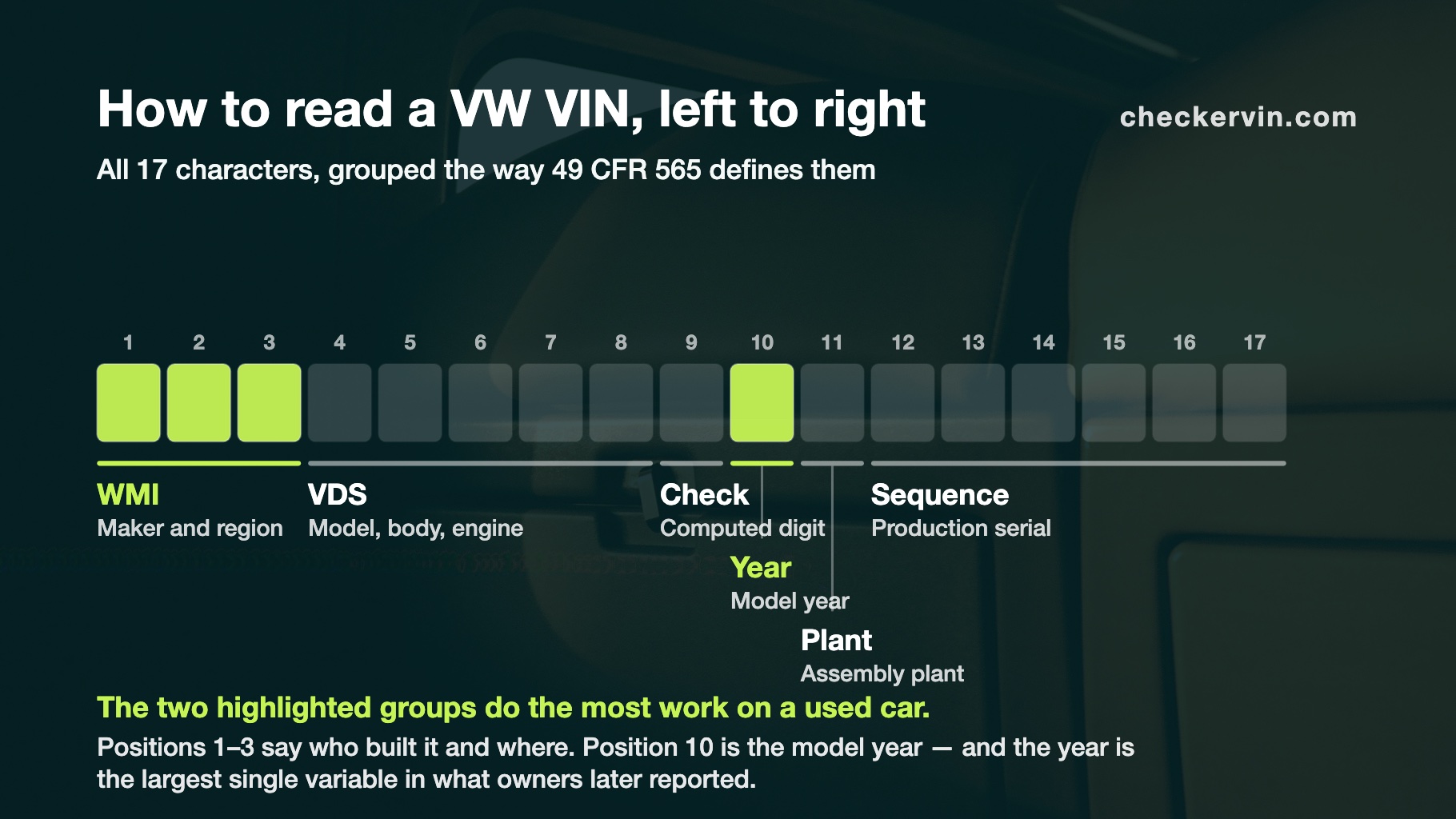
- Characters one to three identify country and manufacturer — a German code, a Mexican code and a United States code all appear on US-market Volkswagens. Four to eight cover model, body and engine. Nine is the check digit, ten the model year, eleven the plant, and twelve to seventeen the production sequence.
- Where do I find the equipment list?
- The PR code sticker, usually in the trunk under the floor covering or in the spare wheel well, and often reproduced in the service book. It records every option the car was built with, including the paint code.
- What is specific to a used TDI?
- Whether the car was part of the emissions settlement, whether it was modified under the approved program, and whether that work is documented. That is a vehicle-specific question rather than a model-level one.
WVW
German-built VW
3VW Mexico, 1VW USA
Trunk
Where the PR sticker is
Under the floor or spare
Shared
Group platforms and engines
With Audi and others
Free
VW data via NHTSA vPIC
Public, no account
What a Volkswagen VIN tells you
- Model year, model and body class as filed with NHTSA
- Engine displacement, cylinder count and fuel type
- Drivetrain — front-wheel drive or all-wheel drive
- Restraint system fitted at the factory
- Country of manufacture and the assembly plant
- Open safety recalls against that exact vehicle
Position by position, on a Volkswagen
The decoders that rank for this query hand back a result without showing their working. The working is public: 49 CFR 565 fixes what each position of a 17-character VIN has to carry, and Volkswagen files its scheme with NHTSA like every other manufacturer. Read left to right and the number stops being a serial number.
| Positions | What they carry on a VW |
|---|---|
| 1–3 · WMI | World Manufacturer Identifier — the maker and the building region. On Volkswagens this is where German, Mexican and US-built cars separate; the table below is verified against NHTSA's own registry. |
| 4–8 · VDS | The descriptor section: model line, body, restraint system and engine. Five characters, and the part manufacturers use most differently from one another. |
| 9 · Check digit | A computed digit, not an assigned one. It is arithmetic over the other sixteen characters, which is why a mistyped VIN usually fails before any database is queried. |
| 10 · Model year | One character. It is a model year, not a build date — a car assembled in autumn commonly carries the following year's code. |
| 11 · Plant | The assembly plant. The one build attribute every vehicle class must encode, which is why plant answers arrive when trim answers do not. |
| 12–17 · Sequence | The production serial. Six characters, and the only part of the VIN that carries no meaning you can look up. |
Two consequences follow for a buyer. The check digit means a VIN that will not decode is usually a transcription error rather than a hidden car — retype it before concluding anything. And because position 10 is a model year, a listing describing a car as a year older or newer than the VIN says is often describing the build date honestly rather than lying. Our full position guide carries the year chart and the check-digit arithmetic.
Volkswagen WMI codes, verified against the federal registry
These are not from a parts catalog or a forum post. Each one below was queried against NHTSA’s vPIC registry, which returns the filing entity and the vehicle class the code is registered for — and the class is the part the tool results do not show you.
| WMI | What NHTSA's registry returns |
|---|---|
| WVW | VOLKSWAGEN AG — passenger car. The German-built saloons and hatchbacks. |
| 1VW | Volkswagen Group of America — passenger car. US assembly, Chattanooga. |
| 3VW | Volkswagen — passenger car. Mexican assembly, Puebla. |
| WV1 | Volkswagen Group of America — registered as a truck, not a car. |
| WV2 | Volkswagen — multipurpose passenger vehicle (MPV), the van classification. |
| 9BW | Volkswagen — passenger car. Brazilian assembly. |
The last three are the useful ones, because the class is doing real work. A Volkswagen whose VIN opens WV1 or WV2 is filed federally as a truck or an MPV rather than a passenger car, and vehicle class drives which federal safety standards applied when it was built. If you are comparing a van-derived Volkswagen against a saloon, you are not comparing two versions of the same regulatory object.
Mexico and Tennessee build a lot of US-market VWs
Volkswagen has manufactured in Mexico for decades and operates a plant in Tennessee building models for North America. A significant share of US-market Volkswagens therefore carry a Mexican or United States identifier rather than a German one.
This is normal and says nothing negative about the car. A seller who implies a German-built VW is inherently superior is describing a preference rather than a specification difference.
The PR code sticker
Volkswagen describes equipment using PR codes and prints the complete list for each vehicle on a sticker, normally in the trunk under the floor covering or beside the spare wheel. It is frequently reproduced in the service book as well.
It records the options, the suspension and brake specification, and the paint code. The system is shared across the group, so the detail is covered once — the Audi page explains PR codes in full, and everything there applies to your Volkswagen.
It is worth being precise about why this matters more on a Volkswagen than the equivalent does on some other marques. The VIN’s descriptor section is five characters, and five characters cannot carry a full options list — so on a car sold with a long options catalog, most of what distinguishes one example from another is simply not in the number. Volkswagen’s answer is to print it all somewhere else. That makes the sticker the authoritative equipment record and the VIN a poor substitute for it.
Three disputes it settles on the spot, all of which otherwise come down to a seller’s word:
- Whether a trim claim is real — the codes list what was fitted at the factory, not what a badge says
- What the paint code is, which decides whether a panel can be matched and whether a respray happened
- Which suspension and brake specification the car left with, which matters on any car sold in sport and standard forms
- Whether equipment a listing calls 'factory' actually was, as opposed to fitted later
If the sticker is missing from the trunk, check the service book — Volkswagen commonly reproduces it there, and a missing sticker on a car whose book carries it is normal rather than suspicious. A car with neither is not proof of anything either, but it does mean every equipment claim reverts to being unverified.
Used TDI diesels and the emissions settlement
Volkswagen's diesel emissions case led to a settlement covering a large population of TDI vehicles in the United States. Many were repurchased from owners. Some were subsequently modified under an approved program and returned to the market, and some remained with owners who chose a modification rather than a buyback.
The practical consequence for a buyer is that the question is about the individual car rather than the model. A used TDI can be a perfectly good purchase — they are durable and economical — but its specific history is something to establish rather than assume.
- 1Establish whether the vehicle was in the affected populationThe model year and engine determine this. A VW dealer can confirm against the VIN.
- 2Ask whether it was bought back and resoldA repurchased vehicle that was modified and returned to market should have documentation of the work performed.
- 3Ask for the modification paperworkIf the approved emissions modification was performed, there should be a record of it. Ask to see it rather than accepting a description.
- 4Check what warranty coverage attachedExtended coverage was associated with modified vehicles in some circumstances. Confirm the position against the VIN with a dealer.
- 5Confirm the car passes emissions where you liveIf your state runs emissions testing, this is the practical test that matters.
- 6Check the title record for any brandRepurchase programs can leave marks on a vehicle's title history. Run the VIN rather than relying on the seller's account.
There is one part of this that works strongly in a used buyer’s favor, and it is routinely missed because it sounds like fine print. A TDI that went through the approved emissions modification did not just get software — it acquired an extended emissions warranty, because the federal settlement required modified vehicles to carry one. Volkswagen published the operative terms itself, and they are drawn more generously than a goodwill program would be: the period is the greater of two measures rather than the first to expire, it is stated to be fully transferable to subsequent owners, and it covers an engine long block rather than emissions plumbing alone.
It also contains a clause that reverses the usual rule about damaged cars — the extension applies to a vehicle with a totaled status provided the earlier damage is not what caused the failure being claimed, which is the opposite of how several manufacturers write their extensions. On a cheap, previously damaged diesel that is the difference between a gamble and a calculated buy. Our Volkswagen warranty check by VIN sets out the terms, the resale clause and what voids it.
Engine codes and what they imply for maintenance
Volkswagen identifies engines by letter codes, and the code is what a parts department or a specialist will ask for. The eighth VIN character identifies the engine as built; the code itself is stamped on the engine.
Most modern VW gasoline engines use direct injection, which brings carbon accumulation on the intake valves as a maintenance item rather than a defect. Turbocharged engines reward strict oil service and punish neglect. Both are worth asking about specifically.
- Get the engine code and research that engine, not the model
- Ask when timing components were last serviced, and with which parts
- Ask whether intake cleaning has been performed on a direct-injection engine
- Ask which oil specification has been used and at what intervals
- On a DSG automatic, ask about transmission service history
- Ask about the water pump and thermostat, common service items on these engines
Shared group platforms
Volkswagen sits within a larger group and shares platforms and engines widely with its sibling brands. For an owner this generally works in your favor: parts availability is good, independent specialists who know group hardware are common, and documented faults are recorded across a large population of vehicles.
Research by engine code rather than by model name. A documented issue on a sibling brand with the same engine almost always applies to yours.
What owners actually reported, by model year
A decoder returns the model year and stops. That single character turns out to be the largest variable on the car, and it is the one thing every tool on this query hands back without comment. We aggregate NHTSA’s complaint database across 27 Volkswagen model years and score each year against its own nameplate’s median, so a model that sold in volume is not flagged merely for selling in volume.
| Nameplate | The spread inside one badge |
|---|---|
| Volkswagen Jetta · 2008–2022 | Median year: 196 complaints. Worst: 2009 at 903 (4.61× its own median, 7 recalls, most about fuel system). Quietest: 2018 at 31. |
| Volkswagen Passat · 2008–2020 | Median year: 162 complaints. Worst: 2013 at 748 (4.62× its own median, 9 recalls, most about air bags). Quietest: 2019 at 12. |
Read the spread rather than the totals. The Volkswagen Jetta runs roughly 29× more reports in 2009 than in 2018; The Volkswagen Passat runs roughly 62× more reports in 2013 than in 2019. Same badge, same dealer, same brochure — and a difference between model years far larger than the difference between one marque and another. This is why “are Volkswagens reliable” is close to an unanswerable question and “isthisyear of this model” is a question with a record behind it.
The practical move is small: decode the VIN, take the model year off position ten, and check that year against its siblings before you drive anywhere. Our reported-problems index carries the per-year breakdown, and it is free because the underlying data is public.
What a Volkswagen VIN cannot tell you
Worth stating plainly, because the tools ranking for this query imply otherwise by returning a dense-looking result. A VIN is a description of how a car was built. It is not a description of what has happened to it since.
- Whether it has been crashed — collision damage leaves no mark on the number
- Whether the title carries a brand, which lives in state title records instead
- The actual mileage, which is recorded at title transfer rather than encoded
- Options and paint — on a VW those sit on the PR sticker, not in the VIN
- Whether a diesel was modified under the settlement, which is a per-vehicle record
- Who owned it, which federal privacy law keeps out of every consumer lookup
None of that is a failing of the decoder; it is the boundary of what seventeen characters were designed to carry. The decode is step one, and the value of doing it first is that it tells you which of the remaining questions are worth paying to answer.
Checking Volkswagen recalls by VIN
Recalls attach to VIN ranges rather than models, and group campaigns sometimes span several brands because the affected component is shared. NHTSA's free lookup answers it at VIN level, and the remedy costs the owner nothing.
Buying a used Volkswagen: the VIN checklist
- 1Decode before you travelConfirm model year, engine and drivetrain match the listing.
- 2Find and photograph the PR stickerTrunk floor or spare wheel well. It settles every equipment claim at once.
- 3On a TDI, establish the individual car's historyAffected population, buyback status, modification documentation.
- 4Get the engine code and research that engineRather than the model. Engines carry across the group.
- 5Ask about the specific maintenance itemsTiming service, intake cleaning, transmission fluid and water pump.
- 6Run the free recall checkInstant, free, and the remedy costs nothing.
Where this information comes from
Keep reading
Frequently asked questions
How do I decode a VW VIN for free?
Enter the 17-character VIN into a decoder. Volkswagen files its VIN structure with NHTSA's public vPIC database, so a free decode returns model, model year, body class, engine, drivetrain and assembly plant with no charge and no account.
What does WVW mean on a Volkswagen VIN?
It identifies a Volkswagen passenger car built in Germany — W is the country code for Germany. VWs built in Mexico and the United States carry different identifiers, and a large share of US-market Volkswagens come from those plants.
Where is the option code sticker on a VW?
Usually in the trunk, under the floor covering or in the spare wheel well, and frequently reproduced in the service book. It lists the PR codes the car was built with, including the paint code — detail the VIN itself does not carry.
Should I avoid a used TDI diesel?
Not automatically, but do your homework. Affected vehicles were subject to a settlement under which many were bought back and some were modified and resold. A modified car should have documentation of the work, and its history is worth establishing before you buy.
Are Volkswagens built in the United States?
Yes. Volkswagen operates a plant in Tennessee building models for the North American market, and also builds heavily in Mexico. A VW with a US or Mexican identifier is entirely normal rather than unusual.
Decode your Volkswagen in seconds
Enter any VW VIN for the factory build, engine, drivetrain, plant and open safety recalls. Free, no account.
Run a free VIN check