The short answer
- What does it cost?
- RepairPal's per-year figures run roughly $103-$132 on older cars up to $270-$350 on a 2014; its general estimate is $243-$313. Published estimates, not ours.
- Is the fluid different on the newer Corolla?
- No. Toyota specifies the same CVT Fluid FE for both the old and new CVT designs. What changed is the hardware — a physical launch gear the earlier CVT didn't have.
- Which years carry the power-train history?
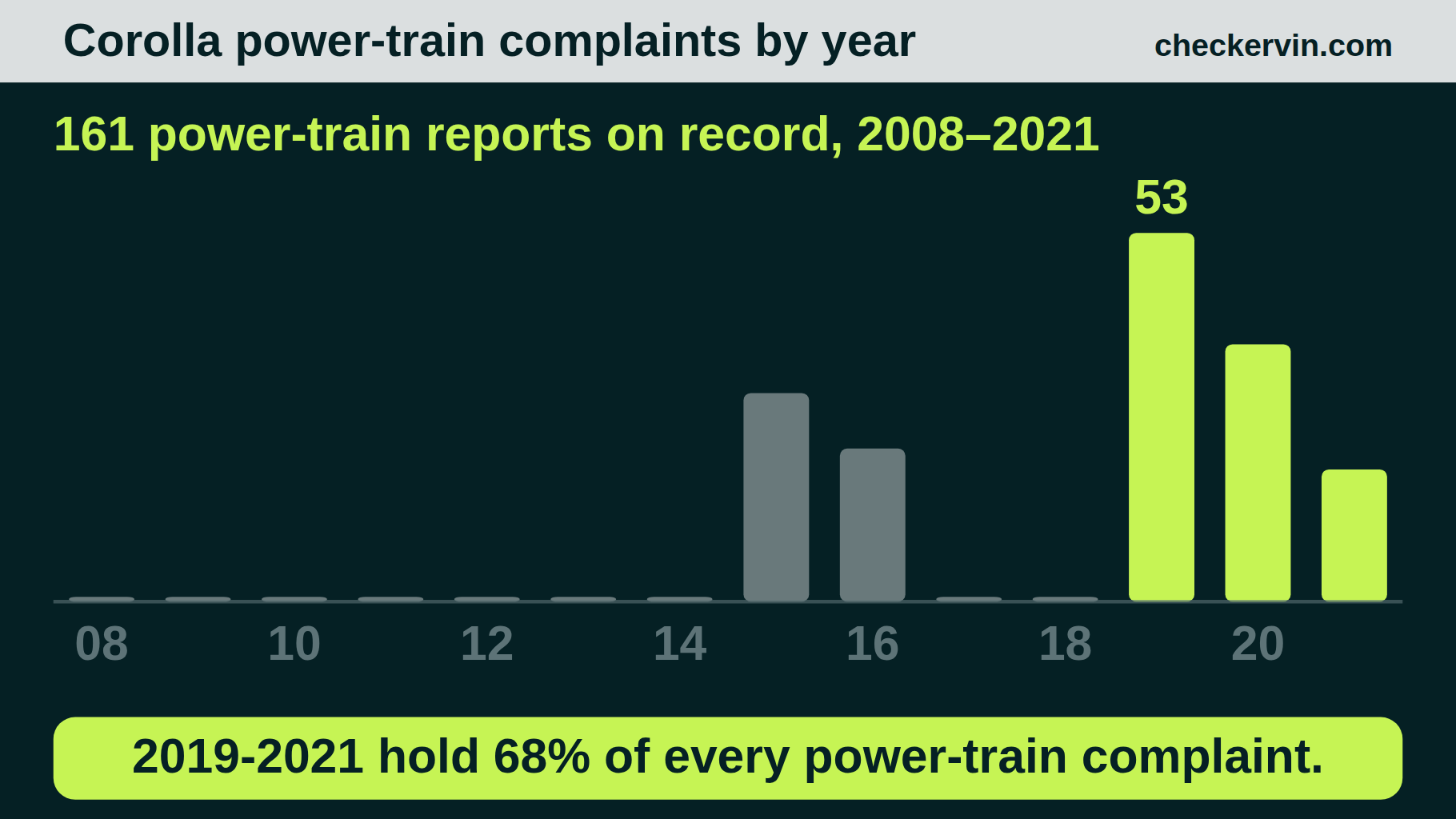
- 2019-2021 hold 67.7% of every POWER TRAIN complaint in the nameplate's 14-year record, at roughly 15.8x the rate of the eleven model years before them.
The numbers, and whose numbers they are
RepairPal’s general estimate for a Toyota Corolla transmission fluid change is $243 to $313. Its own per-year breakdown spreads far wider than that single range suggests: roughly $103 to $132 on a 2013, $270 to $350 on a 2014, and $259 to $339 on a 2018. Every figure here is attributed to whoever published it; we sell VIN checks, not repairs, and price none of this ourselves.
None of those estimators asks the question this page is actually about: which Corolla generation is under the hood. Two Corollas three model years apart can carry a genuinely different transmission design, and the complaint record treats them very differently.
New CVT, same fluid
Toyota redesigned the Corolla for its 12th generation, starting with the Hatchback for model year 2019 and the sedan for model year 2020, on the new TNGA-C platform. The transmission changed with it: the new “Direct Shift-CVT” (Toyota’s K120 unit) was the first Toyota CVT built with a physical first gear, used only from a stop, before the belt-and-pulley system takes over — a different mechanical layout from the prior-generation “Super CVT-i.” A new 2.0L “Dynamic Force” engine (the M20A-FKS) replaced the older 1.8L engines at the same time.
What did notchange is the fluid itself. Toyota specifies Toyota Genuine CVT Fluid FE (part 08886-02505) for both the older CVT and the new Direct Shift-CVT, per allstarjdm.com’s parts listing and forum consensus on BobIsTheOilGuy. A shop or a search result that implies the newer car needs a different fluid product is wrong on that specific point — the hardware is new, the fluid spec is not.
| Generation | Transmission |
|---|---|
| 11th-gen (2014-2019 sedan) | Super CVT-i — belt-and-pulley only |
| 12th-gen (2019 Hatchback, 2020+ sedan) | Direct Shift-CVT — adds a physical launch gear |
What 6,096 complaints say about one generation break
Our corpus of federal NHTSA complaints holds 6,096 reports against the 2008–2021Corolla. Across the first eleven of those model years, 2008–2018, POWER TRAIN barely registers: 52 complaints out of 5,404, a 1% share, and it cracks a year’s own top-5 categories only twice in that span — small blips in 2015 and 2016, not a pattern.
Then the record breaks. Across the three model years since, 2019–2021, POWER TRAIN’s share jumps to 15.8% (109 of 692) — roughly 15.8x the earlier rate — and those three years alone, out of fourteen, hold 67.7% of every POWER TRAIN complaint the nameplate has ever recorded. ENGINE breaks even harder: a 2.2% share for 2008–2018 versus 27% for 2019–2021 — roughly 12.3x — with 2020 alone the single largest one-year ENGINE share on record, at 35.2% of that year’s own total. Complaints are unverified owner reports, not a measured failure rate, but a break this sharp landing on the exact model years a brand-new transmission and a brand-new engine both shipped is not noise.
The recall, and what it actually covers
One documented safety campaign lines up with the new hardware: NHTSA Campaign 18V901000, covering roughly 3,400 to 4,400 model-year-2019 Corolla Hatchback units — the sedan was not part of the redesign yet and is not included — for torque-converter pump impeller blades that could separate inside the new Direct Shift-CVT and stall the engine, per Justia’s recall database, Autoblog and RepairPal’s own recall page. The campaign began in April 2019, the same model year the complaint record breaks.
| Program | What it actually pays for |
|---|---|
| NHTSA recall (18V901000) | Safety defect on affected 2019 Hatchback units — free fix at any dealer, no time limit |
| Technical service bulletin | Repair instructions to dealers — pays nothing by itself |
| Routine fluid service | Scheduled maintenance — not a defect remedy either way |
This page cites the campaign from those three secondary sources, not from a direct fetch of the primary NHTSA filing — this environment blocks outbound requests to nhtsa.gov, api.nhtsa.gov and ecfr.gov identically, confirmed by testing all three in this session, so it is not treated as independently re-verified. A free VIN check settles whether one specific car was ever part of the affected population, rather than relying on a model-year-and-body- style description alone.
“Lifetime fill” doesn’t mean forever
Toyota markets some CVT fluid as a “lifetime fill,” and plenty of owners read that as “never needs changing.” Toyota’s own published guidance, summarized by GetGarageHub, defines “lifetime” as the design life of the transmission itself — and still recommends inspecting the fluid at 60,000 miles and a drain-and-fill at 100,000. Skipping the service on the assumption that “lifetime” means “forever” is a specific, well-documented way owners end up paying for a preventable repair.
That interval applies to both generations here, since the fluid specification did not change across the 2019 platform break. What changed is the risk profile of skipping it — a launch-gear CVT under load has a mechanical failure point the older belt-only design never had.
What a transmission problem sounds like before it costs anything
- A clunk or hesitation from a stop, specific to the Direct Shift-CVT's launch gear — not a symptom the older belt-only CVT could produce
- Sudden loss of power or a stall on a 2019 Corolla Hatchback — the exact symptom named in NHTSA Campaign 18V901000
- A light shudder under steady, light acceleration on either generation's CVT
- Fluid that looks dark or smells burnt at a routine inspection — the point of the 60,000-mile check, even on a “lifetime-fill” system
The order matters because the cheap check comes first: confirm which generation and body style the car actually is, pull its open recalls by VIN, and get the fluid level and condition checked — before anyone prices a repair beyond a routine fluid service.
Where the money goes
On a routine fluid service, RepairPal’s own per-year spread — roughly $103-$132 on a 2013 up to $270-$350 on a 2014 — tracks rising parts and labor costs more than it tracks any single defect, and none of these estimator pages states its fluid-volume assumption outright in the headline figure. On a repair beyond routine service, the number changes entirely: the recall above is free at any dealer for the affected population, and a shop quoting a paid transmission repair on a car that might qualify is quoting the wrong job until the VIN is checked.
Two practical consequences follow. First, confirm the generation and check open recalls by VIN before accepting any transmission quote on a 2019 Corolla Hatchback specifically. Second, get a routine fluid quote itemized by fluid brand, quantity and labor rather than accepting one blended “transmission service” line.
Before you authorize the service
- Confirm the generation and body style by VIN — the Hatchback got the new platform a full model year before the sedan
- Pull the VIN's open recalls before paying for anything that might already be a free fix under 18V901000
- On a 2019 Hatchback, ask directly whether the torque-converter recall has already been performed
- Don't skip the fluid service on a “lifetime-fill” assumption — Toyota's own guidance still calls for a 60,000-mile inspection
- Get the quote itemized — fluid brand, quantity and labor — not a single flat-rate line
If you are buying the Corolla, not maintaining it
The same record reads as a shopping map. A 2019–2021 Corolla should show either a documented recall remedy (if it’s a 2019 Hatchback) and a fluid service history, or a clean test drive with no clunk or hesitation from a stop, before its power train is treated as a non-issue. A Toyota VIN decode confirms the exact generation, body style and transmission before you price a service specific to this window, and checking what factory coverage remains by VIN settles whether anything on the transmission is still someone else’s responsibility to fix.
On any candidate car, run the recall lookup before you negotiate, and check which Corolla model years show the most complaints overall rather than judging the nameplate by the power-train figure alone — other categories report far more often on this car across most of its run. Eleven of the fourteen model years in the record carry almost none of the power-train complaints; a documented fluid service and a clean recall check are usually cheaper than the negotiation it takes to discount around ones that are missing.
Where this information comes from
- NHTSA — Corolla complaint databaseThe federal complaint record this page's figures are computed from, browsable by model year.
- NHTSA — recalls by VINThe official lookup that settles whether a specific Corolla has open safety campaigns, including 18V901000.
- RepairPal — Corolla transmission fluid change estimateThe per-year $103–$350 range quoted above, attributed to its estimator as retrieved September 2026.
- Justia — NHTSA Campaign 18V901000The 2019 Corolla Hatchback torque-converter recall named above, as filed with NHTSA.
Keep reading
Frequently asked questions
How much does it cost to change the transmission fluid in a Toyota Corolla?
RepairPal's general estimate runs $243 to $313, but its own per-year figures spread wider: roughly $103 to $132 on a 2013, $270 to $350 on a 2014, and $259 to $339 on a 2018. None of these figures is ours — we sell VIN checks, not repairs, and price none of this ourselves.
Is the Corolla's CVT a “lifetime fill” that never needs a fluid change?
No — Toyota's own documentation defines “lifetime” as the design life of the transmission, not the life of the car, according to GetGarageHub's summary of Toyota's published maintenance guidance, which recommends inspecting the fluid at 60,000 miles and a drain-and-fill at 100,000. Treating “lifetime” as “never” is a common and costly misreading of that phrase.
Which Corolla model years show the sharpest power-train complaint jump?
2019 through 2021 — three of the nameplate's fourteen model years. Computed from src/data/models/toyota-corolla.json, POWER TRAIN holds only a 1% share of complaints across 2008-2018 (52 of 5,404), then jumps to a 15.8% share for 2019-2021 (109 of 692) — roughly 15.8x the earlier rate — and those three years alone hold 67.7% of every POWER TRAIN complaint the nameplate has ever recorded.
Was there a recall tied to the new Direct Shift-CVT?
Yes — NHTSA Campaign 18V901000, covering roughly 3,400 to 4,400 model-year-2019 Corolla Hatchback units (the sedan was not included), for torque-converter pump impeller blades that could separate and cause the engine to stall, per Justia's recall database, Autoblog and RepairPal's own recall page. This page cites that campaign from those secondary sources; it was not independently re-verified against the primary NHTSA filing, and a VIN decode is the way to check whether a specific car was ever part of the affected population.
Did the CVT fluid itself change between the old Corolla and the new one?
No, and that's worth saying plainly: Toyota specifies the same product, Toyota Genuine CVT Fluid FE (part 08886-02505), for both the outgoing 11th-generation CVT and the new Direct Shift-CVT, per allstarjdm.com's parts listing and BobIsTheOilGuy forum consensus. What's new is the hardware — a physical launch gear the earlier CVT never had — not the fluid spec.
Confirm the generation before you price the service
A free CheckerVIN report shows the factory build, specifications and open recalls for any VIN — confirm what you're actually pricing.
Run a free VIN check