The short answer
- Does my Jetta have a belt?
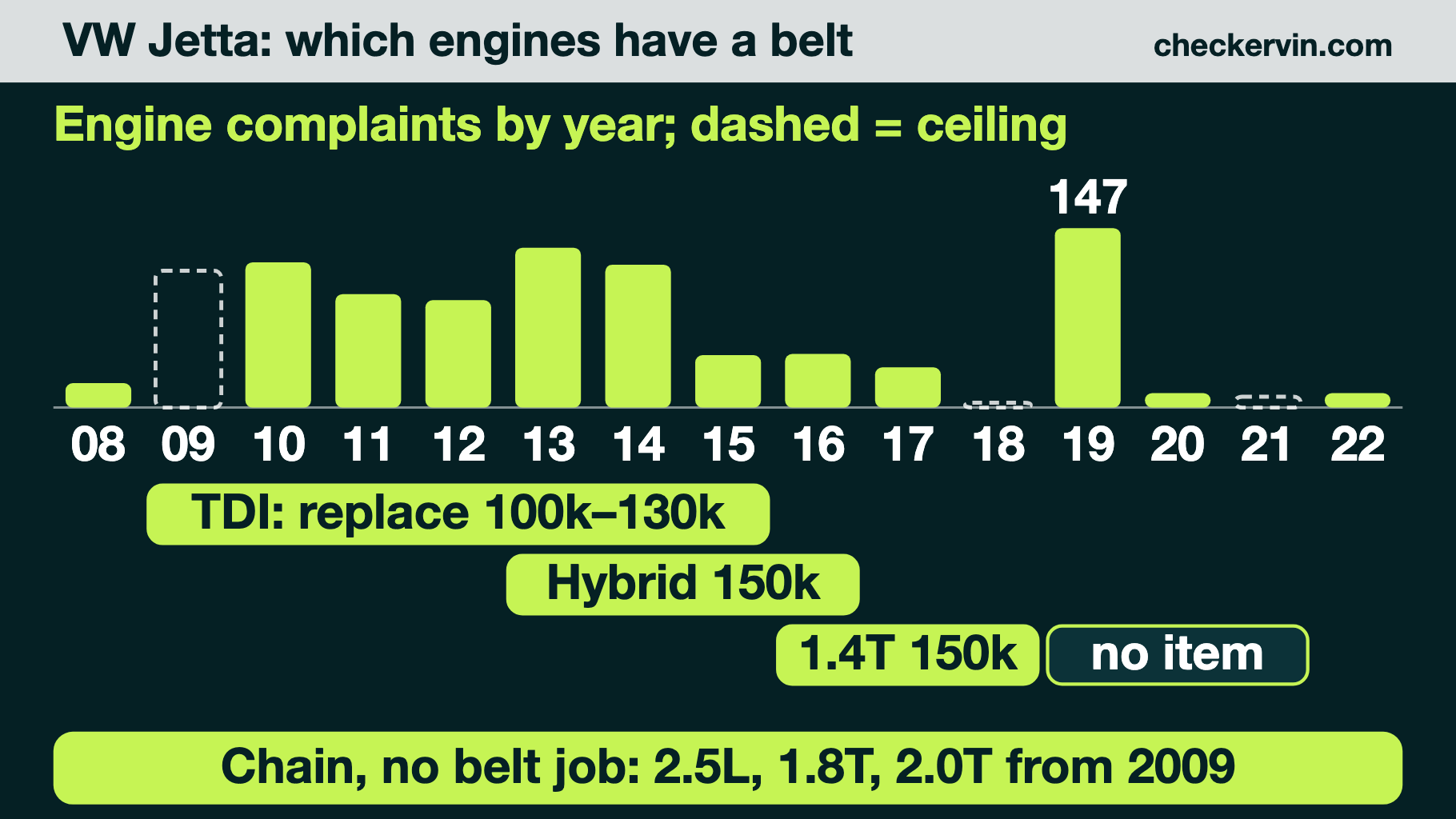
- Only some do: the TDI diesel (2009–2015), the Hybrid (2013–2016) and the 1.4T (2016–2021). The 2.5L, 1.8T and 2009-on 2.0T use chains.
- When is it due?
- VW set a replacement mileage only for the TDI: 120,000 to 130,000 miles depending on the document. The 1.4T gets a check at 150,000 miles.
- What does it cost?
- YourMechanic's Jetta average is $400; KBB prints a generic $409 to $919. Adding the pump and tensioner runs higher.
3
Jetta engine families with a belt
TDI, Hybrid 1.4, 1.4T
130k
TDI belt replacement, 2014–2015
VW schedule; 120k on the 2010 card
150k
First 1.4T belt check
Then every 20k; dropped from 2019
12 of 15
Years ENGINE made the top five
2008–2022, all engine faults
The published prices, and why they are hard to use
We sell VIN checks, not repairs, and we print no price of our own, so every dollar figure here belongs to whoever published it. YourMechanic’s Jetta timing belt page refused our tools, but in two separate searches on November 22, 2026, the text it served gave an average of $400, with $134 for parts and $266 for labor. It names no model year and no engine. Kelley Blue Book’s 2019 Jetta page says you “can expect to pay anywhere from $409 to $919” including parts and labor, and in the same breath shows “No Pricing Data Available” for the ZIP code it was given. The identical range appears on KBB pages for other makes, which is why we call it a generic figure rather than a Jetta estimate.
KBB’s explanation is the useful part: “The real cost is in the labor.” The belt is a small part; the hours go into removing the covers and accessory drive that sit in front of it, and those hours do not shrink because the belt is cheap. Owners who wrote to NHTSA give a sense of the top end. One 2010 TDI owner reported paying $3,127 for the 100,000-mile service, which included the timing belt and other scheduled work, and a 2009 owner reported $1,131.87 for a failed water pump with the belt done at the same time. Those are one person’s bills each, not averages, but they sit a long way above $400.
Both consumer sites also print a timing belt price for model years whose common engines have no timing belt at all. Before any of these numbers means anything, you need to know which engine is in the car.
Which Jetta engines have a belt, from VW's own documents
The Jetta is unusual because, for most of its recent life, Volkswagen sold belt engines and chain engines side by side. A 2014 Jetta could leave the lot with a chain-driven 1.8-liter turbo or a belt-driven TDI. Federal fuel economy records at fueleconomy.gov list the engines offered each year, and Volkswagen’s maintenance schedules and training documents, copies of which sit on NHTSA’s servers, say which ones have a toothed belt:
| Engine and years | What Volkswagen's documents show |
|---|---|
| 2.0L TDI diesel, 2009–2015 | Belt. Replace at 120,000 miles (2010 schedule) or 130,000 miles (2014–2015 schedules) |
| 1.4L Jetta Hybrid, 2013–2016 | Timing belt and coolant-pump belt: check at 150,000 miles, then every 20,000 |
| 1.4L turbo sedan, 2016–2021 | Same check through 2018; the 2019–2022 schedules list no timing item |
| 1.8L turbo, 2014–2018 | No timing item on its schedules; Audi's third-generation EA888 document says chain |
| 2.0L turbo (GLI and 2.0T), 2009 on | Chain: VW tech tips for CCTA/CBFA and a chain warranty extension naming CPLA |
| 2.5L five-cylinder | No belt line; VW's 2012 Passat schedule limits the belt to the TDI |
| 2008 2.0T, 2011–2015 2.0L, 2022 1.5L turbo | Not settled by any VW document we read; check the engine code |
The last row is honest rather than tidy. Volkswagen’s documents give two engine codes for the 2008 Jetta’s 2.0-liter turbo, and we did not find a VW document stating how the 2011–2015 base 2.0-liter or the 2022 1.5-liter turbo drive their camshafts. A timing belt or chain lookup by VIN starts from the engine code, which is the only reliable way to answer the question for a specific car.
The TDI: the only Jetta with a replacement mileage
The diesel is the one Jetta where Volkswagen told owners, in plain terms, to replace the belt. The 2010 Volkswagen maintenance schedule, which covers every 2010 model except the Routan, has a row that reads “Timing belt: Replace (2.0L TDI only)” with its mark in the 120,000-mile column. The 2014 Jetta SportWagen and 2015 Jetta sedan schedules for the 2.0L TDI put “Timing Belt: Replace” in the 130,000-mile column.
Volkswagen’s documents do not agree with each other for the early cars. The service tables VW now publishes on its owner literature site list the diesel belt and tensioning roller at every 130,000 miles for Jettas “from 2010” and every 100,000 miles for 2007–2009 cars. So a 2010 TDI has a 120,000-mile figure on the schedule printed for its model year and a 130,000-mile figure on VW’s current table, and a 2009 TDI may be due at 100,000. Where two VW documents disagree, the lower number is the safer one to plan around.
Mileage is not the only clock. The youngest TDI Jetta is a 2015 model, 11years old this year. None of the VW schedules we read prints a time limit for the diesel belt, but rubber ages whether or not the car moves, and a low-mileage TDI with no record of a belt is the riskiest kind. Many of these cars also went through Volkswagen’s emissions buyback and modification programs; that history does not change the belt interval in any VW document we found, but it does mean ownership and service records can be patchy, so ask for the belt receipt specifically.
The 1.4-liter turbo: two belts and no due date
The 1.4-liter engines are the Jettas most cost pages get wrong, in both directions. Volkswagen’s training document for the 2019 Jetta, Self Study Program 890183, describes the 1.4-liter TSI as an EA211-family engine with a “toothed belt camshaft drive” and adds that “a toothed belt from the exhaust camshaft drives the coolant pump.” So the car has two toothed belts: the timing belt, and a small one for the coolant pump, which sits in the thermostat housing. Our Jetta water pump post covers that pump module and VW’s warranty extensions on it.
What Volkswagen never gave the 1.4-liter is a replacement mileage. The 2013 and 2015 Jetta Hybrid schedules, the 2016 1.4T schedule and the 2018 schedule all say the same thing: check the timing belt and the coolant-pump belt at 150,000 miles, and if replacement is not necessary, check again every 20,000 miles “until replacement is necessary.” Then, from the 2019 model year, the item disappears. We searched the 2019, 2020, 2021 and 2022 Volkswagen schedules for the word “timing” and found nothing, though each one names the Jetta and the 2019 edition lists the “Jetta 1.4L” by name in its spark plug rows.
Chain engines have no belt job, but they have their own warranty
A Jetta with the 2.5-liter five-cylinder, the 1.8-liter turbo, or a 2.0-liter turbo from 2009 on does not have a timing belt, and a quote for “timing belt replacement” on one of those cars is either a mislabeled chain job or a mistake. Audi’s training document for the third-generation EA888 1.8- and 2.0-liter engines lists “chain driven camshafts” in its specifications, and the 2014–2016 Jetta 1.8T schedules carry no timing item at all.
The earlier 2.0-liter turbo had chain trouble of its own. Volkswagen bulletin VWP-18-07, revised October 29, 2018, extended coverage on a failed timing chain or chain tensioner to 10 years or 100,000 miles from the in-service date for certain 2008–2010 and 2012–2014 Jetta sedans, the engines with codes CBFA and CPLA, and set out how VW would pay for consequential engine damage. That window has now closed on practically every car it covered. It still matters to a buyer, because a 2.0T Jetta with a documented chain or tensioner repair under the extension is a better bet than one with no record.
What belongs in a Jetta timing belt quote
Shops rarely replace a belt on its own, and on a Jetta there are good reasons. The tensioner and idler rollers are wear parts that the belt rides on, and VW’s own table names the “toothed belt and camshaft drive tensioning roller” together for the diesel. The 2014 Gates recall described below concerned replacement pumps for certain Jettas whose “pulley or sprocket that turns the timing belt” could crack, which tells you that on those engines the pump runs in the belt drive. Where it does, replacing the pump while the belt is off saves paying the same labor twice; ask the shop whether that is true of your engine.
- Timing belt, with the brand and part number written on the invoice
- Tensioner and idler rollers
- The water pump, if the shop confirms it runs in the timing-belt drive on your engine
- On a 1.4T, the separate coolant-pump belt, if the shop is already in there
- Coolant to Volkswagen's specification after the pump is disturbed
- Camshaft and crankshaft timing checked and recorded after the job
Ask for the belt, tensioner, idlers and pump as separate lines. That lets you compare two quotes honestly and keeps a record a future buyer can read.
If the belt breaks
We did not find a Volkswagen document that states whether the Jetta’s belt engines are interference designs, where the valves and pistons can collide if the belt fails. The owner reports in NHTSA’s database describe the outcome that word implies. A 2014 Jetta owner wrote that the dealer replaced the timing belt and tensioner and then found several bent valves. A 2009 TDI owner was told a cylinder head, at about $7,500, was needed after the belt skipped timing. A 2015 TDI owner reported a belt failure at highway speed a little past 103,000 miles, below the 130,000-mile interval.
Read those reports with some care: owners often call a chain a belt, and a single narrative is not a measured failure rate. The practical point does not change. A belt failure on these engines is usually an engine repair, not a belt repair, which is why the receipt matters so much more than the price of the job.
What the complaint record shows
NHTSA has no timing belt category. Owners file belt failures under ENGINE, along with oil leaks, misfires, carbon buildup and every other engine fault on every Jetta engine sold that year, so ENGINE is context and an upper bound, never a belt count. Across 2008–2022, ENGINE reached the top five complaint categories in 12 of 15 model years, and our corpus counts 859 ENGINE complaints in those years, at least 16% of the 5,480 complaints on file for the nameplate. It was the largest category, or tied for it, in 2014, 2016, 2017 and 2022.
The TDI years, 2009–2015, hold at least 591of those ENGINE complaints, but the diesel has a second bucket. NHTSA also files complaints under DIESEL, and that category made the Jetta’s top five in 2009, 2010 and 2011, with at least 443 complaints between them. When we read the narratives, they are dominated by fuel-system and emissions-equipment failures, not belts; the handful that mention a belt usually mention it as work done alongside something else.
The 1.4T years, 2016–2021, account for at least 236 ENGINE complaints across the 4 years where ENGINE made the top five, and 67% of those come from 2019–2021, the years with no scheduled belt item. Most of that is 2019: 147 ENGINE complaints, 27% of that year’s record and the most of any Jetta year. Several 2019owners described the same sequence: bolts on the camshaft cover backing out, oil reaching the timing belt, and a new belt, in one case at 46,000 miles. We found no Volkswagen bulletin on it in NHTSA’s manufacturer communications, so treat it as an owner-reported pattern, not a confirmed defect.
Three limits apply. Our data keeps only each year’s top five categories; in 2009, 2018 and 2021 ENGINE ranked below fifth, so it was smaller than the fifth category, not zero, and every total above is a minimum. The 2018 model year has only 32complaints on file, too few to read anything into. And when we checked NHTSA’s live database on November 22, 2026, it showed fewer complaints for the 2013 and 2014 Jetta than our file holds, while other years matched within a few reports. The full picture by year is on the Volkswagen Jetta years-to-avoid page.
Recalls and bulletins
No Volkswagen safety recall names a timing belt, tensioner or idler on any Jetta from 2008 to 2022; we checked NHTSA’s recall database for every model year. The one recall that touches the belt drive is not Volkswagen’s. In 2014 Gates recalled aftermarket Tru-Flow water pumps, campaign 14E007, listed against 2008 and 2011–2013 Jettas, because the pulley or sprocket that turns the timing belt could crack. One 2013 owner told NHTSA the dealer found a failed belt caused by water pump damage on a car that had been repaired under that campaign. If a belt-engine Jetta had its pump replaced around 2013 or 2014 with an aftermarket part, look at the receipt.
Check any specific car through the Volkswagen recall check. Our TSB versus recall page explains why a warranty extension like VWP-18-07 pays only within its window and at a VW dealer, while an open recall is free at any age.
Before you authorize the job
- Confirm the engine code by VIN: TDI, 1.4T and Hybrid have belts; 2.5L, 1.8T and 2009-on 2.0T do not
- On a TDI, compare the odometer with 130,000 miles, and with 100,000 or 120,000 on a 2009 or 2010
- On a 1.4T, ask what the shop saw at inspection; VW never set a replacement mileage
- On a 2019–2021 1.4T, ask the shop to look for oil on the belt and loose camshaft cover bolts
- Get belt, tensioner, idlers and pump as separate lines with part numbers
- Keep the invoice; it is worth money when you sell
The engine size lookup by VIN reads the engine from the factory build, which settles the first line before anyone orders a part.
If you are buying the Jetta, not repairing it
For a shopper the belt question sorts Jettas into three groups. A 2.5-liter, 1.8T or 2009-on 2.0T car has no belt job coming, and the useful check is for the chain: on a 2.0T from the VWP-18-07 years, ask whether the chain or tensioner was replaced under the extension. A TDI past 100,000 miles with no belt receipt should be priced as if the job is due. A 1.4T is the gray zone: Volkswagen says to inspect, not replace, so a seller with a recent inspection note is offering something real.
Run the Volkswagen VIN decoder first to confirm the engine and build, then the recall check on the same VIN. If you are comparing the Jetta with a Subaru, our Outback timing belt post shows a maker that did set a time limit as well as a mileage.
Where this information comes from
- Volkswagen 2010 Maintenance Schedule, all models except Routan (NHTSA-hosted)Timing belt replacement for the 2.0L TDI in the 120,000-mile column.
- Volkswagen 2015 Jetta Sedan 2.0L TDI Maintenance Schedule (NHTSA-hosted)Timing belt replacement in the 130,000-mile column; the 2014 SportWagen TDI schedule matches.
- Volkswagen 2018 Maintenance Schedule (NHTSA-hosted)Timing belt and coolant pump toothed belt: check at 150,000 miles, then every 20,000, 1.4L Jetta only.
- Volkswagen Self Study Program 890183, The 2019 Jetta Introduction (NHTSA-hosted)Confirms the 1.4L TSI's toothed belt camshaft drive and the separate belt for the coolant pump.
- Volkswagen bulletin VWP-18-07, Timing Chain/Tensioner Limited Warranty Extension (NHTSA-hosted)10-year/100,000-mile chain coverage on certain 2008–2010 and 2012–2014 Jetta 2.0T sedans.
- NHTSA: Jetta complaints, recalls and manufacturer communicationsThe federal complaint record behind every figure here and the recall list with no VW belt campaign.
- EPA and DOE: fueleconomy.gov vehicle recordsWhich engines were offered in each Jetta model year.
- Kelley Blue Book: Jetta timing belt replacementThe generic $409–$919 range and the note that labor is the real cost, read November 22, 2026.
Keep reading
Frequently asked questions
How much does it cost to replace a timing belt on a Volkswagen Jetta?
The published figures are thin. YourMechanic's Jetta page, as served in search results on November 22, 2026, gives an average of $400, with $134 for parts and $266 for labor, without naming an engine or year. Kelley Blue Book's Jetta page says $409 to $919 including parts and labor, but shows no local price and prints the same sentence on other makes, so treat it as generic. A job that adds the water pump, tensioner and idlers will sit higher, and owners reporting to NHTSA describe bills well above both figures. CheckerVIN publishes no repair price of its own.
Does my Jetta have a timing belt or a timing chain?
It depends on the engine, not the year. Volkswagen's documents show belts on the 2.0-liter TDI diesel (2009–2015), the 1.4-liter Jetta Hybrid (2013–2016) and the 1.4-liter turbo sedan (2016–2021). The 2.5-liter five-cylinder, the 1.8-liter turbo and the 2.0-liter turbo from 2009 on use chains. A 2008 2.0T, the 2011–2015 2.0-liter base engine and the 2022 1.5-liter turbo need the engine code checked; we did not find a VW document that settles them.
When should the timing belt be replaced on a Jetta TDI?
Volkswagen's printed schedules put the replacement at 120,000 miles on the 2010 schedule and at 130,000 miles on the 2014 and 2015 Jetta TDI schedules. VW's current owner-literature table lists 130,000 miles for Jettas from 2010 and 100,000 miles for 2007–2009 cars. Those are mileage figures only, and every TDI is now old enough that the rubber's age matters as much, so a car with no paperwork should be treated as due.
How much does it cost to replace a timing belt on a Volkswagen?
It varies more by engine than by brand. Shops usually quote the belt, tensioner and idlers together, often with the water pump where it sits in the belt drive; on a 1.4-liter turbo there is a second small belt for the coolant pump. Published Jetta figures run from YourMechanic's $400 average to KBB's generic $409–$919. On a Jetta with a 2.5-liter, 1.8-liter turbo or 2.0-liter turbo from 2009 on there is no timing belt to replace.
What year to stay away from a VW Jetta?
By NHTSA complaint volume, our data flags 2009, 2010, 2011, 2012, 2013, 2014 and 2019 as the Jetta years with unusually many complaints for the nameplate. 2019 has the most ENGINE complaints of any Jetta year, at 147. Those counts cover every kind of fault, not timing belts, and the year-by-year breakdown is on our Jetta years-to-avoid page. For a belt question specifically, the engine matters more than the year.
Know the engine before you price the belt
A free CheckerVIN report shows the factory build, engine, specifications and open recalls for any VIN, so you know whether that Jetta has a timing belt at all before you call a shop.
Run a free VIN check