The short answer
- Does my Outback have a timing belt?
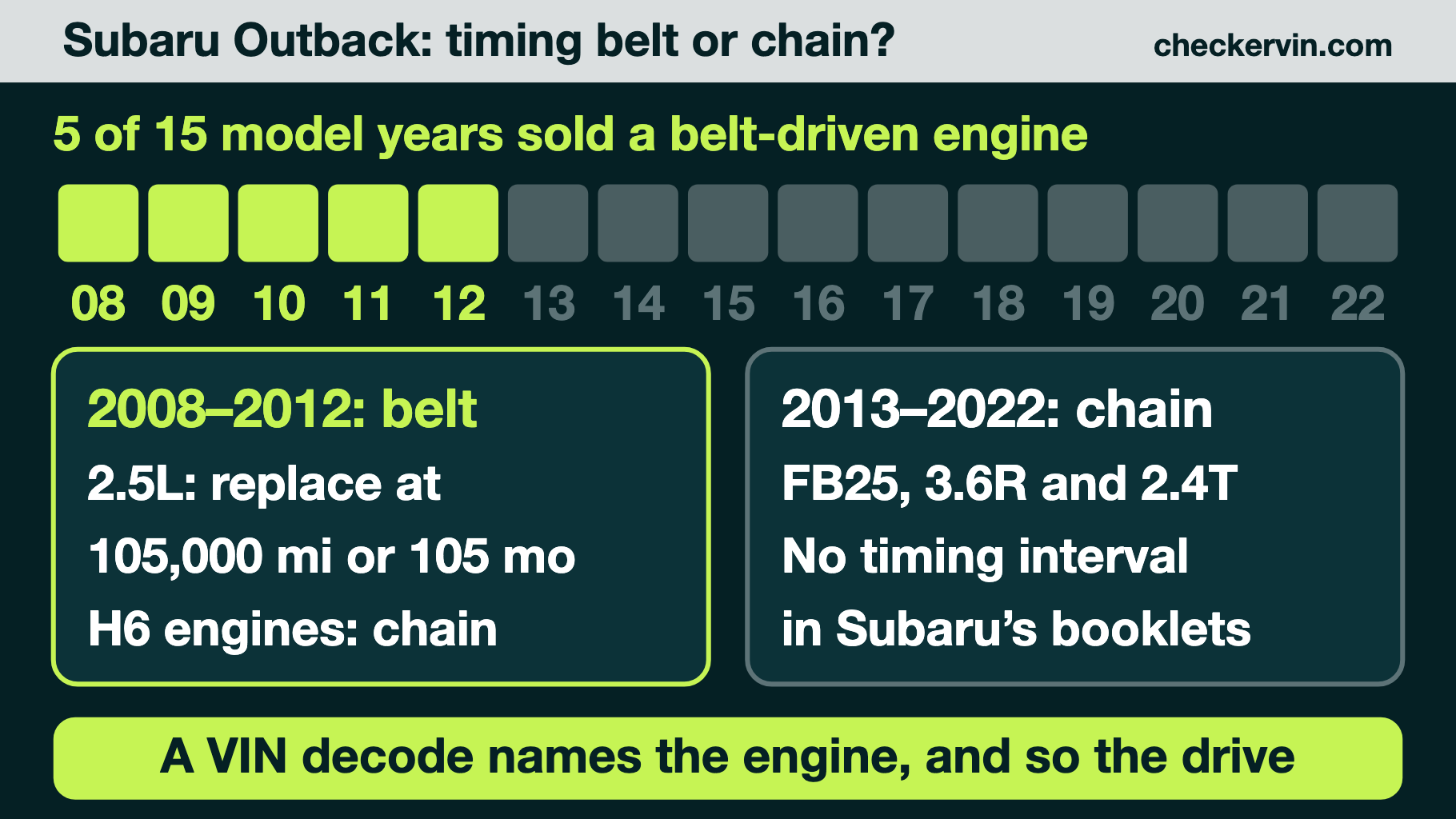
- Only a 2.5-liter Outback from 2008 to 2012. The sixes of those years, and every Outback from 2013 on, use chains with no scheduled replacement.
- When is it due?
- Subaru says 105,000 miles or 105 months, whichever comes first. Every belt-era Outback is past the month limit now.
- What does it cost?
- KBB lists $409 to $919 including parts and labor; YourMechanic's average is $826. Adding the water pump and tensioner pushes a quote higher.
The published prices, and what they actually describe
Two consumer sites publish an Outback timing belt price, and neither belongs to us. Kelley Blue Book’s Outback timing belt pages say you “can expect to pay anywhere from $409 to $919 (including parts and labor).” We read the 2010, 2012, 2016 and 2018 versions on November 22, 2026. All four carry the same sentence and all four say a local Fair Repair Range “is not yet available,” so the figure is a general Subaru number, not one calculated for a particular car or ZIP code. YourMechanic’s Outback page could not be opened directly from our tools, but in two separate searches the same day its served text gave an average of $826, made up of $378 in parts and $448 in labor, with no model year attached.
Notice what both sites have in common: they publish a timing belt price for every Outback year, including 2016 and 2018, years whose engines have no timing belt at all. That is the first thing to sort out before any number means anything. We sell VIN checks, not repairs, and print no price of our own. What we can add is Subaru’s own answer to which cars need the job, and when.
Which Outbacks have a belt, in Subaru's own words
Subaru prints a maintenance schedule in the Warranty & Maintenance Booklet for every model year, and it hosts those booklets on its technical-information site. We opened them one by one. The schedule calls the part a “camshaft drive belt,” and the brackets after that name are the whole story:
| Booklet | What the schedule says |
|---|---|
| 2008 U.S. | Camshaft drive belt, except 3.0L and 3.6L: inspect at 30k, 60k, 90k; replace at 105k |
| 2010 U.S. | Same row and exception; chains on the sixes need no periodic inspection or replacement |
| 2011 and 2012 U.S. | Same interval, except 3.6L and the 2.5L Forester, which had already moved to a chain |
| 2013 Legacy/Outback | Timing belt listed for the Turbo Model only; no 2013 Outback was turbocharged |
| 2014 Legacy/Outback | No timing belt row at all |
| 2015 and 2022 | The only timing belt row is the WRX and WRX STI |
So the belt-driven Outbacks are the 2.5-liter cars from the start of our record through 2012: the 2.5i, and in 2008 and 2009 the turbocharged 2.5XT as well. The 3.0R six of 2008 and 2009 and the 3.6R six from 2010 run chains. The 2011 and 2012 booklets give it away in their exception list: the Forester’s 2.5-liter had already switched to the chain-driven engine, and the Outback’s had not. The 2009 booklet would not download from Subaru’s site, which is a limit of our tools; it sits between two booklets that say the same thing.
2013 and later: there is no belt job
Put plainly: if the Outback is a 2013 or newer, it does not have a timing belt, and nobody should be selling you a timing belt replacement for it. The 2.5-liter engine Subaru moved the Outback to for 2013, the FB25, drives its camshafts with a chain, as do the 3.6R six that continued through 2019 and the 2.4-liter turbocharged engine of the 2020-on Outback XT. The Subaru booklets we could open for those years, 2013, 2014, 2015 and 2022, list no timing replacement interval for the Outback at all; the 2016–2021 editions would not download from Subaru’s site.
The only belt at the front of a newer 2.5-liter Outback is the accessory drive belt, the one that turns the alternator and air-conditioning compressor. It is cheap, it is on the outside of the engine, and Subaru even issued a bulletin, 02-168-17, offering a new belt material for 2013–2017 Legacy and Outback 2.5-liter cars whose belt squealed or chirped. A squeal from the front of a 2015 Outback is that belt. If a quote for one of these cars says “timing,” ask whether the shop means the chain, the chain cover, or the accessory belt, because they are three very different bills.
105,000 miles or 105 months, and why the months now decide it
The interval has two halves, and the second one gets ignored. 105 months is 8.75 years. The youngest belt-driven Outback, a 2012, is now about 14 years old. Every belt-era car has therefore passed the calendar limit on its original belt, whatever the odometer says. A low-mileage 2010 that spent its life in a garage is not an exception; by Subaru’s own schedule it was due years ago.
The same arithmetic catches cars that were serviced. A belt fitted before about February 2018 has itself been on the engine for more than 105months, so an Outback that had its first belt done on time around 2017 may be due for its second now, even at modest mileage. The question to ask a seller or a previous shop is not “has the belt been done?” but “when, and at what mileage?”
What belongs in an honest belt quote
The belt itself is the smallest part of the bill. On the 2.5-liter engine it wraps around the crankshaft and both camshaft sprockets, a set of idler pulleys and a tensioner, and it also turns the water pump. All of those parts are reached with the same teardown, which is why aftermarket suppliers sell the 2005–2012 Outback job as a kit with the water pump included, and why quotes vary so much. A belt-only price and a belt, tensioner, idlers and water pump price are different jobs with the same name.
- Timing belt — the scheduled item
- Tensioner and idler pulleys — the belt runs on them, and they wear on the same clock
- Water pump — driven by the belt on this engine, so it is exposed during the job
- Coolant — drained for the pump; Subaru's 2012 booklet says to add its cooling system conditioner whenever coolant is replaced
- Camshaft and crankshaft seals — only if they are seeping
- Accessory drive belts — they come off first anyway; Subaru's schedule inspects them on non-turbo cars
Ask for each of those as a line item. A shop that leaves the tensioner and pump out is not necessarily cutting corners if they were replaced recently, but you should know which parts are still the originals before you pay for the teardown again in a few years.
If the belt breaks
A broken timing belt stops the camshafts while the crankshaft keeps turning, and the engine quits immediately. One federal complaint against a 2008 Outback describes exactly that on the highway: the belt failed, the car “immediately lost all power,” and the owner had seconds to get off the road. Whether the valves then hit the pistons depends on whether the engine is an interference design. Parts catalogs and belt-or-chain reference sites list the Outback’s 2.5-liter as interference, and owners argue the point on forums. We did not find a Subaru document that settles it, so we label it unconfirmed and give the practical advice that holds either way: on an overdue belt, a tow and a possible cylinder head repair cost far more than the scheduled job.
What 7,740 complaints can and cannot say about the belt
Our corpus holds 7,740 federal NHTSA complaints against the 2008–2022Outback. NHTSA has no timing-belt category; belt failures, if reported, land under ENGINE, along with oil consumption, leaks, stalling and every other engine fault. ENGINE ranks among each year’s five most-reported components in 14 of 15 years, and we count 586 engine reports in those years. That is context and an upper bound, never a belt count.
Split at the belt line, the 5 belt years hold 209 counted engine reports and the 10 chain years hold 377. Per counted year that is about 42 in both eras: losing the belt did not thin the engine record. The single heaviest year for engine complaints is 2011, with 85, and it is a chain car. The reason is an oil-consumption problem on the first FB25 years that our Outback head gasket cost post covers in full. In the belt years ENGINE ranks no higher than number 2 on any year’s list; the 1,649 complaints filed against those 5 years are led by other systems, and in 3 of them (2010, 2011, 2012) power train complaints, mostly the CVT, outnumber engine complaints.
One year needs care: in 2018, ENGINE is not among the five most-reported components, so our data holds no count for it. That means the figure was below that year’s fifth-place category (visibility, 41), not that it was zero, and the chain-era totals above are a minimum for that reason. We also read the complaint narratives for every model year. Reports that mention a timing belt at all are rare, nearly all sit in the belt years, and mostly describe the belt being replaced alongside other work. One owner of a 3.6R six calls its timing drive a belt, which it is not, and a 2020 report of “timing chain slip” turns out to be about the transmission’s drive chain, not the engine’s. Owner reports are unverified, and the record does not show belt failure as a pattern.
Recalls and bulletins: none for the belt
We queried NHTSA’s recall database for every Outback model year from 2008 through 2022on November 22, 2026. The campaign counts it returned match our data file year for year, and the text search does read the summaries: it flagged a brake-line recall for the phrase “salt belt.” No campaign names a timing belt, idler, tensioner or pulley. The two engine-coded campaigns are a 2010 CVT cooler hose and a 2022 engine-computer wiring harness.
Subaru’s bulletins tell the same story. NHTSA lists several hundred Subaru communications covering the 2008–2014 Outback; we searched their summaries for timing, belt, idler, tensioner, pulley and water pump terms and opened the hits. None concerns the timing belt. The near misses are worth knowing because their titles confuse people:
| Subaru bulletin | What it actually covers |
|---|---|
| 09-83-21R | Water pump design change on 2010–2019 Legacy and Outback 3.6L — a chain engine, so not part of any belt job |
| 02-158-14 | Accessory drive belt tensioner parts on 3.6L H6 engines |
| 02-168-17 | New accessory V-belt for squealing 2013–2017 Legacy and Outback 2.5L |
That search covered bulletin summaries, not the full text of every document. For open safety recalls on a particular car, the Subaru recall check shows which campaigns remain unrepaired on that VIN.
Before you authorize the work
- Confirm the engine and model year by VIN — a 2013-or-newer Outback, or any six-cylinder, has no belt
- Ask for the belt, tensioner, idlers and water pump as separate line items
- Ask what coolant goes back in, and whether Subaru's conditioner is added
- Ask whether the accessory belts are being replaced or only refitted
- Get the date and mileage of any previous belt job in writing
- On a chain-engine car, ask exactly which part a 'timing' quote replaces
If you are buying the Outback, not servicing it
For a shopper the belt line is a pricing line. A 2008–20122.5-liter Outback without a receipt for the belt job should be priced as if the job is still to do, because by Subaru’s calendar it is. A Subaru VIN decode confirms the engine, and the timing belt or chain lookup by VIN answers the drive question directly. A vehicle maintenance report explains which records are worth asking the seller for.
For a 2013 or newer car, cross the belt off the list and spend the attention elsewhere. The Outback years-to-avoid breakdown shows which systems the complaint record actually piles up on for each year.
Where this information comes from
- Subaru — 2012 Warranty & Maintenance BookletThe camshaft drive belt row (inspect 30k/60k/90k, replace at 105,000 miles or 105 months) and the 3.6L chain exception.
- Subaru — 2008 Warranty & Maintenance BookletSame belt row, excepting the 3.0L and 3.6L, whose chains need no periodic inspection or replacement.
- Subaru — 2013 Warranty & Maintenance BookletThe Legacy/Outback table lists a timing belt for the turbo model only; the 2.5L Outback has none.
- Subaru — 2014 Warranty & Maintenance BookletThe Legacy/Outback schedule carries no timing belt row at all.
- NHTSA recalls API — Outback by model yearQueried for every year 2008–2022; no campaign names the timing belt, idlers or tensioner.
- NHTSA-hosted Subaru bulletin 02-168-17 — accessory V-belt2013–2017 Legacy and Outback 2.5L: the squealing belt on newer cars is the accessory belt, not a timing belt.
- NHTSA-hosted Subaru bulletin 09-83-21R — 3.6L water pumpA water pump revision for the chain-driven six, separate from any belt job.
- Kelley Blue Book — Outback timing belt replacementThe $409–$919 figure, retrieved November 22, 2026; KBB says a local Fair Repair Range is not yet available.
- YourMechanic — Outback timing belt estimateThe $826 average ($378 parts, $448 labor), as served in search results on November 22, 2026; no model year stated.
Keep reading
Frequently asked questions
When should you replace the timing belt on a Subaru Outback?
Only if the car has one. Subaru's U.S. maintenance booklets list a camshaft drive belt for the 2.5-liter Outback through the 2012 model year: inspect it at 30,000, 60,000 and 90,000 miles, and replace it at 105,000 miles or 105 months, whichever comes first. The six-cylinder Outbacks of those years use chains that Subaru says need no periodic inspection or replacement, and from 2013 every Outback engine is chain-driven. Because every belt-era Outback is now older than 105 months, the time limit has already been reached on all of them; what matters is whether the work was done, and when.
How much does it cost to replace a timing belt in a Subaru?
Kelley Blue Book's Outback timing belt pages say to expect $409 to $919 including parts and labor, but the same sentence appears on every model year we checked and KBB says a local Fair Repair Range is not yet available. YourMechanic's Outback page, as served in search results on November 22, 2026, gives an average of $826, with $378 for parts and $448 for labor, without naming a model year. A quote that adds the water pump, tensioner and idlers will sit higher than a belt-only figure. CheckerVIN publishes no repair price of its own.
Will a timing belt last 200,000 miles?
Not on Subaru's schedule. For the 2.5-liter Outbacks that have one, Subaru calls for replacement at 105,000 miles, so a car at 200,000 miles should be on its second belt. The engines that can reach 200,000 miles without any timing service are the chain-driven ones: the 3.0R and 3.6R sixes and every Outback engine from the 2013 model year on, for which Subaru's booklets list no timing replacement at all.
Can a timing belt last 10 years?
Subaru does not plan for it to. The time half of its interval is 105 months, which is 8.75 years, so a belt-driven Outback that reaches ten years without a new belt is already past the maker's limit even if it has covered few miles. Rubber ages with time as well as use, which is why the schedule carries a month figure at all. On a low-mileage 2008 to 2012 car with no paperwork, assume the belt is due.
Is replacing a timing belt a big job?
On a belt-driven Outback it is a front-of-engine job: the accessory belts, timing covers and pulleys come off before the belt can be reached, which is why KBB writes that the real cost is in the labor. The parts are modest by comparison. The sensible version of the job replaces the parts the belt runs on while they are exposed, which on the 2.5-liter engine usually means the tensioner, idlers and the belt-driven water pump. On a 2013 or newer Outback there is no timing belt to replace.
Check the engine before you pay for a belt
A free CheckerVIN report shows the factory build, engine, specifications and open recalls for any VIN, so you know whether that Outback has a timing belt at all.
Run a free VIN check