The short answer
- What does it cost?
- RepairPal's per-year figures run roughly $101-$136 on a 2019-2021 model up to $233-$277 general estimate. Published estimates, not ours.
- Is the fluid the same across every 4Runner?
- No. The 4th-generation (through 2009) uses Type T-IV in a serviceable transmission with a dipstick; the 5th-generation (2010+) uses sealed ATF WS with no dipstick.
- Which years carry the power-train history?
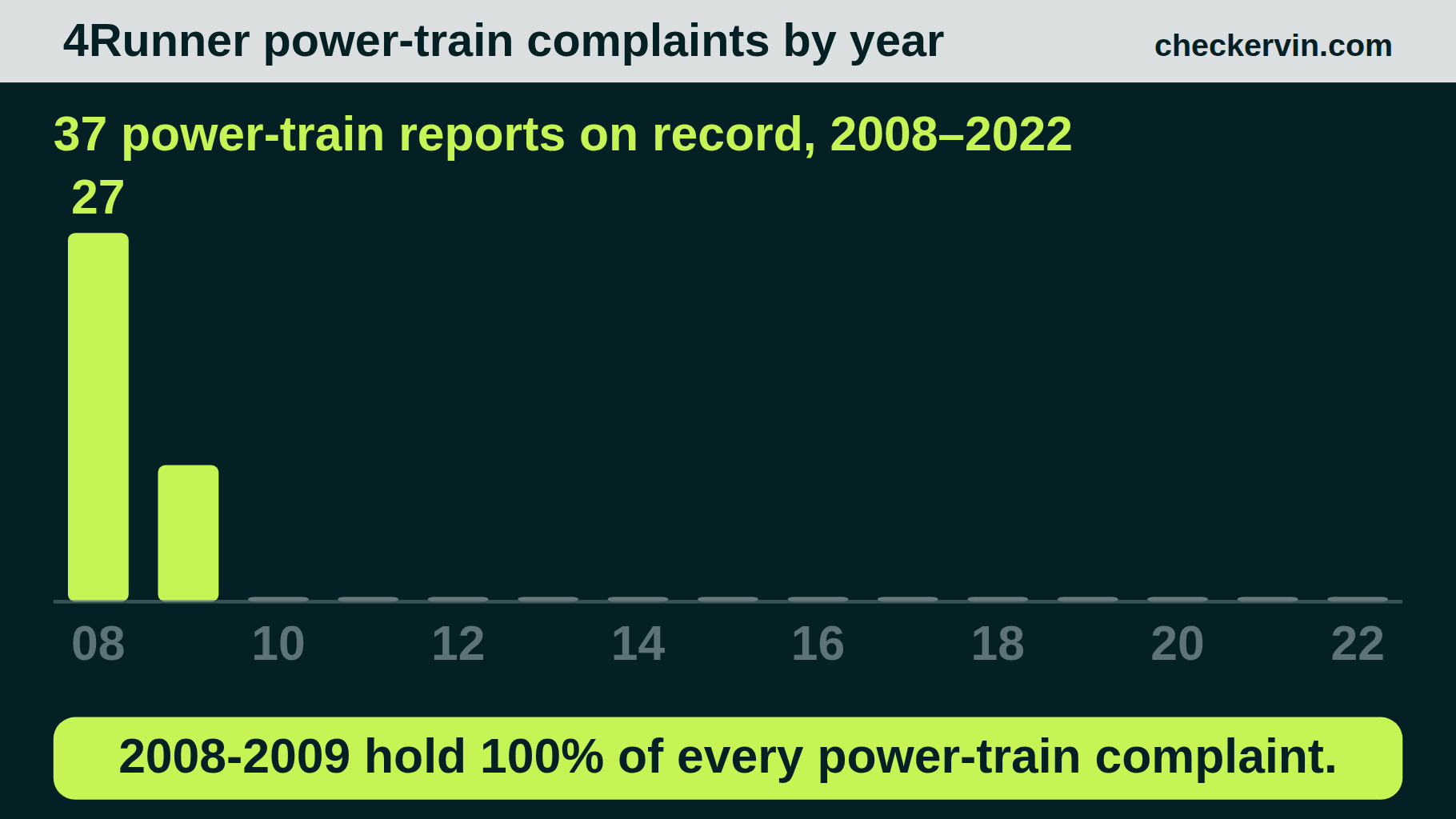
- 2008 and 2009 hold every one of the 37 POWER TRAIN complaints the nameplate has ever recorded — none of the thirteen model years since has one place in its own top 5.
The numbers, and whose numbers they are
RepairPal’s general estimate for a Toyota 4Runner transmission fluid change runs roughly $233 to $277. Its own per-year breakdown spreads far wider than that single range suggests: about $101 to $136 on a 2019, 2020 or 2021 model, and $130 to $164 on a 2008. Every figure here is attributed to whoever published it; we sell VIN checks, not repairs, and price none of this ourselves.
None of those estimator pages asks the question this page is actually about: which 4Runner generation is under the hood. A 2009 and a 2010 4Runner sit one model year apart and share almost nothing about how this job is even done.
Two generations, two different fluids
Toyota rebuilt the 4Runner for model year 2010, moving it onto a new platform. The V8 engine option was dropped entirely, and the lineup shifted to a 2.7L four-cylinder paired with a 4-speed automatic, or a 4.0L V6 paired with a 5-speed automatic (Toyota calls it Super ECT-i), per Toyota’s own 2010 press materials. It was a ground-up redesign, not a facelift.
The transmission’s fluid specification changed with it. The 4th-generation 4Runner, through the 2009 model year, uses Toyota Type T-IV fluid in a non-sealed transmission that has a dipstick for checking the level yourself. The 5th-generation redesign moved to Toyota Genuine ATF WS in a sealed transmission with no dipstick at all, per Blauparts’ parts-fitment listings and forum consensus across 4Runners.com and toyota-4runner.org. A DIY guide or a shop that treats the fluid spec as constant across both generations is wrong on a point that decides which product actually gets poured in.
| Generation | Transmission fluid |
|---|---|
| 4th-gen (2003-2009) | Toyota Type T-IV — non-sealed, dipstick-equipped |
| 5th-gen (2010-2024) | Toyota Genuine ATF WS — sealed, no dipstick |
What 1,060 complaints say about one generation break
Our corpus of federal NHTSA complaints holds 1,060 reports against the 2008–2022 4Runner. POWER TRAIN places in the nameplate’s own top-5 complaint categories in exactly two of those fifteen model years: 2008, at 27 complaints out of 96 (28.1% of that year’s own total), and 2009, at 10 of 22 (45.5%). Combined, those two years hold 37 of the 118 complaints filed against them, a 31.4% share — and, all-time, 37of the nameplate’s 37 POWER TRAIN complaints ever recorded, every single one of them.
In every one of the 13 model years since, 2010 through 2022, POWER TRAIN does not appear in that year’s own top 5 at all — bounded below whatever that year’s fifth-ranked component count happened to be, which ranged from as few as 2 to as many as 8 complaints. That is not the same claim as zero; it is the claim our source data can actually support, and it is still the sharpest concentration found across this series so far. Complaints are unverified owner reports, not a measured failure rate, but a break this total landing on the exact two model years before a ground-up redesign is not noise.
Does your 4Runner even have a dipstick
This is the practical consequence of the 2010 platform break, and it trips up more owners than the fluid’s brand name does. A 4th-generation 4Runner (2009 and earlier) has a transmission dipstick you can pull to check the fluid level and condition yourself. A 5th-generation 4Runner (2010 and newer) does not — the transmission is sealed, and checking or changing the fluid means a shop pulling the fill plug rather than anyone reading a dipstick in the driveway.
A shop quote or a forum thread that assumes a dipstick exists is describing the older car. Confirm the generation before assuming either the fluid or the procedure carries over.
“Inspect” is not “never”
Toyota’s owner’s manuals for the sealed, WS-fluid transmission tell owners to inspect the fluid rather than naming a fixed change interval, and some dealers read that as a lifetime fill that never needs service. Independent transmission specialists and forum consensus still recommend a change around 60,000 miles under normal use, sooner under regular off-road driving or towing — conditions Toyota itself classifies as severe service.
That interval is specific to the sealed 5th-generation transmission. The earlier T-IV-fluid transmission has its own dipstick-based inspection routine, which is exactly why confirming the generation comes before pricing either job.
What a transmission problem sounds like before it costs anything
- A delay of a few seconds shifting from reverse to drive, one of the specific complaints filed against the 2008-2009 4Runner in the federal record
- A clunk, hesitation or flare on acceleration on either generation
- Fluid that looks dark or smells burnt at a routine inspection — the point of checking it at all, dipstick or not
- Any warning light tied to the transmission, especially on a 5th-generation car where you cannot verify fluid condition visually
The order matters because the cheap check comes first: confirm which generation the car actually is, pull its open recalls by VIN, and get the fluid checked by whichever method that generation actually supports — before anyone prices a repair beyond a routine service.
Where the money goes
On a routine fluid service, RepairPal’s own per-year spread — roughly $101-$136 on a 2019-2021 up to $233-$277 general — tracks fluid type, quantity and labor rate more than any single defect, and the two generations here do not even share a fluid product. On a repair beyond routine service, get the shop to state plainly which generation and fluid spec they are quoting before accepting a number.
Two practical consequences follow. First, confirm the generation and transmission type by VIN before accepting any quote that names a specific fluid. Second, get the quote itemized by fluid brand, quantity and labor rather than one blended “transmission service” line — a shop that quotes the wrong fluid spec for your generation is quoting the wrong job.
Before you authorize the service
- Confirm the generation by VIN — 2009 and earlier take Type T-IV through a dipstick, 2010 and later take sealed ATF WS
- Pull the VIN's open recalls before paying for anything that might already be covered
- Ask directly which fluid product the shop is quoting, by name, not just “transmission fluid”
- Don't assume “inspect only” means “never” on a 5th-generation car — forum and specialist consensus still points to roughly 60,000 miles
- Get the quote itemized — fluid brand, quantity and labor — not a single flat-rate line
If you are buying the 4Runner, not maintaining it
The same record reads as a shopping map. A 2008 or 2009 4Runner should show either a documented transmission fluid history or a clean test drive with no delay engaging reverse-to-drive, given where the complaint record concentrates. A Toyota VIN decode confirms the exact generation, engine and transmission before you price a service specific to either era, and checking what factory coverage remains by VIN settles whether anything on the transmission is still someone else’s responsibility to fix.
On any candidate car, run the recall lookup before you negotiate, and check which 4Runner model years show the most complaints overall rather than judging the nameplate by the power-train figure alone — other categories, especially air bags and electrical systems, report far more often across most of this record. Thirteen of the fifteen model years here carry no top-5 power-train complaints at all; a documented fluid history and a clean recall check on the remaining two years are usually cheaper than the negotiation it takes to discount around ones that are missing.
Where this information comes from
- NHTSA — 4Runner complaint databaseThe federal complaint record this page's figures are computed from, browsable by model year.
- NHTSA — recalls by VINThe official lookup that settles whether a specific 4Runner has open safety campaigns.
- RepairPal — 4Runner transmission fluid change estimateThe per-year $101–$277 range quoted above, attributed to its estimator as retrieved September 2026.
- Toyota USA Newsroom — 4Runner generation historyToyota's own account of the 2010 platform redesign named above, including the dropped V8 and new engine lineup.
Keep reading
Frequently asked questions
How much does it cost to change the transmission fluid in a Toyota 4Runner?
RepairPal's per-year figures spread widely by generation: roughly $101 to $136 on a 2019-2021 model, $130 to $164 on a 2008, and a general estimate around $233 to $277. None of these figures is ours — we sell VIN checks, not repairs, and price none of this ourselves.
Does the 4Runner take the same transmission fluid across every model year?
No. The 4th-generation 4Runner (through 2009) uses Toyota Type T-IV fluid in a non-sealed, dipstick-equipped transmission. The 5th-generation redesign (2010 onward) switched to Toyota Genuine ATF WS in a sealed transmission with no dipstick at all, per Blauparts' fitment listings and forum consensus. Pouring the wrong spec in is a real, specific mistake this generation split makes possible.
Which 4Runner model years carry the power-train complaint history?
2008 and 2009 — two of the nameplate's fifteen model years on record. Computed from src/data/models/toyota-4runner.json, those two years hold 37 of the nameplate's 37 all-time POWER TRAIN complaints, a 31.4% share of their own 118 combined complaints. Every model year since Toyota's 2010 redesign shows no POWER TRAIN category in that year's own top 5 at all.
What changed in the 2010 4Runner redesign?
Toyota rebuilt the 4Runner on a new platform for model year 2010: the V8 engine option was dropped entirely, and the lineup moved to a 2.7L four-cylinder paired with a 4-speed automatic or a 4.0L V6 paired with a 5-speed automatic, per Toyota's own 2010 press materials. It was a ground-up redesign, not a facelift, and the transmission's fluid specification changed along with it.
Is “inspect only” the same as “never needs changing”?
No — and treating it that way is a common, costly misreading. Toyota's owner's manuals for the sealed WS-fluid transmission say to inspect the fluid rather than naming a fixed interval, which some dealers interpret as a lifetime fill. Independent shops and forum consensus still recommend a change around 60,000 miles, sooner under regular off-road or towing use, which Toyota itself classifies as severe service.
Confirm the generation before you price the service
A free CheckerVIN report shows the factory build, specifications and open recalls for any VIN — confirm what you're actually pricing.
Run a free VIN check