The short answer
- What does it cost?
- Estimates run from about $455 (YourMechanic) to $815–$1,054 (RepairPal). Toyota lists the radiator itself at $334 to $513.
- Why the spread?
- Hybrids cool their inverter too. A 2012–2017 hybrid has a separate inverter radiator listed at $638.71.
- Any free fix?
- Not for the radiator. A 2018–2021 coolant leak may be Toyota’s covered flow shut-off valve, or the 2020 block recall.
$334–$513
Toyota list price, radiator only
2015 and 2019 Camry, gas and hybrid
2
Coolant loops on a Camry Hybrid
Engine plus power control unit
100k mi
First coolant change
Or 120 months, Toyota 2020 guide
0
Recalls naming the radiator
Camry and Camry Hybrid, MY2007–2024
What the quoted prices actually cover
The number most searches surface for this repair is $455. It comes from YourMechanic’s Camry radiator estimate, which splits it into $273 for parts and $182 for labor. RepairPal’s Camry repair listing puts the same job at $815 to $1,054. Both sites block automated reading, so these are the figures their search listings showed on November 24, 2026, and neither says which model year, engine or radiator it priced.
That missing detail is most of the gap. Toyota’s own list price for a Camry radiator ranges from about $334 to $513 depending on the year and whether the car is a hybrid, and a hybrid can need a second radiator for its inverter. A low estimate that assumes an aftermarket radiator on a 2.5-liter sedan and a high one that assumes a Toyota hybrid part can both be honest.
| Source and listing | What it shows |
|---|---|
| YourMechanic, Camry radiator replacement | $455 average: $273 parts, $182 labor (search listing) |
| RepairPal, Camry repair costs page | $815 to $1,054 (search listing; no date shown) |
| Toyota list price, 2015 Camry 2.5L or 3.5L radiator | $333.82 |
| Toyota list price, 2019 Camry Hybrid radiator | $512.77 |
| Toyota list price, 2015 Camry Hybrid inverter radiator | $638.71, a separate part |
The labor side is steadier. On every Camry here the radiator is at the front of the car with the A/C condenser, not buried in the engine, so the bill moves mainly with the part and with what else gets replaced at the same visit. We did not find a Toyota labor time for the radiator itself, so this page prints none beyond YourMechanic’s labor figure.
Which radiator your Camry has, and which one a hybrid quote means
A gas Camry has one radiator, and Toyota’s manual for the 2018-and-later gas car tells owners with a falling coolant level to check “the radiator” and its hoses. The hybrid manual for the same generation says “radiators,” and the reason is the inverter, the power electronics that drive the motors. It runs on its own coolant loop with its own reservoir, marked FULL and LOW, next to the engine’s reservoir marked F and L.
How Toyota packages that second loop has changed. For the 2015 Camry Hybrid, Toyota’s parts catalog lists the engine radiator (16400-0V120, $343.85) and, in a separate hybrid cooling group, an inverter radiator (G9010-33031, $638.71) with its own electric pump. For the 2019 Camry Hybrid, the inverter cooling diagram lists no radiator at all. It lists hoses labeled “Radiator To Inverter” and “Radiator To Pump,” and the radiator group shows one hybrid-only assembly (16400-F0021, $512.77) that costs more than the gas car’s.
We could not open the parts pages for the 2007–2011 Camry Hybrid. A Toyota parts reseller lists G9010-33010 as an inverter cooler radiator for those years, which fits the same pattern, but we have not seen it in Toyota’s catalog. Our Toyota VIN decoder confirms whether a given car left the factory as a hybrid.
Toyota part prices, Toyota’s cheaper line and aftermarket
The prices above are Toyota’s list prices as shown on ToyotaPartsNow, a Toyota dealer parts site, on November 24, 2026. That site sold each radiator for about 30% below list, so a 2019 non-hybrid radiator listed at $355.93 was offered at $249.29, and the 2019 hybrid assembly at $349.89.
| Camry and part | Toyota list price |
|---|---|
| 2015, 2.5L four radiator (16400-0V110) | $333.82 |
| 2015, 3.5L V6 radiator (16400-0P350) | $333.82 |
| 2015, lower-priced Toyota-listed 2.5L / 3.5L radiators | $233.36 / $227.83 |
| 2015 Hybrid, engine radiator (16400-0V120) | $343.85 |
| 2015 Hybrid, inverter radiator (G9010-33031) | $638.71 |
| 2019, non-hybrid US-built radiator (16400-F0010) | $355.93 |
| 2019 Hybrid radiator assembly (16400-F0021) | $512.77 |
For the 2015 car Toyota also lists a second, cheaper radiator for each engine, marked “Mvp” in the catalog, at roughly two-thirds of the standard part’s price. Beyond that are aftermarket radiators from the usual cooling brands, which fit most gas Camrys and are what a low independent-shop quote usually assumes. For an inverter radiator or a 2018-and-later hybrid assembly, the choice is narrower; ask the shop what brand it plans to install and whether it matches the factory connections.
One part that often gets bundled in is the fan. Toyota lists the 2019 non-hybrid fan assembly at $1,380.57 and the hybrid’s at $1,669.16, several times the radiator’s price. A quote that reads “radiator and fan” is a different job from a radiator alone.
2008–2017: what the job involves by generation
On the 2008–2011 Camry (2.4-liter 2AZ-FE four through 2009, 2.5-liter 2AR-FE from 2010, and the 3.5-liter V6), the radiator does more than cool the engine. One widely watched owner video of a 2009 Camry shows a radiator replaced because it was leaking transmission fluid from a fitting at its base, and another, on a 2007–2011 V6, pairs the radiator swap with an automatic transmission fluid refill. If a quote for one of these cars involves disconnecting transmission lines, ask that the transmission fluid be checked and topped up along with the coolant.
The 2012–2017 car carried over the 2.5-liter four and the V6. The cost difference in these years is mostly the hybrid: the 2012–2017 Camry Hybrid has the separate inverter radiator described above, so a leak at the front of the car needs a diagnosis that says which core is wet.
Toyota left one cooling note for this era that is not about the radiator. NHTSA’s index lists a Toyota tech tip, TTT-0119-11, for 2010–2011 Camrys with an inoperative cooling fan. The document is not posted, so we cannot say what it replaced; on an overheating 2010–2011 car, it is a reason to test the fan before condemning the radiator.
2018 and later: the job, the shutter and the hybrid assembly
The 2018 redesign brought the 2.5-liter A25A four, a 3.5-liter V6 (2GR-FKS) and a new hybrid. The radiator still sits at the front of the car with the A/C condenser, which Toyota’s maintenance guide has inspected as a pair, so the work stays in front of the engine rather than inside it. The video below follows the whole job on a four-cylinder car.
The 2018–2020 Camry Hybrid adds an active grille shutter in front of the radiator, and Toyota’s parts list calls it a “shutter sub-assembly, radiator.” Bulletin T-SB-0017-23 replaced it on hybrids that set code P05A074 at highway speed, at 1.6 labor hours, under the 36-month, 36,000-mile basic warranty. That window has closed for these cars, but it shows the shutter is its own part: a shutter fault is not a radiator fault, and a quote that replaces the radiator for one is replacing the wrong thing.
For a hybrid, the quote should also say whether the inverter loop was drained and bled, since its hoses connect to the same assembly. The engine’s electric water pump and the 2018-only software bulletin for it are covered in our Camry water pump cost post, so we will not repeat them here.
Coolant: Toyota’s type, how much, and when
Every Camry in this range leaves the factory with Toyota Super Long Life Coolant, the pink premix. Toyota’s manuals call for that or a similar non-silicate, non-amine, non-nitrite, non-borate ethylene glycol coolant with hybrid organic acid technology, and say not to use plain water. In the U.S. it is sold already mixed 50/50 with deionized water, so it goes in straight. Our coolant type by VIN page matches the specification to a specific car.
| Camry (2018-or-later manuals) | Toyota reference capacity |
|---|---|
| 2.5L four (A25A-FKS) | 7.3 qt (6.9 L) |
| 3.5L V6 (2GR-FKS) | 9.1 qt (8.6 L) |
| Hybrid, engine loop | 6.4 qt (6.1 L) |
| Hybrid, power control unit loop | 1.9 qt (1.8 L) |
Toyota labels these figures “reference,” and they describe the full system. A radiator swap drains most but not all of it, so plan on buying close to the full amount and expect the shop to bleed the air out afterward. We read only the 2018-and-later manuals for capacities; for older Camrys, check your own booklet.
On timing, Toyota’s 2020 Camry Warranty and Maintenance Guide schedules the first coolant replacement at 100,000 miles or 120 months, and asks for the engine and inverter coolant and the radiator and condenser to be inspected along the way. A car that is near that mark gets its scheduled coolant change as part of the radiator job, which takes some of the sting out of the fluid cost.
Parts worth replacing at the same visit
With the coolant drained and the front of the cooling system open, a few cheap parts are worth a look. The point is not to upsell; it is that each of them costs labor to reach again later.
- Upper and lower radiator hoses, if they are original on a high-mileage car or feel soft at the ends.
- The radiator cap; Toyota’s manuals tell owners who cannot find a leak to have the cap tested.
- On 2008–2011 cars, inspection of the transmission cooler lines and a fluid top-up.
- On hybrids, the inverter loop hoses that connect at the radiator end.
- A thermostat only if there is a reason, such as slow warm-up or temperature swings; it is not part of a radiator job.
The water pump is the one to resist bundling by default. On the four-cylinder cars it is a separate job, and on the V6 it is far deeper in the engine than the radiator. If the pump is the leak, price it on its own.
Before you buy a radiator: the 2018–2021 leaks that are not the radiator
The documented coolant trouble on recent Camrys is not in the radiator. Toyota’s Customer Support Program 24TE04 covers a “small engine coolant leak” from a flow shut-off valve on certain 2018–2021 Camry and Camry Hybrid cars, about 1.17 million Camrys in all. The leak can drip coolant onto other parts and bring up an “Engine Maintenance Required” message or make the air conditioning misbehave.
The repair is a new water bypass hose assembly, booked at 1.5 hours for the Camry. Its first phase ran to November 30, 2025 regardless of mileage. The second phase lasts 10 years from the car’s first use or 100,000 miles, whichever comes first, at a Toyota dealer, so most 2018–2021 Camrys under 100,000 miles are still inside it. The dealer letter, updated August 11, 2026, says reimbursement instructions for past repairs are in the owner letter.
Two related items sit next to it. Bulletin T-SB-0112-24 covers the same years with the Engine Maintenance Required message and bypass valve circuit codes P268111 or P268115, and sends warranty claims through 24TE04. And recall 20V064000 covers certain 2020 Camry and Camry Hybrid 2.5-liter engines whose block castings may leak coolant inside or out, with engine replacement where needed. Both are free fixes, and either can look like a radiator leak from the driveway. Our Toyota recalls by VIN page runs the open-recall check.
What the complaint record shows, and what it does not
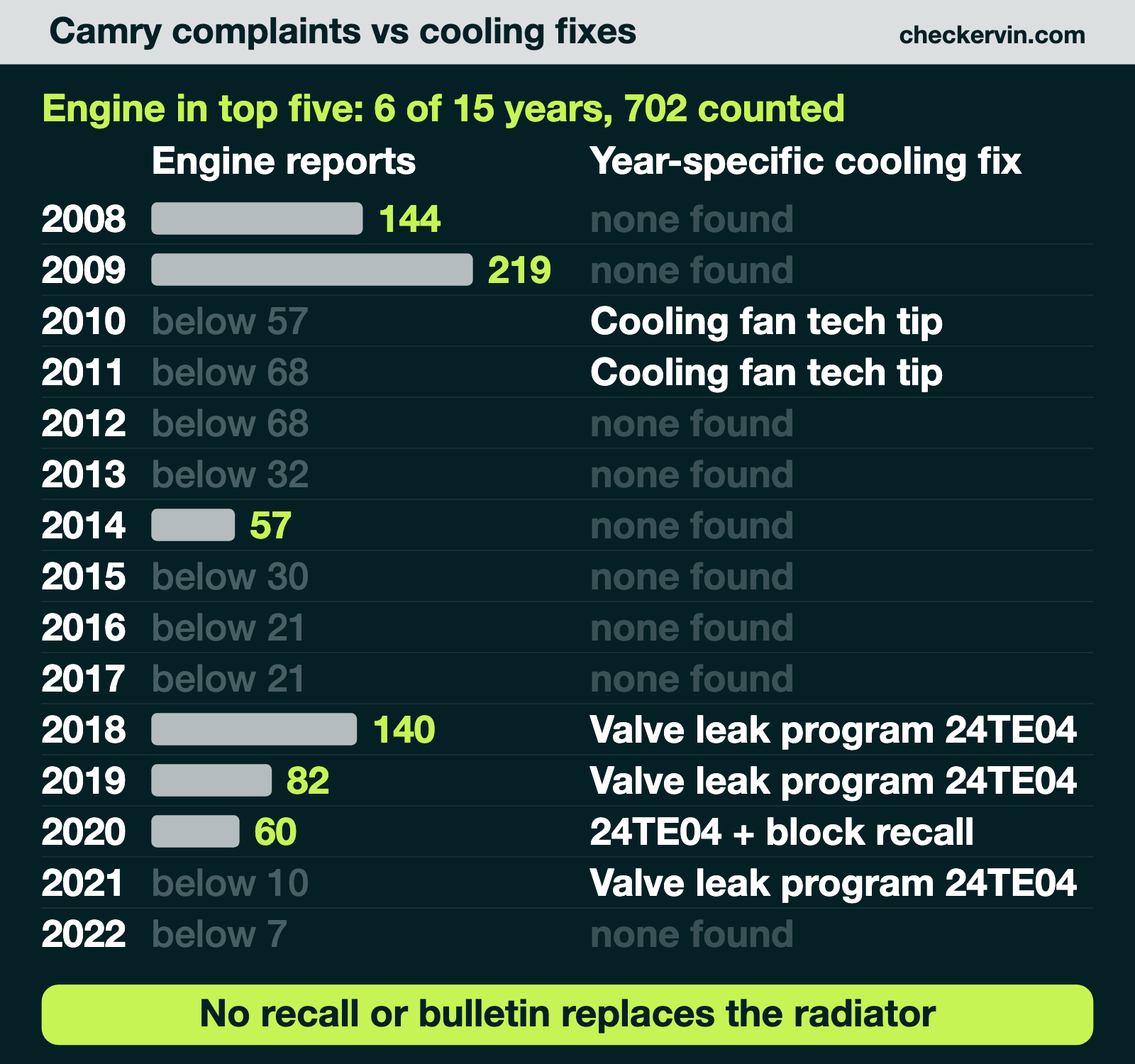
NHTSA files coolant complaints under its engine and engine cooling category, together with oil burning, stalls and everything else under the hood. Across 7,586 complaints against the 2008–2022Camry in our corpus, that category reaches a year’s top five in 6 of 15 years (2008, 2009, 2014, 2018, 2019, 2020), for 702 counted reports. That is a minimum, because in the other 9 years it falls below fifth place, never above 68 reports, rather than to zero.
None of the peaks is about radiators. The 2008 and 2009 cars account for 363 of the counted reports (52%), which is the 2.4-liter oil consumption story, and the 2018–2020 peaks line up with engine and fuel pump recalls; our Camry timing chain costpost walks through which recall explains which year. We read the complaint narratives for every year on November 24, 2026 looking for a radiator pattern. The word appears in only a handful of reports per year, and many of those are crash damage or a list of past repairs. Owner reports of a radiator that simply leaked, such as a 2016 car with “micro leaks” in the plastic top tank, are scattered rather than clustered.
The 2018–2021 cars covered by 24TE04 contribute 282 counted engine reports, all of them in 2018, 2019, 2020; in 2021 the category sits below that year’s fifth place. When owners in those years write about coolant, they mostly describe the bypass valve, an electric water pump code or the 2020 block, which is the same picture Toyota’s paperwork gives. The Toyota Camry years-to-avoid breakdown scores each year on its full record.
Recalls and bulletins we checked
On November 24, 2026 we queried NHTSA’s recall database for the Camry and Camry Hybrid in every model year from 2007 to 2024. No campaign names the radiator, the inverter coolant loop or the cooling fan. The search works: it returns the 2020 block recall 20V064000 and the 2018 piston recall 18V200000, both filed under engine and engine cooling. Our recall check by VIN runs the same lookup for one car.
We also searched the 1,102 Toyota service communications NHTSA indexes for those cars for radiator, coolant, inverter, fan and overheating terms. The cooling items that apply to a specific Camry year are the ones on this page: the 2010–2011 fan tech tip, the 2018–2021 bypass valve bulletin and 24TE04, the 2018–2020 hybrid grille shutter, and a 2020 tech tip on coolant leaks from the four-cylinder’s electric water pump. Two general bulletins on telling a coolant leak from a normal seep apply across every year. The many Camry Hybrid bulletins about the battery cooling fan concern an air fan for the battery pack, not the radiator. Our TSB vs recall explainer covers why a bulletin, unlike a recall or program, is paid for only while a warranty applies.
Reading a Camry radiator quote
- Does it name the year, the engine and, on a hybrid, the part number of the radiator being replaced?
- On a 2012–2017 hybrid, is it the engine radiator or the inverter radiator?
- Is the radiator a Toyota part, Toyota’s lower-priced line or an aftermarket brand?
- Does it include Super Long Life coolant, enough for the full system, and bleeding?
- Is the fan included, and if so, why? It can cost more than the radiator.
- On a 2018–2021 car, has the flow shut-off valve program 24TE04 been ruled out?
Two quotes that answer those questions the same way will usually land close together. When they are far apart, one is typically pricing a Toyota hybrid part or a fan, and the other is pricing an aftermarket radiator alone.
If you are shopping a used Camry
Look at the coolant reservoir cold: the level should sit between the marks and the coolant should be pink, not brown or oily. Look under the front of the car for drips and at the plastic tanks on the radiator for crusted residue. On a 2018–2021 car, ask whether the 24TE04 work was done; on a 2020 car, ask whether the block recall applies and was completed. On a hybrid, check the second reservoir too.
A radiator is not a reason to walk away from an otherwise healthy Camry. On the hybrid, our Camry Hybrid battery replacement cost post covers the larger bill worth pricing before you buy.
Where this information comes from
- Toyota Customer Support Program 24TE04, flow shut-off valve coolant leak (NHTSA-hosted)Certain 2018–2021 Camry and Camry HV; 10 years or 100,000 miles; water bypass hose, 1.5 hours.
- Toyota T-SB-0112-24 Rev2, Engine Maintenance Required with P268111/P268115 (NHTSA-hosted)2018–2021 Camry and Camry HV bypass valve circuit; warranty through 24TE04; lists Super Long Life coolant.
- Toyota T-SB-0017-23, MIL with DTC P05A074 (NHTSA-hosted)2018–2020 Camry HV radiator shutter sub-assembly, 1.6 hours, basic warranty.
- Toyota T-TT-0614-20, A25A coolant leak from water pump (NHTSA-hosted)2020 Camry and Camry HV electric water pump codes or leak; under investigation at publication.
- NHTSA — recalls API, 2020 CamryReturns 20V064000 (block porosity coolant leak). Queried for 2007–2024 Camry and Camry Hybrid; no radiator campaign.
- NHTSA — manufacturer communications index, 2018 CamryThe same index was searched for every Camry and Camry Hybrid year 2007–2024.
- NHTSA — complaints API, 2016 CamrySource of the narratives read for this post; every year 2007–2022 was read under three model names.
- Toyota owner’s manual, 2018-or-later Camry Hybrid (OM06261U, Toyota Canada)Engine and power control unit reservoirs and capacities; Super Long Life coolant; ‘radiators’.
- Toyota owner’s manual, 2018-or-later Camry (OM06259U, Toyota Canada)Reference coolant capacity 7.3 qt (A25A-FKS) and 9.1 qt (2GR-FKS).
- Toyota 2020 Camry Warranty & Maintenance Guide (dealer-hosted copy)First coolant replacement at 100,000 miles or 120 months; inverter coolant inspection.
- ToyotaPartsNow — 2019 Camry radiator and componentsToyota list prices for gas and hybrid radiators and fans, retrieved November 24, 2026.
- ToyotaPartsNow — 2015 Camry hybrid cooling componentsSeparate inverter radiator G9010-33031 at $638.71 list, retrieved November 24, 2026.
- YourMechanic — Toyota Camry radiator replacement$455 average ($273 parts, $182 labor), as shown in search results November 24, 2026.
- RepairPal — Toyota Camry repair costsRadiator replacement $815–$1,054, as shown in search results November 24, 2026.
Keep reading
Frequently asked questions
How much does it cost to replace a radiator in a Toyota Camry?
Published estimates retrieved November 24, 2026 range from about $455 (YourMechanic, $273 parts and $182 labor) to $815–$1,054 (RepairPal’s Camry listing). Neither names a model year or engine. Toyota’s own list price for the radiator alone runs from $333.82 on a 2015 gas Camry to $512.77 for a 2019 Camry Hybrid, before labor and coolant. A hybrid quote can be higher still if it covers the separate inverter radiator used on 2012–2017 hybrids.
How much is a Toyota Camry radiator?
On a Toyota dealer parts site we checked November 24, 2026, Toyota’s list prices were $333.82 for the 2015 Camry 2.5-liter and 3.5-liter radiators, $343.85 for the 2015 Camry Hybrid, $355.93 for a 2019 non-hybrid Camry and $512.77 for a 2019 Camry Hybrid, with that site selling each for roughly 30% less. Toyota also lists lower-priced alternative radiators for the 2015 car at $227.83 to $233.36. Aftermarket brands sell for less again.
Does the Toyota Camry Hybrid have two radiators?
It has two coolant loops. Toyota’s owner’s manual for the 2018-and-later Camry Hybrid lists a separate power control unit coolant reservoir and capacity (1.9 quarts) alongside the engine’s 6.4 quarts, and tells owners to check the radiators, plural. On 2012–2017 hybrids Toyota’s parts catalog lists a separate inverter radiator; on the 2019 hybrid it lists one hybrid-specific radiator assembly that the inverter hoses connect to. Ask which one a quote covers.
What coolant does a Camry take, and how much?
Toyota Super Long Life Coolant, sold in the U.S. premixed 50/50 with deionized water. Toyota’s manuals for the 2018-and-later Camry list a reference capacity of 7.3 quarts for the 2.5-liter four and 9.1 quarts for the V6; the hybrid takes 6.4 quarts in the engine loop and 1.9 in the inverter loop. Toyota’s 2020 maintenance guide schedules the first coolant replacement at 100,000 miles or 120 months.
Is there a recall or warranty for Camry radiator leaks?
No recall or Toyota bulletin we found replaces a Camry radiator. Toyota does cover a different leak: Customer Support Program 24TE04 pays for a leaking flow shut-off valve on certain 2018–2021 Camry and Camry Hybrid cars for 10 years from first use or 100,000 miles. Recall 20V064000 covers 2020 2.5-liter engines whose blocks can leak coolant. Check both before paying for a radiator.
Know which Camry you have before you price the radiator
A free CheckerVIN report shows the factory engine, whether the car is a hybrid, its specifications and open recalls for any VIN, so the radiator you compare is the one your Camry actually uses.
Run a free VIN check